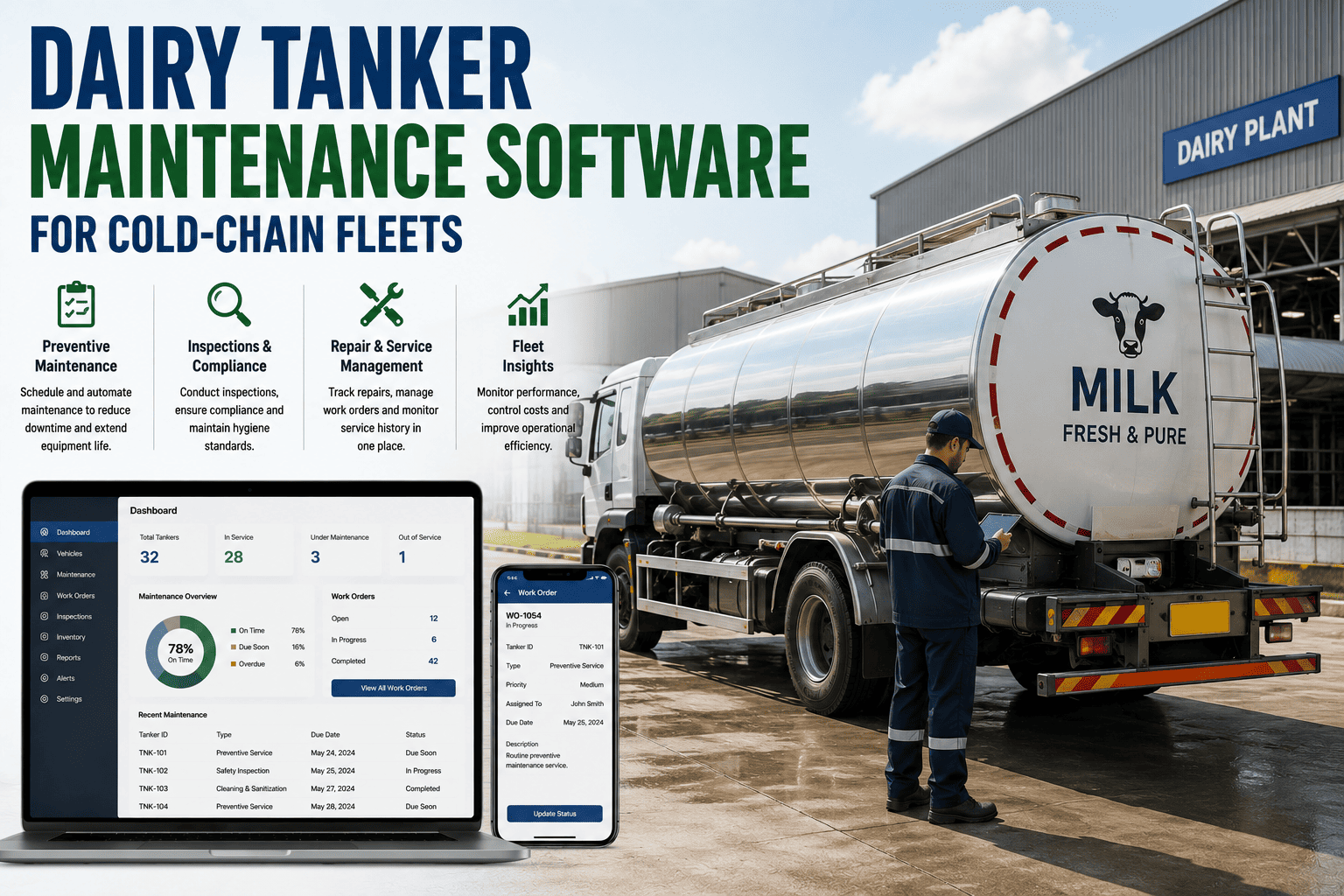
A dairy tanker does not run one route and park, it runs a loop between a dozen farms and a processing plant, gets washed out, and does it again the next morning, sometimes twice a day. That schedule leaves almost no slack for a maintenance surprise, and it leaves zero tolerance for a wash cycle that runs long or a barrel that holds product a few degrees above the line. Dairy is one of the least forgiving cargoes in cold-chain transport, governed by rules that go beyond standard FSMA temperature logging into wash windows, seal verification, and Grade A PMO sanitation. This page covers what actually drives tanker downtime, how the wash-to-wash clock works, and how a fleet keeps every load defensible without a driver carrying a clipboard through a milking parlor.
Every dairy tanker runs on that same clock, whether it is hauling raw milk from farms or finished product from a plant, because a barrel that sits past its wash window is a sanitation failure before it ever picks up a drop. Fleets running paper wash tags almost always lose the thread here, since nobody is checking the clock on twenty tankers by hand every morning. That is exactly the gap a fleet manager closes the day they sign up and let the platform track the wash clock automatically instead of trusting a tag stapled to the manway.
A collection route is really a fill-level story as much as a route map, and the two need to be tracked together. A tanker that reaches its last farm stop already near capacity is one bad estimate away from a spill or a rejected top-off, while one running under capacity all morning is burning a route for less product than it should be. Fleets that book a demo of live fill and route tracking together usually find the biggest win is not in maintenance at all, it is catching an inefficient collection order before it costs a farm relationship.
Connect your tanker fleet and let FleetRabbit track wash windows, seals, and temperature together, tanker by tanker.
The wash system belongs on that schedule the same way a compressor does, because a spray ball that is losing pressure or a CIP pump that is cycling slow will not always throw an obvious fault, it will just quietly stretch the wash time until a tanker starts missing its window without anyone noticing why. Tracking wash-system engine hours next to the compressor's is how a fleet manager finds that kind of drift before a Grade A inspector does.
Stacking those four requirements on top of each other is what makes dairy tanker compliance heavier than almost any other refrigerated asset, and it is why so many fleets are choosing to sign up for one system that holds wash records, temperature logs, and traceability data together instead of three separate binders that never quite agree with each other at audit time.
- Wash window tracked by hand, easy to miss
- Temperature and wash records kept separately
- Fill levels estimated at each farm stop
- Audit records assembled after the fact
- Wash clock auto-alerts before a tanker is out of window
- Temperature, wash, and traceability data in one record
- Live fill-level tracking across the whole collection route
- One export covers PMO, FSMA, and FSMA 204 together
The distance between those two columns is usually the distance between a tanker that gets held at the plant gate and one that clears in minutes. Dairy runs on tight, repeating loops, and the fleets protecting those loops best are the ones who stopped treating wash records, temperature logs, and maintenance as three separate jobs. If your tankers are still running on tags and clipboards, this is a good week to sign up and connect the first one.
Book a demo and see wash windows, fill levels, and PM schedules on one screen for your whole tanker fleet.