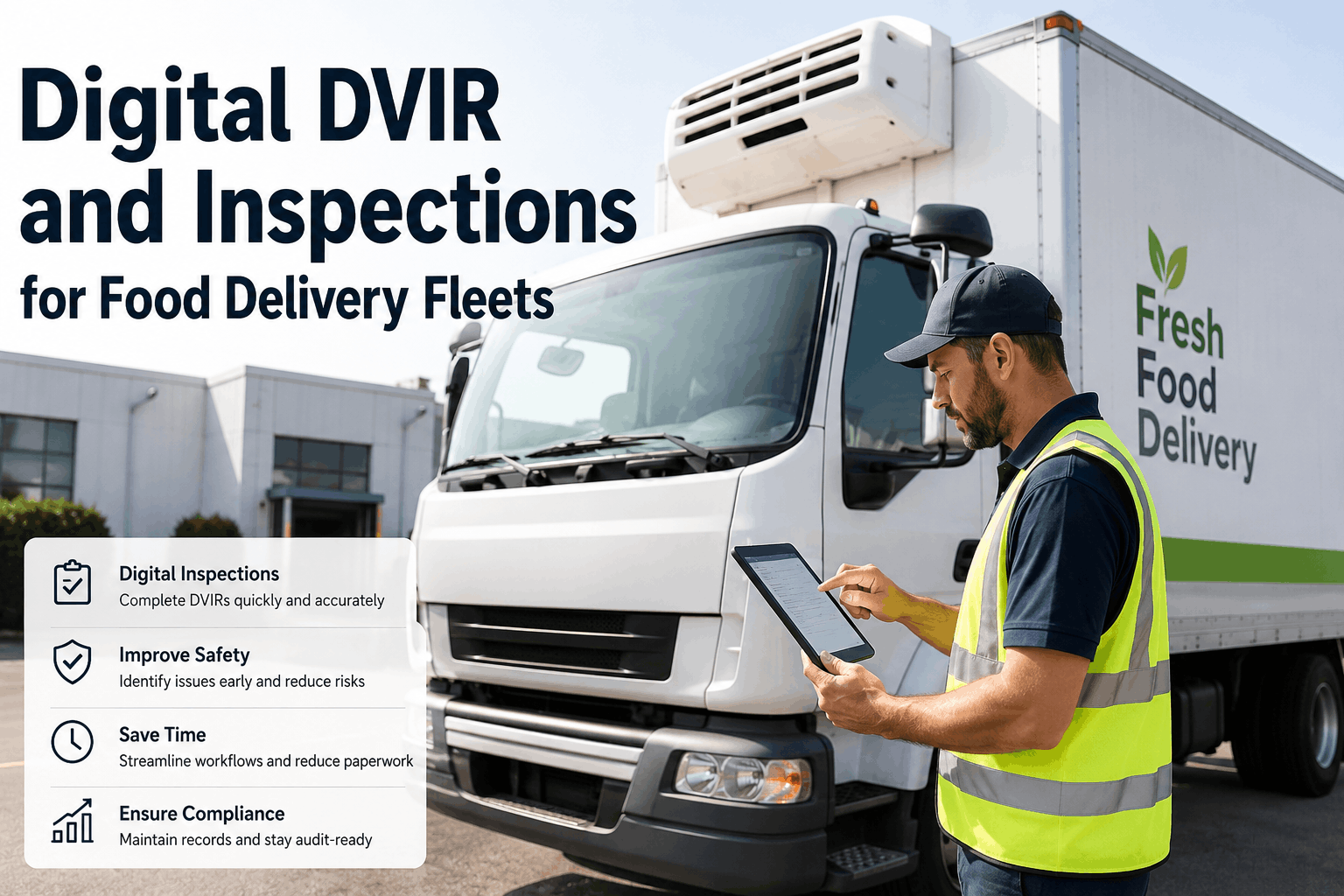
Digital DVIR and Inspections for Food Delivery Fleets
When a refrigerated delivery truck fails its temperature log check at 4 AM because the reefer unit was showing fault codes that nobody documented on the previous shift's paper DVIR—and the load of perishables is already aboard—the real cost isn't the failed inspection. It's the spoiled product, the FDA compliance violation, the customer relationship damage, and the insurance claim that follows a preventable cold chain failure. Paper-based DVIRs in food delivery fleets aren't just an administrative inconvenience. They are an active liability in an industry where regulatory compliance, product integrity, and driver accountability must be provable on demand, not reconstructed after the fact.
This guide gives food fleet managers, operations directors, and safety compliance officers a comprehensive framework for implementing digital DVIR and inspection workflows across refrigerated and temperature-controlled delivery fleets. We cover automated inspection triggers, cold chain documentation, FDA and DOT compliance workflows, and the connected platform capabilities that eliminate food safety incidents caused by undetected vehicle defects. Food delivery operations ready to eliminate paper DVIR exposure can start their free trial today.
Food Fleet Compliance Reality 2026
The Hidden Cost of Paper DVIRs in Food Delivery Fleets
78%
of food delivery fleet violations involve incomplete or missing DVIR documentation rather than actual mechanical failure
63%
of refrigerated truck pre-trip inspections are completed in under 3 minutes on paper—too fast for meaningful cold chain verification
5.1x
ROI when digital DVIR platforms replace paper inspection workflows in temperature-controlled food delivery fleets
Source: FMCSA, FDA FSMA Compliance Reports, and Food Logistics Industry Surveys 2024–2025
The financial stakes extend far beyond DOT violation costs. A single cold chain failure event—a reefer unit fault not caught at pre-trip because the paper DVIR didn't include a temperature verification step—can result in $50,000–$400,000 in spoiled product claims, customer contract termination, and FDA FSMA enforcement action. Digital DVIR food fleet workflows convert this chaotic, paper-dependent compliance process into a verifiable, automated audit trail that protects product integrity from the depot gate to the delivery dock.
The Food Fleet DVIR Failure Cycle: From Missing Check to Regulatory Exposure
Most food delivery operators don't understand the full compliance exposure of paper-based DVIR workflows because the damage is distributed across departments and regulatory timeframes. The driver sees the defect they didn't log. Operations sees the delivery delay. Quality sees the product rejection. And the compliance team sees the FDA audit notice—weeks after the cold chain event that triggered it.
Food Fleet DVIR Failure Impact Framework
From missed inspection item to regulatory action and product loss
01
Defect Undetected
Driver completes paper DVIR in under 3 minutes; reefer fault code, door seal gap, or temperature sensor fault goes undocumented
02
Cold Chain Breached
Undetected reefer fault causes temperature excursion during transit; perishable load exposed to unsafe temperature range for 2–6 hours
03
Product Rejection
Delivery rejected at receiving dock; temperature data triggers product recall investigation; customer notifies regulatory body
04
Regulatory Cascade
FDA FSMA audit, DOT violation, spoilage claim, and customer contract review compound into costs 20–50x the value of a proper digital DVIR system
Digital DVIR food fleet workflows break this cycle at step one. When every refrigerated truck inspection includes mandatory temperature log entries, reefer unit fault code checks, door seal verification steps, and photo documentation requirements—all enforced by a mobile app that won't let the driver submit an incomplete form—cold chain breaches from undetected vehicle defects become measurable exceptions rather than invisible daily risks. Book a Demo.
Paper DVIR vs. Digital Food Fleet Inspection Platform: The Compliance Gap
The gap between paper-based food delivery fleet compliance and a purpose-built digital DVIR platform isn't incremental—it's the difference between hoping your drivers completed the checklist thoroughly and knowing exactly what was inspected, photographed, and signed off at what time and location. Facilities still running paper DVIRs are making food safety decisions based on driver handwriting legibility, clipboard management, and the assumption that a 3-minute paper check is equivalent to a structured digital inspection workflow.
Food Fleet Inspection Approach Comparison
✗
Reactive / Paper DVIR Compliance
Paper forms completed in 2–3 minutes with no verification
Reefer temperature logged by hand—no sensor integration
No photo proof of door seals, load condition, or defects
Missing forms discovered only during DOT audit
Defect routing requires supervisor phone call or walk-in
Cold chain history impossible to reconstruct post-incident
Driver certification status unknown until violation occurs
Risky, Slow & Audit-Vulnerable
✓
FleetRabbit Digital DVIR Food Fleet Platform
Guided mobile inspection enforces every step before submission
Temperature set-point and actual temp recorded per trip
Photo proof mandatory for all defect flags and condition items
Real-time compliance dashboard shows completion per vehicle
Defects auto-route to maintenance with urgency classification
Immutable cold chain inspection audit trail per vehicle per day
Driver licence and food handler cert expiry alerts automated
Proactive, Verified & Audit-Ready
Digital food fleet DVIR workflows don't just reduce regulatory exposure—they create entirely new operational capabilities that paper systems cannot deliver. Reefer unit performance trend data by vehicle reveals which refrigerated trucks are highest-risk for cold chain failure before a product rejection event occurs. Automated defect escalation to maintenance means a door seal gap flagged at 4 AM depot check-in triggers a repair work order before the first route departs. And integration with temperature sensor data turns inspection records into a complete, defensible food safety audit trail that satisfies FDA FSMA Subpart O requirements without manual reconstruction.
Digital DVIR Food Fleet Platform Performance Impact
Measured improvements from FleetRabbit digital inspections across temperature-controlled food delivery fleets
94%
Inspection Completion Rate
vs. 67% with Paper DVIRs
89%
Cold Chain Incident Reduction
Reefer Defects Caught Pre-Trip
71%
DOT Violation Reduction
Roadside Inspection Outcomes
5.1x
Platform ROI
Within First 12 Months
Digital DVIR Core Capabilities: What the Food Fleet Platform Must Deliver
Not all fleet management platforms include genuine food-industry inspection intelligence. Many offer generic DVIR templates without refrigerated truck-specific inspection categories, temperature documentation fields, FDA FSMA record control, or cold chain photo verification. Food delivery operations evaluating digital DVIR platforms must assess five core capabilities that separate food-safe compliance platforms from digitised paper forms.
Five Core Digital DVIR Capabilities for Food Fleets
Refrigerated Truck Inspection Workflows
Purpose-built refrigerated truck inspections covering reefer unit operation, temperature set-point vs. actual, door seal integrity, defrost cycle status, and cargo area condition—enforced step-by-step before submission.
Temperature Log Documentation
Pre-trip and post-trip temperature readings recorded digitally per load compartment with time-stamp and driver signature—creating an immutable cold chain documentation record for every trip without manual data entry.
Photo Proof & Defect Documentation
Mandatory photo capture for load condition, door seal status, reefer fault codes, and any flagged defect—images geo-tagged and time-stamped, attached directly to the DVIR record for regulatory and insurance purposes.
Automated Defect-to-Repair Routing
Safety-critical defects flagged during refrigerated truck inspections automatically generate maintenance work orders and lock the vehicle from dispatch—preventing a cold chain-compromised unit from departing the depot unrepaired.
The ROI Equation: Paper DVIR vs. Digital Food Fleet Compliance
Investing in digital food delivery fleet compliance software is frequently viewed as a regulatory overhead, but the financial reality of paper-based DVIR management tells a different story. Product spoilage from undetected reefer faults, DOT violation fines, FDA enforcement costs, and the insurance premium increases that follow cold chain incidents far exceed the platform investment within the first incident avoided.
ROI Calculator: Digital DVIR vs. Paper Food Fleet Compliance
Based on a mid-sized food delivery operation (20–60 refrigerated vehicles, regional distribution)
Paper DVIR / Manual Compliance
Product spoilage per cold chain event$50K – $400K
DOT/FMCSA violations annually$16K – $80K
FDA FSMA enforcement action$25K – $250K+
Manual compliance admin labor400+ hrs / $32K+ yr
Annual Risk Exposure: $123K – $762K+
VS
FleetRabbit Digital DVIR Food Fleet
Platform subscription (annual)$10K – $32K / yr
Implementation & driver onboarding$4K – $12K
Cold chain incidents (89% reduction)Near Zero
DOT violations (71% reduction via digital records)Minimised
Annual Investment: $14K – $44K
Food delivery operations that implement digital DVIR platforms also benefit from improved insurance terms as cold chain incident frequency declines; stronger customer contract positions through verifiable food safety documentation; and reduced driver administrative burden as guided mobile inspection workflows replace clipboard management. The financial argument for digital food fleet compliance is decisive: paper DVIR risk exposure costs multiples more than the platform that eliminates it.
Stop Undetected Reefer Faults from Becoming Cold Chain Incidents
FleetRabbit delivers purpose-built digital DVIR workflows for food delivery fleets—refrigerated truck inspections, temperature log documentation, mandatory photo proof, and automated defect-to-repair routing. Schedule a consultation to see how digital food fleet compliance eliminates cold chain exposure at your operation.
Implementation: Building Food Fleet DVIR Compliance Maturity
Transitioning from paper DVIRs to a digital food fleet compliance platform is a phased process that delivers measurable regulatory risk reduction at each stage. Operations that attempt to digitise every inspection category simultaneously often face driver adoption resistance and data configuration delays. A structured three-level approach consistently delivers 85–95% of projected compliance improvement within 60 days of go-live.
Start with the compliance foundation: migrate every vehicle and driver record into the platform, configure DOT-compliant DVIR templates, and get every driver completing guided mobile inspections before the first route of the day. Then activate cold chain verification steps—temperature logging, reefer fault checks, mandatory photo documentation—so every refrigerated truck inspection creates a verifiable food safety record. Finally, use accumulated inspection and reefer fault data to build predictive compliance models that identify high-risk vehicles before cold chain failures occur—turning your DVIR process from a daily paperwork obligation into a proactive food safety intelligence system.
Digital DVIR Across the Food Delivery Fleet Ecosystem
Modern food delivery fleet compliance doesn't stop at refrigerated truck inspections. The same platform that manages reefer unit DVIRs should cover dry delivery vans, refrigerated trailers, tail-lift vehicles, and every other asset class in a mixed temperature-controlled fleet. A unified digital DVIR food fleet platform gives operations managers a single compliance dashboard for every vehicle and every driver—regardless of asset type, depot location, or delivery route.
Digital DVIR Compliance Across Food Fleet Asset Classes
One platform for every vehicle, every inspection, and every cold chain compliance record
Refrigerated Trucks
Freezer Vans
Dry Delivery Vans
Multi-Temp Trailers
Tail-Lift Vehicles
Last-Mile Delivery Vehicles
Depot Yard Trucks
Pallet Jacks & Forklifts
Real-Time Inspection Completion Monitoring
Operations managers see live DVIR completion status for every vehicle across every depot before the first route departs—no more discovering missing inspections during a DOT roadside check or an FDA audit three months later.
Cross-Vehicle Cold Chain Audit Trail
Every temperature log entry, reefer fault photo, and driver sign-off is stored immutably per vehicle per trip—creating a complete cold chain documentation record that satisfies FDA FSMA Subpart O requirements without manual record reconstruction.
Fleet-Wide Compliance Score Dashboard
Safety and operations managers see a real-time compliance score across the entire food delivery fleet—DVIR completion rates, reefer defect frequency, driver certification status, and cold chain incident trends—in a single dashboard view updated every shift.
Connect every food fleet vehicle to a verified digital DVIR workflowGet Started →
Effective digital food delivery fleet compliance builds operational confidence that pays dividends far beyond regulatory risk reduction. When drivers complete structured digital inspections, they develop more consistent pre-trip verification habits. When maintenance teams receive automated defect alerts from overnight inspections, they resolve reefer faults before routes depart. And when operations managers can see fleet-wide DVIR completion and cold chain status in real time, they make dispatch decisions with verified compliance evidence rather than trust. Book a Demo.
Give Your Food Fleet the DVIR Intelligence It Needs to Stay Compliant
Join food delivery operations using FleetRabbit to eliminate paper DVIR exposure, protect cold chain integrity, and build the inspection audit trail that satisfies DOT, FDA, and customer food safety requirements every single day. Take the first step toward digital food fleet compliance today.
What FMCSA and DOT regulations apply to DVIR requirements for food delivery fleets?
Food delivery vehicles operating in interstate commerce and meeting CMV weight thresholds are subject to FMCSA 49 CFR Part 396.11 and 396.13, which require drivers to complete a pre-trip and post-trip inspection report—the DVIR—for every day of operation. The DVIR must cover all required vehicle components including brakes, steering, tires, lights, horn, mirrors, and coupling devices. For refrigerated trucks, the reefer unit is considered an accessory component and its operational status should be documented. Importantly, the previous driver's post-trip DVIR defect list must be reviewed by the incoming driver and signed off before departure—a step that paper systems frequently skip and digital platforms enforce automatically. Digital DVIRs satisfy all FMCSA record retention requirements when the platform stores records immutably with driver signature, timestamp, and vehicle identification for a minimum of 90 days.
How does the platform document refrigerated truck temperature compliance for FDA FSMA purposes?
FDA FSMA Subpart O (Sanitary Transportation of Human and Animal Food) requires shippers and carriers transporting temperature-controlled food to maintain records demonstrating that food was transported under conditions that prevent adulteration. The FleetRabbit digital DVIR platform supports FSMA compliance by capturing pre-trip reefer set-point and actual temperature readings per load compartment as mandatory DVIR steps; documenting reefer unit fault codes and operational status with photo evidence at each inspection; recording driver identity and digital signature against every temperature log entry; and creating an immutable, time-stamped inspection record per vehicle per trip that can be exported as a PDF audit package within minutes of an FDA inspector arriving at your depot. This eliminates the need to reconstruct cold chain records from handwritten logs, separate temperature recorders, and driver memory—all common weaknesses in paper-based food safety documentation systems.
Can the platform prevent a refrigerated vehicle with a reefer fault from being dispatched?
Yes—vehicle dispatch lock-out is one of the most critical capabilities for food delivery fleet compliance. When a driver flags a reefer unit fault, temperature excursion, or door seal defect as a safety or food safety-critical item during the digital DVIR, the platform immediately generates a maintenance work order, sends an alert to the fleet manager and maintenance supervisor, and marks the vehicle as out-of-service in the dispatch system. The vehicle cannot be marked as available for dispatch until a maintenance technician records a completed repair and a supervisor with authorised access resets the vehicle status in the platform. This creates an enforceable, auditable lock-out workflow that removes the human judgment call of whether a flagged reefer fault is serious enough to delay a route—and replaces it with a systematic, documented process that protects both product safety and regulatory compliance.
How does the digital DVIR system handle multi-depot food delivery operations?
Multi-depot operations are a core use case for the platform. Each depot can be configured as a separate location with its own inspection templates, shift schedules, maintenance contacts, and compliance reporting settings while sharing a central fleet register and consolidated compliance dashboard for regional or national operations management. Drivers who move between depot locations carry their digital profile and completion history with them—their certification status, prior inspection records, and assigned vehicle authorisations are all accessible at any depot they operate from. The platform's real-time completion dashboard allows a regional compliance manager to see DVIR completion status across all depots simultaneously at route departure time, rather than relying on individual depot supervisors to report compliance status by phone or email before first departure.
How does consumption data from digital DVIRs help predict reefer unit failures?
Every reefer fault code, temperature excursion, and maintenance intervention recorded through the digital DVIR and work order system builds a cumulative fault history per vehicle unit. When the platform accumulates 3–6 months of reefer inspection data, it can identify fault frequency trends that precede unit failure—for example, a pattern of intermittent fault codes during cold morning start-ups that typically escalates to a full unit failure within 30–45 operating days. Fleet managers receive a predictive maintenance alert recommending a reefer unit service before the failure event occurs, enabling scheduled maintenance during a planned downtime window rather than an emergency roadside breakdown in the middle of a delivery route with a full load of perishables aboard. This transforms the digital DVIR from a compliance documentation tool into a predictive maintenance data source that directly protects cold chain continuity.