Last Thursday at 2:47 PM, an FDA investigator arrived unannounced at your food distribution depot. The compliance officer asked for sanitation logs on three refrigerated trucks that had transported ready-to-eat deli products the previous week. Your dispatcher searched a filing cabinet, found a partial paper log for one truck, located a handwritten cleaning sheet for the second tucked inside a maintenance folder, and couldn't locate anything at all for the third. By 4:00 PM, the investigator had issued a Form 483 observation citing inadequate documentation of sanitation procedures under FSMA's Sanitary Transportation Rule. The follow-up corrective action plan took three weeks to prepare, a consultant cost $14,000, and the threat of a consent decree nearly ended a $2.1 million contract with a national grocery chain. This scenario plays out every month across food fleets that still manage sanitation compliance on paper clipboards, shared spreadsheets, and driver memory—exposing operations to regulatory action, contract loss, and food safety liability that no amount of retroactive documentation can repair. Schedule a consultation to explore how digital sanitation records transform food fleet compliance.
Digital Compliance Platform for Food Fleets
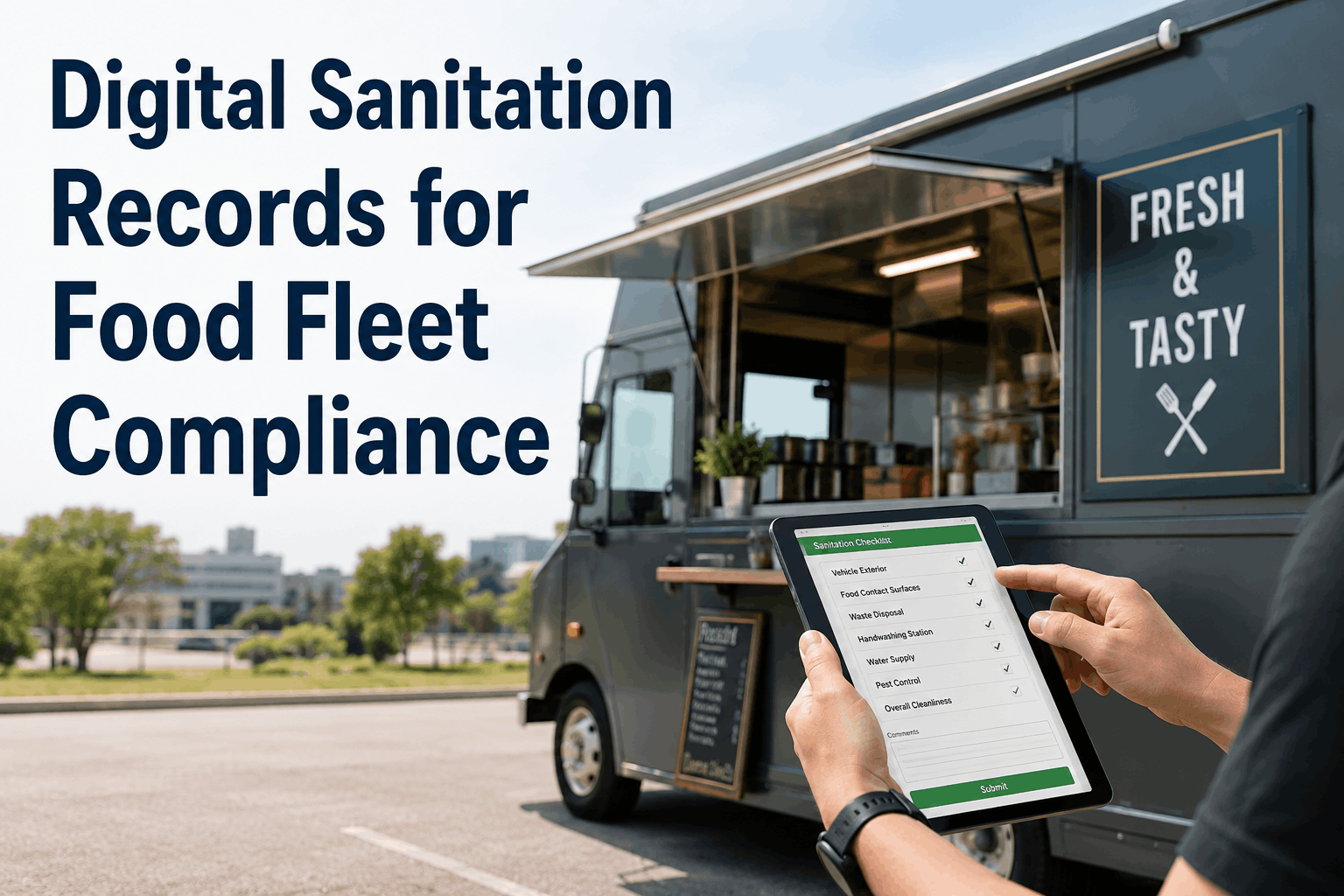
Digital Sanitation Records for Food Fleet Compliance
Organized electronic logs, automated FDA/FSMA audit trails, and real-time sanitation tracking that keep your food fleet inspection-ready every single day
FDA FSMA Sanitary Transport Rules Apply To
500K+
food transport vehicles operating in the U.S. food supply chain
3–5 days
Average time to compile paper logs for an audit
Under 60 sec
Pull any vehicle's full sanitation history digitally
100%
Audit-ready documentation on every vehicle, every route
$14K+
Avg. consultant cost per FSMA corrective action
72%
Of food fleets lack complete electronic sanitation records
100%
FSMA Sanitary Transportation Rule traceability
24/7
Real-time access to all sanitation logs
Why Paper Sanitation Logs Fail Food Fleets
Clipboards, handwritten forms, and shared spreadsheets weren't designed for the documentation rigor that FSMA's Sanitary Transportation Rule demands. When a driver completes a pre-trip cleaning check on a paper form that gets stuffed in a glove box, soaked by a spill, or simply forgotten, the entire compliance chain breaks at the first link. FDA investigators don't accept "we clean our trucks regularly" as a substitute for timestamped, verifiable records—and neither do major retail buyers who now require third-party audit documentation before awarding distribution contracts. Start Free Trial.
01
Missing & Incomplete Logs
38%
of paper sanitation forms are incomplete, illegible, or unlocatable when needed for audits or incident investigations
02
Zero Real-Time Visibility
None
managers have no live view of which vehicles have completed sanitation checks today—until a driver returns to the depot hours later
03
FSMA Documentation Gaps
Form 483
the most common FDA inspection finding for food transporters is inadequate written procedures and records under 21 CFR Part 1.900
04
Retail Contract Risk
$2.1M
average value of retail distribution contracts that require third-party sanitation audit documentation before annual contract renewal
05
No Temperature-Sanitation Link
N/A
paper records can't correlate sanitation events with temperature logs, creating blind spots in cold chain food safety documentation
06
Supervisor Time Drain
35%
of compliance manager time spent manually collecting, filing, and searching paper sanitation records rather than verifying and improving hygiene standards
The Digital Sanitation Record Lifecycle: From Clean to Certified
A modern food fleet sanitation platform transforms every cleaning event—pre-trip, post-trip, deep-clean, and incident-triggered—into a timestamped, GPS-verified, photo-documented digital record that is instantly accessible, automatically organized, and perpetually audit-ready. No missing clipboards. No illegible handwriting. No "we can't find that log."
1
Driver Initiates Sanitation Checklist
Mobile App
Pre-Trip Form
Post-Trip Form
Deep-Clean Form
Driver opens FleetRabbit mobile app, selects vehicle, and completes the assigned sanitation checklist. GPS location, timestamp, and driver ID auto-captured. Photo documentation required for each cleaning zone.
2
Auto-Validation & Compliance Scoring
FSMA Check
Gap Detection
Scoring
System validates submission against FSMA sanitation requirements, flags incomplete fields, scores the cleaning event against hygiene standards, and alerts supervisors to any deficiencies before the vehicle departs.
3
Supervisor Review & Digital Sign-Off
Remote Approval
E-Signature
Compliance manager reviews submitted record with photos, applies digital signature via mobile or desktop, and approves vehicle for departure. Rejected records trigger corrective cleaning workflow before approval is granted.
4
Cold Chain & Temperature Correlation
IoT Integration
Temp Linking
Sanitation record is automatically linked to the vehicle's temperature telemetry for the corresponding route—creating the combined food safety documentation chain that FDA and GFSI auditors require.
5
Audit-Ready Archive & Reporting
Instant Retrieval
FDA Export
Complete signed record stored in searchable digital archive. Any vehicle's full sanitation history retrievable in under 60 seconds. One-click FDA audit package export with date range, vehicle, driver, and product filters.
See the Digital Sanitation Workflow Live
Watch how FleetRabbit transforms driver cleaning checklists into GPS-timestamped, photo-verified, FSMA-compliant digital records—from mobile submission to one-click FDA audit export.
Sanitation Record Types: Covering Every Cleaning Event
FSMA's Sanitary Transportation Rule requires documentation across multiple cleaning event types—not just a single daily log. A digital platform standardizes every record type into a consistent, verifiable format that satisfies both internal hygiene standards and external regulatory requirements. Each form type captures the specific data fields that FDA inspectors look for during a sanitary transport audit.
Pre-Trip Inspection
Compartment check, odor assessment, surface condition, prior load verification, temperature pre-cool confirmation
Post-Trip Washout
Full washout documentation, chemical agent used, drying confirmation, drainage clearance, photo evidence upload
Scheduled Deep Clean
Full interior sanitization, ATP swab results, chemical concentration log, third-party verifier sign-off, zone-by-zone photo documentation
Incident-Triggered Clean
Spill, contamination, or temperature exceedance response, corrective action steps, product disposition record, return-to-service authorization
All record types feed into a single searchable compliance archive—enabling instant retrieval by vehicle, date, driver, product type, or cleaning event, regardless of how the sanitation event was triggered.
FSMA Compliance Scoring by Record Category
FleetRabbit's compliance engine automatically evaluates every sanitation submission against FSMA Sanitary Transportation Rule requirements, scoring each record for completeness, timeliness, and regulatory adequacy. Fleet managers see a live compliance dashboard—not a quarterly paper review—so gaps are identified and corrected before an FDA inspector arrives.
Pre-Trip Verification
Required: Every departure
Compartment condition, prior load type, temperature pre-set, odor & contamination check
Post-Trip Washout
Required: After each route
Full washout record, chemical used, drying verification, drainage confirmation
Scheduled Deep Clean
Required: Per schedule / GFSI
ATP swab results, zone photos, chemical concentration, third-party sign-off
Incident Response
Required: Within 4 hours of event
Corrective action steps, product disposition, return-to-service authorization, root cause note
Before & After: The Compliance Transformation in Numbers
The gap between managing sanitation records on paper and operating a digital compliance platform isn't a minor efficiency gain—it's the difference between passing an FDA audit in 60 minutes and spending three weeks in corrective action. Every metric that matters to food safety officers, compliance managers, and retail buyers improves dramatically when records are digitized, automated, and centrally archived.
Make Your Fleet FDA-Audit-Ready Today
Join food distributors using FleetRabbit to digitize sanitation records, automate FSMA compliance scoring, and deliver the documentation that protects contracts and passes audits.
Regulation Coverage & Documentation Matrix
Food fleet compliance spans multiple regulatory frameworks simultaneously—FSMA Sanitary Transportation, FDA 21 CFR Part 1.900, GFSI scheme requirements, and customer-specific food safety audits. FleetRabbit's digital record system captures the specific documentation fields that each framework requires, ensuring a single cleaning record satisfies every compliance obligation simultaneously.
| Regulation / Standard |
Key Documentation Required |
Record Retention |
FleetRabbit Coverage |
| FSMA Sanitary Transport |
Written procedures, training records, sanitation logs, prior load disclosure |
2 years minimum |
Full auto-archive with e-signature |
| FDA 21 CFR Part 1.900 |
Shipper-carrier agreements, temperature logs, cleaning verification records |
12 months rolling |
Linked temp + sanitation records |
| SQF / BRCGS Transport |
ATP swab results, chemical agent records, third-party audit certificates |
3 years minimum |
ATP result entry, certificate upload |
| GFSI Scheme Requirements |
Corrective action records, non-conformance log, hygienic zoning records |
Per scheme specification |
CAR workflow with root cause tracking |
| Retail Buyer Audits |
Vehicle-level sanitation history, driver training certifications, incident log |
Per buyer requirement |
One-click custom report export |
| DOT / FMCSA Transport |
Vehicle maintenance records, pre-trip inspections, hazmat placarding logs |
12 months minimum |
Pre-trip + maintenance integration |
| ISO 22000 Food Safety |
Prerequisite program records, control point documentation, monitoring logs |
Per ISO specification |
PRP checklist templates included |
| Internal HACCP Plans |
CCP monitoring records, deviation records, verification activities log |
Per HACCP plan terms |
Custom HACCP template builder |
Expert Perspective: Why Digital Records Change Everything
"
The single most powerful thing about digital sanitation records isn't the time savings—it's what happens when an FDA investigator walks in unannounced. With paper, you're spending three days finding documents, explaining gaps, and praying nothing is missing. With digital records, you open a laptop and pull every vehicle's complete sanitation history for the last two years in about four minutes. The investigator sees timestamped GPS-verified records with photos, driver signatures, and supervisor approvals. That's not just compliance—that's the kind of documentation that turns a potential warning letter into a clean inspection report. Our retail buyers noticed immediately too. Our GFSI audit score went from a C to an A in one cycle simply because we could finally prove what we'd always been doing.
— VP of Food Safety & Compliance, National Cold Chain Distributor
91%
Reduction in audit preparation time
4 min
To pull 2-year vehicle sanitation history
Zero
FDA Form 483s after platform adoption
$620K
In protected retail contracts annually
The food fleet operations excelling at sanitation compliance share common characteristics: leadership that treats documentation as a competitive asset, platforms that connect every cleaning event to a verifiable digital record, and a culture where compliance isn't a quarterly scramble but a daily operational standard. If you're ready to explore what this looks like for your fleet, our team can help design the solution. Schedule a consultation to build your digital sanitation compliance program.
Give Your Fleet the Compliance Protection It Deserves
FleetRabbit transforms food fleet sanitation from paper clipboards into GPS-timestamped, photo-verified, FSMA-compliant digital records with real-time compliance scoring, automated audit exports, and complete chain-of-custody documentation.
Frequently Asked Questions
What does FSMA's Sanitary Transportation Rule specifically require food fleet operators to document?
The FDA's FSMA Sanitary Transportation of Human and Animal Food Rule (21 CFR Part 1.900) requires shippers and carriers to maintain written procedures covering: vehicle and equipment cleaning and sanitizing, protection of food from contamination during transport, and temperature controls for refrigerated foods. Carriers must retain records of prior cargo, sanitation procedures, and any temperature monitoring data for a minimum of 12 months (2 years for some shipper agreements). Records must be made available to FDA within 24 hours of a written request. FleetRabbit generates and archives all required documentation automatically, with timestamped entries, driver and supervisor e-signatures, and GPS-verified location data that meets or exceeds the rule's evidentiary requirements.
How quickly can a food fleet implement digital sanitation records with FleetRabbit?
Most food fleet operations are fully live with digital sanitation records within 1–3 weeks. The typical implementation: Week 1 covers platform setup, vehicle database import, and customization of sanitation checklist templates to match your existing cleaning protocols and regulatory requirements. Week 2 involves driver mobile app installation, supervisor approval workflow configuration, and compliance scoring threshold calibration. Week 3 focuses on live deployment, supervisor training, and first-cycle audit report generation. For fleets with existing digital maintenance records in a CMMS or fleet management platform, API integration can link sanitation records to maintenance and temperature data, creating a unified compliance record. The most common accelerator is having your existing paper checklist formats available during setup—FleetRabbit can digitize them directly.
How does FleetRabbit handle sanitation records for vehicles that operate in areas with poor cellular connectivity?
FleetRabbit's mobile app supports full offline operation. Drivers complete sanitation checklists, capture photos, and submit forms without any cellular connection. All data is stored locally on the device and syncs automatically to the cloud archive when connectivity is restored—typically within minutes of the driver reaching a depot or area with signal. Every offline record receives its original submission timestamp (not the sync time), ensuring regulatory accuracy. Supervisors see a clear indicator in the dashboard when records are pending sync, and the system flags any submission delay beyond configurable thresholds. For fleets operating in permanently low-connectivity areas, Bluetooth-based proximity sync with a depot-installed gateway is also supported.
Can FleetRabbit generate custom audit reports for specific retail buyer or GFSI scheme requirements?
Yes. FleetRabbit's report builder supports fully customizable audit exports filtered by any combination of vehicle, date range, driver, product type, cleaning event type, compliance score, and regulatory framework. Pre-built report templates cover the most common retail buyer audit formats (Walmart, Kroger, Sysco, US Foods) and GFSI scheme requirements (SQF, BRCGS, FSSC 22000). For custom buyer requirements, the template builder allows drag-and-drop field selection to match any specific documentation format. Reports export as PDF with digital signature verification, or as structured CSV/Excel for buyer portals that require data upload. Scheduled automatic report delivery can push weekly or monthly compliance summaries directly to buyer audit portals or internal QA teams.
How does digital sanitation recordkeeping integrate with temperature monitoring and maintenance records?
FleetRabbit creates a unified compliance record by automatically linking each sanitation event to the corresponding temperature telemetry data for that vehicle and route. When an inspector asks for documentation of a specific delivery date, a single query returns the sanitation pre-trip record, the route temperature log, the post-trip washout record, and any maintenance work orders completed on that vehicle—all in one exportable package. Integration with major temperature monitoring hardware (Sensitech, Berlinger, Emerson) and fleet telematics platforms means data flows automatically without manual entry. For refrigerated transport, this combined sanitation-plus-temperature record is the gold standard of FSMA documentation—and it's generated automatically on every route without any additional driver or dispatcher action.
May 22, 2026
By Taylor
All Posts