Driver Certification and Training Record Management for Food Fleets
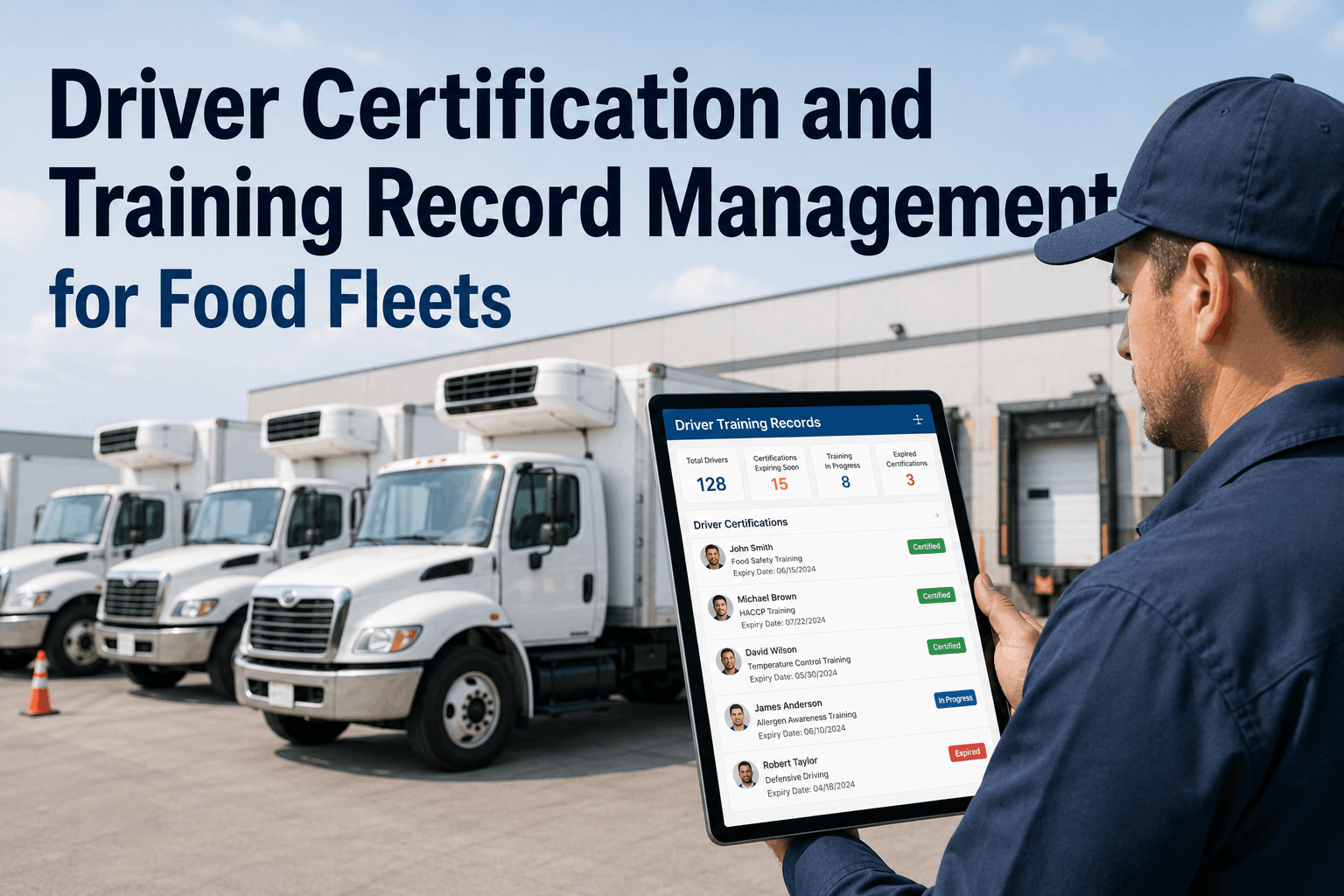
When a food safety auditor asks "Can you prove every driver on your refrigerated fleet has a current HACCP awareness certification and a valid food handler permit?" and the fleet manager responds with "We ran a training session last spring," the compliance gap is immediate and costly. Running a session is an activity; maintaining verified, current, individual certification records is a compliance outcome. If the answer requires pulling physical files from three different cabinets — or worse, guessing — the fleet is exposed to FSMA citations, retailer disqualification, and liability in the event of a foodborne illness incident. The difference between food fleets that pass audits effortlessly and those that scramble before every inspection is almost always the rigor of their Driver Certification and Training Record Management system — a centralized digital framework that tracks every credential, flags every expiry, and produces audit-ready documentation in seconds. Start managing your driver certifications with a platform built for food fleet compliance.
Complete Guide — 2026 Edition
Driver Certification & Training Record Management for Food Fleets
Centralized tracking of food handler permits, HACCP certifications, CDL credentials, and FSMA driver compliance records — from hire to audit, in one platform
Of food fleet audits cite incomplete or expired driver certification records as a primary finding
$25K+
Average FSMA citation cost for undocumented driver training in food transport operations
6+
Separate credential types a single food fleet driver must maintain — CDL, food handler, HACCP, and more
100%
Audit readiness when every credential is tracked, verified, and auto-alerted in a centralized platform
Why Centralized Certification Tracking Is Non-Negotiable for Food Fleets
Every driver operating a food-grade vehicle represents a compliance node in a highly regulated supply chain. CDL requirements, food handler permits, HACCP awareness certifications, refrigerated transport training, and FSMA Sanitary Transportation Rule acknowledgements do not expire on the same schedule, are not issued by the same authority, and are not stored in the same place — unless a fleet has deliberately built a centralized system to manage them. Without it, fleets make roster decisions blind, assign unqualified drivers to regulated loads, and discover expired credentials only when an auditor is already in the building.
What Centralized Driver Record Management Enables
Audit Readiness
Retrieve any driver's full certification history instantly. Present complete, organized, and verified records to FDA, SQF, or retailer auditors without manual searching.
Expiry Alerts
Automated notifications 30, 60, and 90 days before any credential expires. No certification lapses — no unqualified drivers dispatched on food-grade loads.
FSMA Compliance
Document Sanitary Transportation Rule training acknowledgements, food safety plan reviews, and driver qualification files to the letter of FSMA requirements.
Gap Analysis
Identify training gaps across the entire driver roster by role, route type, or load category. Prioritize which drivers need recertification before their next scheduled run.
Trend Reporting
Fleet-wide dashboards showing certification compliance rates over time. Identify departments or routes with recurring training gaps before they become regulatory findings.
Qualified Dispatch
Ensure only drivers with current, verified credentials are assigned to regulated loads. Integration with dispatch workflows prevents unqualified driver assignments at the source.
Credential Types: What Food Fleet Drivers Must Maintain
Food fleet driver compliance is not a single certification — it is a matrix of overlapping credentials with different issuing authorities, renewal cycles, and regulatory requirements. Managing this matrix manually across dozens or hundreds of drivers is where most fleets fail. A digital certification tracking system maps every credential type to every driver, providing a single compliance view that no paper system can replicate.
Driver Credential Matrix by Regulatory Category
Licensing & CDL
Commercial Driver's License (CDL)Mandatory
CDL Medical Certificate (DOT)Mandatory
Hazmat Endorsement (if applicable)Conditional
Renewal: Every 2–5 years (state-dependent)
Authority: FMCSA / State DMV
Food Safety Training
Food Handler Permit / CertificateMandatory
HACCP Awareness TrainingMandatory
Food Allergen AwarenessRequired
Renewal: Annual or biennial
Authority: FDA / State Health Dept.
FSMA & Cold Chain
Sanitary Transport Rule AcknowledgementMandatory
Reefer / Temperature Control TrainingRequired
Cold Chain Handling ProceduresRequired
Renewal: Upon policy change or annually
Authority: FDA / FSMA Sanitary Transport
Centralize Every Driver Credential in One Platform
FleetRabbit's driver compliance tools track food handler permits, HACCP certifications, CDL records, and FSMA acknowledgements across your entire fleet — with automated expiry alerts, gap analysis dashboards, and audit-ready export in seconds.
The 1–5 Compliance Status Scale: Rating Driver Record Health
To prioritize corrective actions, each driver's certification portfolio must be rated on a standardized compliance scale. A consistent 1–5 system translates the complex state of a driver's credentials into a clear, actionable status for fleet managers and safety directors. This allows dispatch teams to immediately identify qualified drivers while compliance teams schedule recertification for those approaching risk.
Driver Certification Compliance Status Scale
5
Fully Compliant — All Credentials Current
All certifications verified and current. No expirations within 90 days. Driver qualification file complete. Cleared for all regulated food-grade loads and routes.
Action: Routine monitoring — next review at scheduled interval
Clear
4
Watch Status — Expiry Within 90 Days
One or more credentials expiring within 90 days. Driver is currently compliant and deployable. Recertification scheduling should be initiated immediately to prevent lapse.
Action: Schedule recertification — monitor weekly
Monitor
3
At Risk — Expiry Within 30 Days
Critical credential expiring within 30 days. Driver may be restricted from specific load types after expiry. Recertification booking must be confirmed and documented.
Action: Confirm recertification booking within 5 business days
At Risk
2
Non-Compliant — Credential Lapsed
One or more required certifications have expired. Driver must not be assigned to regulated food loads until recertified. Immediate corrective action and dispatch restriction required.
Action: Remove from regulated routes — immediate recertification required
Restricted
1
Critical — Multiple Failures or Unverified Records
Multiple expired credentials or unverifiable training records. Driver qualification file is incomplete. Continued operation creates direct regulatory liability and potential FSMA violation exposure.
Action: Immediate suspension from food routes — executive review required
Suspended
The Cost of Unmanaged Certification Records
Compliance record failures do not announce themselves — they compound quietly until they surface in the worst possible context: an FDA inspection, a retailer audit, or a foodborne illness investigation. The cost of correcting a certification gap at the scheduling stage is a phone call and a training fee. The cost of discovering that gap during a regulatory inspection is measured in citations, contract losses, and legal exposure. The timeline below illustrates why proactive digital tracking delivers returns that no paper-based system can match.
Cost of Unmanaged Driver Certification Gaps Over Time
Cost multiplier relative to proactive digital record management
5 Proactive Digital Tracking
$200 (Software)
0.1x
4 Manual Spreadsheet Monitoring
$2K (Admin Hours)
0.5x
3 Pre-Audit Scramble
$8K (Remediation)
1.0x (baseline)
2 FDA Citation Issued
$25K+ (Fines / Legal)
5.0x
1 Retailer Contract Loss
$500K+ (Revenue Loss)
25x+
Investing in centralized digital tracking (Level 4–5) prevents the compounding costs of regulatory crisis (Level 1–2).
Turn Certification Gaps into Compliance Confidence
FleetRabbit helps food fleet compliance teams track every driver credential, automate expiry alerts, and generate qualification file reports that satisfy FDA, SQF, and retailer audit requirements — ensuring that no certification gap ever reaches the audit stage.
Building a Driver Certification Program: The 5-Phase Compliance Lifecycle
A disciplined driver certification management function follows a structured lifecycle — from onboarding credential capture to ongoing compliance verification and audit reporting. This cycle ensures that every driver's qualification file is complete, current, and instantly retrievable. Systematic execution of these phases positions fleets to pass any food safety or transport audit without notice.
Driver Certification Compliance Lifecycle
1
Onboarding Credential Capture
Collect and digitize all credentials at hire: CDL, medical certificate, food handler permit, HACCP training records, and prior employer verification. Upload to a centralized driver qualification file with issue date, expiry date, and issuing authority recorded for every document.
Onboarding Phase
2
Role-Based Compliance Mapping
Assign each driver a role profile (e.g., refrigerated long-haul, local food service delivery, frozen distribution) that defines the specific certifications required for that role. The system automatically identifies gaps between what the driver holds and what the role demands.
Classification Phase
3
Continuous Monitoring & Alert Dispatch
Automated daily monitoring of all credential expiry dates. Tiered alert system notifies the driver, their dispatcher, and the compliance manager at 90, 60, and 30 days before any expiry. Escalation protocols trigger if booking confirmation is not received within response windows.
Ongoing Phase
4
Recertification Workflow & Record Update
Upon completion of any training or recertification, the new credential is uploaded, verified by the compliance manager, and automatically updates the driver's compliance status. Dispatch restrictions are lifted only after verification is confirmed in the system — not assumed.
Recertification Phase
5
Audit Reporting & Compliance Verification
Generate complete driver qualification file packages for any individual or the entire fleet on demand. Export formats meet FDA, FMCSA, SQF, and retailer audit documentation requirements. Historical records with timestamps provide a defensible chain of custody for every credential on file.
Continuous / On-Demand
Fleet Operator Perspective: What Digital Tracking Changes
"
We had 140 drivers across three distribution centers. Every time an SQF auditor came in, it was a two-day fire drill trying to pull paper files and prove that every driver had current food handler certifications and HACCP training. We failed one audit section entirely because we couldn't produce documentation for drivers who had been trained — the records just weren't findable. After moving to a centralized digital system, our next audit took 45 minutes. The auditor asked for documentation on six specific drivers, we pulled all six qualification files in under three minutes, and we passed with zero findings in the driver training section. That was the moment our leadership understood that compliance software isn't a cost — it's insurance.
— Director of Fleet Safety & Compliance, Regional Cold Chain Distributor
45 min
Audit prep time reduced from 2 days to under an hour with digital records
Zero
Driver training findings in first post-digitization SQF audit
100%
Certification coverage rate achieved within 60 days of platform onboarding
Food fleets that achieve consistent audit success share one operational trait: they manage driver certifications as a living, monitored compliance program — not an administrative task that surfaces before inspections. By centralizing credential records, automating expiry workflows, and integrating compliance status with dispatch decisions, these fleets eliminate the most common audit finding category before it can form. Start building your driver compliance program with the tools designed for food fleet operations.
Empower Your Compliance Team with FleetRabbit
FleetRabbit provides the digital infrastructure for food fleet driver certification management — centralizing every credential, automating every alert, and tracking the full lifecycle of every qualification file to ensure your fleet is always audit-ready and always compliant.
What certifications must food fleet drivers maintain under FSMA?
Under the FSMA Sanitary Transportation of Human and Animal Food Rule (21 CFR Part 1), carriers are required to ensure that personnel engaged in food transport operations are trained in practices that are appropriate to their duties. This includes documented awareness of sanitary practices, temperature control requirements, cleaning procedures, and the shipper's food safety responsibilities. At minimum, food fleet drivers should hold documented training acknowledgements for the Sanitary Transport Rule, food handler certifications where state law requires them, and HACCP awareness training. Fleets serving retailer accounts with SQF or BRC certification requirements often face additional documentation obligations layered on top of FDA requirements.
What should a Driver Qualification File (DQF) include for food transport?
A complete Driver Qualification File for a food fleet driver should include: a copy of the current CDL and DOT medical certificate, results of pre-employment drug and alcohol screening, motor vehicle record (MVR) review, employment history verification for the prior three years, and all food safety training records including food handler permit, HACCP awareness training, allergen training, cold chain handling training, and the signed FSMA Sanitary Transport Rule acknowledgement. For drivers handling specific regulated commodities (meat, seafood, dairy), additional USDA-specific training documentation may be required. FleetRabbit structures the DQF to meet all these requirements in a single organized digital file per driver.
How often must food handler certifications be renewed for fleet drivers?
Food handler certification renewal requirements vary by state and certification type. Most state-issued food handler cards expire every 2–3 years and require renewal training. HACCP awareness certifications are typically valid for 2–3 years as well, though employer policy and retailer audit standards (SQF, BRC) often require annual refresher acknowledgements regardless of the formal expiry date. DOT medical certificates expire every 24 months for most drivers, or more frequently for drivers with certain medical conditions. A centralized tracking system that records the specific expiry date and renewal requirement for each credential type — rather than applying a single blanket renewal rule — is the only reliable way to maintain compliance across a diverse driver fleet.
What happens if an unqualified driver is caught operating a food-grade vehicle during an FDA inspection?
Dispatching a driver without documented, current food safety training on a regulated load is a direct violation of the FSMA Sanitary Transportation Rule. Consequences can include FDA Warning Letters, which are publicly posted and can trigger retailer audits; consent decrees requiring third-party monitoring of compliance programs; civil monetary penalties; and in cases involving foodborne illness, criminal liability referrals. Beyond regulatory penalties, major grocery retailers and food service distributors typically have contractual provisions allowing immediate contract termination if a carrier cannot demonstrate compliant driver training records during an audit. The reputational and financial impact of a single compliance failure can exceed the entire cost of a digital certification management system many times over.
How does FleetRabbit handle multi-location fleets with drivers across different states?
FleetRabbit supports enterprise-wide multi-location fleet management with location-based compliance rules. Because food handler certification requirements, renewal cycles, and specific permit types vary by state, the platform allows compliance managers to configure location-specific credential requirements for each driver based on their home state and operating territory. Fleet-wide dashboards aggregate compliance status across all locations, while location managers see only their own driver records. Audit export functions can generate location-specific or fleet-wide qualification file packages, giving both regional managers and corporate compliance directors the documentation they need for simultaneous multi-site audits.