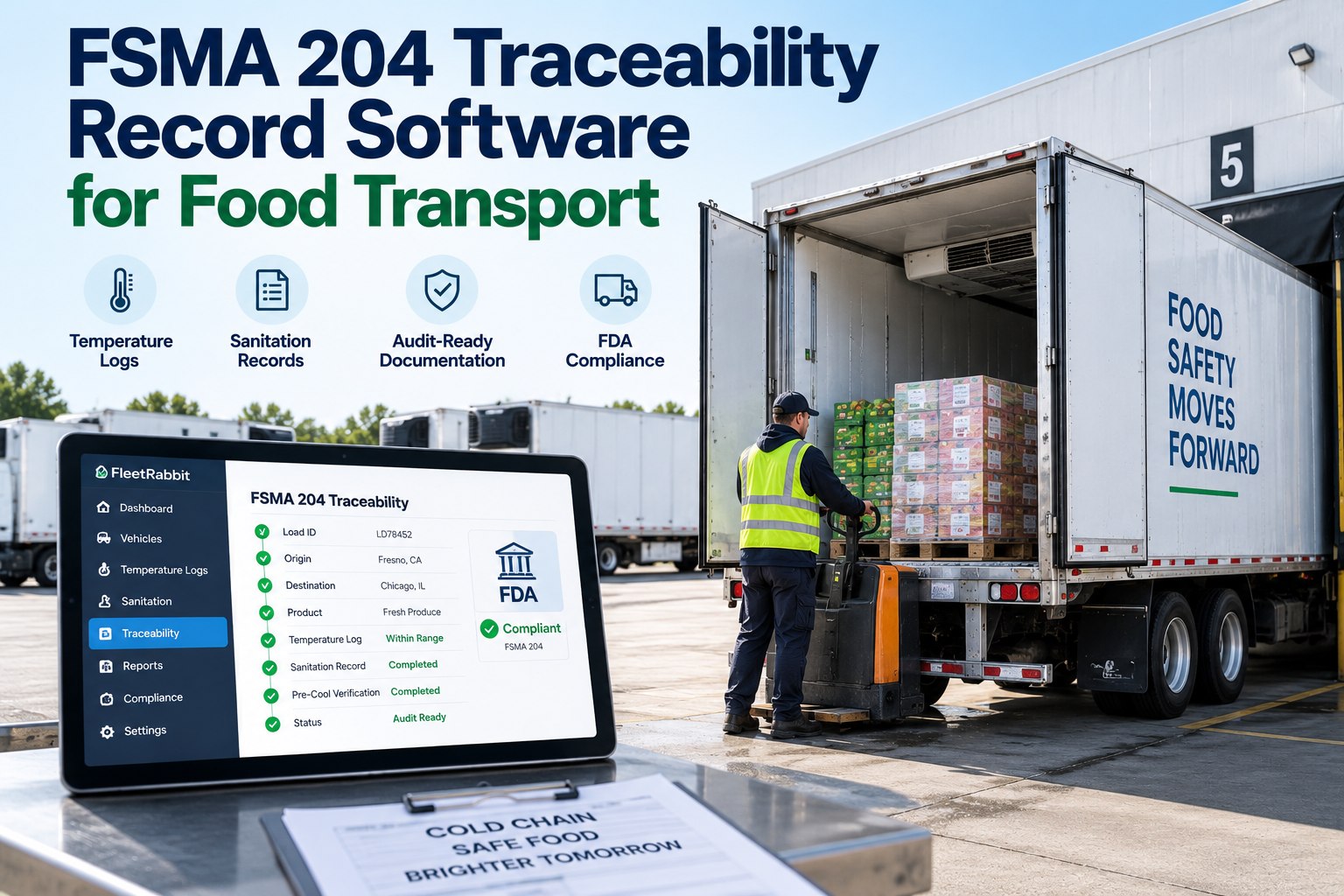
FSMA 204 changes what a load of spinach, cantaloupe, or soft cheese needs to carry with it on the road. It is no longer enough to know a shipment left the warehouse and arrived at the customer — the rule requires specific Key Data Elements to be captured at each Critical Tracking Event, and if the FDA comes asking during a foodborne illness investigation, those records need to be produced within 24 hours. For a cold-chain carrier hauling products on the Food Traceability List, that means the shipping and receiving events happening at your dock and inside your trailers are now part of a federally mandated recordkeeping chain, not just an internal logistics detail. FleetRabbit builds FSMA 204 traceability directly into fleet operations, capturing the required data automatically at the moment a load ships or arrives instead of asking dispatchers to reconstruct it from memory later. You can sign up to see how your own shipping and receiving events map onto FSMA 204 requirements.
Where Transportation Fits in the FSMA 204 Chain
FSMA 204 defines several Critical Tracking Events across the supply chain, but for a fleet, two of them matter most: the moment a load ships out and the moment it is received. Each event has to be tied to specific product and location data, and a gap at either point breaks the traceability chain for everyone downstream.
Three of these five events run directly through your fleet's operations. Fleets that sign up for FleetRabbit get all three covered without adding a separate manual step to the driver's workflow.
Key Data Elements FleetRabbit Logs Automatically
Missing even one of these fields at a shipping or receiving event breaks the chain for whoever needs to trace the product later. Fleets that sign up get every field below captured without adding a manual step for drivers.
Traceability Lot Code
The unique lot identifier tied to the product moves with the shipment record instead of living only on a paper bill of lading.
Quantity and Unit of Measure
Product quantity is recorded at both shipping and receiving so any discrepancy is visible immediately, not discovered weeks later.
Date and Time of Event
Shipping and receiving timestamps are captured automatically at the moment the event happens, removing guesswork from the record.
Location Identifier
Origin and destination location data is logged against each event, tying the physical movement to the paper trail.
Can You Produce a Record Fast Enough
The FDA does not give extra time because a record is hard to find. Once a request lands, the clock runs the same whether your traceability data lives in a searchable system or in a folder of mixed paperwork at a regional office.
You can book a demo and run a mock FDA request against your own fleet's data to see exactly how fast a complete record comes back.
Core Traceability Features
Each of these runs quietly in the background of a normal shift, so drivers keep moving loads while the traceability record builds itself. You can book a demo to see the full feature set working against a live shipment.
Automatic KDE Capture
Shipping and receiving data is captured directly from the driver workflow, without a separate manual data-entry step.
Temperature-Linked Records
In-transit temperature logs are tied to the same shipment record as the KDEs, connecting cold-chain proof to traceability proof.
Offline Dock Capture
Shipping and receiving events at docks with poor signal are captured offline and synced automatically once connected.
Instant Record Export
A complete traceability record for any lot, shipment, or date range can be pulled and exported in a single search.
Get Ahead of the FSMA 204 Compliance Date
Automatic Key Data Element capture at every shipping and receiving event, records ready the moment the FDA asks for them, and a fleet team that never has to reconstruct paperwork from memory.
Products Covered Under FSMA 204
| Food Category | Examples | Carrier Impact |
|---|---|---|
| Leafy greens | Spinach, lettuce, fresh-cut greens | Shipping and receiving KDEs required at every load |
| Soft and semi-soft cheeses | Queso fresco, brie, feta | Lot code and temperature record tied to shipment |
| Shell eggs | Fresh shell eggs | Quantity and date recorded at shipping and receiving |
| Tropical and melon produce | Cantaloupe, tomatoes, cucumbers | Location and lot data required across the haul |
| Ready-to-eat deli salads | Prepared salads, deli-counter items | Full KDE set required due to higher risk classification |
FSMA 204 Compliance at a Glance
These details are worth reviewing with your compliance team, but the short version is that fleets who sign up now will already have every retention and format requirement handled well before the deadline.
Retention Period
Traceability records must be kept for a minimum of two years and made available in a format that can be provided electronically.
Record Format
Records can be requested in either a sortable spreadsheet or an electronic format the FDA can use directly during an investigation.
Compliance Date
The FDA extended enforcement to July 2028, giving covered fleets a longer runway to move off manual recordkeeping before it becomes mandatory.
Chain-of-Custody Sharing
Records need to be shared with the immediate party before and after in the supply chain, not just retained internally by the carrier.
Manual Traceability vs. FleetRabbit
| Task | Manual Process | FleetRabbit |
|---|---|---|
| Capturing KDEs at shipping | Written on a bill of lading, entered later | Captured automatically at the point of shipping |
| Linking temperature to lot code | Kept in separate systems, matched manually | Linked automatically to the same shipment record |
| Responding to an FDA request | Hours to days of manual document search | Minutes, searchable by lot, date, or shipment |
| Dock capture with poor signal | Paper backup, entered when signal returns | Captured offline, synced automatically |
| Record retention | Physical or scattered digital files | Centralized cloud record kept for the required period |
Fleets that sign up now build the habit of automatic capture well before the July 2028 compliance date arrives.
Build Your FSMA 204 Record Trail Now
Automatic shipping and receiving capture, temperature records linked to every lot, and traceability data ready whenever the FDA asks.
Frequently Asked Questions
What is a Critical Tracking Event under FSMA 204
A Critical Tracking Event is a specific point in the supply chain, such as shipping or receiving, where Key Data Elements about a food product must be captured and recorded. For a carrier, the shipping, transportation, and receiving events are the ones that matter most.
Which foods are covered by FSMA 204
The rule applies to foods on the FDA Food Traceability List, which includes items such as leafy greens, soft cheeses, shell eggs, certain fruits and vegetables, and ready-to-eat deli salads. Carriers hauling these products need shipping and receiving records that meet the rule.
How fast do traceability records need to be produced during an FDA request
Records generally need to be produced within 24 hours of a request. FleetRabbit stores traceability data in a searchable digital record so it can be pulled in minutes rather than the hours or days a manual search often takes.
Has the FSMA 204 compliance date changed
Yes. The FDA extended the compliance date to July 2028, giving fleets additional time to move off manual recordkeeping before the rule becomes fully enforceable.
Can FleetRabbit link temperature data to the same record as the traceability lot code
Yes. In-transit temperature logs are tied to the same shipment record as the required Key Data Elements, so cold-chain proof and traceability proof live in one place instead of two separate systems.