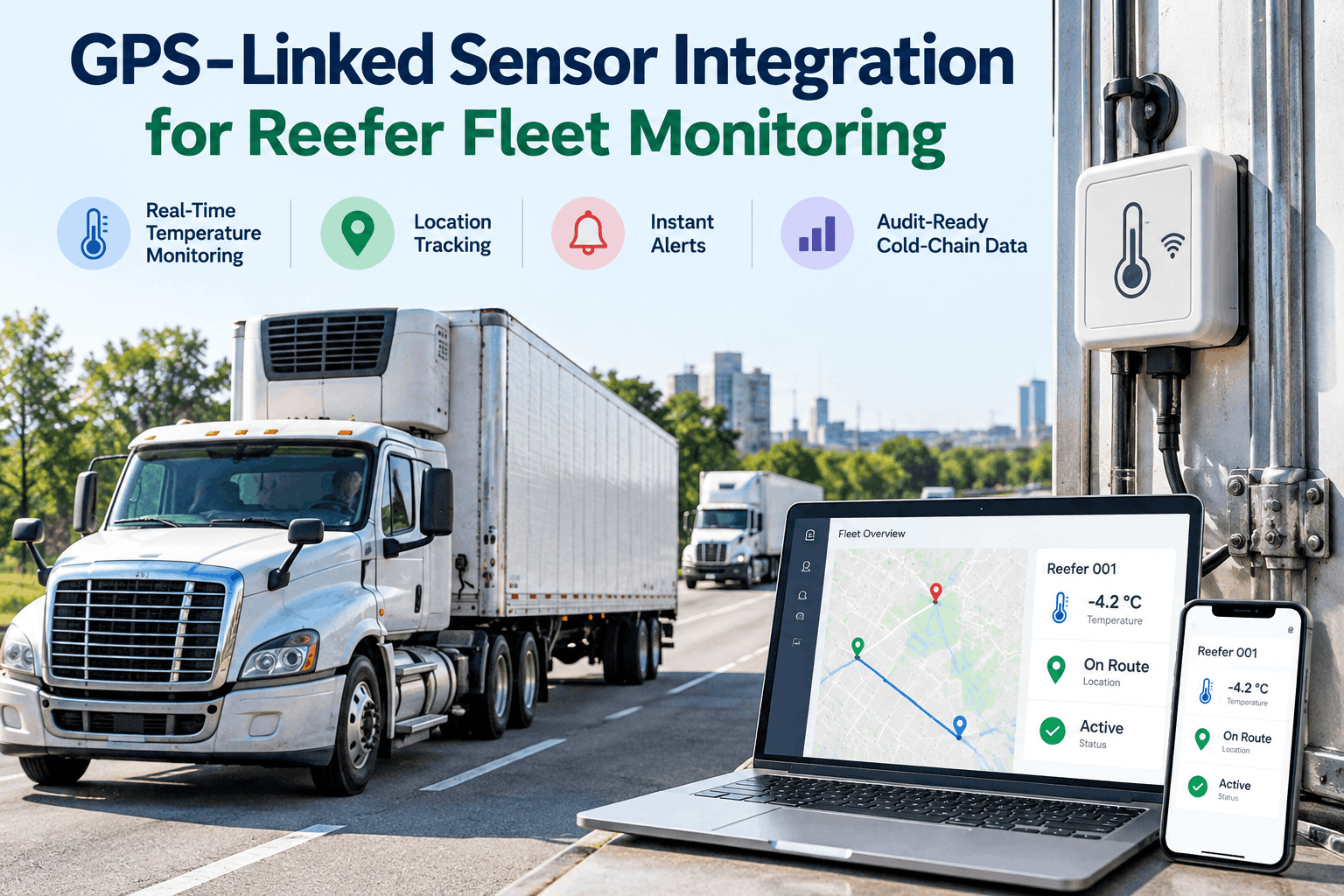
GPS-Linked Sensor Integration for Reefer Fleet Monitoring
Cold-chain transport directors, quality assurance leads, and refrigerated carrier fleet controllers face an ongoing operational hazard: managing transit locations and cargo compartment temperatures as isolated data streams. A standard GPS unit reveals where a vehicle is idling, but remains completely blind to microclimate temperature spikes, compressor fault codes, and open trailer doors. Conversely, standalone temperature dataloggers store thermal readings on internal memory cards, leaving dispatchers powerless to prevent thermal excursions until the vehicle arrives at a receiving dock and pallets of ice cream or fresh poultry are rejected. GPS-linked sensor integration bridges this physical gap by attaching multi-zone wireless IoT environmental sensors, door-open reed switches, and reefer microprocessor diagnostics directly to satellite location telemetry. When every 30-second temperature reading is cryptographically stamped with satellite latitude, longitude, vehicle speed, and geofence status, carriers eliminate dockside acceptance disputes, automate preventive reefer maintenance, and guarantee full FDA Food Safety Modernization Act (FSMA) compliance. Fleet Rabbit provides a purpose-built cold-chain telematics and sensor integration software platform that links IoT temperature probes with dynamic route mapping and mobile driver tools. Protect perishable margins, prevent load rejections, and achieve end-to-end chain of custody. Book a Demo to see our GPS-linked reefer sensor integration in action.
GPS-Linked Sensor Integration for Reefer Fleet Monitoring
A comprehensive engineering and operational deployment guide: pair multi-point wireless BLE thermal probes with high-precision GPS telemetry, automate sub-minute excursion geofencing, correlate door-open thermal loss, and deliver tamper-proof FDA FSMA compliance records.
Integrated GPS & Sensor Telematics Network
30 sec
Telemetry Sync Rate
Synchronized GPS coordinates, return air temperatures, and door sensor pings.
0.1°F
Thermal Precision
Calibrated industrial-grade wireless BLE probes for multi-zone compartments.
100%
Audit Verification
Time-stamped geofence entry and exit records for FDA 21 CFR Part 1 compliance.
$5
Per Asset / Month
Complete telematics, sensor integration, route mapping, and maintenance suite.
Link Satellite Location Tracking with Real-Time Reefer Temperature Sensors
Eliminate dockside cargo rejections, receive sub-minute alerts when setpoints drift, and provide customers with cryptographic proof of delivery for just $5/asset/month.
When a driver opens trailer rear doors to unload pallets, hot ambient air rushes in. Without GPS-linked magnetic door sensors, dispatchers cannot confirm whether a thermal spike occurred during authorized customer deliveries or unauthorized highway roadside stops. Book a demo to inspect our door-sensor geofence correlation engine.
Vulnerability 02
Subjective Dockside Receiver Rejections
Receiving clerks frequently use handheld infrared thermometers on carton exteriors immediately after trailer doors open. Without an unbroken satellite-linked temperature history proving the cargo was held at setpoint throughout transit, carriers absorb devastating cargo claim write-offs.
Vulnerability 03
Delayed Excursion Discovery on Highway Lanes
Standalone memory-card dataloggers only reveal thermal failures after goods arrive at destination. If a reefer engine stalls or runs out of diesel on a 400-mile highway haul, lack of real-time GPS-linked alerts guarantees total product loss before dispatch can intervene. Sign up to enable real-time sub-minute excursion alerts.
Vulnerability 04
Missing Proof During PACA Produce Inquiries
Under the Perishable Agricultural Commodities Act (PACA), produce carriers must demonstrate "Good Delivery." Paper temperature charts lacking cryptographically verified satellite coordinates are routinely dismissed during federal arbitration hearings.
The 4 Pillars of GPS-Linked Reefer Sensor Integration
Fleet Rabbit establishes an integrated digital architecture that merges IoT wireless environmental probes, refrigeration microprocessors, and satellite positioning into a single operational data stream. Book a demo to see our full cold-chain sensor integration suite.
1. Multi-Zone Wireless IoT BLE Probes
Industrial Bluetooth Low Energy sensors measure return air, discharge air, and core product temperatures across dual-temp bulkheads without running physical wires through insulated trailer panels. Probes transmit data every 30 seconds to the in-cab gateway. Sign up to configure multi-zone BLE sensor profiles.
2. High-Precision Spatial Watermarking
Every thermal packet is stamped with exact satellite latitude, longitude, vehicle speed, and geofence boundary status. If an anomaly occurs, dispatchers pinpoint the exact mile-marker, rest stop, or customer receiving bay where temperatures deviated.
3. Reefer Controller Diagnostics & Engine PM
Direct CAN-Bus and serial integration with Thermo King SmartReefer and Carrier Transicold APX controllers captures diesel engine run-hours, fuel levels, battery voltage, and operating modes (Continuous vs. Cycle-Sentry), auto-triggering preventive maintenance work orders. Book a demo to inspect our controller integration modules.
4. One-Click Point-of-Delivery Audit PDF
Upon arriving at customer docks, drivers generate an unalterable, time-stamped delivery certificate on their smartphone. The document displays pre-cooling verifications, continuous transit graphs, and exact geofenced drop coordinates for instant receiver sign-off.
Data Telemetry Pipeline: From Sensor to Dispatch Console
The cloud analytics engine correlates readings against customer geofences, triggering instant push notifications if temperatures drift out of spec.
System Comparison: Disconnected Tracking vs. Fleet Rabbit
Compare the operational, financial, and compliance differences between standalone tracking tools and Fleet Rabbit’s integrated cold-chain suite. Sign up now to explore all platform features.
Capability
Fleet Rabbit Integrated Suite
Standalone GPS Trackers
Manual Memory-Card Dataloggers
Subscription Rate
$5 / asset / month
$25 – $45 / vehicle / month
$0 (High claim loss risk)
Telemetry Latency
< 30 seconds sub-minute sync
5 to 15-minute breadcrumbs
Post-trip download only
GPS & Temperature Correlation
Cryptographic location watermark
Location only (no cargo data)
Time only (no spatial proof)
Door Sensor Geofence Tracking
Correlates dock doors with temp
Door sensor only (no temp match)
Not supported
Reefer PM Scheduling
Automated compressor engine hours
Truck odometer miles only
Manual calendar estimates
FDA FSMA Audit Export
1-click 12-month digital dossier
Not compliant for food safety
Days manual spreadsheet formatting
Trial & Contract Terms
14-day free trial, cancel anytime
1 to 3-year auto-renewing contract
Hardware purchase only
Refrigerated Fleet Case Study: Great Plains Fresh Transport
Interstate Perishable Carrier Eliminates Cargo Rejections Across 34 Reefers
Hauling fresh beef, dairy, and seasonal produce across six Midwestern states, Great Plains Fresh Transport operated separate GPS units for tractor dispatch and manual temperature recorders for cargo. When an alternator belt failed on a trailer hauling fresh pork, the driver was unaware while parked at a highway rest area. By the time the vehicle reached the Chicago distribution center, surface temperatures exceeded 46°F, resulting in a rejected $42,000 load.
By deploying Fleet Rabbit, the carrier integrated wireless BLE temperature sensors directly with GPS location tracking and reefer controller diagnostics. Sub-minute alerts caught three subsequent alternator issues during rest stops, allowing drivers to engage backup settings before temperatures drifted. Cargo rejection claims dropped to zero, reefer PM compliance reached 100%, and verified mobile delivery reports eliminated dockside acceptance disputes entirely.
Frequently Asked Questions
What is the advantage of linking temperature sensors directly to GPS telemetry?
Linking temperature probes with GPS provides cryptographic proof of where and when microclimate fluctuations occurred. Instead of seeing an isolated temperature chart, dispatchers and customers can verify exact vehicle location, road speed, and geofence boundary status at the precise moment temperatures drifted, distinguishing between normal dock unloadings and mechanical highway failures.
Do wireless BLE temperature sensors require drilling holes through trailer walls?
No. Fleet Rabbit uses ruggedized industrial Bluetooth Low Energy (BLE) sensors equipped with industrial-strength adhesive and magnetic mounts. The high-output RF signal penetrates composite refrigerated trailer panels and polyurethane insulation without requiring drilled wiring passages, allowing complete trailer sensor installation in under 15 minutes.
How does the system distinguish between normal door openings and cooling failures?
Fleet Rabbit correlates magnetic door open/close sensors with customer geofences and reefer defrost cycles. If rear doors open inside an authorized customer delivery geofence, the system recognizes a scheduled delivery drop, tracking recovery pulldown times rather than triggering false emergency alarms.
Can drivers and dispatchers access temperature graphs without cellular reception?
Yes. Fleet Rabbit features an offline-first architecture. All BLE temperature readings, door events, and GPS coordinates buffer locally on the in-cab gateway and driver smartphone. Drivers can view real-time temperatures via local Bluetooth connection inside remote mountain passes or underground docks, and all data syncs to dispatch as soon as cellular service returns.
What are the pricing details and contract terms for Fleet Rabbit's software?
Fleet Rabbit is priced at a flat rate of $5 per asset per month billed annually. This gives complete access to GPS-linked sensor integration, continuous microclimate monitoring, reefer engine-hour PM scheduling, mobile driver DVIR tools, and 12-month FDA FSMA compliance archives. We offer a 14-day free trial on up to 3 assets with zero setup fees or locked contracts.
Ready to Integrate GPS Telematics with Real-Time Reefer Sensors?
Eliminate dockside cargo rejections, automate auxiliary engine maintenance, and ensure 100% audit-ready cold-chain compliance for just $5/asset/month.