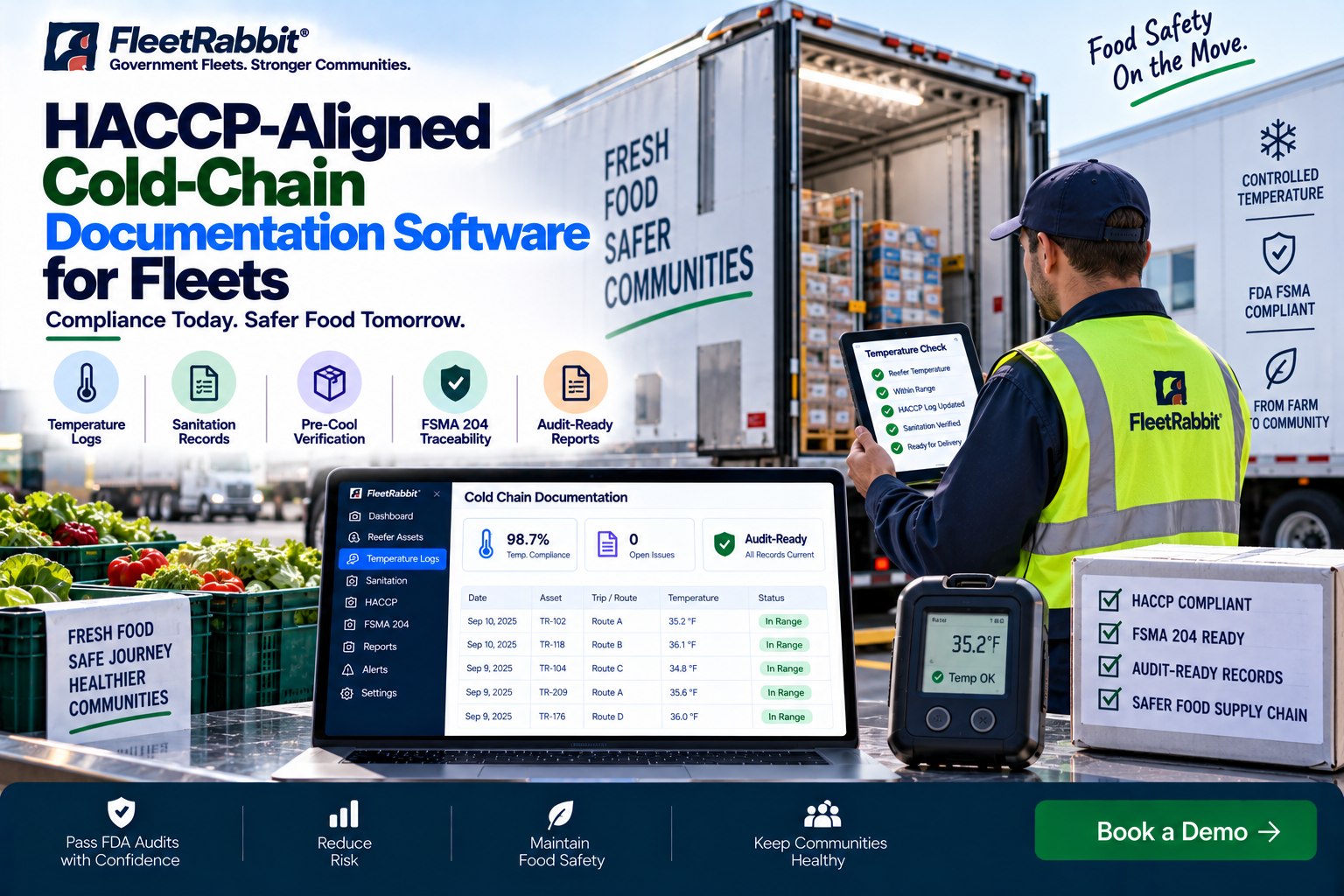
A truck rolls up to the dock at 6 a.m. carrying three pallets of shell eggs, two of soft cheese, and a rack of fresh-cut greens. Somewhere between the pre-cool check and the delivery signature, an auditor is going to ask one question: can you prove this load never left the safe zone? For most fleets, the honest answer is buried in a clipboard, a driver's phone photos, and a spreadsheet nobody has opened since March. That gap is exactly what HACCP cold chain documentation software was built to close.
147average FDA Form 483 observations tied to recordkeeping gaps, not spoiled product itself
Most cold chain violations aren't about bad food. They're about missing paperwork.
Why "We Kept It Cold" Isn't a Defense Anymore
Every cold chain fleet believes it runs a tight operation. Drivers pre-cool trailers, dispatch checks the weather, and product arrives fine nine times out of ten. The problem is that food safety audits don't grade on "usually fine." They grade on documented evidence: timestamped temperature logs, sanitation records tied to specific trailers, pre-cool verification before loading, and a paper trail that survives a recall investigation. Without that evidence, even a perfectly handled shipment can read as a violation on paper. This is where a purpose-built system for haccp cold chain documentation software stops being a nice-to-have and starts being the difference between a clean audit and a corrective action plan.
A single shipment generates checkpoints most fleets still track on paper
Pre-Cool Verification
Trailer temperature confirmed before a single case is loaded
In-Transit Logging
Continuous temperature capture from dock to delivery
Sanitation Record
Wash-out and inspection tied to the specific trailer used
Delivery Proof
Final temperature and signature captured at the door
What "HACCP-Aligned" Actually Requires From a Fleet
Hazard Analysis and Critical Control Points isn't a checklist you fill out once a year, it's a living framework that expects every critical control point, including transportation, to have a record behind it. For fleets, that means temperature isn't the only thing under review. Auditors also want to see that hazards were identified in advance, that corrective actions were logged the moment a threshold was crossed, and that records are retained long enough to matter during a traceback. A fleet that wants to be genuinely HACCP-aligned needs documentation that connects pre-cool checks, in-transit readings, sanitation logs, and driver corrective actions into one retrievable record per load, not four disconnected systems that never talk to each other.
This is also where the FDA's Sanitary Transportation of Human and Animal Food rule overlaps with HACCP expectations. The rule requires carriers to maintain vehicles in sanitary condition, monitor temperature during transport, and keep written procedures for pre-cooling and cleaning. If your fleet is still reconstructing this information from driver memory after an incident, you're not just risking a bad audit, you're risking the kind of documentation gap that turns a minor deviation into a full recall investigation. Fleets that want to stop reconstructing and start proving usually book a demo to see what automatic capture looks like against their own routes.
The Clipboard Method
- Driver logs temperature by hand, sometimes late
- Sanitation records live in a separate binder
- Corrective actions are remembered, not written down
- Retention depends on someone not losing the folder
Audit-Ready by Default
- Temperature captured automatically, tied to the trailer
- Sanitation and pre-cool records linked to the same load
- Deviations flagged and logged the moment they happen
- Every record retained and searchable on demand
FSMA 204 Is Coming, and Cold Chain Fleets Are Squarely in Scope
The FDA's Food Traceability Rule, known as FSMA 204, was originally set to require compliance by January 2026, and after a 30-month extension announced by the FDA in 2025, the enforcement date has now moved to July 20, 2028. That extra runway is a gift, but it's also a trap for fleets that decide to wait until the deadline gets close. FSMA 204 requires businesses that manufacture, process, pack, or hold foods on the Food Traceability List, things like leafy greens, soft cheeses, shell eggs, and certain seafood, to capture Key Data Elements at every Critical Tracking Event and produce those records to the FDA within 24 hours of a request. For carriers and distribution fleets, that means the temperature and handling data attached to a shipment can no longer live in a driver's head or a stack of paper tickets. It needs to be structured, timestamped, and instantly retrievable.
The 24-hour production window is the detail most fleets underestimate. It's not enough to eventually find the record, it has to be produced fast enough to support a live investigation. Fleets that build their traceability habits now, well ahead of the 2028 date, avoid the scramble that will hit everyone else in the final months before enforcement begins. If you're mapping out what your fleet's traceability gap actually looks like, you can sign up and run your own routes against the same Critical Tracking Event checkpoints an FDA reviewer would look for.
Stop rebuilding records after the fact
See how fleets turn every load into an audit-ready file automatically, without extra paperwork for drivers.
What Actually Belongs in an Audit-Ready Cold Chain File
When an FDA investigator or a customer's third-party auditor asks for records, they're not looking for a single temperature reading. They're looking for a complete story of the load, from the moment the trailer was inspected empty to the moment the product was signed for. A documentation system that's genuinely built for cold chain fleets pulls all of these pieces into one file, without a dispatcher having to chase down four different sources.
Pre-Cool Confirmation
Trailer temperature verified and logged before loading begins, with a timestamp that can't be edited after the fact.
Continuous Temperature Data
Readings captured throughout transit, not spot-checked at a few convenient stops.
Sanitation History
Wash-out records tied to the specific trailer and driver, retrievable by unit number.
Corrective Action Log
Every deviation, and exactly what was done about it, recorded at the moment it happened.
Retention & Retrieval
Records kept for the required window and searchable in minutes, not buried in a filing cabinet.
Chain of Custody
A clear handoff trail from dock to delivery that matches what FSMA 204 expects at each tracking event.
The fleets that pass audits without scrambling aren't the ones with the fewest deviations, they're the ones who can produce a complete, organized file the moment it's requested. That's the entire premise behind building your compliance process around software instead of memory and paper. If your current process would take a full day to reconstruct one load's history, it's worth seeing what an automated version looks like, and most teams find it easier to just book a demo than to try to explain their current setup over email.
How This Fits Into a Driver's Actual Day
Compliance software only works if it doesn't fight the people using it. Drivers already juggle routes, delivery windows, and paperwork; adding another manual log is a recipe for the exact gaps that show up during an audit. The systems that actually hold up are the ones where pre-cool checks and sanitation confirmations take seconds, and temperature capture happens in the background without anyone touching a form. That's the difference between records that exist because someone remembered, and records that exist because the system doesn't let a load move without them.
From dock to delivery, in one connected record
This is also why haccp cold chain documentation software for food fleets needs to be built for fleets specifically, not adapted from a generic food safety tool. Fleet operations have variables that a single-facility HACCP plan never accounts for: multiple trailers per driver, routes that cross temperature zones, and handoffs between carriers. A system designed around fleet realities keeps every record tied to the right truck, the right driver, and the right load, so nothing gets misattributed when an auditor starts asking pointed questions.
Retention Isn't Optional, and Neither Is Being Able to Find What You Kept
Keeping records is only half the requirement. FSMA 204 and most third-party audit standards expect those records to be retrievable within a defined window, and a folder full of unsorted PDFs doesn't meet that bar. Cold chain documentation software solves the retention half automatically, but the real value shows up in retrieval: pulling every temperature reading, sanitation log, and corrective action for a specific load, on a specific date, in under a minute. When an auditor or a customer's compliance team asks for proof, speed matters as much as completeness. Teams that want to test their own retrieval speed before an auditor forces the question can sign up and pull a sample record themselves.
Turn your next audit into a formality
Get every pre-cool check, temperature log, and sanitation record organized automatically, load by load.
Frequently Asked Questions
What counts as HACCP-aligned documentation for a transportation fleet
It means every critical control point in the transport process, pre-cool verification, in-transit temperature, sanitation, and corrective actions, has a timestamped, retrievable record behind it, not just a general assurance that procedures were followed.
When does FSMA 204 actually take effect for fleets
The FDA's original compliance date of January 20, 2026 was extended by 30 months, moving enforcement to July 20, 2028. Fleets carrying foods on the Food Traceability List should still start building the required data habits now rather than waiting for the deadline.
How long do cold chain temperature and sanitation records need to be kept
Retention windows vary by regulation and customer contract, but the safe standard is keeping every record long enough to support a traceback investigation and producing it quickly when requested, which is exactly what automated documentation systems are built to do.
Does this replace a driver's manual temperature checks
It removes the manual logging burden, not the physical checks. Pre-cool verification still happens at the trailer, but the confirmation and every temperature reading afterward are captured automatically instead of written down by hand.
What happens if a temperature deviation occurs mid-route
The deviation and the corrective action taken are logged the moment it happens, creating the exact record an auditor expects to see rather than a reconstructed explanation after the fact.
Is this only useful right before an audit
No. The documentation builds continuously with every load, so when an audit does happen, there's nothing to prepare. It's also useful day to day for spotting patterns, like a trailer that consistently runs warm before it becomes a compliance problem.