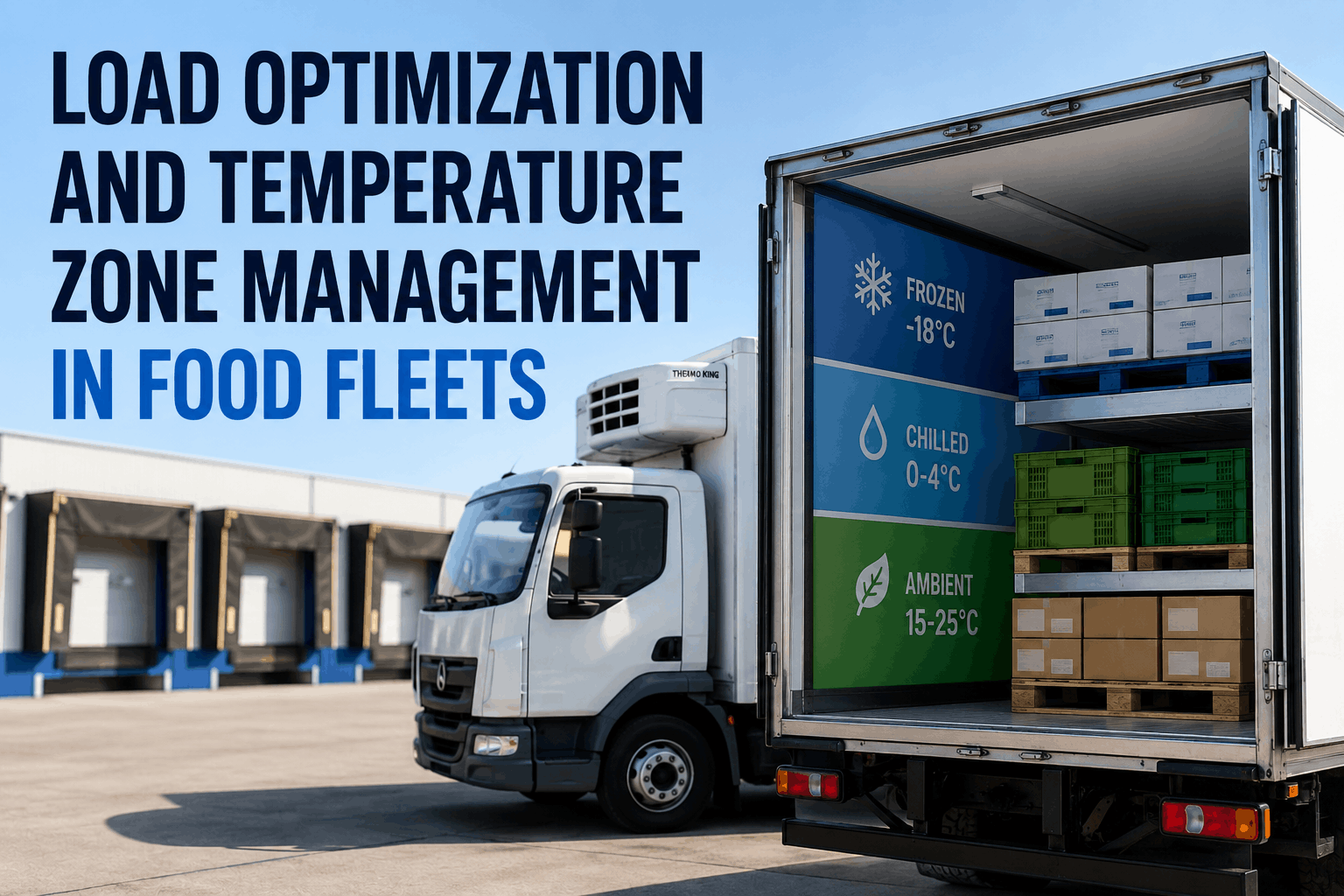
When a multi-temp trailer leaves a distribution centre carrying frozen goods in the front zone, chilled dairy in the mid zone, and fresh produce in the rear zone — and the load plan was built on a spreadsheet without route-sequenced drop optimisation, payload balance calculations, or temperature zone compatibility checks — the inefficiency doesn't announce itself at departure. It accumulates invisibly: a rear-zone door opened repeatedly at ambient temperature because the produce customer comes first on a route planned around geography rather than thermal risk; a payload 340kg underweight because no one calculated the combined density of the frozen and chilled zones against the axle rating; and a mid-zone dairy consignment running 90 minutes longer than necessary because the route wasn't built around the chilled window for that cargo class. Load optimisation failures in refrigerated food fleets aren't dramatic. They're quiet, compounding, and entirely preventable.
This guide gives food distribution fleet managers, refrigerated transport logistics directors, and cold chain supply managers a comprehensive framework for implementing load optimisation and temperature zone management across multi-temp trailer operations, grocery fleet routing, and perishable goods logistics. We cover payload optimisation, multi-zone temperature compatibility planning, route-sequenced load building, reefer trailer configuration, and the connected platform capabilities that reduce cargo loss, improve fleet utilisation, and protect cold chain integrity from the moment a trailer is loaded to the moment the last drop is made. Food distribution fleets ready to take control of their load planning can start their free trial today.
FleetRabbit Food Fleet Intelligence 2026
Load Optimization and Temperature Zone Management in Food Fleets
How route-sequenced load planning, multi-zone temperature compatibility, payload optimisation, and reefer trailer configuration intelligence eliminate cold chain losses, maximise fleet utilisation, and protect perishable cargo integrity across every drop on every route.
34%
average payload underutilisation in food fleets without load optimisation software
$820M
annual US perishable loss linked to temperature zone mismanagement during loading and routing
27%
reduction in cold chain temperature excursions achieved through route-sequenced load planning
4.8x
ROI on load optimisation platform investment versus manual load planning operations
The Load Planning Gap: Where Food Fleet Efficiency Actually Breaks Down
Load planning in most food distribution fleets is a manual, experience-dependent process that sits outside any connected system. A planner reviews the day's orders, assigns trailers based on available capacity, builds a rough zone split by cargo class, and sequences the route by geography or driver preference. The result is a load plan that may be technically executable but is rarely optimal — underutilising payload capacity, mismatching temperature zones to route sequence, and creating the conditions for thermal excursions that compound across a multi-drop run.
Zone Incompatibility at Load
Frozen, chilled, and ambient cargo placed in adjacent zones without thermal separation planning — allowing temperature bleed between zones that elevates chilled product above safe thresholds before the first drop is reached.
Impact: Cold chain excursion on chilled zone, product rejection at delivery
Route Sequence vs. Load Sequence Mismatch
The last customer on the route receives cargo loaded at the rear of the trailer — requiring repeated full door-opens at ambient temperature for every prior drop, exposing the remaining cargo to cumulative thermal risk that no monitoring system alerts on.
Impact: 6–14°C ambient infiltration per unplanned door-open event
Payload Underutilisation
Manual load plans allocate by order count or volume estimate without calculating actual payload density per zone — leaving 20–40% of available axle capacity unused on routes where consolidation would have been possible with proper weight distribution planning.
Impact: 1–3 additional vehicles required per week across a mid-sized fleet
No Pre-Load Compatibility Check
Cargo classes with conflicting odour transfer risk, cross-contamination potential, or incompatible temperature specifications are co-loaded without a systematic compatibility screen — creating food safety violations that only surface at customer delivery or during FSMA audit review.
Impact: FSMA compliance violation, shipper contract exposure
Multi-Temperature Zone Architecture: How a Properly Configured Trailer Works
A multi-temp refrigerated trailer is not a single cold environment with a door at the back. It is a segmented thermal system where each zone maintains an independent temperature specification, has its own airflow management, and requires its own access sequence planning. Understanding the physical architecture of multi-zone temperature management is the prerequisite for building load plans that protect cargo integrity across the entire route — not just at the moment of loading.
FRONT ZONE
−18°C to −22°C
Frozen Goods
Loaded last — delivered last. Highest thermal mass, longest dwell tolerance.
Access Sequence: 3
MID ZONE
0°C to +4°C
Dairy & Chilled
Tightest temperature tolerance. Most vulnerable to door-open thermal events.
Access Sequence: 2
REAR ZONE
+2°C to +8°C
Fresh Produce
Loaded first — delivered first. Widest temperature tolerance; highest ambient exposure.
Access Sequence: 1
Frozen zone — maximum thermal isolation required; no adjacent warm cargo
Chilled zone — tightest compliance window; route-sequenced delivery priority
Produce zone — first-out loading position; maximum ambient door-open exposure
The access sequence principle is the single most important concept in multi-temperature load planning: cargo that will be delivered first must be loaded last (at the rear, closest to the door), and cargo delivered last must be loaded first (deepest in the trailer). When route sequence and load sequence are not planned together — as a single integrated operation rather than two separate processes — every mis-sequenced drop creates an unnecessary door-open event that exposes cargo classes with tighter temperature tolerances to ambient air infiltration they were never designed to withstand repeatedly.
FleetRabbit Load Optimisation Platform: Core Capabilities
Effective food fleet load optimisation requires more than a route planning tool that considers distance and time windows. A purpose-built cold chain load optimisation platform integrates temperature zone compatibility, payload density calculations, route-sequenced load building, FSMA cargo compatibility checks, and real-time reefer trailer configuration — operating as a unified load intelligence layer that connects every cargo placement decision to the thermal and regulatory requirements of the route it will travel.
Route-Sequenced Load Building
Load plans generated with drop sequence as the primary variable — placing each consignment in the trailer position that minimises door-open exposure for every cargo class on the route. Frozen zone loads are positioned for last delivery; produce and ambient loads are positioned for first access. Every load plan is auditable against the route sequence that generated it.
27%Excursion reduction
100%Sequence-verified loads
Temperature Zone Compatibility Engine
Automated pre-load compatibility screening that cross-checks cargo classes, odour transfer risk, temperature specification overlap, and FSMA co-loading restrictions before a load plan is confirmed — flagging any incompatible combination for dispatcher review and substitution before the trailer is loaded.
Payload Density & Axle Balance Optimisation
Per-zone weight and density calculations that maximise trailer payload utilisation within axle rating constraints — identifying consolidation opportunities across routes and flagging under-utilised vehicle assignments that could be merged without compromising temperature zone separation requirements.
Reefer Configuration & Zone Pre-Conditioning
Pre-departure zone pre-conditioning schedules that ensure each trailer zone reaches its target temperature before loading begins — eliminating the cargo temperature absorption that occurs when warm product is loaded into a zone still cooling to specification, and providing a documented pre-load temperature record for FSMA compliance.
Multi-Stop Door-Open Risk Scoring
Route-level thermal risk scoring that calculates the cumulative ambient exposure each cargo class will experience across all door-open events on the route — adjusting load positioning recommendations and delivery sequence to minimise total thermal risk for the most temperature-sensitive consignments on the load.
FSMA Load Compliance Documentation
Automatic generation of the FSMA-required load record for each trip: cargo class per zone, temperature specifications, pre-conditioning record, compatibility check outcome, and load sequence verification — stored per vehicle visit in an audit-ready archive with two-year retention and one-click export for FDA or shipper audit response.
FleetRabbit Food Fleet Load Optimisation
Stop Building Load Plans on Spreadsheets. Start Optimising Every Zone, Every Route, Every Load.
FleetRabbit gives food distribution fleets route-sequenced load building, multi-zone temperature compatibility screening, payload density optimisation, reefer pre-conditioning scheduling, and automatic FSMA load compliance documentation — connected to your fleet operations and ready on every shift.
Temperature Zone Compatibility Matrix: What Can and Cannot Be Co-Loaded
Food cargo compatibility in refrigerated transport extends beyond temperature specification. Odour transfer, ethylene gas emission, moisture migration, and cross-contamination risk create co-loading constraints that exist independently of temperature zone assignment. A rigorous load optimisation platform applies a multi-dimensional compatibility matrix to every load plan — not just checking whether cargo fits in the available zone, but whether that cargo class should be in the same trailer as the other consignments, regardless of physical separation.
| Cargo Class |
Frozen Zone
−18°C to −22°C |
Chilled Zone
0°C to +4°C |
Produce Zone
+2°C to +8°C |
Ambient Zone
+10°C to +18°C |
| Frozen Meat & Poultry |
✓ Primary |
✗ Temp gap |
✗ Temp gap |
✗ Incompatible |
| Dairy & Chilled Products |
⚠ Temp risk |
✓ Primary |
⚠ Monitor |
✗ Temp breach |
| Fresh Produce & Salads |
✗ Chill damage |
⚠ Ethylene risk |
✓ Primary |
⚠ Short window |
| Bakery & Ambient |
✗ Incompatible |
✗ Condensation |
⚠ Odour risk |
✓ Primary |
| Raw Seafood |
⚠ Odour transfer |
✓ Compatible |
⚠ Odour risk |
✗ Temp breach |
| Ready-to-Eat Meals |
✗ Incompatible |
✓ Primary |
⚠ Monitor closely |
✗ Safety risk |
Compatible — standard co-loading approved
Conditional — dispatcher review required before confirmation
Incompatible — co-loading blocked by platform compliance check
Payload Optimisation: Turning Underutilised Capacity into Fleet Efficiency
Payload underutilisation in refrigerated food fleets is simultaneously one of the most measurable and most neglected efficiency levers available to logistics directors. A food distribution fleet running 34% below optimal payload utilisation is effectively operating 34% more vehicles than its cargo volume requires — paying for drivers, fuel, maintenance, and refrigeration unit operation on capacity that was never filled. Load optimisation that integrates zone weight calculations, axle balance requirements, and route consolidation analysis converts that underutilised capacity into measurable cost reduction without adding a single customer or route to the network.
✗
Manual Load Planning — Typical Utilisation Profile
Average payload utilisation
Zone temperature compliance rate
Load-sequence match to route
Pre-load compatibility check rate
High vehicle count. Elevated excursion risk. Compliance gaps.
✓
FleetRabbit Load Optimisation — Platform Performance
Average payload utilisation
Zone temperature compliance rate
Load-sequence match to route
Pre-load compatibility check rate
Fewer vehicles. Full cold chain protection. Zero compliance gaps.
The compound effect of payload optimisation in refrigerated food fleets extends beyond direct vehicle cost reduction. Fewer vehicles per route reduces total door-open events per consignment — directly reducing thermal excursion risk for every cargo class on the load. Reduced vehicle movements lower fuel consumption and driver hours. And consolidated, optimised loads generate cleaner FSMA documentation records because every consignment on a route-sequenced, pre-screened load plan has a compliance record that was built before departure rather than reconstructed after a complaint. Book a Demo.
FleetRabbit Food Fleet Load Optimisation & Temperature Zone Management
Every Zone Optimised. Every Load Sequenced. Every Route Protected.
FleetRabbit gives food distribution fleets route-sequenced load building, multi-zone temperature compatibility screening, payload density and axle balance optimisation, reefer pre-conditioning scheduling, door-open risk scoring, and automatic FSMA load compliance documentation — on every shift, for every vehicle, without manual spreadsheet load planning.
Food Fleet Load Optimisation
Multi-Zone Temperature Management
Refrigerated Transport Logistics
Trailer Payload Optimisation
Cold Chain Optimization
Reefer Trailer Optimisation
Food Supply Chain Logistics
Perishable Goods Logistics
Frequently Asked Questions
01
How does route-sequenced load building differ from standard route optimisation?
Standard route optimisation determines the most efficient delivery sequence based on distance, time windows, and vehicle capacity. Route-sequenced load building takes that delivery sequence as its input and works backwards to determine how cargo must be physically positioned in the trailer to serve that sequence — ensuring that the consignment delivered first is loaded closest to the rear door, and that cargo delivered last is positioned furthest forward. The two processes must be connected: a route optimised for distance efficiency but loaded in reverse sequence will generate more door-open thermal events than a longer route loaded correctly. FleetRabbit treats route sequence and load sequence as a single integrated planning operation — the load plan cannot be confirmed until the delivery sequence that will drive it is locked, and any change to the delivery sequence automatically triggers a load position review.
02
What cargo compatibility checks does the platform perform before confirming a load plan?
The platform runs five compatibility checks before a load plan is confirmed. Temperature specification compatibility verifies that each consignment's required temperature range can be maintained in its assigned zone for the full route duration. Odour transfer risk screening checks whether any cargo class on the load is a known odour emitter that could affect adjacent consignments — particularly important for raw seafood, fresh produce, and dairy co-loading scenarios. Ethylene gas emission screening flags produce varieties that emit ethylene at rates that would accelerate ripening or damage adjacent ethylene-sensitive cargo. FSMA co-loading restriction check verifies that no cargo combination on the load violates the regulatory requirement to prevent food from becoming unsafe during transport due to inadequate separation. And cross-contamination risk screening flags combinations where allergen transfer, moisture migration, or physical contamination risk exists between zones. Any failed check generates a dispatcher alert and blocks load plan confirmation until a substitution or separation plan is approved.
03
How does the platform calculate payload optimisation across multi-temperature zones?
Payload optimisation in multi-zone trailers requires weight distribution to be calculated per zone, not just per vehicle — because the physical dividers between zones constrain how weight can be redistributed to balance the axle load. The platform calculates the product weight, density, and volume for each consignment, assigns it to its required temperature zone, and then calculates the total weight per zone against the trailer's zone-specific capacity constraints and the overall axle rating. Where the calculation identifies significant underutilisation in one or more zones, the platform flags consolidation opportunities — orders from other routes or vehicles that share a compatible temperature zone requirement and a compatible delivery corridor — that could be added to the load without violating temperature separation, axle balance, or delivery time window constraints. The optimisation runs across all active routes simultaneously, not vehicle by vehicle, so consolidation opportunities across the fleet are identified rather than only within individual trailer assignments.
04
Can the platform manage load optimisation across a mixed fleet of single-zone and multi-zone vehicles?
Yes — mixed fleet management is a standard operating requirement for most food distribution networks, which typically combine single-zone reefer trailers for single-temperature runs, dual-zone vehicles for fresh and chilled consolidation, and full multi-temp units for complex multi-class loads. Each vehicle in the platform has a configuration profile that defines its zone count, zone temperature ranges, zone capacity and weight limits, and pre-conditioning schedule requirements. When the load planning engine assigns a load to a vehicle, it matches the load's temperature zone requirements to the vehicle configuration profiles available — recommending the most appropriate vehicle type for the load composition and flagging any assignment that requires a vehicle to operate outside its configuration profile. Fleet managers can override assignments with a documented justification that is added to the load's compliance record. Cross-fleet optimisation across vehicle types identifies opportunities to reduce multi-temp vehicle utilisation on single-class loads that a standard reefer could handle — freeing multi-temp capacity for the complex loads that genuinely require it.
05
What FSMA documentation does the load optimisation platform generate automatically?
The platform generates a complete FSMA Sanitary Transportation load record for every trip. The record includes: the pre-load compatibility check outcome for every cargo class on the load; the zone assignment and temperature specification for each consignment; the pre-conditioning record showing the temperature achieved in each zone before loading began; the load sequence verification confirming that cargo is positioned in compliance with the route-sequenced plan; the payload weight per zone and the axle balance calculation; and any dispatcher override decisions with the documented justification. The record is stored per vehicle visit with a two-year retention period and is exportable as a structured PDF for FDA audit response, shipper verification request, or internal food safety review. For fleets subject to FSMA 204 traceability requirements, the load record integrates with the broader traceability data for the consignments on the load — providing continuous chain-of-custody documentation from origin through transport to delivery.
May 29, 2026
By Taylor
All Posts