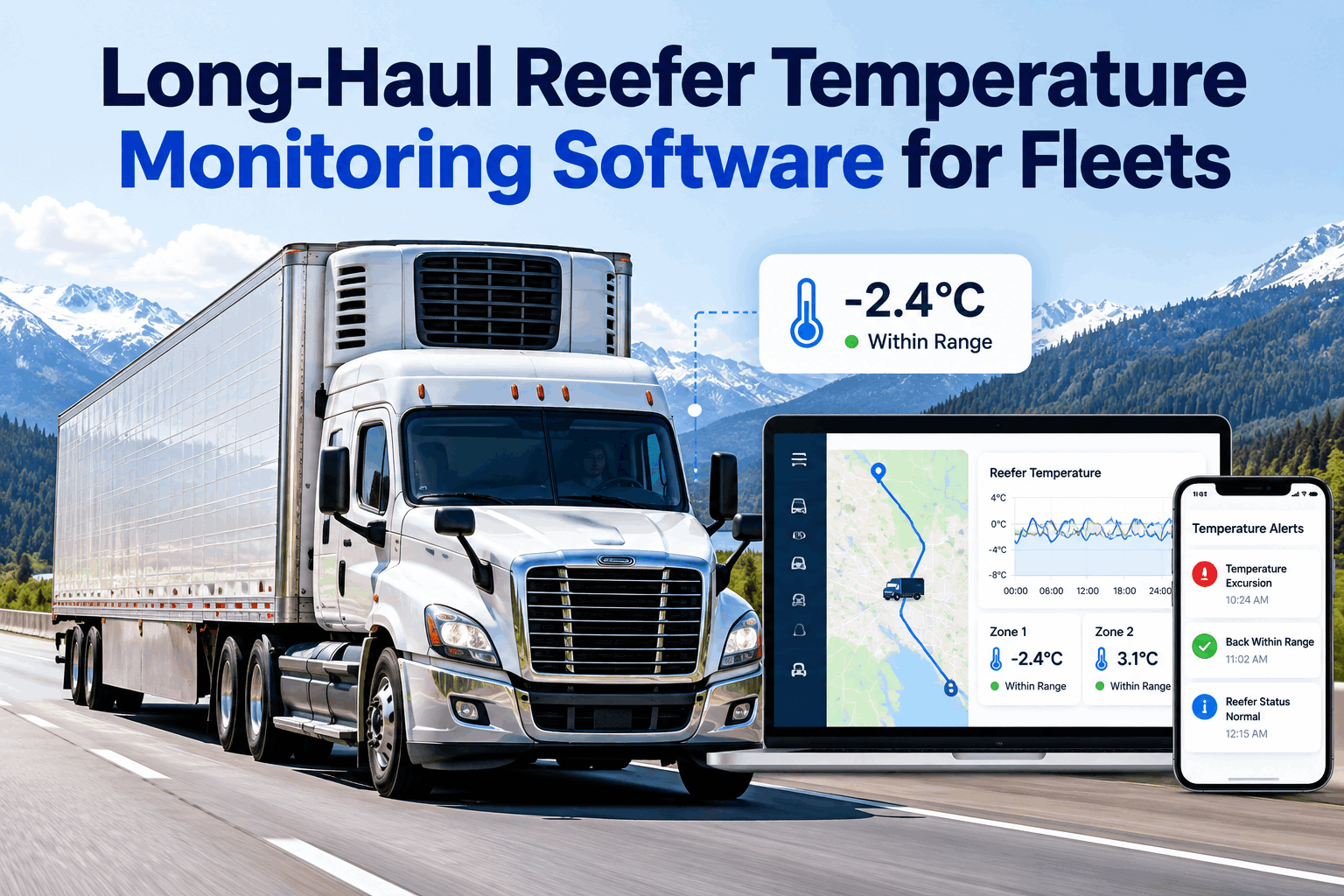
Reefer monitoring built for the miles between checkpoints, not just the moment at the dock
Zone-level temperature visibility, alerts that fire mid-route instead of at delivery, and a record that keeps logging even when the trailer is sitting unhooked with no tractor power.
What a multi-day haul asks of a monitoring system that a same-day run doesn't
Distance and time are what change the risk profile. The longer a load is in transit, the more chances something has to drift before anyone notices — sign up to see how your own long routes hold up against these four.
Days, not hours, in transit
A small drift compounds differently over three days than over three hours — small problems have far more time to become rejected loads.
Drop-and-hook dwell with no power
A loaded trailer staged in a yard between legs has no tractor power for hours or sometimes days — exactly when a unit failure is easiest to miss.
Cross-country dead zones
Long routes cross stretches with no cellular coverage at all, which is where cloud-only monitoring tools quietly stop reporting.
Mixed multi-zone loads
Frozen, chilled, and fresh compartments in the same trailer each need their own threshold — one average reading can't judge all three.
See zone-level status on your own long-haul routes
FleetRabbit tracks every compartment against its own setpoint, mile by mile, not just at pickup and delivery.
Zone-level visibility across the whole trailer
A multi-temp trailer isn't one reading — it's several, each with its own bulkhead, its own airflow, and its own setpoint. Treating them as one number is how a localized problem in one compartment hides behind an average that still looks fine.
Deep frozen
Ice cream, frozen meat and similar loads typically held near −18°F, with the tightest tolerance for drift before a claim becomes likely.
Chilled
Dairy and similar product usually held between 34–38°F, sensitive to both a warm drift and an accidental freeze.
Fresh produce
Often the most forgiving range, but still worth its own threshold rather than being judged against the frozen zone's setpoint.
Each zone gets its own alert threshold, so a two-degree drift in produce doesn't get buried under a frozen zone that's holding steady. It's worth a book a demo look if your current setup only reports one number per trailer.
Reefer unit PM: the engine that makes the monitoring worth trusting
Temperature data is only as good as the unit producing it. A long-haul reefer runs continuously for days at a time, which means preventive maintenance has to be scheduled around actual run-hours, not mileage the way a tractor's PM usually is — worth a book a demo look if yours is still scheduled off the odometer.
Compressor & condenser check
Scheduled off cumulative run-hours, since idle diesel hours on a reefer add up faster than road miles.
Fuel level tracking
A reefer that runs dry mid-route stops holding temperature long before anyone notices from the cab.
Door seal & bulkhead condition
A worn seal or a loose bulkhead is often the real cause behind a "monitoring problem" that's actually a hardware one.
What happens when the tractor unhooks
Drop-and-hook operation is normal for long-haul freight — but it also creates the single longest unmonitored gap in most cold chains, because a lot of monitoring hardware simply goes dark without vehicle power.
The dwell period is exactly when a unit failure, a door left ajar, or a fuel run-out is easiest to miss — and hardest to explain later without a record.
Don't lose visibility the moment the tractor disconnects
Battery and solar-backed reporting keeps the record running through every drop-and-hook dwell.
Audit-ready records for FSMA, without reconstructing them after the fact
Under the FSMA Sanitary Transportation Rule, carriers moving temperature-sensitive food are expected to keep records of monitoring and vehicle sanitation — generally retained for at least twelve months, and available quickly if a reviewer asks for them.
A record that's already continuous, zone-by-zone, and tied to the specific trailer and haul is the difference between a five-minute export and a multi-day scramble through separate logger downloads. Sign up to see your own trailer's record pulled in seconds.
The record that matters is the one covering the whole haul
A single reading at delivery only proves the load was fine at that moment. Long-haul cold chain risk lives in the hours in between — the dwell with no power, the dead zone with no signal, the compartment nobody was watching as closely as the others. Monitoring that covers the entire haul, zone by zone, is what actually protects the load and the record both.
See it running on your own fleet — sign up to connect a trailer, or book a demo and we'll walk through a recent long-haul run together.
Cover the whole haul, not just the checkpoints
Start free and connect your reefer fleet today, or see it live with our team.
Common questions
Does zone-level monitoring work on any multi-temp trailer?
It works on trailers with separated compartments, typically created with insulated bulkheads — each zone gets its own probe and threshold rather than sharing one reading.
What happens to monitoring when the tractor disconnects?
Battery or solar-backed hardware keeps reporting through the dwell, so a drop-and-hook gap doesn't turn into a blind spot in the record.
How is reefer PM different from tractor maintenance scheduling?
A reefer unit's wear tracks with run-hours rather than road miles, since it often keeps running while the trailer is parked — PM intervals need to follow that pattern instead of odometer readings.
What does FSMA actually require for temperature records?
Carriers handling temperature-sensitive food are generally expected to retain monitoring records for at least twelve months and make them available quickly if a reviewer requests them.
Does this work in areas with no cell signal?
Readings continue to log locally through dead zones and sync once connectivity returns, so a stretch of interstate with no signal doesn't leave a gap in the record.
Is this only useful for dedicated cold-chain carriers?
Any fleet running multi-day refrigerated hauls benefits — the risks of extended transit and unattended dwell apply regardless of fleet size.