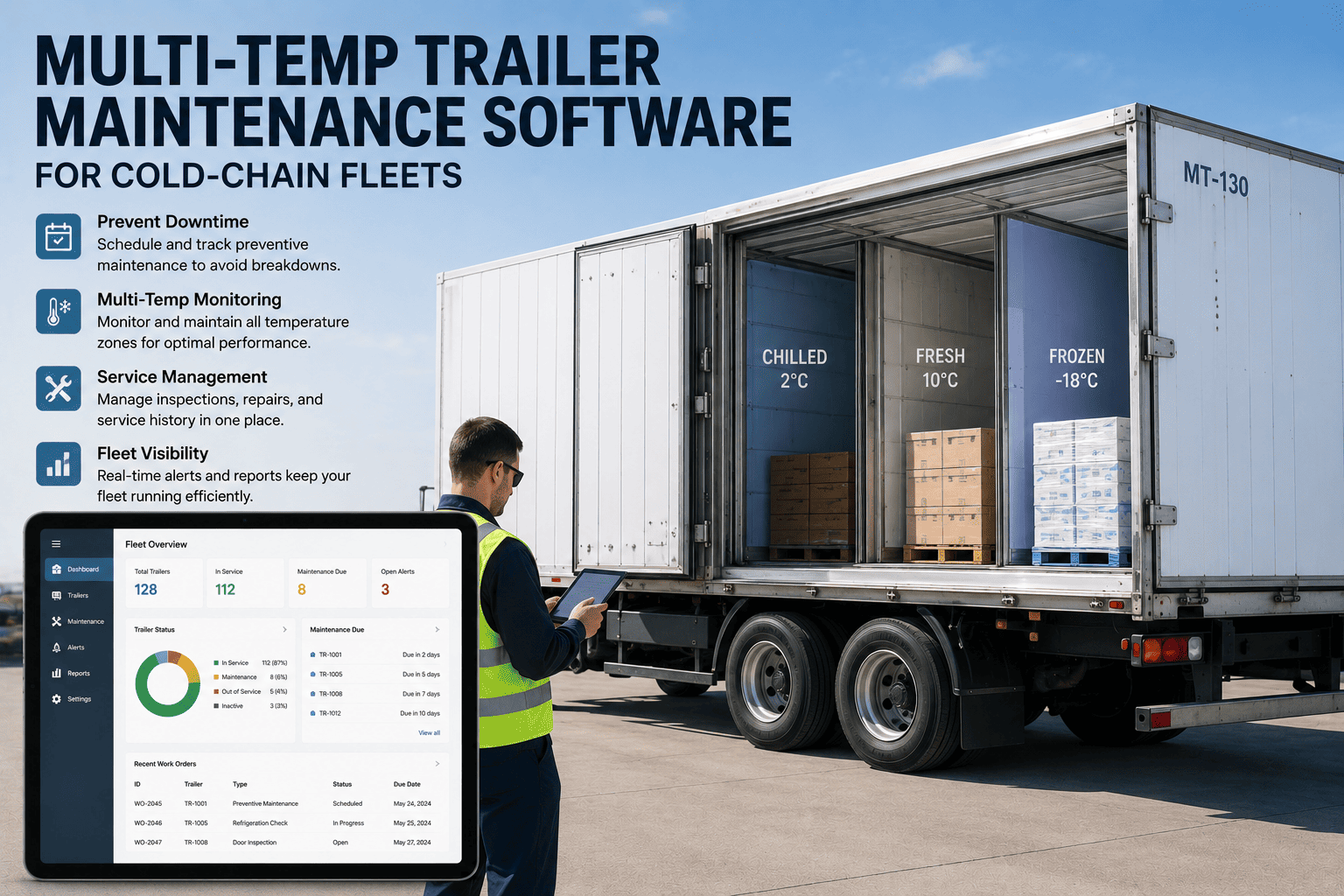
A multi-temp trailer is really three trailers pretending to be one. A single box splits into separate compartments, each held at its own setpoint by shared or dual evaporators, so a distributor can run frozen goods, chilled dairy, and ambient dry goods on one route instead of three. That efficiency is exactly what makes multi-temp trailer maintenance software different from standard reefer PM software. A fixed maintenance calendar built for a single-zone trailer has no way to catch a bulkhead seal letting warm air bleed into the frozen compartment, or a damper stuck feeding too much cold air into a zone that should be running mild. Multi-temp fleets need maintenance software that understands zones, not just units.
Why multi-temp trailers fail in ways single-zone units don't
A single-zone reefer has one job: hold one setpoint. A multi-temp trailer has to hold two or three setpoints at once, using components that are shared across zones, which creates failure points a standard PM checklist was never designed to catch.
Most of these issues develop quietly. A trailer can look perfectly healthy on a walk-around inspection while one compartment is already drifting out of spec, which is why fleets running mixed loads increasingly sign up for zone-level monitoring instead of relying on a single trailer-wide temperature check.
A worn or damaged bulkhead lets warm air migrate between compartments, dragging the frozen zone's temperature up without ever tripping a single-zone alarm.
Dampers direct cold air between zones on demand. A stuck damper can starve one compartment of cooling while over-cooling another, wasting energy and risking both loads.
When one zone calls for deep frozen temperatures while another holds a mild setpoint, the shared compressor works harder and cycles more often, accelerating wear across the whole unit.
Ice buildup on one evaporator can quietly reduce cooling capacity in its zone while the other zone's readings still look normal, masking the problem until a load fails inspection.
What predictive maintenance software needs to track, zone by zone
Watching the trailer's average temperature isn't enough on a multi-temp unit. Every compartment needs its own read on setpoint accuracy, airflow, and equipment condition. Fleets that want to see this running against their own trailers can book a demo and walk through it zone by zone.
- Setpoint accuracy against target, not trailer average
- Evaporator icing and defrost cycle frequency
- Door open events and recovery time after each stop
- Bulkhead differential, comparing this zone against its neighbors
- Damper position and airflow delivery
- Compressor duty cycle attributable to this compartment
- Drift toward either neighboring zone's temperature
- Ventilation and humidity where applicable
- Load-specific setpoint changes between routes
See every zone on your trailers, not just the average
Zone-level temperature, damper, and compressor tracking, built for trailers running frozen, chilled, and ambient loads together.
Nearly a quarter of reefer claims trace back to incorrect temperature settings
On a single-zone trailer, an incorrect setpoint is one mistake. On a multi-temp trailer, it can be three, since a driver or dispatcher has to enter and verify a separate target for every compartment before a load moves. A setpoint meant for the chilled zone entered into the frozen zone's controller, or a setpoint left over from the previous route, can spoil a load without any equipment ever malfunctioning. Multi-temp trailer maintenance software closes that gap by logging and verifying each zone's setpoint against the load assigned to it, so an entry error surfaces immediately instead of showing up as a rejected delivery. Distributors moving mixed loads can sign up to see setpoint verification running against their own routes.
Proof for every zone, not just the trailer as a whole
Food distributors running multi-temp trailers face a compliance question a single-zone carrier doesn't: proving that each compartment, not just the trailer overall, held its required range for the entire trip. A single temperature log for the whole trailer doesn't answer that question, and reconstructing zone-specific history after the fact from separate paper logs is slow and error-prone during an audit.
Multi-temp trailer maintenance software keeps a continuous, zone-tagged record instead, timestamped and tied to the specific compartment, route, and load. When a receiver or auditor asks whether the frozen zone held spec on a particular delivery, the answer is already documented rather than reconstructed. Distributors preparing for their next FSMA-related review can book a demo to see how zone-level compliance records are generated automatically.
Stop losing loads to a single misread setpoint
Zone-tagged compliance records, setpoint verification, and predictive alerts for every compartment on every trailer.
Multi-temp trailer maintenance software, common questions
What makes multi-temp trailer maintenance different from standard reefer maintenance
A multi-temp trailer holds two or three separate setpoints in one box, using shared or dual evaporators and a bulkhead to separate zones. Maintenance has to account for each zone's own performance rather than treating the trailer as a single unit with one temperature reading.
How many temperature zones can one trailer maintain at once
Most multi-temp trailers run two or three zones, commonly frozen, chilled, and ambient, though the exact configuration depends on the trailer's bulkhead layout and evaporator setup.
What usually causes one zone to drift while the others look fine
A worn bulkhead seal, a stuck damper, or an evaporator icing over in one compartment are the most common causes. Each can affect a single zone without triggering an alarm on the trailer's overall reading.
Does this replace the reefer unit's built-in controller
No. It reads data from the existing controller and zone sensors and adds monitoring, verification, and alerting on top, rather than replacing the equipment that actually runs the refrigeration cycle.
Can it catch a bulkhead or damper problem before a load is affected
Yes. Comparing each zone's performance against its neighbors and its own history surfaces gradual drift, like a bulkhead letting warm air through, days before it turns into a full temperature excursion.
How long does it take to get zone-level monitoring running on our fleet
Most distributors connect their first multi-temp trailers within a day using existing telematics and sensors. You can sign up and connect a trailer directly, or book a demo if you'd rather have someone walk through your specific trailer configuration first.