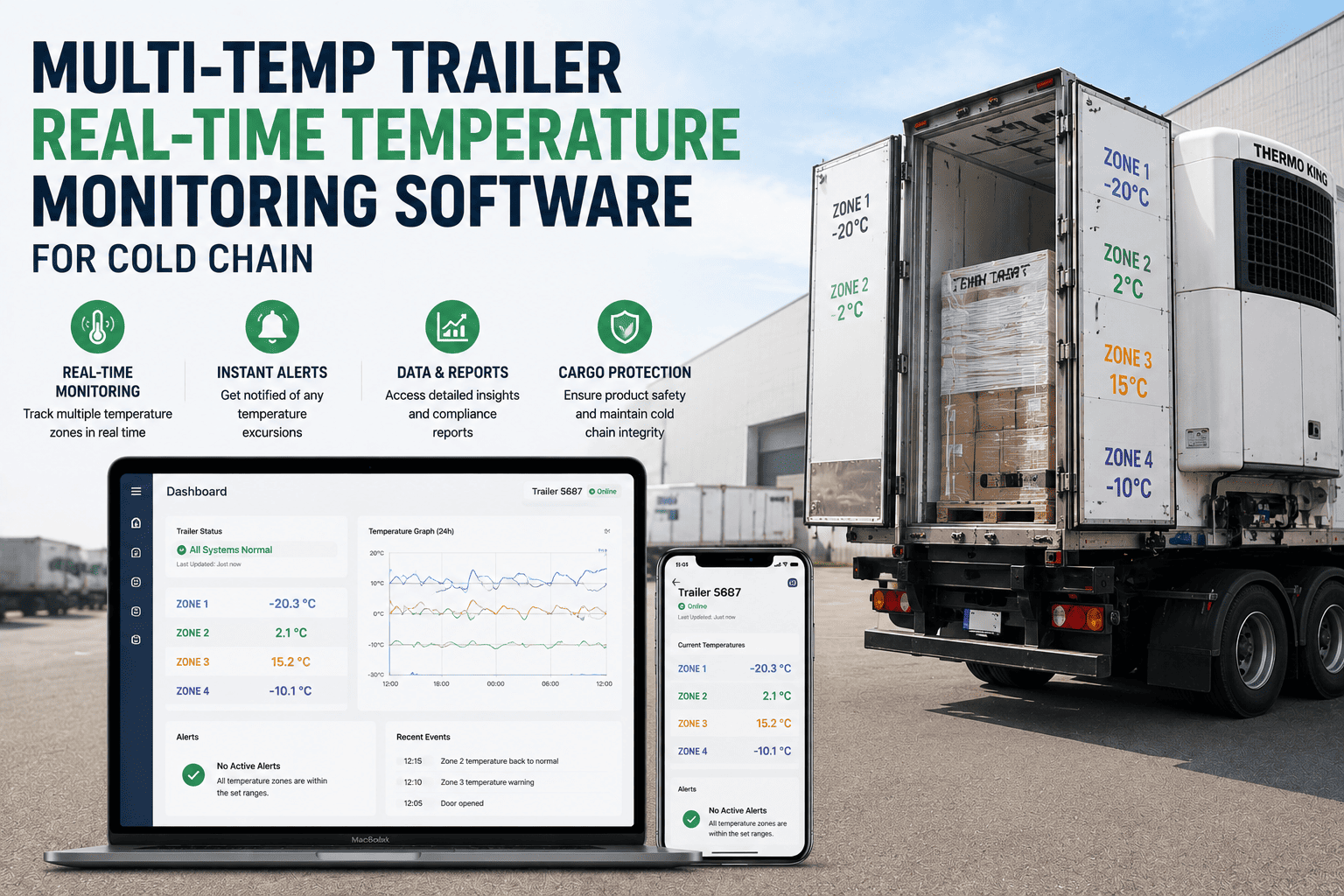
A multi-temp trailer pulls away from a distribution center carrying frozen seafood in the nose compartment and fresh produce in the rear, separated by a single bulkhead. Forty minutes into the route, the rear zone drifts two degrees above setpoint after a longer-than-usual stop with the doors open. The trailer's average reading still looks fine, because the frozen zone is holding rock steady and dragging the number down with it. Nobody catches the produce excursion until the receiving dock does. Multi-temp trailer temperature monitoring software exists because an average is exactly the wrong number to trust on a trailer carrying more than one product at more than one temperature.
The problem with reading a multi-temp trailer as one number
A 53-foot trailer split into two or three compartments by internal bulkheads isn't a single thermal environment — it's several, each with its own setpoint and its own risk. A monitoring system that reports one temperature for the whole trailer is, at best, an average of every zone, which means a serious excursion in a secondary compartment can hide behind a healthy reading in the primary one. That's not a hardware limitation anymore; it's a software problem, and it's solved by treating each compartment as its own asset with its own threshold, not by hoping one sensor near the reefer unit tells the whole story. Distributors running multi-compartment trailers without zone-level alerts can sign up to see what independent compartment monitoring actually catches.
Nose zone — Frozen
Setpoint -18°C
Holding steady
Rear zone — Chilled
Setpoint 2-4°C
Drifted after door event
That diagram is the exact scenario a single-sensor system misses. Two zones, two setpoints, two very different risk profiles — and only one of them was actually a problem on that route. Independent per-zone alert thresholds mean a breach in the rear compartment triggers its own alert regardless of what the front compartment is reading, so a dispatcher sees the real picture instead of a misleading average. Fleet managers who want to see a live multi-zone view against their own trailer configuration can book a demo and walk through it stop by stop.
Where sensors actually need to sit
A single probe mounted near the reefer unit measures the air closest to the evaporator — not the air 40 feet away at the doors, where every stop lets ambient heat in. A trailer isn't a uniform box: the nose zone routinely runs colder than the door zone, and product stacked densely can create airflow shadows that a single sensor never sees. Getting an accurate read means placing sensors at the points that actually vary.
Nose
Closest to the evaporator, typically the coldest and most stable point
Mid-point
Where airflow stratification and product stacking start to matter
Door zone
Absorbs ambient heat every time the trailer opens, loads, or stages at a dock
Per compartment
Each bulkhead-separated zone gets its own sensor and its own threshold, never shared
Reading intervals that actually catch a problem in time
A sensor is only as useful as how often it reports. A reading every thirty minutes might catch a slow drift, but it will miss a door left ajar for twelve minutes at a stop, which is exactly the kind of fast, preventable excursion that adds up across a route. Real-time monitoring means readings every one to five minutes, with alert delivery inside the same short window, so a dispatcher can act while the driver is still at that stop instead of finding out after the trailer is back on the highway.
Stop letting one average hide a real excursion
Independent per-zone monitoring, real-time alerts, and FSMA-ready records for every compartment on every multi-temp trailer.
Door events are the excursion cause that shows up most
Across food fleets tracking excursion causes, one pattern comes up more than any other: frequent door-open events at each stop, not a failing compressor, are the primary driver of temperature excursions. That makes door event monitoring, correlated directly against the temperature impact it causes, one of the most valuable signals a multi-temp platform can surface — especially on a multi-stop route where the rear compartment gets opened repeatedly while the nose zone stays sealed the whole way. Fleets that have never connected door events to temperature data before can sign up to see that correlation on their own delivery routes.
The same real-time visibility that catches a mid-route excursion also builds the compliance record a food safety audit will ask for. Continuous, zone-specific temperature and door-event logging, with a documented response attached to every deviation, is what separates a fleet that survives an FSMA audit from one that's reconstructing a defense after the fact. Distributors preparing for their next audit cycle can book a demo and see a compliance export generated from a live multi-zone trailer.
1-5 min
typical reading interval for real-time multi-zone temperature monitoring
Under 90 sec
alert delivery time from threshold breach to dispatcher notification
Under 2%
excursion rate achieved by food fleets running independent per-zone monitoring
Frequently asked questions
Why isn't one temperature reading enough for a multi-temp trailer
A single sensor near the reefer unit reflects one point in the trailer, and on a multi-compartment trailer it can effectively average across zones with very different setpoints, which means a breach in a secondary compartment can go completely unnoticed behind a healthy primary reading.
How many sensors does a multi-temp trailer actually need
Coverage typically requires a sensor per compartment at minimum, with additional points at the nose, mid-point, and door zone to capture the airflow stratification and ambient heat that a single trailer-wide reading would miss.
What's the most common cause of temperature excursions in multi-temp trailers
Frequent door-open events at delivery stops are the leading cause, more often than a failing reefer unit, which is why monitoring that correlates door events directly with temperature impact per zone is one of the most useful signals a platform can provide.
How fast do alerts reach dispatch after a threshold is breached
Real-time monitoring platforms typically deliver an alert in under 90 seconds of a breach, fast enough for a dispatcher to reach the driver while the trailer is still at the stop where the excursion started.
Does zone-level monitoring create the records needed for an FSMA audit
Yes. Continuous, zone-specific temperature and door-event logs, combined with a documented response to every deviation, build the written corrective-action record FSMA's Sanitary Transportation Rule requires, exportable as a complete audit package rather than reconstructed from paper logs.
How long does it take to get a multi-temp trailer fleet monitored
Most multi-compartment trailer fleets connect within days, with each compartment's sensors mapped to its own threshold from day one and trailers continuing normal routes throughout setup.