Refrigerated transport fleet directors, perishable logistics superintendents, and cold-chain distribution managers face a continuous operational trade-off on every haul: balancing strict biological temperature compliance against fuel consumption rates and mechanical compressor wear. The primary operational lever governing this balance is selecting between reefer operating profiles—specifically Continuous Run mode and Start-Stop / Cycle-Sentry modes. When drivers manually select the wrong refrigeration setting for sensitive cargo, fresh produce suffers from top-freeze or thermal drift, fuel burn spikes unnecessarily on stable frozen loads, and auxiliary starter motors endure premature mechanical fatigue. Fleet Rabbit delivers an integrated reefer telematics and cold-chain compliance platform that monitors operating mode telemetry in real time, automates compressor preventive maintenance (PM) by actual engine-hour load, and issues instant mobile alerts when setpoints drift outside required regulatory boundaries. Eliminate cargo spoilage risks, cut auxiliary fuel waste, and ensure audit-ready compliance across your refrigerated fleet. Book a Demo to see our real-time reefer telematics platform in action.
Reefer Operating Mode Engineering & Fuel Science
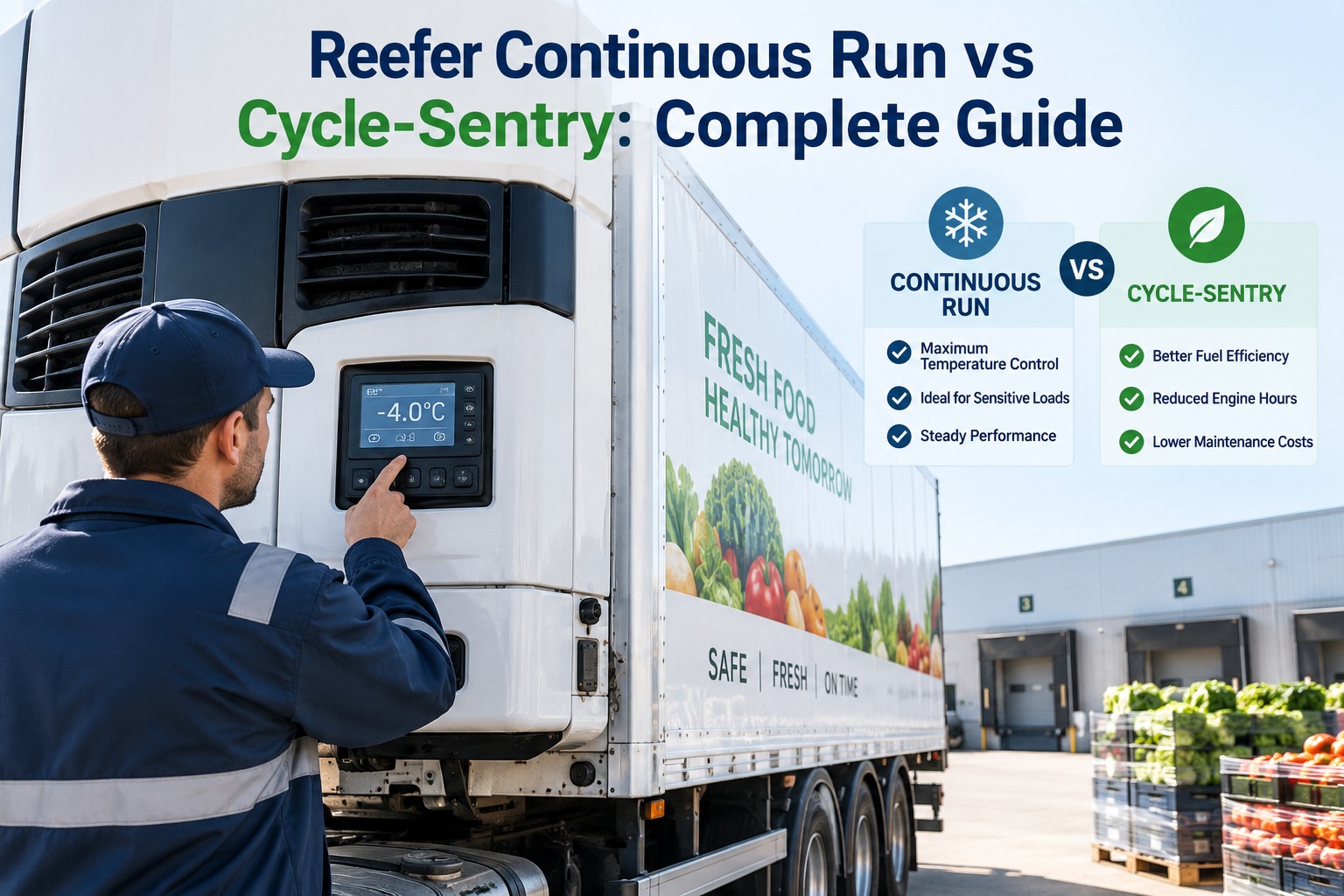
Reefer Continuous Run vs Cycle-Sentry: Complete Guide
An exhaustive operational evaluation for food and beverage carriers: compare the thermodynamic mechanics, airflow patterns, fuel burn curves, and maintenance duty cycles of Continuous Run versus Cycle-Sentry (Start-Stop) modes to maximize payload safety and fleet profitability.
Thermodynamic Airflow
Starter & Battery Duty Cycles
Automated Fuel Optimization
35% – 50%
Fuel Reduction in Cycle-Sentry
Massive auxiliary fuel savings achieved on stable, pre-frozen freight loads.
± 0.5°F
Continuous Run Stability
Constant evaporator circulation prevents hot spots and cold-air layering.
$5
Per Reefer Unit / Month
Unified reefer mode monitoring, PM engine, and mobile driver tools.
Take Control of Reefer Operating Modes Across Your Entire Fleet
Detect improper mode selections in real time, prevent driver error on fresh perishable routes, and automate diesel compressor engine-hour maintenance.
Thermodynamic Breakdown: Continuous Run vs. Cycle-Sentry Mechanics
Understanding the fundamental mechanical and thermal differences between these two modes ensures dispatchers and drivers select the exact operational profile required by the cargo manifest. Sign up to configure automated cargo profile rules.
Mode Profile 01
Continuous Run Mode
Constant Airflow & Modulated Temperature
In Continuous Run mode, the reefer’s diesel engine and evaporator fans run non-stop once engaged. When the compartment reaches its target setpoint, the microprocessor throttles down engine rpm to low-speed and switches cooling capacity from active refrigeration to heat or bypass mode, continually circulating air throughout the trailer.
Air Circulation: Continuous 100% airflow eliminates temperature stratification, stagnant pockets, and top-layer freezing.
Temperature Variance: Extremely tight tolerance (±0.5°F to ±1.0°F across the entire box length).
Best For: Fresh produce, pharmaceuticals, unfrozen meat, floral, and multi-drop delivery routes with frequent door openings.
Mode Profile 02
Cycle-Sentry (Start-Stop) Mode
Thermostatic Cycling & Maximum Fuel Economy
In Cycle-Sentry (Thermo King) or Start-Stop (Carrier Transicold) mode, the refrigeration unit completely shuts down its diesel engine when the box reaches setpoint. It monitors battery voltage, engine temperature, and internal compartment probes, restarting only when temperature drifts outside a pre-set differential band.
Air Circulation: Intermittent. Fans completely turn off when the engine stops, allowing air inside the trailer to settle.
Temperature Variance: Broader deadband (±3.0°F to ±5.0°F between restart cycles).
Best For: Deep frozen seafood, ice cream, packaged frozen poultry, and long-haul non-respiring freight.
Side-by-Side Comparison: Operating Metrics, Fuel, & Maintenance
Evaluate the direct operational and economic trade-offs between Continuous Run and Cycle-Sentry settings across your refrigerated fleet. Book a demo to evaluate your fleet's fuel-saving potential.
| Evaluation Metric |
Continuous Run Mode |
Cycle-Sentry / Start-Stop Mode |
Operational Impact |
| Fuel Consumption Rate |
0.7 – 1.2 gal / hour (continuous burn) |
0.3 – 0.6 gal / hour (intermittent) |
Cycle-Sentry delivers up to 50% fuel reduction on stable loads. |
| Thermal Airflow Profile |
Constant air movement & static pressure |
Intermittent; dead air when engine is off |
Continuous air prevents heat buildup in respiring produce. |
| Top-Freeze Risk for Produce |
Zero; balanced return air mixture |
High risk near discharge chute |
Cycle restart blasts sub-freezing air onto top pallets. |
| Starter & Battery Wear |
Minimal; single ignition per route |
High; 20–60 starts per shift |
Cycle-Sentry accelerates starter and battery degradation. |
| Compressor Mechanical Hours |
Higher accumulated engine hours |
Significantly lower running hours |
Cycle-Sentry extends oil change intervals by calendar time. |
| Door Opening Temperature Recovery |
Instant; fans continue circulating |
Delayed; engine ignition required |
Continuous Run recovers setpoints twice as fast during urban drops. |
When to Use Which Mode: Cargo-Specific Operating Guidelines
Selecting the wrong operating mode is one of the most common causes of preventable cargo rejection at grocery and wholesale receiving docks. Sign up to automate driver reefer checklist prompts.
Mandatory Continuous Run
Fresh Leafy Greens, Berries, & Produce
Fresh agricultural produce continues to respire after harvest, generating internal metabolic heat. If the reefer stops, heat pockets accumulate in the center pallets. Continuous Run distributes air evenly and prevents the blast of sub-freezing discharge air that causes necrotic top-freeze damage.
Mandatory Continuous Run
Fresh Fluid Dairy, Milk, & Chilled Meats
Fluid milk and fresh poultry must be held strictly between 34°F and 38°F. The wider deadband of Cycle-Sentry allows surface temperatures to exceed 40°F during long off-cycles, violating USDA Food Safety and Inspection Service bacterial thresholds.
Book a demo to inspect our dairy thermal rules.
Optimal Cycle-Sentry
Hard Frozen Seafood, Poultry, & Meats
Pre-frozen solid cargo acts as a thermal thermal ballast. With a setpoint of 0°F or below, temperature rise during off-cycles is extremely slow in an insulated trailer. Cycle-Sentry saves hundreds of gallons of diesel fuel without any risk of product softening.
Optimal Cycle-Sentry
Pre-Cooled Ice Cream & Deep Freeze (-20°F)
When cargo is thoroughly deep-frozen prior to loading, Cycle-Sentry maintains sub-zero integrity efficiently on long highway transit legs, cycling on only when temperature climbs near -10°F to re-establish the deep-freeze barrier.
Maintenance Impacts: How Mode Selection Changes Shop Schedules
Fleet maintenance directors cannot maintain reefer units with a one-size-fits-all schedule. Operating mode directly alters component wear patterns. Sign up to automate runtime maintenance schedules.
Continuous Run Wear Patterns
High Engine Runtime & Thermal Balance
Continuous operation accumulates diesel engine hours quickly, requiring frequent oil and filter changes based on running meters. However, steady operation reduces thermal shock on internal engine components, maintains alternator battery charging, and causes zero wear on starter assemblies.
Cycle-Sentry Wear Patterns
Starter Fatigue & Battery Deep-Cycling
While Cycle-Sentry lowers total engine hours, it subjects starter solenoids, flywheels, glow plugs, and 12V batteries to continuous on/off thermal cycling. Fleets running heavy Cycle-Sentry operations experience a 3x higher incidence of dead batteries and starter burnouts in cold weather.
How Fleet Rabbit Enforces Correct Reefer Modes Automatically
Relying on driver memory to switch between Continuous and Cycle-Sentry modes introduces human error. Fleet Rabbit automates reefer mode governance through connected IoT telematics. Book a demo to see our remote reefer control features.
01
Manifest-Driven Mode Verification
When an order containing fresh produce or dairy is assigned to a vehicle, Fleet Rabbit cross-references the reefer microprocessor. If the unit is mistakenly set to Cycle-Sentry, dispatch receives an immediate alert before departure.
02
Sub-Second Microclimate Alarms
Wireless temperature sensors monitor discharge air and return air streams. If discharge temperatures plunge toward freezing on a produce route, the platform alerts the driver to prevent cold-air burn.
Sign up to enable instant microclimate alarms.
03
Engine-Hour Decoupled Maintenance PM
Track diesel compressor running hours and start-cycle counts independently of truck odometer miles, auto-generating preventive maintenance work orders for starters and batteries before roadside failures occur.
04
One-Click FSMA Compliance Reports
Export verified time-temperature graphs indicating operational mode, return air readings, and pre-cooling completion directly to grocery receivers, eliminating disputed cargo rejection claims in seconds.
Operational Case Study: Great Lakes Cold Transport
Learn how a multi-temp food distributor eliminated produce top-freeze claims while slashing auxiliary reefer diesel fuel costs across 32 refrigerated trailers. Sign up to achieve similar fuel and cargo results.
Reefer Case Study
0
Produce Top-Freeze Claims
$52,000
Annual Reefer Fuel Savings
100%
Mode Compliance Verification
Fleet Cuts Reefer Fuel Burn by 38% on Frozen Freight While Protecting Fresh Berries
Operating 32 refrigerated trailers carrying a combination of fresh seasonal fruit and frozen bakery products, Great Lakes Cold Transport struggled with dual headaches: drivers frequently ran Cycle-Sentry mode on berry loads (resulting in $34,000 in top-freeze leaf damage claims), while others left frozen loads on Continuous Run, burning thousands of unnecessary gallons of diesel.
By deploying Fleet Rabbit, the company instituted automated reefer mode monitoring tied to load manifests. Fresh berry routes were automatically verified on Continuous Run with sub-minute discharge air alerts, while frozen routes were locked into Cycle-Sentry. Reefer fuel consumption on frozen lanes dropped by 38%, top-freeze claims were eliminated completely, and driver inspection compliance reached 100%.
Frequently Asked Questions
What causes fresh produce to suffer top-freeze damage in Cycle-Sentry mode?
In Cycle-Sentry mode, the reefer unit shuts off when setpoint is met, allowing air to settle. As top pallet layers slowly warm under roof heat, the unit senses the temperature rise and restarts with full refrigeration capacity. The resulting burst of sub-freezing air directly strikes the top cartons before recirculating air has a chance to blend, freezing sensitive leaf tissues.
Can Cycle-Sentry mode run down the reefer’s 12V battery during long off-cycles?
Modern reefer microprocessors monitor 12V battery voltage and will automatically restart the diesel engine to recharge the battery even if the temperature setpoint does not require cooling. However, frequent restarts combined with weak battery cells or faulty alternators can still lead to a dead battery, especially during winter operations.
How much diesel fuel can a fleet realistically save by using Cycle-Sentry on frozen cargo?
Depending on outside ambient temperatures, trailer insulation quality, and door-opening frequency, Cycle-Sentry can reduce auxiliary reefer diesel fuel consumption by 35% to 50% compared to Continuous Run, saving between 0.4 and 0.7 gallons of diesel per hour of operational transit.
Can drivers toggle between modes while the reefer engine is running?
Yes, modern Carrier Transicold and Thermo King controllers allow mode switching while operating. However, standard operating procedures should require drivers to verify mode changes through mobile DVIR checklists so dispatch and quality assurance teams receive immediate digital verification.
What are the pricing details and contract terms for Fleet Rabbit’s reefer software?
Fleet Rabbit is priced at a transparent rate of $5 per refrigerated asset per month billed annually. This gives complete access to reefer telemetry, automated mode monitoring, engine-hour PM scheduling, mobile driver DVIR tools, and FDA FSMA audit exports. We provide a 14-day free trial on up to 3 vehicles with zero setup fees or long-term contracts.
Ready to Optimize Your Reefer Operating Modes and Fuel Consumption?
Automate reefer mode monitoring, protect delicate produce from top-freeze damage, and cut auxiliary fuel costs for just $5/asset/month.
September 19, 2026
By Mark
All Posts