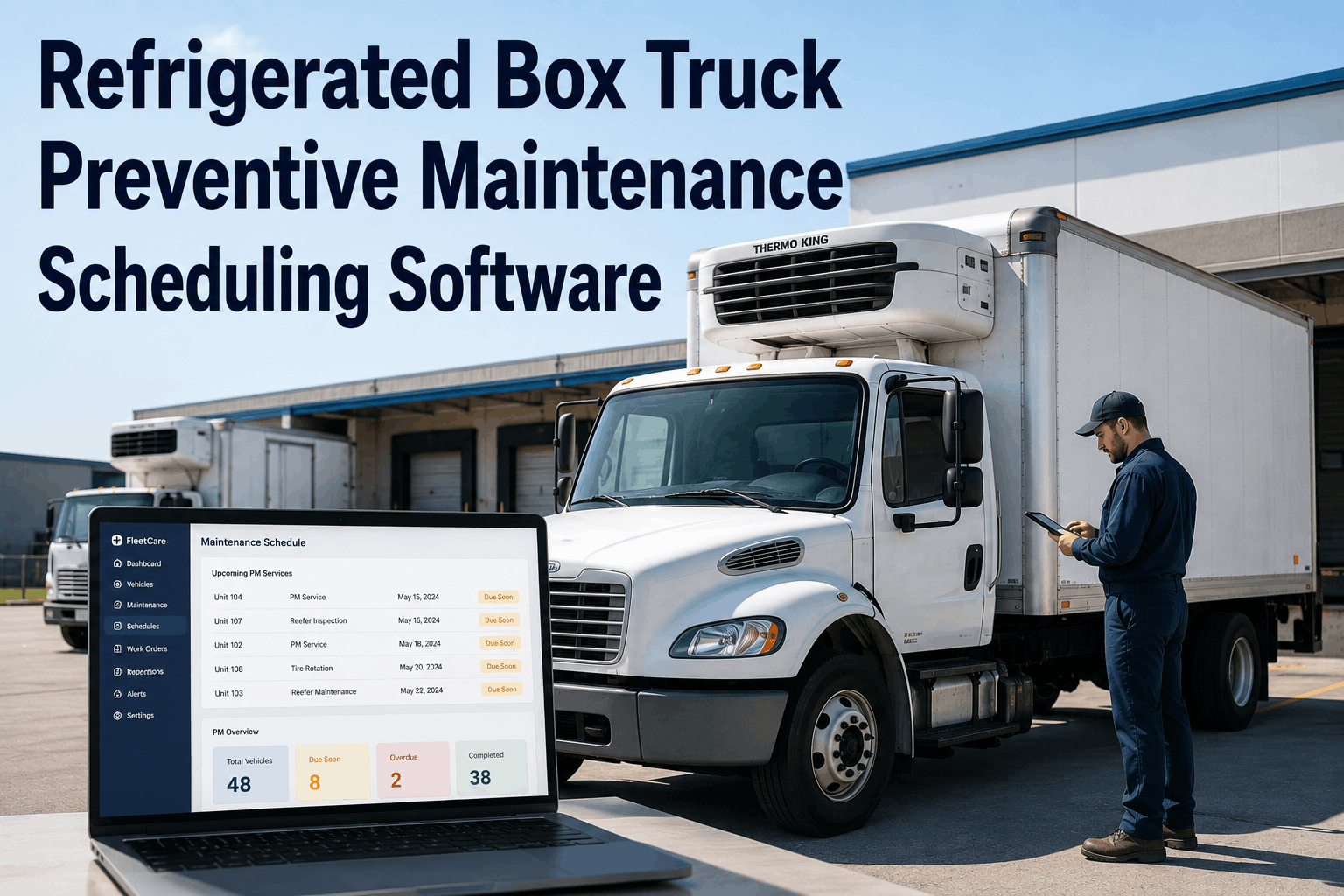
Most refrigerated fleets are not failing because nobody is watching the reefer. They are failing because three different things are supposed to trigger a PM — mileage, engine hours, and the calendar — and none of them are talking to each other. A unit sits two weeks past its hour threshold because the shop was tracking the tractor's odometer instead. FleetRabbit's refrigerated box truck preventive maintenance software exists to close that exact gap, turning mileage, engine hours, and seasonal checkpoints into one scheduling system instead of three separate guesses.
FSMA Rule 204 turned real-time traceability from a nice-to-have into a requirement, and distributor contracts increasingly carry financial penalty clauses on top of the lost product value for a late or rejected cold chain delivery. Once a load crosses out of its safe temperature band for too long, the entire shipment is typically considered compromised, regardless of how briefly the breach lasted. Distributors that sign up for FleetRabbit stop treating PM scheduling as a shop-floor afterthought and start treating it as the thing standing between them and a contract penalty.
Three triggers, one work order
A reefer PM schedule only works if every input that should open a work order actually does
Engine hours
The reefer unit's own operating hours, tracked independently of the tractor, driving oil, filter, and belt intervals
Calendar checkpoints
Fixed-date items that do not care how many hours a unit has logged, like refrigerant certification and winter battery checks
Condition signals
Live data such as compressor cycling frequency and setpoint recovery time, flagging drift before it hits a fixed interval
Converge into
On a spreadsheet, these three inputs live in different tabs, checked by different people, on different days. Fleets that book a demo usually see the gap between the three the moment FleetRabbit lines them up side by side.
Reactive, preventive, and what actually changes
Traditional reactive maintenance fixes the reefer after it fails. A structured PM schedule is the difference between planned downtime and a roadside call
Reactive
Repairs happen after a driver reports a temperature drift or the unit stops cooling entirely
Roadside labor rates and rush parts sourcing carry a premium over scheduled service
Failures repeat, often multiple times per vehicle, per year, without a pattern anyone tracks
Scheduled with FleetRabbit
Work orders open automatically as engine hours, calendar dates, or condition signals cross their threshold
Service happens in the shop, on a planned date, not on the shoulder of a highway
Every completed PM builds a compliance record tied to the vehicle, ready for an FSMA audit
Fleets running IoT-connected predictive monitoring alongside a structured PM schedule commonly see 40 to 60% fewer roadside breakdowns, with payback periods often landing inside twelve months. Distributors that sign up tend to see the shift in their first full PM cycle, not their first year.
Line up mileage, engine hours, and calendar PM on one schedule
Fifteen minutes with your own fleet's data, not a canned demo script.
What a developing failure looks like before it happens
Most fixed-interval schedules miss these because they are time-based, not condition-based
Compressor cycling more often than normal
An early sign of refrigerant loss or a struggling component, well before the unit stops holding setpoint entirely
Slower setpoint recovery
A unit that used to reach temperature in minutes and now takes longer is telling you something before it fails outright
Door seal letting in ambient air
A gasket that is slightly worn forces the compressor to work harder on every cycle, long before it looks like a problem
Oil and fluid condition drift
Wear metals or moisture contamination in a compressor oil sample can flag bearing deterioration between scheduled services
Machine learning models trained on commercial refrigeration data can now surface risk 20 to 45 days before traditional diagnostics raise an alarm. When fleets sign up, FleetRabbit turns these signals into a scheduled work order instead of a surprise.
For food distributors specifically
A missed PM is not just a mechanical risk, it is a contract risk
Retailer and distributor contracts increasingly tie payment terms to on-time, in-spec delivery, which means a reefer failure does not just cost the price of the repair and the spoiled load. It can trigger a penalty clause that was written into the contract long before anyone thought about which truck would miss its PM. FleetRabbit ties every scheduled service, every temperature reading, and every corrective action to the specific vehicle and shipment, so the chain of evidence a distributor needs already exists the moment a customer asks for it.
Staggering PM across the fleet keeps this manageable at scale. Rather than servicing every unit on the same week, FleetRabbit spreads scheduled maintenance so no more than a small share of the fleet is out of service at once, while still keeping every reefer current on its own hour and calendar thresholds. Distributors that book a demo often ask to see this exact staggering logic first, since it is what keeps deliveries moving during PM season.
Turn mileage, hours, and condition data into one PM schedule
Free trial for your maintenance team, or a live walkthrough with your own fleet data.
Common questions
What triggers should a reefer PM schedule actually track
Three inputs matter: the reefer unit's own engine hours, fixed calendar checkpoints like refrigerant certification, and condition signals such as compressor cycling frequency. A schedule that only tracks one of these will miss the other two.
Is predictive maintenance worth it for a mid-size cold chain fleet
Most operators run a hybrid model rather than an all-or-nothing approach, applying predictive monitoring to high-value assets like key reefer units while keeping structured preventive schedules for the rest of the fleet. That hybrid approach is now the industry standard rather than the exception.
How does FSMA Rule 204 affect PM scheduling specifically
Rule 204 expects a complete, continuous chain of evidence tying temperature data to the specific shipment, vehicle, and any corrective action taken. That means PM records cannot live separately from temperature logs, they need to be tied to the same vehicle history.
What early warning signs indicate a reefer needs service before its scheduled PM
Compressor cycling more frequently than normal, a longer setpoint recovery time, a door seal letting in ambient air, and abnormal wear metals in an oil sample are all signals that typically show up weeks before a fixed-interval schedule would catch the same problem.
How does staggering PM across a fleet help a distributor
Spreading scheduled service so only a small share of the fleet is out of service at any given time keeps delivery capacity steady, while every reefer unit still stays current on its own hour and calendar-based thresholds.