Somewhere on a highway right now, a box truck full of dairy, seafood, or vaccines is running on a reefer unit nobody is watching. If the compressor drifts two degrees off set point at 2 a.m., the first person to find out is usually the receiving manager holding a thermometer at the dock, not the fleet manager who could have fixed it hours earlier. That gap between "something went wrong" and "someone finds out" is exactly what refrigerated box truck temperature monitoring software is built to close.
Refrigerated Box Truck Temperature Monitoring Software: Real-Time Visibility for the Cold Chain
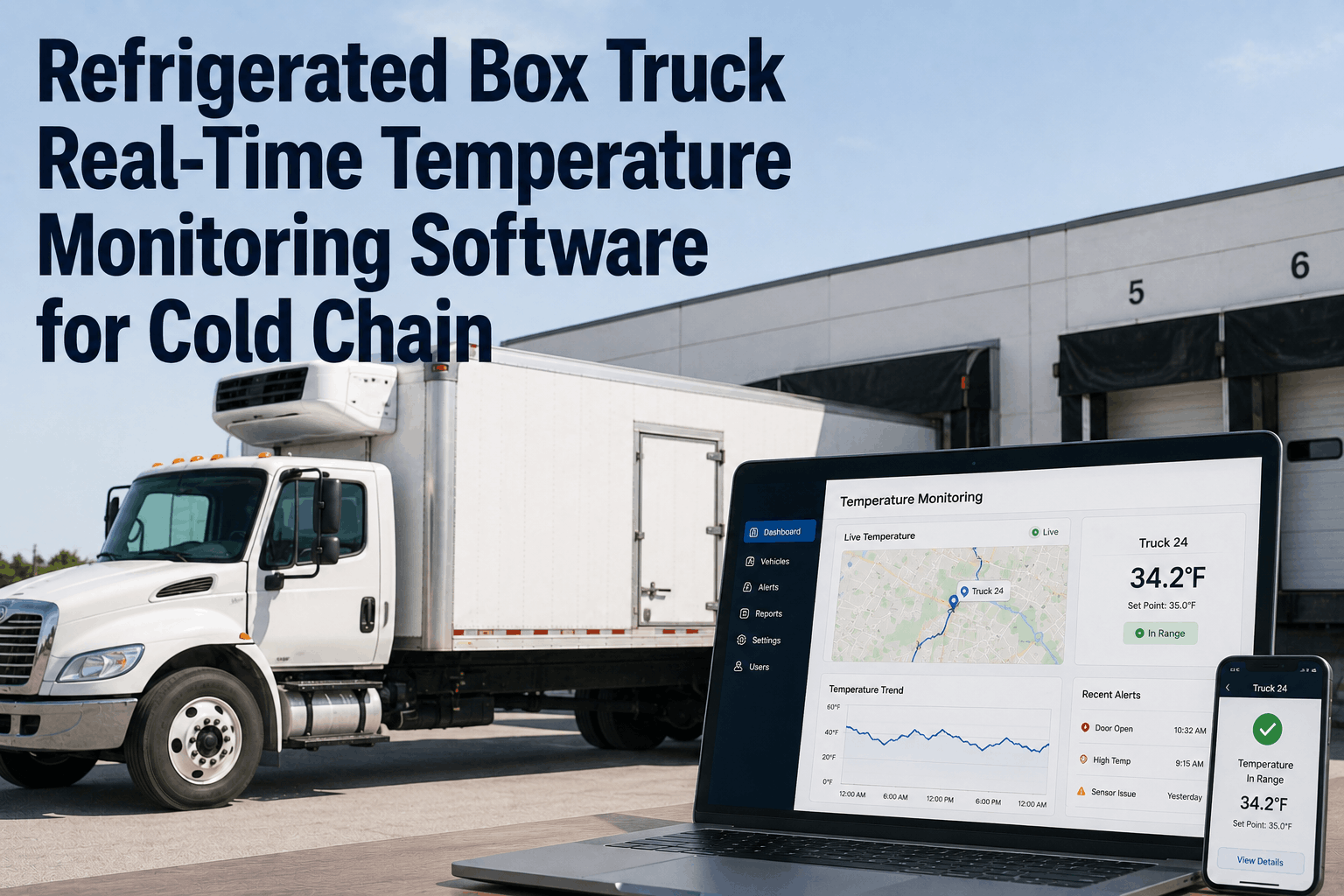
Refrigerated box trucks are not one uniform cold box on wheels. The nose zone near the evaporator runs colder, the door zone absorbs heat every time a driver makes a stop, and the middle zone drifts depending on how tightly the load is packed. A single sensor bolted near the reefer unit tells you what the air is doing at the front of the box. It tells you nothing about the pallet sitting closest to the doors, which is usually the first thing to spoil and the last thing anyone checks. Real-time temperature monitoring software fixes that blind spot by turning a sealed, unwatched cargo box into a fleet manager's dashboard, updated continuously, from pickup to final delivery.
For fleets hauling perishable food, dairy, seafood, frozen goods, or temperature-sensitive pharmaceuticals, this is no longer an optional upgrade. Regulators, insurers, and shippers increasingly expect digital, timestamped proof that a cold chain was never broken, and a driver's memory or a paper log at the loading dock cannot produce that proof on demand.
Why Fleets Are Moving Away from Manual Checks
Manual reefer checks rely on a driver remembering to glance at a dial during a delivery run, which means most excursions are discovered only after the damage is done. Fleets that switch to continuous, sensor-based monitoring consistently report the same pattern: fewer surprises, fewer disputes, and fewer rejected loads.
If your fleet is still reconciling paper logs against delivery disputes, it is worth taking ten minutes to sign up and see what continuous monitoring looks like on your own routes.
How Refrigerated Box Truck Temperature Monitoring Software Works
The mechanics are straightforward once you break them into stages. Sensors capture the environment, connectivity carries the data off the truck, software turns raw readings into decisions, and alerts put the right information in front of the right person before a load is lost.
Multi-point sensing
Wireless temperature and humidity sensors placed at the nose, mid-box, and door zones capture what is actually happening throughout the cargo area, not just near the reefer unit.
Door and power tracking
Door sensors log exactly how long the box stayed open at every stop, while reefer power and fuel status reveal whether the unit is actually maintaining set point.
Continuous transmission
Cellular and Bluetooth connectivity streams readings to a central dashboard at short, configurable intervals, so data keeps flowing even during long stretches between stops.
Alerts and action
When a reading drifts outside a configured threshold, the platform pushes an alert to dispatch and the driver immediately, turning a slow discovery into a fast correction.
See Your Reefer Fleet in Real Time
Stop finding out about temperature excursions at the delivery dock. Connect your refrigerated box trucks to a live dashboard and catch problems while there is still time to fix them.
What Good Monitoring Software Actually Delivers
Not every temperature monitoring tool is built for the realities of a multi-stop delivery route. The features below are the ones that separate a system fleets actually trust from one that just produces a spreadsheet of numbers nobody reads.
Live cargo visibility
Temperature, humidity, and location data update continuously, so a fleet manager can check the status of every refrigerated box truck on the road from a single screen.
Configurable alert thresholds
Every cargo type has a different safe range. Setting thresholds per load type means drivers and dispatch get notified only when a reading actually matters, not for every minor fluctuation.
Door-open event logging
Every door opening is timestamped and duration-logged, distinguishing a routine two-minute delivery stop from an unusually long opening that let warm air flood the box.
Predictive reefer diagnostics
Compressor run status, fuel or battery draw, and set-point deviation are analyzed over time to flag a failing reefer unit before it causes a full cooling breakdown mid-route.
Audit-ready compliance records
Every reading is stored, timestamped, and exportable, producing the kind of documentation that regulatory and food-safety audits actually require, without a manual spreadsheet.
Historical trend analysis
Graphs and heatmaps of past routes make it easy to spot recurring problem lanes, chronically underperforming units, or drivers who need retraining on cold chain handling.
Most fleets only discover which of these features they actually need after a load has already been rejected. It is faster, and cheaper, to book a demo and walk through the platform before that happens.
Manual Checks vs. Real-Time Monitoring Software
The difference between the old approach and the current standard comes down to when a problem is discovered, and who discovers it.
Built for Every Kind of Temperature-Sensitive Load
Cold chain requirements are not identical across cargo types, and a monitoring platform should flex to match what is actually in the box.
Fresh Produce & Dairy
Narrow safe ranges and short shelf life mean even brief excursions can turn a full pallet into a write-off.
Frozen & Seafood
Consistent sub-zero holding is critical, and thaw-refreeze cycles are one of the fastest ways to lose product quality.
Pharmaceuticals & Vaccines
Tight tolerances and strict documentation requirements make audit-ready logging a non-negotiable feature, not a nice-to-have.
Prepared & Packaged Foods
Multi-stop delivery routes with frequent door openings demand door-event logging that separates real risk from routine handling.
Whatever moves through your refrigerated box trucks, the right setup starts with understanding your specific routes and load types, which is exactly what a walkthrough covers when you book a demo.
What Happens When You Don't Have Real-Time Visibility
Without continuous monitoring, a fleet is effectively operating on trust. A reefer unit can run a slow compressor fault for hours with no outward sign, right up until a receiving team opens the doors and either smells trouble or clocks an out-of-range reading. At that point, the load is often already compromised, the delivery is rejected, and the dispute over who is responsible for the loss begins. None of that is necessary when a platform is already tracking temperature, door events, and reefer health continuously and pushing an alert the moment something drifts. Fleets that sign up for this kind of visibility typically describe the shift in the same way: fewer emergency phone calls, fewer arguments with customers, and a lot more confidence in what is actually happening inside every truck on the road.
Ready to Stop Guessing What's Happening Inside Your Trucks
Connect your refrigerated fleet to a single dashboard for live temperature, door, and reefer health data, and get audit-ready records without lifting a spreadsheet.
Frequently Asked Questions
What is refrigerated box truck temperature monitoring software
It is a platform that connects wireless sensors inside a refrigerated box truck to a central dashboard, giving fleet managers continuous visibility into cargo temperature, humidity, door activity, and reefer unit performance throughout a delivery route, instead of relying on a driver's manual check at each stop.
How many sensors does a single box truck actually need
Most cold chain experts recommend placing sensors at multiple points, typically the nose near the evaporator, the middle of the box, and the door zone, because temperature is rarely uniform across a 20 to 26 foot cargo area. A single sensor near the reefer unit misses what is happening at the doors, which is usually where problems start.
Does this kind of software help with regulatory compliance
Yes. Continuous monitoring platforms automatically log timestamped readings at regular intervals and store them in an exportable format, which is exactly what food safety and pharmaceutical compliance frameworks require. That removes the manual reconciliation work that paper logs and spreadsheet tracking usually create.
Can the software predict a reefer breakdown before it happens
Modern platforms analyze compressor run time, fuel or battery draw, and set-point deviation over time to flag equipment that is trending toward failure, giving fleet managers a chance to schedule maintenance before a unit fails mid-route and puts an entire load at risk.
Will drivers need to change how they operate
Very little changes for drivers day to day. Sensors work in the background and alerts are pushed automatically, so the main difference drivers notice is getting a notification if a door was left open too long or a reading drifted, giving them a chance to correct the issue immediately rather than finding out at the next stop.
How long does it take to get a refrigerated fleet connected
Setup is largely a matter of installing wireless sensors in each truck and pairing them with the fleet dashboard, which most operators complete without disrupting active routes. The fastest way to get an accurate timeline for your own fleet size and truck configuration is to book a demo and walk through it directly.