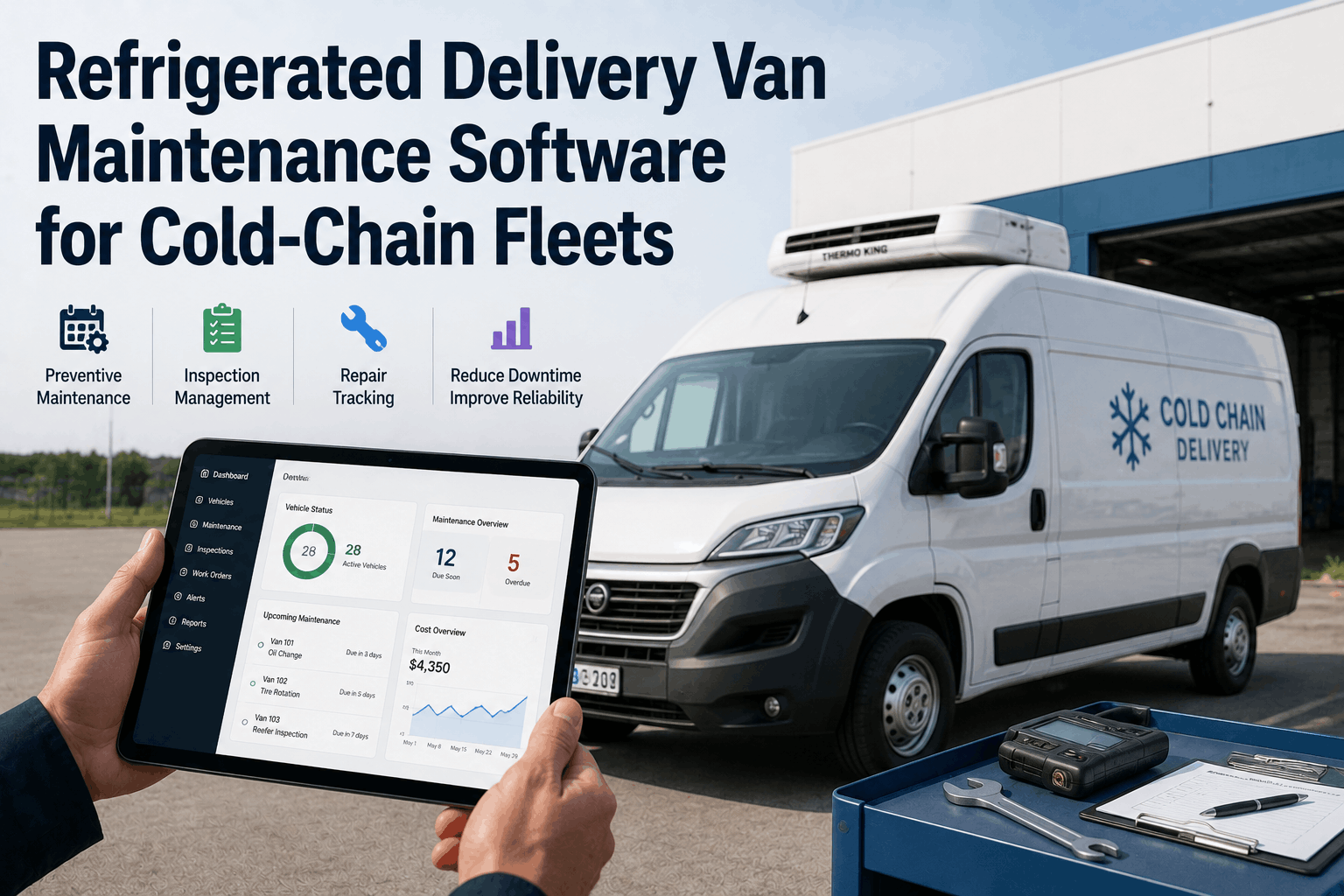
A refrigerated delivery van rarely fails on the highway. It fails at stop twelve of thirty, with the back doors opening and closing every few minutes, the compressor cycling harder than it ever would on a long haul, and no one behind the wheel trained to notice that the reefer unit is starting to lose ground. Refrigerated delivery van maintenance software exists because last-mile cold chain work punishes equipment differently than long-haul trucking does, and the maintenance approach built for a 53-foot trailer doesn't translate to a fleet of vans making thirty stops a day.
Why Delivery Vans Wear Out Their Reefer Units Faster Than You'd Expect
A long-haul reefer trailer typically holds one setpoint for hours at a stretch. A delivery van doing home or foodservice drops opens its doors dozens of times a day, in every kind of weather, often idling at the curb between stops. Every door opening lets warm air in, and every time it closes, the compressor has to work to pull the box back down to temperature. That cycle, repeated all day, puts more real wear on a van's refrigeration unit than the mileage on the odometer would suggest, which is exactly why fleets that manage van maintenance on the same fixed schedule as their trucks tend to get surprised by failures.
Refrigerated delivery van maintenance software tracks what actually causes wear, compressor cycling, door-open frequency, and reefer run hours, rather than treating every vehicle the same because they share a make and model. Distributors and grocery delivery fleets that sign up for this kind of monitoring typically discover within the first few weeks which vans in their fleet are running hotter and harder than the rest, often before a single alarm ever goes off.
A Reefer Maintenance Timeline Built Around Real Usage
Vans doing high-frequency multi-stop routes can rack up reefer run hours far faster than their mileage suggests, which is why hour-based tracking catches service needs that a calendar-based plan misses.
Give Every Van in the Fleet Its Own Maintenance Clock
FleetRabbit tracks each refrigerated delivery van's reefer run hours, door activity, and box temperature independently, so service is scheduled around how hard the vehicle is actually working. Sign up to start tracking your fleet today, or book a demo to see hour-based scheduling applied to a real route.
The Early Warning Signs Most Fleets Miss
Almost every reefer failure on a delivery van traces back to something small that went unaddressed for weeks. A condenser coil collecting road grime loses airflow efficiency gradually, not all at once. A door seal that's starting to compress unevenly lets in a little more warm air on every single stop. A compressor pulling slightly more current than its baseline is compensating for a problem that hasn't announced itself yet. None of these show up on a walk-around inspection, but all of them show up in the data if something is actually watching for them.
This is the core difference between fixed-interval maintenance and condition-based monitoring. Fixed schedules catch problems on a calendar date, whether or not the equipment needs attention yet. Condition-based tracking catches the problem exactly when it starts, which for a delivery van running the same routes every week can mean the difference between a scheduled coil cleaning and a compressor replacement.
Four Signals Worth Watching on Every Refrigerated Van
Compressor current draw
A rising baseline means the unit is working harder to hold the same setpoint, often the earliest sign of trouble.
Door-open duration
Longer or more frequent openings than a route's normal pattern point to a delivery process issue or a failing seal.
Defrost cycle frequency
Cycles running more often than expected usually mean a coil is icing up faster than it should.
Recovery time after stops
A van that takes longer to return to setpoint after each stop is losing cooling capacity somewhere in the system.
Why Compliance Gets Harder to Fake and Easier to Prove
Food and beverage distributors handling FSMA-covered perishables need more than a good-faith belief that the cold chain held. They need a record. A refrigerated delivery van making thirty stops a day generates thirty opportunities for a brief temperature excursion, and a manual log checked at the start and end of a shift will miss almost all of them. Refrigerated delivery van maintenance software that logs temperature continuously turns that blind spot into a documented, time-stamped history that's ready the moment an auditor or a customer asks for it.
That same record works in the fleet's favor commercially. When a customer claims a delivery arrived warm, a continuous temperature log either confirms the claim or settles it in the fleet's favor immediately, instead of turning into a dispute with no evidence on either side. Distributors who want that protection in place before their next audit can book a demo and see exactly what a compliance-ready report looks like.
Manual Logs vs. Automated Van Maintenance Tracking
Manual, Calendar-Based
- Temperature checked a few times per shift, not continuously
- Service scheduled by date, regardless of actual reefer run hours
- Door seal and coil issues found during a breakdown, not before
- Compliance records reconstructed by hand after the fact
Automated, Condition-Based
- Temperature logged continuously across every stop on the route
- Service triggered by real reefer engine hours, per vehicle
- Early warning signals flagged before a component fails
- Compliance reports generated automatically, ready on demand
Rolling It Out Across a Mixed Van Fleet
Most delivery fleets aren't running identical vehicles. A mix of ages, refrigeration unit brands, and route types is normal, and it's exactly why per-vehicle, hour-based tracking matters more for vans than it does for a uniform trailer fleet. Onboarding typically starts with connecting each van's reefer telematics, letting the platform learn a couple of weeks of normal behavior per route, and then turning on excursion alerts and maintenance scheduling once those baselines are set. If you're weighing whether this fits a mixed fleet, the clearest way to find out is to sign up and connect a few vans, or book a demo and walk through it with your own route data.
Stop Guessing Which Van Will Fail Next
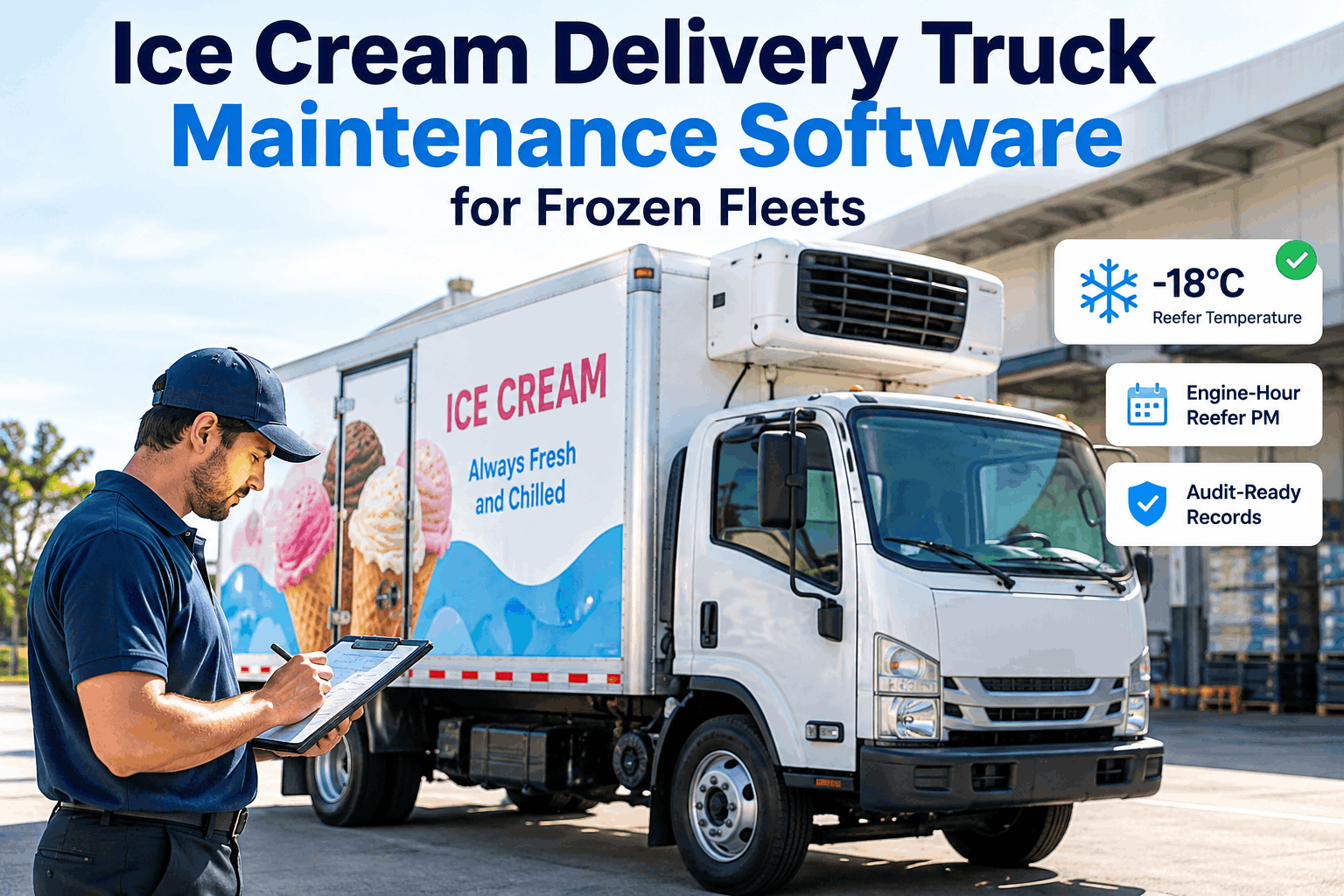
Real-time temperature monitoring, engine-hour reefer PM, and audit-ready compliance logging, built for the way delivery vans actually run. Get your fleet connected today.
Frequently Asked Questions
What is refrigerated delivery van maintenance software?
It's a fleet platform that monitors each van's reefer unit performance, box temperature, and engine hours continuously, then schedules preventive maintenance and flags temperature excursions based on real usage instead of a fixed calendar.
Why do delivery vans need different maintenance tracking than long-haul trucks?
Delivery vans open their doors far more often per route and idle between stops, which cycles the compressor harder than steady long-haul operation. That means reefer run hours and wear can outpace mileage, so hour-based, per-vehicle tracking catches service needs that a mileage or calendar schedule would miss.
What typically causes a reefer failure on a delivery van?
Most failures trace back to small issues left unaddressed, such as a grime-covered condenser coil, a compressing door seal, or rising compressor current draw. These develop gradually and are detectable in performance data well before the unit actually fails to hold temperature.
How does this support FSMA compliance for perishable deliveries?
Continuous temperature logging across every stop creates a time-stamped record that's ready for an audit or a customer dispute without reconstructing paper logs. For distributors handling FSMA-covered high-risk foods, that record is often the difference between a quick resolution and a drawn-out investigation.
Can this work across a mixed fleet of van ages and reefer brands?
Yes. Because tracking is per-vehicle and based on each unit's own baseline behavior, it accommodates a mixed fleet without requiring every van to be the same age, model, or refrigeration brand.
How long does it take to see results after onboarding?
Most fleets connect their first vans and begin collecting baseline data within days, with excursion alerts and hour-based maintenance scheduling active shortly after. Sign up to connect your first vehicles, or book a demo to see the onboarding process before committing.