A refrigerated truck that breaks down mid-route doesn't just cost you a repair bill—it costs you the load, the customer relationship, and the downstream schedule disruption that ripples across your entire delivery network. Yet most reefer fleets still manage preventive maintenance the same way they managed it fifteen years ago: a paper binder in the shop, a whiteboard with oil change reminders, and a dispatcher who relies on driver phone calls to learn that the reefer unit has been "making a weird noise for a week." The difference between a fleet that runs at 94% uptime and one that averages 76% isn't better trucks—it's a systematic preventive maintenance program tied to real mileage and engine hour triggers, not calendar dates or gut feel. This free refrigerated fleet preventive maintenance template gives you the framework to stop reacting to breakdowns and start preventing them, organized by Thermo King and Carrier service intervals, tractor PM milestones, and the compliance documentation your auditors expect. Start your free FleetRabbit trial or book a demo to see digital PM scheduling in action.
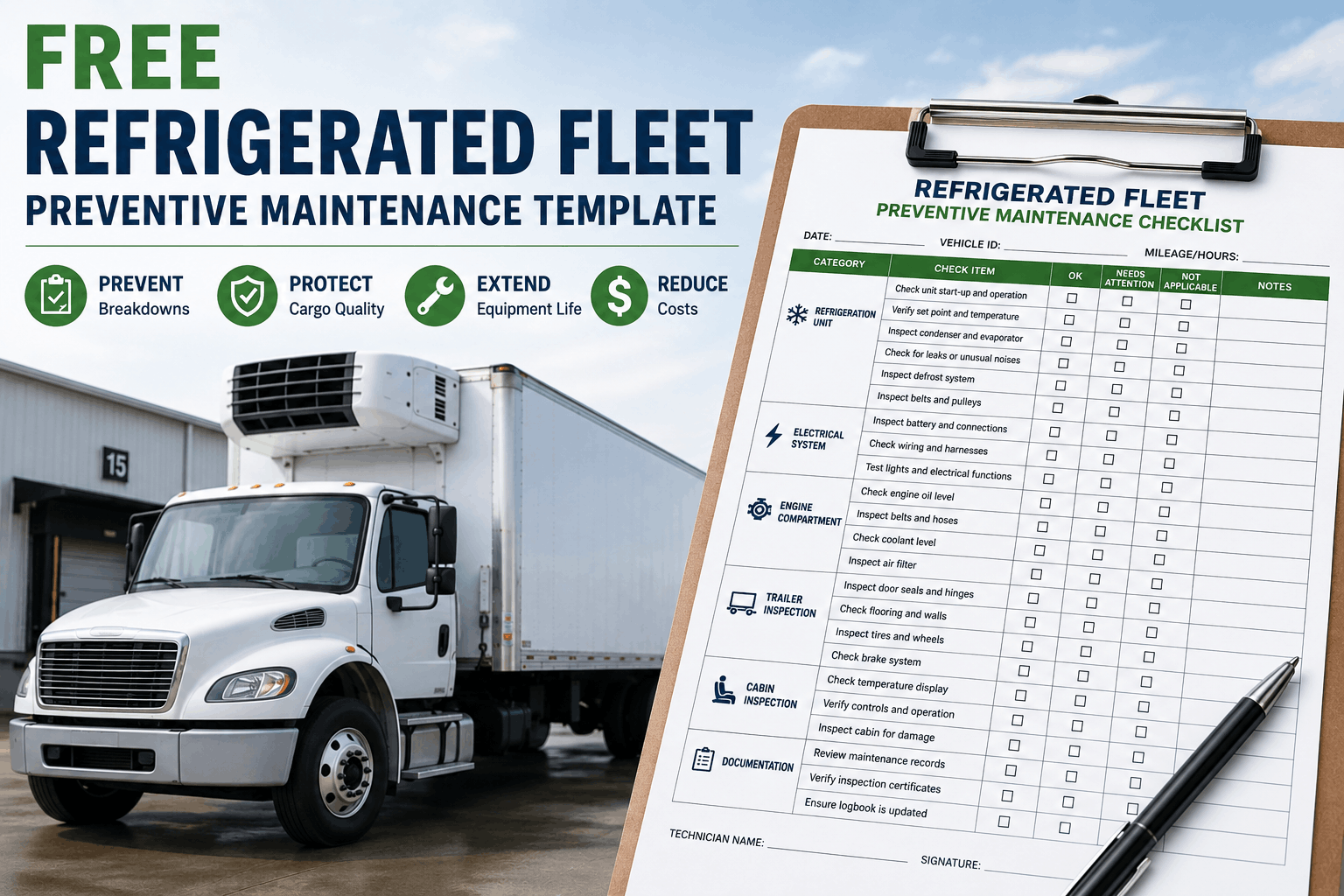
Free Refrigerated Fleet Preventive Maintenance Template
Mileage- and hour-triggered PM intervals for Thermo King and Carrier reefer units, tractor powertrains, and trailer systems — with the documentation framework your fleet auditors and food safety compliance programs require.
Why Reefer Fleets Defer Maintenance — and Pay Double Later
Preventive maintenance deferral is the single largest controllable driver of unplanned reefer downtime. It happens for understandable reasons: the truck is needed on the road, the shop is backed up, and the interval reminder got buried under a stack of repair orders. But the economics of deferral are brutal. A $280 belt replacement skipped at 1,800 engine hours becomes a $4,200 compressor replacement when the belt snaps at 2,100 hours during a Friday night delivery. A missed refrigerant check that would have flagged a slow leak becomes a condemned $85,000 produce load when the unit loses capacity on a summer afternoon. The fleet that tracks PM by actual engine hours and mileage — not by hope and memory — is the fleet that keeps loads cold, customers satisfied, and repair costs predictable.
The Complete Refrigerated Fleet PM Template
The template below is organized into five categories covering reefer unit engine-hour milestones, tractor powertrain intervals, trailer structural and systems checks, temperature monitoring equipment, and compliance documentation. Use it as a paper checklist, import it into a spreadsheet, or load it directly into FleetRabbit to convert every interval into an automated work order trigger. Intervals shown reflect Thermo King and Carrier manufacturer recommendations for continuous-operation cold chain fleets — adjust based on your specific unit models and operating environment.
- Check and record engine oil level; top off to full mark with manufacturer-approved oil grade
- Inspect drive belt for wear, cracking, glazing, and proper tension; replace if wear indicators met
- Check refrigerant sight glass — verify no bubbles under normal operating load; note any discoloration
- Inspect all high-pressure and low-pressure hoses for chafing, abrasion, and fitting integrity
- Check condenser coil fins — clean with low-pressure water or brush if blocked by road debris or lint
- Verify fuel level and fuel filter condition (primary and secondary); record hours on current filter
- Test all operating modes: continuous, cycle-sentry, and defrost cycle completion and reset
- Inspect evaporator coil and drain pan — clear any ice bridging; flush drain line
- Log engine hours on unit hourmeter; enter service record into PM tracking system
- Full engine oil and filter change — use only manufacturer-specified oil type and viscosity
- Replace fuel filter (primary and secondary elements); prime system and check for air in fuel lines
- Replace drive belt(s) regardless of visible condition — interval replacement prevents in-route failure
- Inspect and replace air filter element if contamination level exceeds restriction gauge threshold
- Refrigerant charge verification — weigh refrigerant in system against spec; recharge if underweight
- Check and adjust belt tensioners, idler pulleys, and all drive system mounting hardware torque
- Compressor oil check on applicable unit models; top off or change per manufacturer schedule
- Electrical system inspection — check alternator output voltage, battery terminals, wiring harness routing
- Test and calibrate temperature controller accuracy against certified reference thermometer
- Defrost heater element resistance test; verify defrost timer or smart defrost logic operation
- Document all parts replaced, technician name, and hourmeter reading on completed work order
- Every 15,000–25,000 miles: Engine oil and filter change; check all fluid levels (coolant, transmission, power steering, brake fluid); inspect belts and hoses
- Every 25,000 miles: Fuel filter replacement; DPF inspection and cleaning if equipped; inspect charge air cooler for leaks
- Every 50,000 miles: Coolant system flush and refill with fresh OAT or NOAT coolant; thermostat function test; pressure test cooling system
- Every 50,000 miles: Transmission fluid and filter service; inspect driveshaft u-joints and slip yoke; lubricate all chassis grease points
- Every 100,000 miles: Differential fluid change; fifth wheel inspection and lubrication; full brake system inspection including lining thickness and slack adjusters
- Record odometer reading at each service; update PM due mileage in fleet management system
- Verify ELD hours of service logs are consistent with odometer progression; flag discrepancies
- Pre-trip / every route: Inspect door gaskets on all cargo doors — check for compression set, tears, missing sections, or mould accumulation in the gasket channel
- Monthly: Inspect trailer roof, sidewalls, and floor for delamination, cracks, punctures, or exposed insulation that reduces thermal performance
- Monthly: Lubricate door hinges, locking bars, and cam locks; check door cam handle operation and security latch engagement
- Quarterly: Full brake inspection — lining thickness, drum or rotor condition, brake chamber stroke, S-cam and slack adjuster condition
- Quarterly: Inspect landing gear operation, cross-tube, and gear box for damage or seized components; lubricate per spec
- Annually: Full undercarriage inspection including frame cross-members, outriggers, suspension hangers, and spring components
- Annually: Verify trailer reefer unit mounting brackets and vibration isolators are intact and correctly torqued
- Document all trailer inspections with trailer unit number, date, inspector name, and findings
Load your reefer fleet PM schedule into FleetRabbit and the system automatically generates work orders at configurable lead times before each interval is due — 250 hours early for major services, 50 hours for checks. Parts are pre-listed on every work order so your shop is ready before the truck rolls in.
From the Fleet Manager
"We had a 42-unit refrigerated fleet and were running reactive maintenance for years. Our reefer breakdown rate was around one unplanned event per truck per quarter — that's 42 unplanned events a year costing us an average of $6,000 each in repair, load loss, and schedule disruption. When we implemented a proper hour-based PM program and loaded the intervals into FleetRabbit, the system started generating work orders automatically 300 hours before each service was due. Our shop could plan the week instead of reacting to phone calls. In 18 months we went from 42 unplanned reefer events to seven. The PM software cost us less than what we used to spend on a single condemned produce load. The template framework you're looking at is essentially what we built our entire program around."
Frequently Asked Questions
FleetRabbit converts your refrigerated fleet PM template into automated work order triggers, pre-staged parts lists, and compliance-ready service histories. One platform, zero missed intervals, and complete visibility into the maintenance status of every reefer unit in your fleet.