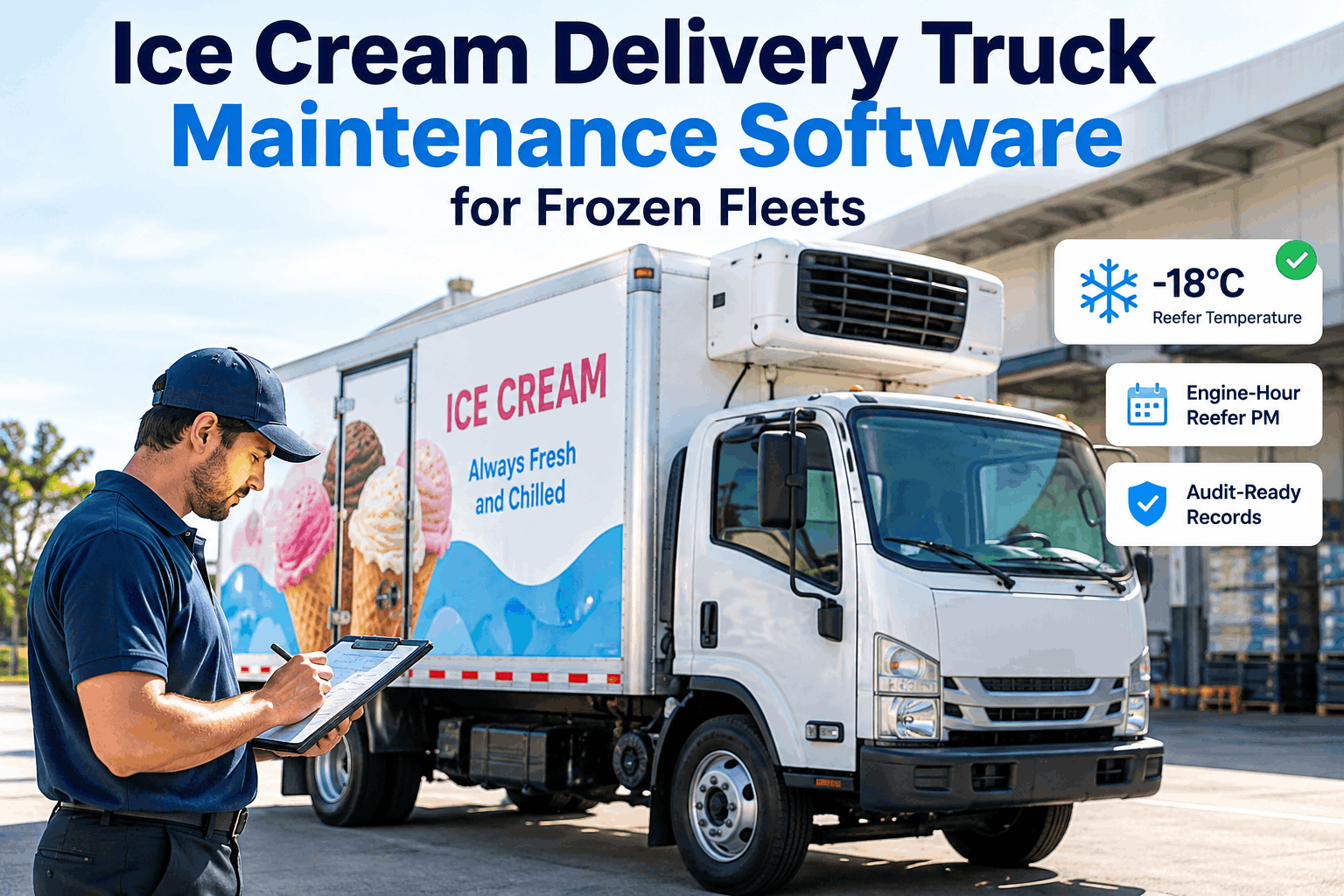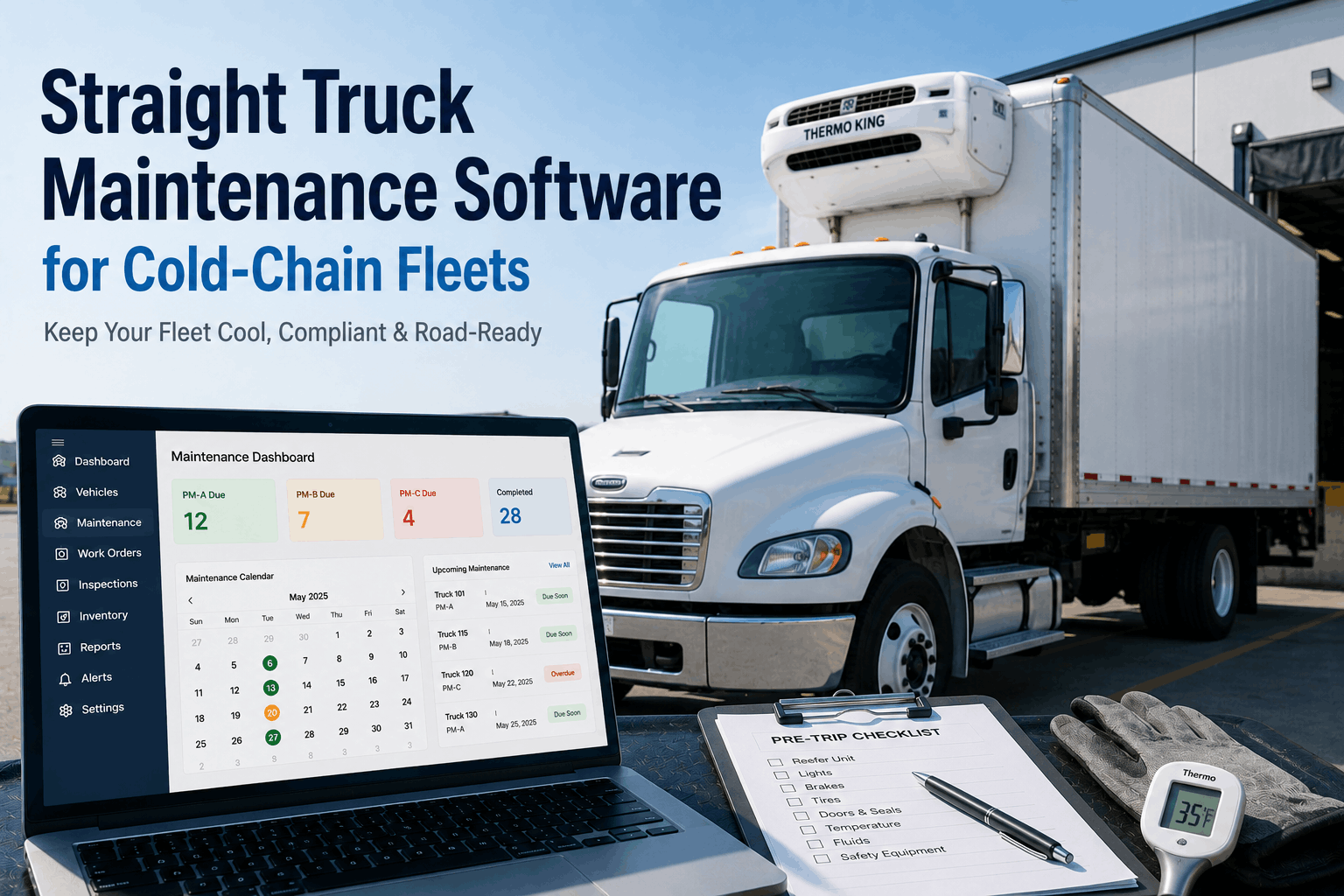
Most fleets still write one maintenance plan for the whole truck: chassis and reefer together, serviced on the same calendar. On a refrigerated straight truck that habit is exactly what breaks fleets, because the refrigeration unit racks up engine hours two to three times faster than the chassis it rides on. Treat them as one item and the reefer fails long before its "next service due" date ever shows up, which is the core problem refrigerated straight truck maintenance software is built to solve for cold-chain fleets.
Two engines, one truck, and only one maintenance clock in most fleets
A refrigerated straight truck is really two machines sharing a frame. The chassis engine moves the vehicle. The reefer unit runs independently, often on its own diesel or electric motor, cycling constantly to hold box temperature regardless of whether the truck is moving or parked at a dock. Most fleet maintenance software was built for the chassis side only, tracking mileage and hours for the drivetrain while leaving the reefer to a separate paper log or, worse, no schedule at all beyond "call someone when it stops cooling." Fleets that sign up for a cold-chain-specific platform get both engines tracked against their own real service clocks instead of one borrowed schedule.
The reefer engine-hour milestones that actually predict failure
Fleets that track this by mileage alone routinely miss every one of these windows on their hardest-working trucks, because the odometer and the reefer's run time simply do not move together. Ready to see where your own units sit against these milestones. Book a demo and we will map it against your current fleet.
Track the reefer and the chassis on their own real clocks
Engine-hour PM scheduling, live temperature data, and audit-ready records for every cold-chain straight truck in the fleet.
Where the money actually goes when a reefer fails on the road
Every one of the top four bars only exists because the fifth one, scheduled preventive service, got skipped or delayed. That is the entire economic case for moving reefer maintenance onto a real engine-hour schedule instead of a best-effort one, and it is the fastest way to book a demo conversation to pay for itself.
A component-by-component PM matrix, not a single blanket schedule
| Component | Service trigger | Cost of skipping it |
|---|---|---|
| Reefer compressor and clutch | Engine hours, roughly every 1000 | $4,000-$12,000 unplanned replacement |
| Condenser and evaporator coils | Seasonal plus engine hours | Reduced cooling capacity, longer temp recovery |
| Box door seals and gaskets | Visual inspection, monthly | Slow temperature drift, constant compressor strain |
| Chassis brakes and tires | Mileage based, standard DOT interval | Roadside failure, missed delivery window |
What audit-ready actually means for a cold-chain straight truck fleet
When a retailer disputes a delivery or a claim comes in on spoiled product, the question is never just "was the truck moving." It is whether the box held temperature, whether the reefer had its scheduled service, and whether that record can be produced quickly. Distributors running paper logs and spreadsheets typically spend days reconstructing that story from driver notes and shop invoices. Distributors running a connected platform pull the same trip history, temperature curve, and service record in minutes. If your team is still assembling that picture by hand after every claim, it is worth taking the time to sign up and see what a single-source record actually looks like.
Stop losing loads to reefer failures you could have scheduled around
See engine-hour PM, temperature monitoring, and audit-ready records running together on your fleet.
Frequently asked questions
Why track the reefer unit separately from the chassis engine.
The reefer runs on its own motor and duty cycle, often accumulating two to three times the run hours of the chassis engine on the same truck. A single mileage-based schedule for both will systematically under-service the reefer.
Does this replace our existing telematics or reefer sensors.
No. FleetRabbit connects to the data your reefer telematics already generates and turns it into engine-hour PM scheduling, deviation alerts, and audit-ready service records.
What happens if a reefer starts drifting out of its set point mid-route.
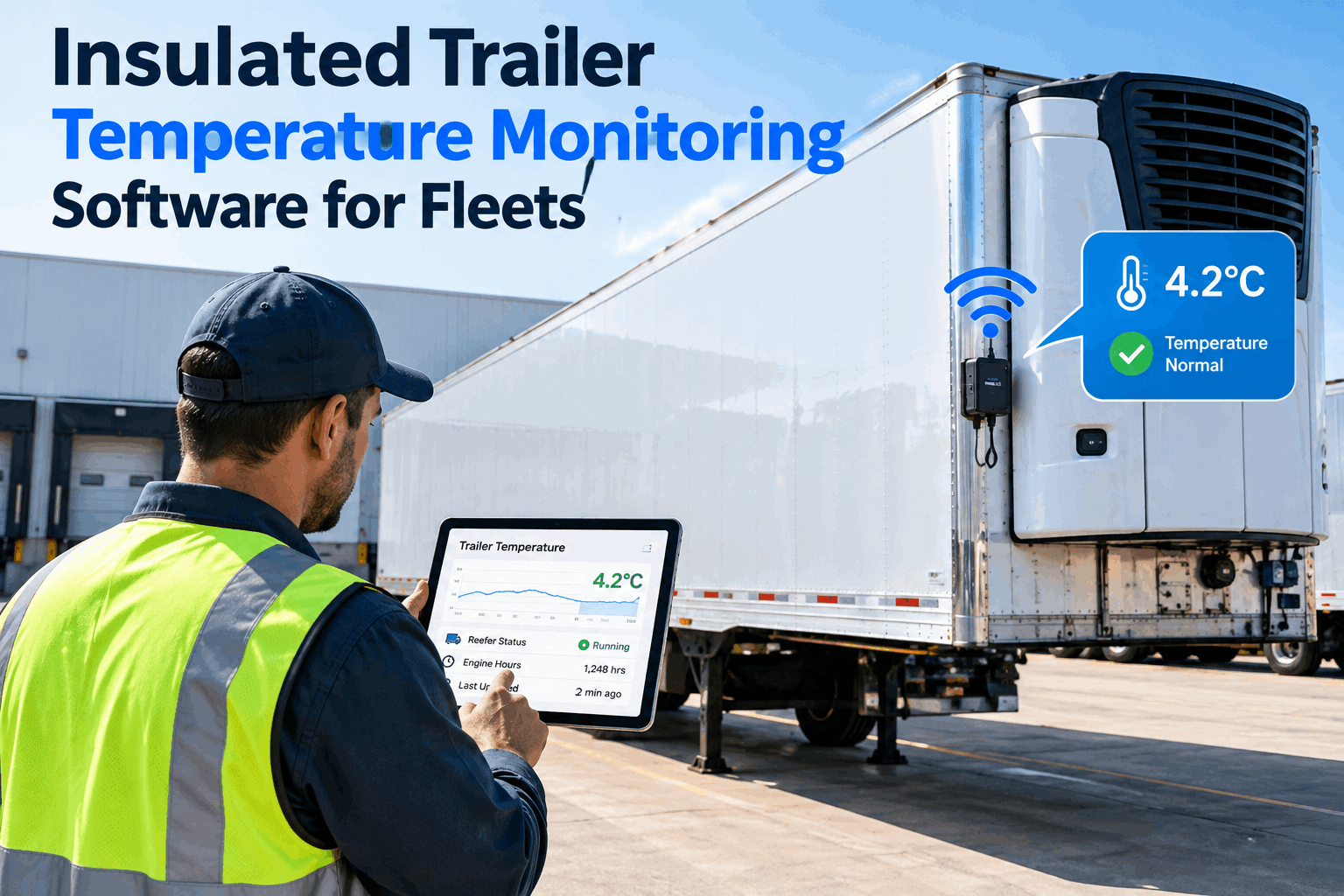
Deviation alerts flag the drift in real time rather than after the delivery, giving dispatch a chance to reroute, reassign, or intervene before the load is compromised. Fleets that want to see this in action can sign up for a trial route.
Is this only useful for large fleets.
No. Smaller fleets often feel the cost of an unplanned reefer failure more acutely, since they have fewer spare trucks to absorb the disruption, which makes predictable engine-hour scheduling proportionally more valuable.
How fast can we get a fleet onboarded.
Most cold-chain fleets are live within days, since the platform is designed to plug into data you are already generating rather than requiring new hardware across the board.