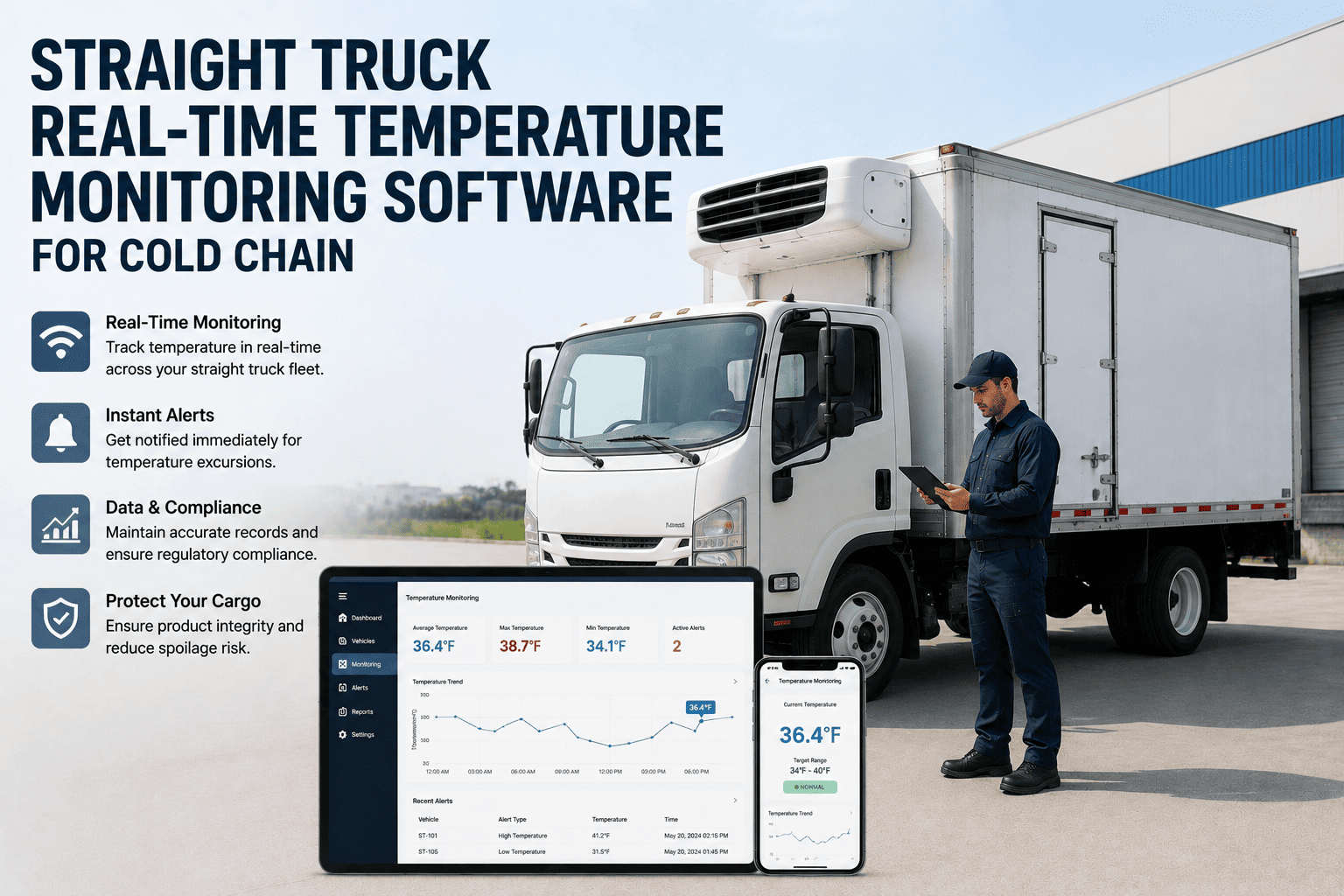
Every straight truck running a food distribution route makes the same trade twenty or thirty times a day: the doors open, cold air escapes, product gets handed off, and the doors close again. A long-haul reefer trailer might open twice on a cross-country run. A refrigerated straight truck serving restaurants, grocery stores, and convenience chains opens constantly, on tight urban schedules, often without a driver ever checking the thermostat between stops. That single difference is why refrigerated straight truck temperature monitoring software has become less of an add-on and more of an operating requirement for food distributors who cannot afford a spoiled route, a failed audit, or a customer who stops answering calls. FleetRabbit built its platform around exactly this problem, giving distributors real-time visibility into every degree, every door opening, and every mile.
Why Straight Trucks Play by Different Rules
Straight trucks are the workhorses of local and regional cold chain delivery. They run restaurant routes, grocery replenishment, foodservice distribution, and last-mile drops that a long-haul trailer never touches. That job comes with a different risk profile: shorter routes but far more stops, frequent door openings, tighter delivery windows, and drivers juggling handheld units, paperwork, and a schedule that leaves no time to babysit a dashboard gauge. Manual temperature checks work fine for a single overnight haul. They fall apart across a route with 25 stops before lunch. That's exactly where distributors decide to book a demo and see how continuous monitoring replaces the clipboard entirely.
What Real-Time Monitoring Actually Tracks, Stop by Stop
Confirms the compartment hits the required temperature before a single case is loaded, satisfying the carrier's pre-cooling obligation under the Sanitary Transportation Rule.
Logs the starting temperature and compartment status the moment the doors close, creating a clean baseline for the route.
Captures every door open and close event across the route, so a two-minute delivery stop never gets confused with a stalled truck.
Pushes a live alert the second temperature drifts outside the safe range, so dispatch can act before product is compromised.
Generates a time-stamped temperature record at drop-off, ready to hand a receiver or auditor without a single phone call.
Staying FSMA Compliant Without Slowing Down Routes
The FDA's Sanitary Transportation Rule places real, specific obligations on shippers, carriers, and receivers, and refrigerated straight trucks sit right in the middle of it. Carriers are expected to pre-cool compartments, monitor temperature throughout transit rather than only checking at pickup and delivery, and retain records that can be produced on short notice. Falling short doesn't just risk a fine; it risks the load itself, since product suspected of a temperature failure cannot legally be sold until its safety is confirmed. This is where distributors typically decide to sign up for continuous digital monitoring rather than relying on a driver's manual log sheet that's easy to forget and hard to defend in an audit.
Defines the temperature conditions the load must be held at and can request a full record from the carrier at any point.
Pre-cools the compartment, monitors temperature continuously in transit, and keeps the truck sanitary between loads.
Confirms the delivered temperature matches what was agreed and flags any deviation before accepting the product.
Predictive Maintenance: Keeping the Reefer Unit Running Before It Fails
A refrigerated straight truck is only as reliable as its reefer unit, and unlike a long-haul trailer, that unit is cycling on and off constantly across a stop-heavy route, working harder than most people realize. FleetRabbit tracks compressor run time, engine hours, and cooling performance trends so fleet managers can spot a unit that's drifting toward failure weeks before it strands a load of product on a delivery route. Distributors running tight margins on perishable freight can't afford a mid-route breakdown, which is why so many teams choose to book a demo to see predictive maintenance alerts in action before their next reefer unit fails without warning.
Manual Logs vs. Real-Time Monitoring
See Your Cold Chain in Real Time
Give dispatch and drivers one shared view of every truck, every compartment, and every degree, from the first pre-cool to the last drop-off.
Built for the Way Distributors Actually Run Routes
Foodservice distributors, grocery replenishment fleets, and restaurant supply routes don't run like long-haul carriers, and their software shouldn't pretend they do. FleetRabbit's platform is built around the reality of dozens of daily stops: it separates a legitimate two-minute delivery pause from a genuine cooling problem, so drivers aren't flooded with false alarms and dispatch only sees the alerts that actually matter. Fleet managers get a live map of every truck's compartment temperature, uptime status, and route progress in one screen, which is exactly why growing distribution fleets choose to sign up instead of stitching together spreadsheets, driver phone calls, and after-the-fact paperwork.
Uptime is the quiet metric that decides whether any of this works. A reefer unit that fails on a Tuesday morning route doesn't just cost the price of a repair, it costs the product on the truck and the trust of every customer on that day's stop list. By combining real-time temperature data with predictive maintenance signals, FleetRabbit gives fleet managers a head start on repairs, scheduling service during downtime instead of losing a route mid-delivery. Distributors who want to see how much downtime that head start actually prevents usually start by choosing to book a demo with the team directly.
Frequently Asked Questions
What makes refrigerated straight truck temperature monitoring different from long-haul reefer monitoring?
Straight trucks make far more stops per route, which means far more door openings and short-term temperature swings. Monitoring software for straight trucks needs to distinguish a normal delivery pause from a genuine cooling failure, something long-haul systems built for two or three stops rarely account for.
Is real-time temperature monitoring required for FSMA compliance
The Sanitary Transportation Rule requires continuous monitoring and record-keeping throughout transit, though it does not mandate a specific technology. Electronic monitoring is widely accepted as the most reliable way to meet this requirement and produce records within the 24-hour window the FDA allows.
How long do temperature records need to be kept
Temperature monitoring, sanitation, and training records must be retained for at least 12 months and made available to the FDA within 24 hours of a request, which makes digital, searchable records far more practical than paper logs.
Can this software help prevent reefer unit breakdowns
Yes. FleetRabbit tracks compressor cycles, engine hours, and cooling trends over time, flagging units that show early signs of wear so repairs can be scheduled before a breakdown strands a delivery route.
Who typically uses refrigerated straight truck monitoring software
Food distributors, foodservice suppliers, grocery replenishment fleets, and any operation running multi-stop, temperature-sensitive delivery routes across a city or region rather than a single long-haul leg.
How quickly can a distributor get started
Most fleets are up and running within days. The fastest way to see the platform against your own routes is to sign up directly or book a demo so the team can walk through your specific fleet setup.