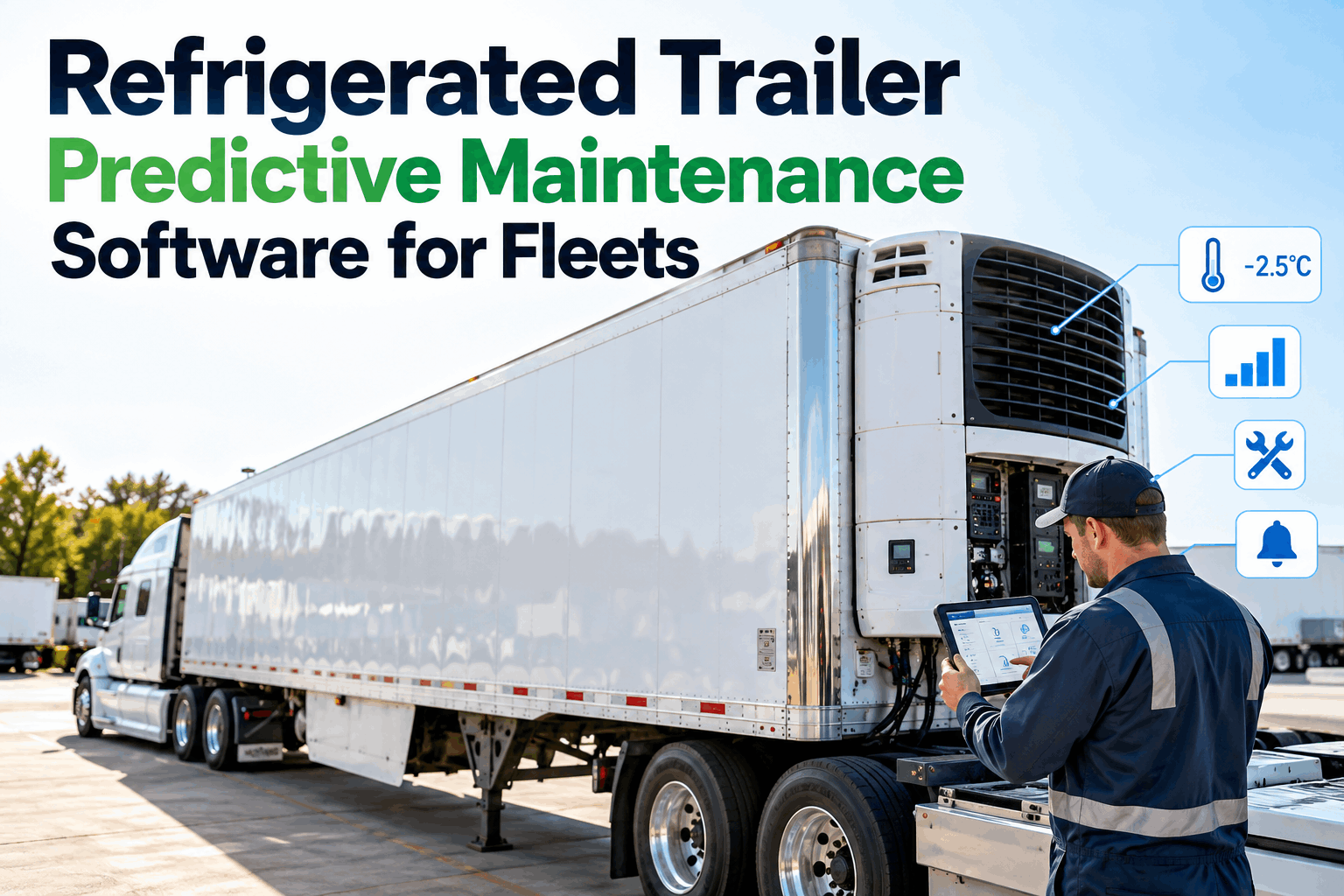
Refrigerated Trailer Predictive Maintenance Software for Fleets
Long-haul refrigerated freight carriers, protein processors, and enterprise cold-chain distributors manage high-value rolling assets: 53-foot refrigerated semi-trailers loaded with upwards of $150,000 in perishable inventory. Unlike dry vans or standard fleet tractors, a refrigerated trailer is a dual-asset system combining structural road hardware with a primary diesel-driven transport refrigeration unit (TRU). When fleets rely on conventional scheduled servicing based on tractor odometer miles or static calendar intervals, catastrophic mechanical failures occur in transit. A trailer staging on a distribution yard dock or waiting at a terminal gate racks up zero road miles while its independent diesel engine runs under full continuous displacement for 16 hours straight to hold sub-zero frozen setpoints. Disregarding genuine auxiliary engine operating workload causes undetected belt micro-slippage, compressor suction valve leaks, unmonitored alternator diode failures, and sudden roadside shutdowns along interstate corridors. Under FDA Food Safety Modernization Act (FSMA) 21 CFR Part 1 Subpart O rules, a single unmonitored temperature spike condemns an entire load. Refrigerated trailer predictive maintenance software shifts carriers from reactive roadside firefighting to data-driven component failure prevention. By combining direct J1939 CAN-bus telemetry from Thermo King and Carrier microprocessors with real-time multi-point Bluetooth Low Energy (BLE) temperature probes and predictive thermal Delta-T capacity modeling, fleets eliminate roadside breakdowns, prevent cargo claims, and streamline compliance. Book a Demo to see our refrigerated trailer predictive maintenance software in action.
Cold-Chain 53-Foot Fleet ReliabilityTRU Engine-Hour Predictive AnalyticsFSMA 21 CFR Part 1 Subpart O Ready
Refrigerated Trailer Predictive Maintenance Software for Fleets
An engineering and fleet reliability manual: decouple TRU diesel and electric standby engine run-hours from tractor odometer miles, capture real-time microclimate drift across 53-foot boxes, intercept compressor valve failures prior to highway breakdown, and safeguard cargo value.
Thermo King SR-4 & Carrier APX Microprocessor Telematics
Halt In-Transit Reefer Failures and Protect Perishable Freight Margins
Decouple auxiliary TRU diesel engine hours from tractor road miles, deploy multi-point wireless BLE probes, and automate predictive shop work orders for just $5/asset/month.
The Costly Structural Friction of Legacy Reefer Maintenance
Operating a refrigerated semi-trailer fleet under calendar-based or mileage-based maintenance models creates compounding financial exposure. A 53-foot reefer trailer carries its own mechanical powerplant, separate electrical generation, high-pressure refrigeration circuit, and insulated thermal envelope. When fleets treat trailers as unpowered boxes, costly failures occur. Sign up to automate predictive maintenance across your refrigerated fleet.
Vulnerability 01
The Tractor Odometer vs. TRU Operating Hour Disconnect
A trailer dropped at a customer cold-storage staging yard or cross-dock terminal accumulates zero tractor road miles while its independent diesel engine operates continuously under heavy thermal load for 24 hours to hold ice cream at -20°F. Maintenance scheduled by road miles misses true oil breakdown, drive belt fatigue, and fuel filter clogging, leading to sudden compressor seizure on the highway. Book a demo to inspect our automated TRU engine-hour tracking.
Vulnerability 02
Gradual Delta-T Capacity Loss and Unnoticed Refrigerant Leaks
Transport refrigeration units rarely fail without warning. Vibration causes hairline cracks in discharge lines, pinhole leaks in condenser coils, or sticky electronic throttling valves (ETVs). The unit compensates by running at higher engine RPM, burning excessive fuel while Delta-T (cooling capacity across coils) narrows until ambient summer heat triggers complete temperature runaway.
Atmospheric moisture pulled from fresh produce cargo builds up on evaporator coils. If defrost cycle termination switches fail or duckbill drain kazoos become blocked with road grime, condensate cannot drain. Water refreezes across the coil face into a solid block of ice, choking airflow and allowing box temperatures to climb even with the compressor running at full load. Sign up to deploy predictive defrost cycle diagnostics.
Receiving managers at major grocery distribution centers routinely probe product core temperatures upon delivery. If core readings exceed safe storage limits due to localized air pockets near rear doors, the receiver rejects the trailer. Without tamper-proof digital temperature logs proving continuous compliance from shipper origin, carriers absorb tens of thousands in unrefuted freight claim losses.
The Tiered Refrigerated Trailer PM Matrix: PM-A, PM-B, and PM-C Schedules
To preserve refrigeration compressor lifespans and comply with FDA Food Safety Modernization Act (FSMA) standards, refrigerated trailers must follow preventive maintenance intervals triggered by true engine runtime hours and compressor displacement rather than civilian odometer miles. Book a demo to calibrate refrigerated trailer PM intervals for your fleet.
Preventive Maintenance Level
Engine Runtime Trigger
TRU Mechanical & Electrical Inspection Scope
Cold-Chain Failure Prevention Goal
PM Level A: Dry Inspection & Belts
Every 1,500 Operating Hours
Inspect compressor drive belt tension and idler pulleys; check Delta-T across evaporator coils; clean defrost drain kazoos; test defrost termination switches; verify receiver tank refrigerant sight glass; chassis grease lubrication; air brake pushrod check.
Prevent sudden drive belt snaps, clear blocked defrost drain lines, and catch minor refrigerant leaks before cooling loss occurs.
PM Level B: Wet Service & Electrical
Every 3,000 Operating Hours
PM Level A scope PLUS: full synthetic TRU engine oil and filter flush; primary and secondary fuel filter replacement; clean fuel pump strainer; battery conductance test; electric standby motor contactor check; chassis synthetic oil and filter replacement.
Prevent fuel filter waxing, stop battery cranking voltage drop during automated engine stop/start cycles, and protect engine warranties.
PM Level C: Heavy Overhaul & Valves
Every 6,000 Operating Hours
PM Level A & B scope PLUS: flush engine cooling loop and replace extended-life coolant; inspect electronic throttling valve (ETV); test three-way valve seals; replace compressor oil filter; vacuum clean condenser coil; calibrate BLE temperature sensors.
Comprehensive structural and thermal certification, prevent three-way valve bypass leakage, and eliminate catastrophic compressor seizure.
The 4 Diagnostic Pillars of Reefer Predictive Maintenance Software
Fleet Rabbit unites on-board vehicle diagnostic telemetry, refrigeration microprocessor controllers, wireless BLE microclimate probes, and garage repair queues into an automated cold-chain management ecosystem. Sign up to connect your transport refrigeration unit microprocessors.
Pillar 01
Automated Dual-Hour Meter Telematics Sync
Extract total diesel run-hours, loaded cooling hours, and electric standby runtime directly from Thermo King SmartReefer and Carrier Transicold APX microprocessors. Maintenance counters advance only when the auxiliary reefer engine or electric standby runs, ensuring service is scheduled by genuine mechanical workload rather than highway miles.
Pillar 02
Wireless Multi-Point BLE 5.0 Temperature Probes
Deploy ruggedized, IP68 waterproof Bluetooth Low Energy probes at the front bulkhead, middle pallet zone, and rear roll-up door threshold. Probes stream microclimate readings every 30 seconds to the in-cab gateway without requiring holes to be drilled through insulated trailer bodies, eliminating thermal air leaks. Book a demo to inspect our non-invasive wireless BLE probes.
Pillar 03
Door Dwell Time & Delta-T Capacity Analytics
Magnetic door sensors link with delivery geofences to track exact roll-up door open durations. Cloud algorithms analyze Delta-T (temperature difference between discharge and return air), sending an immediate in-cab driver chime if compartment temperatures fail to recover within safe pulldown thresholds.
Pillar 04
Pre-Staged Shop Work Orders & FSMA Compliance
When an engine-hour threshold or diagnostic trouble code is triggered, the system auto-opens a digital shop ticket, calculates labor hours, and reserves matching synthetic oil, fuel filters, and belts from internal storeroom inventory, while generating 1-click exportable FSMA compliance dossiers. Sign up to automate reefer parts staging and shop tickets.
The Closed-Loop Cold-Chain Maintenance & Triage Pipeline
In-cab telematics query vehicle chassis and reefer microprocessors every 30 seconds, monitoring diesel engine hours, compressor pressures, and cargo bay air temperatures.
Step 02
Thermal Drift & Fault Detection
The software identifies that trailer #608 has reached 3,000 operating hours on its TRU engine while Delta-T efficiency has dropped by 15%, isolating compressor belt slip before cargo is compromised.
Step 03
Dual Driver & Dispatch Alerting
An instant audio alert sounds on the driver's mobile device while dispatchers receive a priority notification with vehicle location, remaining delivery stops, and estimated thermal safe-time. Sign up to enable instant driver and dispatch push alerts.
Step 04
Pre-Staged Shop Execution
The maintenance terminal receives the work order with pre-assigned genuine filters, synthetic fluids, and belt part numbers, reserving components before the trailer arrives at the yard.
Platform Comparison: Manual Clipboards vs. Fleet Rabbit Platform
Commercial Fleet Case Study: Great Lakes Cold Freight
Learn how an interstate refrigerated food carrier operating 64 refrigerated semi-trailers eliminated roadside compressor breakdowns and passed customer audits with zero temperature rejections. Sign up to achieve similar cold-chain delivery reliability.
Cold-Chain Case Study
0
Dock Temperature Refusals
68%
Drop in In-Transit Stalls
$114,000
Annual Spoilage & Tow Savings
Interstate Carrier Eliminates Highway Reefer Stalls Across 64 Semi-Trailers
Operating 64 fifty-three-foot refrigerated semi-trailers transporting dairy, frozen poultry, and pharmaceuticals across four states, Great Lakes Cold Freight faced severe summer mechanical downtime. Trailers hauling high-value loads suffered four roadside compressor clutch seizures and two alternator failures during extreme heatwaves, resulting in over $95,000 in condemned freight claims, emergency mobile technician dispatch fees, and customer contract penalties. The maintenance facility had scheduled reefer servicing every 15,000 tractor road miles, unaware that extended staging yard dwell was causing TRU diesel engines to accumulate double the mechanical workload.
By implementing Fleet Rabbit at $5/asset/month, the carrier deployed real-time controller telematics to track engine hours on both the host diesel and electric standby units while installing wireless BLE temperature probes inside each trailer. The system's Delta-T analytics caught a failing electronic expansion valve on a trailer staging at a terminal yard, allowing technicians to replace the $280 component in under an hour before a $110,000 shipment of artisan cheese was loaded. Over 12 months, in-transit compressor breakdowns dropped by 68%, dockside temperature refusals fell to zero, and the company saved $114,000 in prevented food waste, eliminated emergency towing, and reduced overtime repair costs.
Frequently Asked Questions
Why is auxiliary engine-hour tracking essential for refrigerated semi-trailers?
Refrigerated trailers spend extensive time stationary at customer distribution centers, staging yards, and cross-docks while the refrigeration unit runs continuously under heavy thermal load. A trailer dropped for 48 hours over a weekend may accumulate 30 hours of reefer engine run-time while adding zero tractor odometer miles. Scheduling maintenance strictly by tractor miles ignores genuine mechanical workload, leading to oil sludge, filter waxing, and sudden highway compressor seizures.
What is Delta-T and why does it indicate refrigeration performance issues?
Delta-T is the temperature difference between the return air entering the evaporator coil and the discharge air blowing back into the trailer. A healthy 53-foot trailer refrigeration unit maintains a specific Delta-T spread depending on commodity setpoints. If the Delta-T narrows over time, it indicates dirty evaporator coils, refrigerant leaks, failing electronic expansion valves, or compressor reed valve wear, alerting mechanics before cargo temperatures drift into dangerous spoilage zones.
How does door dwell tracking help prevent temperature excursions on multi-stop routes?
Refrigerated delivery drivers open rear doors frequently during regional multi-stop distribution. Fleet Rabbit utilizes magnetic door sensors linked with delivery geofences to measure open durations. If doors remain open past safe limits in warm ambient conditions, the system fires in-cab alerts to the driver, prompting them to check strip curtains and close doors promptly to protect cargo holding temperatures.
Can drivers and dispatchers access temperature graphs without cellular reception?
Yes. Fleet Rabbit features an offline-first mobile architecture. All wireless BLE probe telemetry, door events, and vehicle diagnostic codes buffer locally on the in-cab gateway and driver smartphone app. Drivers can view real-time microclimate conditions via local Bluetooth connection inside concrete distribution centers or mountain dead zones, and all buffered data auto-syncs to dispatch the moment cellular connectivity returns.
What are the pricing details and contract terms for Fleet Rabbit's software?
Fleet Rabbit is priced at a flat rate of $5 per active refrigerated asset per month billed annually. This includes complete access to engine-hour reefer PM scheduling, real-time wireless BLE temperature monitoring, door dwell analytics, mobile driver proof-of-delivery tools, and FSMA compliance archives. We offer a 14-day free live trial on up to 3 assets with zero setup fees or long-term locked contracts.
Ready to Automate Predictive Maintenance Across Your Refrigerated Trailer Fleet?
Deploy engine-hour reefer service triggers, eliminate dockside temperature rejections, and ensure 100% audit-ready cold-chain compliance for just $5/asset/month.