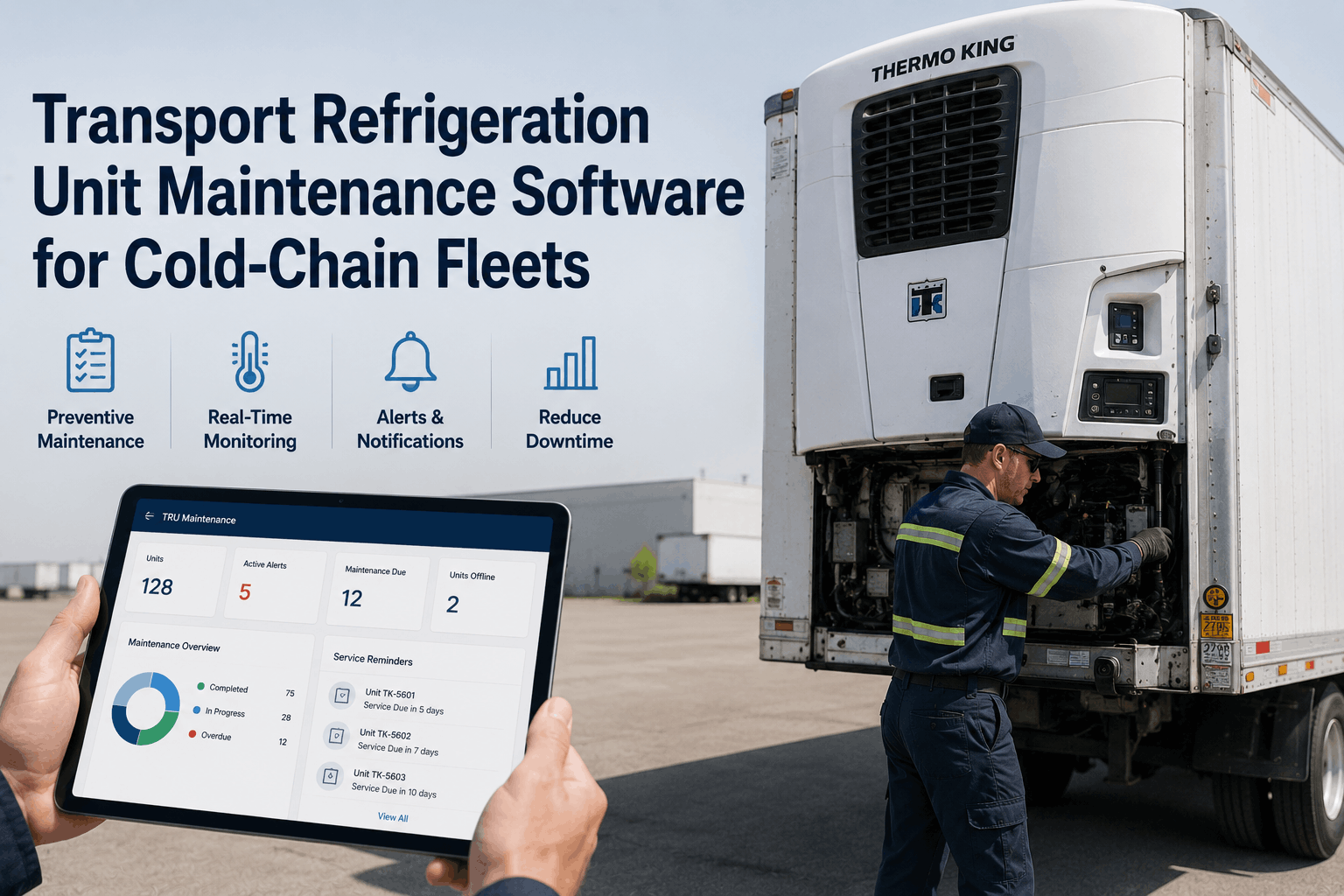
A transport refrigeration unit is a complete mechanical system in its own right, its own engine or electric drive, its own compressor, its own refrigerant circuit, bolted onto a trailer, truck, or container that has entirely different maintenance needs than the vehicle carrying it. Treating the TRU as an afterthought on the truck's service schedule is how fleets end up with a compressor failure on a Tuesday afternoon delivery that a week of warning signs could have prevented. Transport refrigeration unit maintenance software exists to track that system on its own terms, by its own run hours, its own performance data, and its own compliance requirements.
A TRU Is Not the Same Asset as the Vehicle It Rides On
A tractor and its trailer's transport refrigeration unit are two separate mechanical systems that happen to travel together. The tractor's engine and drivetrain wear based on mileage. The TRU's engine, compressor, and refrigerant circuit wear based on run hours, and those run hours often have almost no relationship to how far the vehicle has driven. A trailer running frozen goods on short, frequent routes can put more hours on its refrigeration unit in a month than a long-haul unit sees in three, simply because the compressor is cycling constantly to hold temperature through repeated door openings.
Fleets that maintain the TRU on the same interval as the tractor are maintaining the wrong asset on the wrong clock. Transport refrigeration unit maintenance software separates the two, tracking each TRU's own engine hours, compressor cycles, and refrigerant performance independently, so service gets scheduled around what the unit has actually done, not what the truck's odometer says. Fleets ready to see this separation applied to their own equipment can sign up and connect their first TRU in a matter of minutes.
The Four Systems a TRU Maintenance Platform Should Watch
The heart of the unit. Rising current draw or unusual cycling is often the first measurable sign that something downstream is failing.
Airflow loss from debris or corrosion reduces cooling capacity gradually, long before a driver would notice a problem.
Slow pressure loss reduces cooling efficiency and, depending on the refrigerant, may also carry compliance obligations.
The microprocessor managing setpoint and defrost cycles needs its own diagnostic checks, since a miscalibrated sensor can mask a real problem.
Track Every TRU as Its Own Asset, Automatically
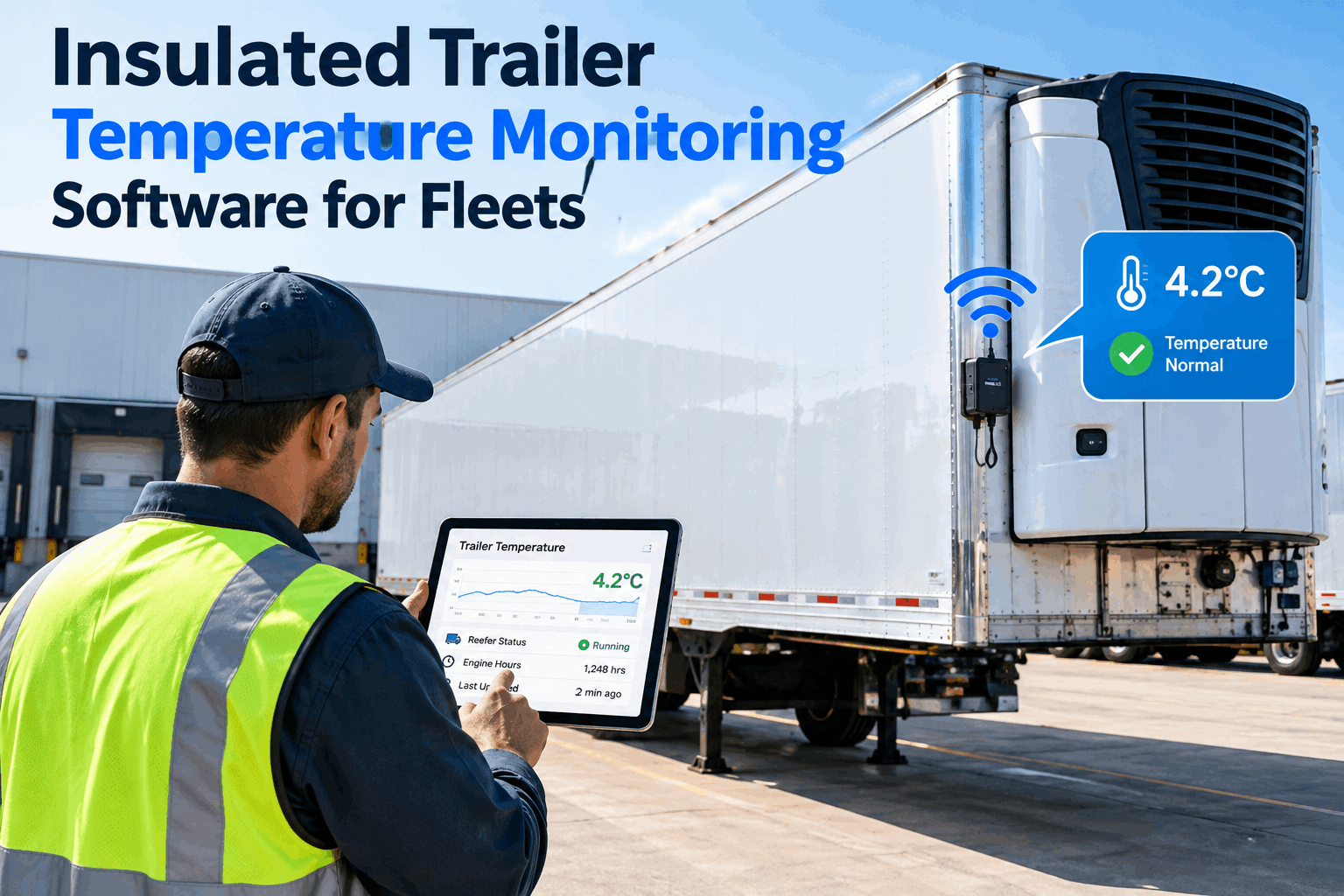
FleetRabbit logs engine-hour run time, compressor behavior, and box temperature for every transport refrigeration unit in the fleet, separate from the vehicle it's mounted on. Sign up to connect your TRUs today, or book a demo to see engine-hour scheduling running on a live fleet.
Why a Fixed Service Calendar Leaves Money and Uptime on the Table
Time-based maintenance schedules are built conservatively, around worst-case usage, because a calendar has no way of knowing whether a specific unit has been running hard or sitting idle. That conservatism cuts both ways. Units running harder than average slip past their real service point undetected, while units running lighter duty get pulled in for service they don't yet need. Neither outcome is efficient, and both cost the fleet either unplanned downtime or unnecessary shop time.
Condition-based monitoring replaces the guesswork with actual performance data. A pre-trip self-diagnostic alone catches a majority of developing issues before they turn into a roadside call, and when that diagnostic is paired with continuous run-hour and temperature tracking, the gap between "the unit still seems fine" and "the unit is about to fail" closes considerably. Distributors and carriers who want to see this in action on their own fleet can book a demo before their next scheduled service window.
Pre-Trip Diagnostics Catch the Majority of Developing Issues
A structured pre-trip self-diagnostic, paired with continuous engine-hour and temperature tracking, moves the majority of TRU problems out of the "roadside surprise" category and into the "scheduled repair" category.
Compliance Is Its Own Maintenance Category for TRUs
Transport refrigeration units carry compliance obligations that a tractor engine doesn't. In California and the growing list of states aligning with its rules, diesel TRUs are subject to registration, reporting, and emissions requirements, and newer units must run refrigerant below a defined global warming potential threshold. None of that is optional paperwork; facilities receiving refrigerated shipments are increasingly expected to verify a TRU's compliance status before accepting the load. A maintenance platform that already tracks each unit's service history, refrigerant type, and registration status turns a compliance check from a scramble into a lookup.
For food and beverage distributors, this compliance layer sits directly on top of FSMA traceability requirements. The same continuous temperature and maintenance record that proves a TRU was serviced on schedule also proves the cargo it carried stayed within its safe range. Fleets that want both layers handled in one place can sign up and start building that record from their very next load.
What a Compliance-Ready TRU Record Should Include
Engine-hour service history
Every service event logged against the TRU's actual run hours, not a generic calendar date.
Refrigerant type and status
Current refrigerant on file, matched against applicable global warming potential limits.
Registration and reporting status
Up-to-date compliance status available on demand, not reconstructed the day a facility asks.
Continuous temperature log
A time-stamped record tying every shipment to the TRU's performance throughout the route.
The Fuel and Uptime Case for Watching TRU Performance Closely
A diesel-powered TRU can account for a meaningful share of a refrigerated vehicle's total fuel consumption on long routes, which means a unit that's degraded and working harder than it should isn't just a breakdown risk, it's a fuel cost quietly climbing in the background. Tracking compressor performance against a baseline surfaces that kind of inefficiency long before it shows up as a failed load or an unexplained jump in the fuel bill. Combined with engine-hour scheduling, that visibility is what separates fleets running reactive TRU maintenance from fleets running a genuinely predictive program.
Put Every Transport Refrigeration Unit on Its Own Data-Driven Schedule
Real-time temperature monitoring, engine-hour reefer PM, and compliance-ready records, built specifically around how a TRU actually operates. See it live today.
Frequently Asked Questions
What is transport refrigeration unit maintenance software?
It's a platform that tracks a TRU's engine hours, compressor performance, and refrigerant status separately from the vehicle it's mounted on, scheduling preventive maintenance and flagging temperature excursions based on the unit's own real-world usage.
Why should a TRU be maintained separately from the tractor or truck?
The TRU wears based on engine hours and compressor cycles, which don't track with the tractor's mileage. A unit running frequent short routes with heavy compressor cycling can accumulate wear far faster than the mileage alone would suggest, so a shared service schedule misses the TRU's real needs.
What typically causes a TRU to fail on the road?
Most failures trace back to gradual issues, rising compressor current draw, a coil losing airflow to debris, or slow refrigerant pressure loss, that go undetected because they don't show symptoms a driver would notice during normal operation.
Does this help with CARB and other TRU compliance requirements?
Yes. Tracking each TRU's service history, refrigerant type, and registration status in one place makes it far faster to confirm compliance status when a facility or regulator asks, instead of reconstructing records after the fact.
Can this work with both diesel and electric TRUs?
Yes. Because tracking is based on each unit's own performance data and run hours rather than a fixed engine type, it applies to diesel, hybrid, and electric transport refrigeration units alike.
How fast can a fleet get its TRUs connected?
Most fleets connect their first units and begin collecting baseline performance data within days, with engine-hour maintenance scheduling and excursion alerts active shortly after. Sign up to connect your first TRUs, or book a demo to see the process before committing.