Refrigerated fleet maintenance directors, cold-chain maintenance leads, and perishable transportation superintendents face a costly vulnerability when relying on tractor odometer miles or calendar dates to schedule transport refrigeration unit (TRU) servicing. Engine-hour reefer maintenance is the proactive practice of tracking actual diesel compressor run-time and electric standby operating hours to trigger preventative maintenance (PM) services based on real mechanical duty cycles. Unlike dry freight equipment, auxiliary reefer engines run for extended hours while trucks sit stationary during warehouse staging, dock loading delays, and multi-drop delivery routes. When oil flushes, drive belt tension checks, alternator testing, and compressor valve calibrations are planned around truck mileage instead of reefer engine hours, fleets suffer from oil degradation, sudden roadside compressor seizures, and multi-thousand-dollar cargo spoilage write-offs. Fleet Rabbit provides dedicated engine-hour reefer maintenance software that connects directly to refrigeration microprocessors and wireless engine-hour meters, automating PM tiers, parts inventory deductions, and mobile technician work orders in a unified platform. Eliminate highway compressor failures, cut unbudgeted shop overtime, and protect cold-chain margins. Book a Demo to see our engine-hour reefer maintenance platform in action.
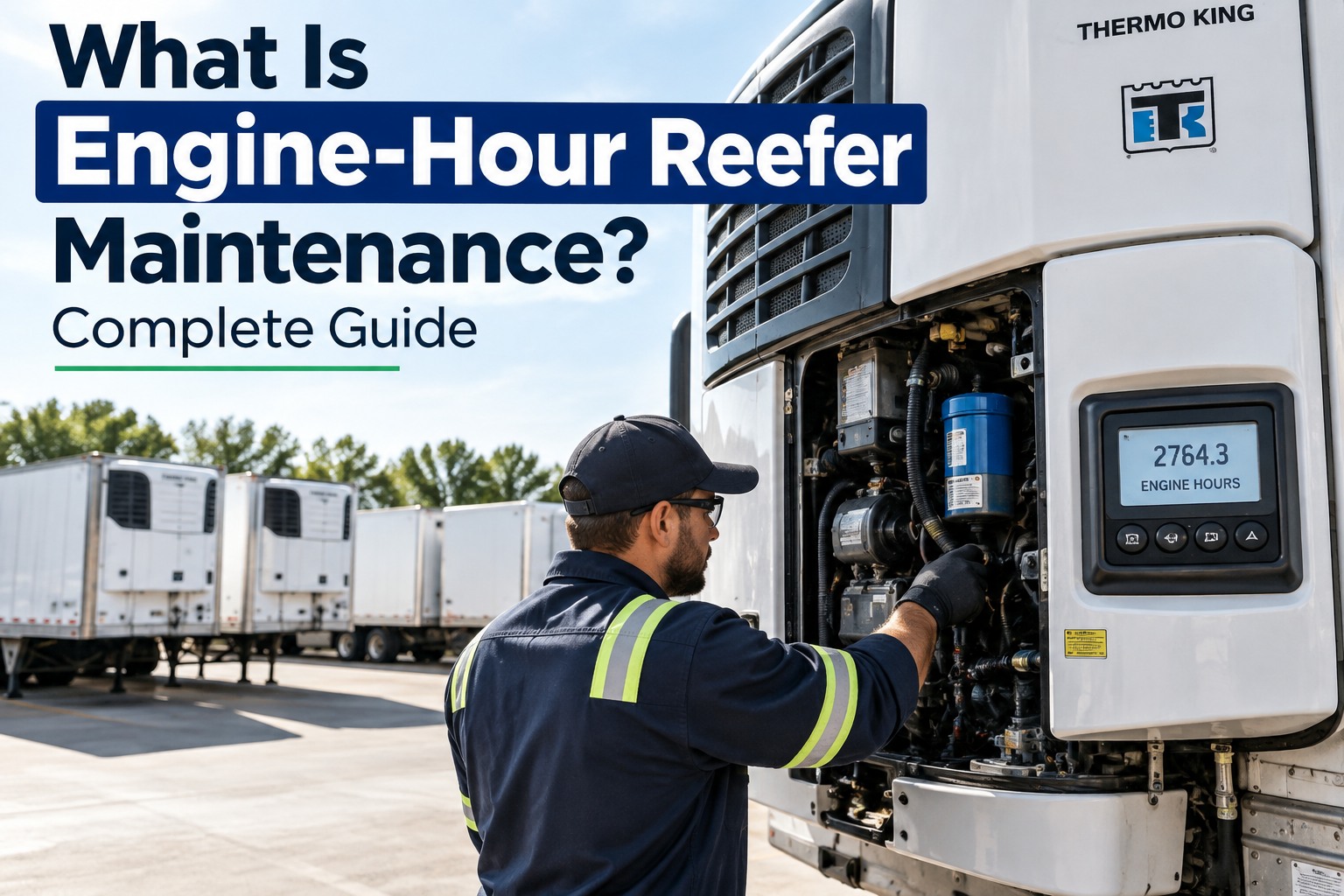
What Is Engine-Hour Reefer Maintenance? Complete Guide
A deep-dive operational guide for food and beverage carriers: compare mileage versus engine-hour service tracking, master the standard 500/1500/3000-hour PM intervals, and automate shop work orders before catastrophic compressor failure strikes.
The Fundamental Mechanical Flaw: Mileage vs. Engine-Hour Tracking
Tractor mileage and reefer compressor usage operate on completely divergent timelines. A highway truck might log 3,000 road miles in a week while the reefer only cycles on for 25 hours. Conversely, an urban distribution truck delivering dairy or seafood might only cover 250 road miles over five days, but its reefer unit runs continuously for 70 hours while stationary at docks and red lights. Sign up to decouple reefer maintenance from truck odometer miles.
When fleets track reefer maintenance using truck mileage, urban delivery units run hundreds of hours past their safe lubrication limits. The engine oil shears down, soot loads spike, and cooling capacity degrades. Engine-hour maintenance tracks the actual mechanical runtime of the diesel engine, compressor crankcase, and electric standby motor, ensuring every service interval aligns directly with component wear. Book a demo to inspect our automated engine-hour telemetry mapper.
Standard Reefer PM Interval Ladder: What to Service & When
Commercial transport refrigeration manufacturers (including Thermo King and Carrier Transicold) structure preventive maintenance around rigorous hour-based tiers to ensure cooling capacity remains intact under peak summer loads. Sign up to deploy standard PM-A, PM-B, and PM-C reefer ladders.
- Drain engine oil and install heavy-duty multi-viscosity diesel lube oil.
- Replace spin-on primary engine oil filter and secondary fuel water separator.
- Inspect and gauge drive belt tension, checking for glazing or cord fraying.
- Clean debris, insect build-up, and road grime from the condenser and evaporator coils.
- Check refrigerant receiver tank sight-glass moisture indicator and operating charge.
- Complete all core tasks included within the standard 500-hour PM-A tier.
- Replace engine air intake filter element and verify vacuator valve operation.
- Conduct load and conductance testing on the 12V auxiliary starting battery.
- Inspect alternator output voltage, starter motor draw, and terminal connections.
- Test defrost initiation and termination pressure switches and drain pan heaters.
- Complete all service procedures specified in PM-A and PM-B ladders.
- Flush cooling system, pressure test radiator, and replace extended-life coolant.
- Replace compressor drive coupling, damper bushings, and idler pulley bearings.
- Perform laboratory oil analysis on compressor lubricant for acid and metal wear.
- Calibrate return and discharge air temperature sensors against NIST-traceable probes.
The High Cost of Missed Reefer Maintenance Windows
Neglecting runtime intervals triggers compounding mechanical failures that quickly wipe out carrier shipping margins. Book a demo to evaluate your fleet's breakdown prevention strategy.
Reefer Maintenance Software Architecture: Fleet Rabbit vs. Legacy CMMS
Evaluate how Fleet Rabbit delivers automated engine-hour synchronization and mobile shop repair ticketing without the bloat of legacy enterprise CMMS packages. Sign up now to explore our maintenance software platform.
| Capability | Fleet Rabbit (Hour-Engine Built) | Standard Fleet Tracking Tools | Legacy Enterprise CMMS |
|---|---|---|---|
| Subscription Rate | $5 / asset / month | $25 – $45 / vehicle / month | $75+ / asset / mo + setup fees |
| Hour Meter Synchronization | Direct microprocessor telematics sync | Odometer miles only | Manual hours entry required |
| Automated PM-A/B/C Triggers | Dynamic alerts at 500, 1500, 3000 hrs | Not available | Requires custom development |
| Mobile Bay Work Orders | Included mobile tablet/phone app | None; manual clipboards | Clunky desktop-only portals |
| Reefer Parts Stockroom Management | Auto-deductions & low-inventory alerts | Not supported | Separate expensive module |
| Implementation & Trial | 14-day free trial, live in 14 days | 1 to 3-year locked contracts | 6-month paid consultant rollout |
Deploying Engine-Hour Reefer Maintenance in 4 Steps
Modernize your refrigerated shop operations and automate runtime service triggers with zero disruption to active customer freight schedules. Book a demo to arrange your shop onboarding timeline.
Maintenance Case Study: Polar Express Logistics
Learn how a multi-temp food distributor eliminated catastrophic reefer breakdowns and lowered shop overtime across 38 refrigerated trailers. Sign up to achieve similar reefer reliability results.
Operating 38 multi-temp trailers transporting fresh poultry and frozen bakery freight, Polar Express Logistics previously scheduled all reefer maintenance every 15,000 tractor miles. Because urban distribution units accumulated hundreds of stationary dock hours, three compressors suffered catastrophic oil shear lockups in a single summer, resulting in $65,000 in emergency towing, shop rebuilds, and rejected cargo.
By deploying Fleet Rabbit, the carrier synchronized reefer microprocessors directly with automated 500-hour engine PM triggers and equipped bay technicians with mobile tablet work orders. Unscheduled roadside reefer breakdowns dropped by 58%, in-transit compressor failures were completely eliminated, and shop technician wrench-time productivity jumped by 24%.