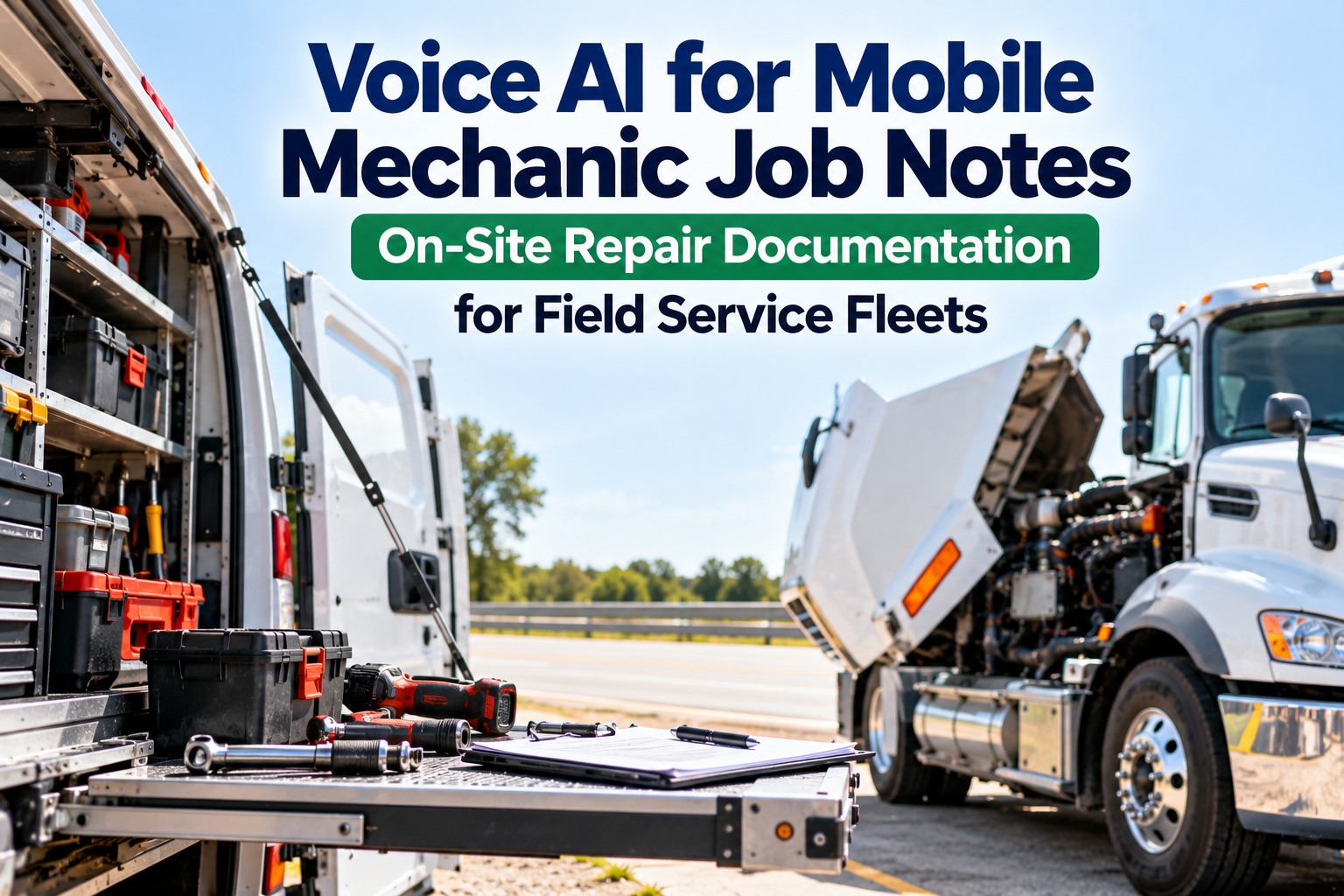
Voice AI for mobile mechanic job notes lets a field technician describe a repair out loud, at a roadside or customer yard, and turns it into a structured job record: findings, work done, parts, labor time and follow-ups. There is no keyboard to fight and no pile of notes to retype back at the shop. For fleets that send trucks and mechanics to the breakdown instead of the other way around, the note is the only paperwork, so it has to be complete. See a roadside job note get built by voice, or read the voice AI guide for fleet technicians.
VOICE JOB NOTES · MOBILE AND FIELD MECHANICS
The Shop Is Wherever the Truck Stopped. The Paperwork Should Follow.
Field mechanics do the repair on a shoulder or in a customer yard, then lose the details by the time they reach a keyboard. Dictate the note on site and leave with the record finished.
● RecordingNo signal · saving on phone
"Unit 52, no start. Both batteries weak, positive cable corroded. Replaced both and the cable end. One and a half hours on site."
Unit52
FindingsWeak batteries, corroded cable
Parts2 batteries, 1 cable end
Labor1.5 hr
Three Conditions a Keyboard Can't Survive
1
Hands full or filthy
Gloves, grease and a torque wrench in hand do not mix with a phone keyboard.
2
Wind, traffic and engines
Roadside noise is loud and constant, so capture has to cope with real conditions.
3
Patchy signal
Rural yards and shoulders drop coverage, so a job note cannot depend on being online.
A Field Job in Five Spoken Moments
A mobile job has a natural rhythm: arrive, assess, repair, bill and leave. One short spoken line at each moment is enough to build the full record, with nothing to reconstruct on the drive home.
"At the customer yard, Unit 52, no start, driver says it clicks."
Job opened: Unit 52 · arrival time stamped
"Batteries test low, one cable end corroded, no fault codes active."
Findings: low batteries, corroded cable
"Replaced both batteries and the positive cable end, started on first try."
Work done · parts: 2 batteries, 1 cable end
"Ninety minutes on site, forty miles round trip."
Labor 1.5 hr · mileage 40
"Driver signed. Recheck charging voltage on the next service."
Signed · follow-up flagged
Try it on a real call-out
Take one of your mobile jobs from last week and see how it would have been captured on site.
What a Good Roadside Repair Is Worth Documenting
Mobile repair keeps a truck from being towed, and the numbers show why. A heavy-duty tow and recovery can run $2,500 to $5,000 or more, while direct repair costs for a typical breakdown are around $450 to $760, according to Geotab. Each hour the truck sits also costs about $90.89 in driver idle time. A good record on site keeps the savings from being lost to a repeat failure.
COST PER BREAKDOWN EVENT (ROUGH RANGES, $0 TO $5,000)
Heavy-duty tow and recovery
$2,500–5,000+
Direct repair cost
$450–760
$0$1,250$2,500$3,750$5,000
of trucks returned to service had undiagnosed fault codes
Geotab's analysis of breakdown data found that a majority of trucks sent back out after a repair still carried undiagnosed fault codes. Reading and recording codes on site, by voice, is how a roadside fix stops being the first of two visits. The same analysis counts 2.6 unscheduled repairs per truck per year.
Leaving the Site: What Gets Said Before You Drive Away
Everything on this list takes seconds to say and is almost impossible to recall accurately later.
- Unit number and location confirmed
- Complaint in the driver's words
- Findings, including any fault codes read
- Work performed and parts used
- Labor time and mileage
- What was NOT fixed and why
- Follow-up needed, with an owner
- Customer or driver sign-off
No Signal? The Note Still Gets Made
Mobile work happens where coverage is worst. A field app should capture the note on the phone first and send it when a connection returns. FleetRabbit's voice AI guide describes offline operation with later sync.
ON SITE
Speak the note
Saved on the phone with a timestamp.
→
NO SIGNAL
Held in queue
Nothing is lost while offline.
→
BACK ONLINE
Synced to the job
Attached to the work order for the office.
A Note on the Market
Voice AI is growing fast. One research firm projects the AI voice agent market growing from about $2.54 billion in 2025 to $35.24 billion by 2033. That figure covers voice agents broadly, such as receptionists and support lines, rather than technician note-taking tools, but it shows how quickly voice interfaces are becoming normal for work that used to require a keyboard.
AI VOICE AGENT MARKET, BILLIONS OF DOLLARS
Give Every Field Job a Complete Record Before the Truck Rolls
FleetRabbit's voice AI turns spoken technician observations into structured work order data: faults, parts, time and next steps, with no screen needed.
See how voice closes a work order.
Hands-free job notes
Works with patchy signal
Parts, labor and mileage
Follow-up flags
Frequently Asked Questions
What is voice AI for mobile mechanic job notes?
It is software that lets a field mechanic dictate job notes on a phone and converts them into structured records covering findings, work done, parts, labor time, mileage and follow-ups, without typing.
Why not just type notes after the job?
Notes written later are shorter and less accurate, and they cost evening time. Spoken notes made while the details are fresh include the measurements, part numbers and observations that matter at the next visit.
Does it work without cell coverage?
FleetRabbit's guide describes offline capture with later sync. Confirm how it behaves in your dead zones by testing in the worst spots on your routes before rolling it out.
Can it capture fault codes?
Technicians can read codes aloud as they scan and have them recorded in the job note. That matters because a large share of trucks returned to service in one analysis still had undiagnosed codes. See
the voice AI guide for how spoken data becomes structured.
How does a mobile mechanic bill from a voice note?
Labor time, mileage and parts are extracted into their own fields, so the office can build an invoice from the record without calling the technician to ask what happened.
Will it work in wind and traffic noise?
Results depend on the microphone and conditions. Test with a headset or phone mic on real roadside calls, and review the first notes for misheard part names and numbers.
Can customers sign off on site?
A signature step at the end of the job lets the driver or customer confirm the work on the phone. Ask your vendor how signatures are stored and shared with the customer.
Finish the Job and the Paperwork at the Same Time
When the repair happens in the field, the record should too. Talk it through before you pack the tools.
Free tier for up to 3 vehicles · No credit card required · Notes attach to the work order
October 3, 2026
By Emily Parker
All Articles