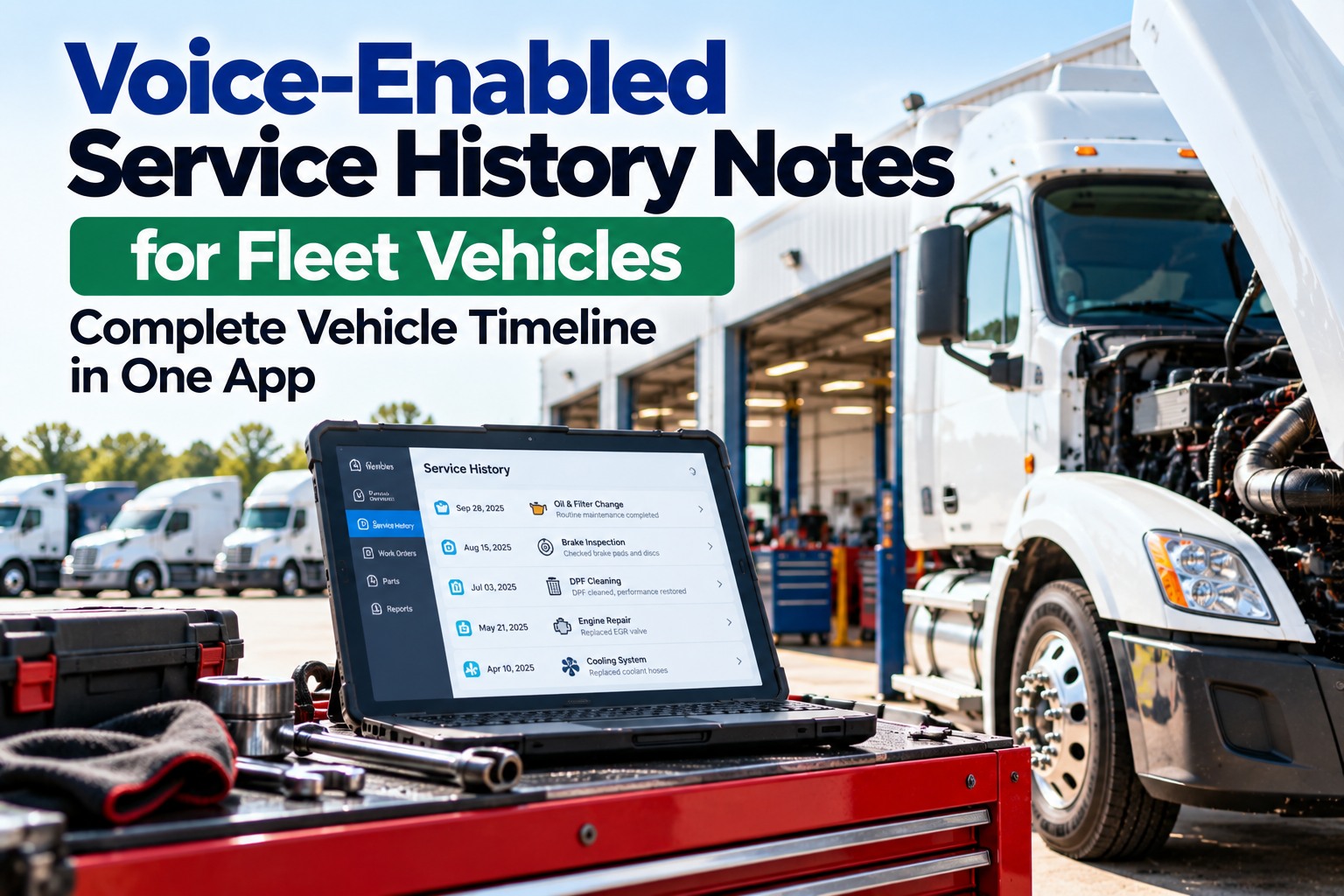
Voice-enabled service history notes let a technician add the reasoning to a vehicle's record by speaking it: why the repair was done, what was found and what to watch next. A service history that lists only dates and invoices tells a reader what happened. One that includes the reason tells them what to do next. For fleets losing experienced technicians, those spoken reasons are some of the most valuable data in the system. See a vehicle timeline get built by voice, or read the voice AI guide for fleet technicians.
VOICE SERVICE HISTORY · VEHICLE TIMELINES
A Repair Without a Reason Is Only Half a Record
Invoices say what was replaced. Technicians know why. Capture that reasoning by voice, in seconds, and attach it to the exact entry in the vehicle's history.
UNIT 52 · SERVICE HISTORY
Nov 2023
Water pump replaced
"Coolant loss twice in six weeks. Seal weeping, impeller pitted."
Feb 2025
Alternator replaced
"Repeat cold no-start. Batteries good, alternator output low."
What a Standard Service Record Holds, and What It Leaves Out
Most fleet records capture the same six things. They are essential, but none of them explains the decision behind the work. The reason is the seventh field, and it is the one that usually goes missing.
Vehicle ID: VIN, unit number, plate
Date and odometer
Work performed
Parts and cost
Technician observations
Service provider
The reason: why it was done and what the tech saw
The Same Repair, Two Ways to Remember It
RECORD WITHOUT CONTEXT
Nov 2023 · 121,900 mi
Replaced water pump. Parts $410, labor 3.0 hours.
Next reader asks: was this wear, a defect or a symptom of something else?
RECORD WITH A VOICE NOTE
Nov 2023 · 121,900 mi
Replaced water pump. Parts $410, labor 3.0 hours.
"Coolant loss twice in six weeks. Seal weeping, impeller pitted. Hoses checked first and were fine."
Next reader knows the cause, the checks already done and what to compare.
Pick a truck and rebuild its story
We will take one unit's last three repairs and show how spoken context would have changed its history.
One Vehicle, Three Years, With the Reasons Attached
When context is attached to each entry, the history reads like a story. Patterns such as the coolant losses before the pump and the repeat no-start before the alternator become easy to see. The unit and entries below are an illustration.
Mar 202248,200 mi
Aftertreatment PM and DEF filter
WHY, BY VOICE
"Driver reported frequent regens on short routes. Moved this truck to longer lines."
Nov 2023121,900 mi
Water pump replaced
WHY, BY VOICE
"Coolant loss twice in six weeks. Pump seal weeping, impeller pitted. Checked hoses first, they were fine."
Jun 2024156,300 mi
Front brake chambers and slack adjusters
WHY, BY VOICE
"Stroke out of range on both sides after a mountain run. Recheck at next PM."
Feb 2025188,700 mi
Alternator replaced
WHY, BY VOICE
"Repeat no-start in cold weather. Batteries tested good, so alternator output was the cause."
What Buyers and Appraisers Look For
Records are not only for the shop. When a truck is sold, appraisers go through six categories. A buyer who cannot rule out a bad history tends to price in the worst plausible case, which is why a documented history is often cited as worth a premium of 10 to 20 percent.
1
Preventive maintenance
Scheduled service, not just reactive repairs.
2
Repair records
What failed and how it was fixed. Repeats are a warning.
3
Major components
Engine or transmission replacements, with dates.
4
Inspection history
Proof that problems were caught early.
5
Mileage and meter readings
Odometer claims that match service dates.
6
Maintenance cost trends
Rising costs hint at when to replace.
COMMONLY CITED VALUE GAP, INDEXED TO 100 FOR AN UNDOCUMENTED VEHICLE
Documented history
110–120
The range is a commonly cited rule of thumb from fleet remarketing guides, not a guarantee. Your results depend on the vehicle, the market and the buyer.
When a Technician Leaves, the Reasoning Shouldn't
ATRI's research found that 44% of truck technicians are considering other jobs, annual turnover averaged 16.5% in 2024 and the average vacancy rate was 19.3%. Every departure takes unwritten knowledge, such as why a unit gets a different PM interval, with it. Spoken notes are the fastest way to get that knowledge into the record before it walks out the door.
44%
of truck technicians considering other jobs
16.5%
average annual technician turnover in 2024
19.3%
average technician vacancy rate
From Spoken Reason to Searchable History
1
Speak
The tech says why the work was done.
→
2
Attach
The note is tied to the repair on that unit.
→
3
Build
The vehicle timeline updates in order.
→
4
Find
Anyone can search by unit, part or symptom.
Who Reads the History, and What They Want
NEXT TECHNICIAN
Skip what was already ruled out
Sees the checks done last time and starts from the right place.
FLEET MANAGER
Spot repeat repairs
Sees which units keep failing in the same way and decides repair or replace.
BUYER OR AUDITOR
Trust the record
Finds a consistent, dated history that explains the work, fast.
Give Every Truck a History That Explains Itself
FleetRabbit's voice AI turns spoken technician observations into structured records tied to the vehicle, so the reason behind each repair travels with it.
See how voice closes a work order.
Reasons by voice
Per-vehicle timeline
Searchable history
Repeat-repair view
Frequently Asked Questions
What are voice-enabled service history notes?
They are spoken technician comments attached to a repair or service entry on a vehicle's record. The app transcribes them, ties them to the right unit and entry and keeps them searchable alongside parts, labor and dates.
What should a fleet service history include?
Vehicle identification, date and odometer, work performed, parts and cost, technician observations and the service provider. Add the reason for the repair so later readers understand the decision.
Why do records without context fall short?
A line that says a part was replaced does not say whether it wore out, failed early or was swapped to chase another problem. Without that, repeat failures and patterns are hard to spot.
Does a good service history raise resale value?
Fleet remarketing guides commonly cite a premium of 10 to 20 percent for documented history versus none. Treat it as a rule of thumb, since actual results vary by vehicle and market.
Can voice notes be edited later?
They should be. Ask your vendor how corrections work and who can change an entry, so records stay accurate and the history stays trustworthy.
How does it help with technician turnover?
When someone leaves, their reasoning leaves too unless it is written down. Spoken notes make it quick enough to record the why on every job. See
the voice AI guide.
Does it work in a noisy shop?
Results depend on noise and microphone placement. Pilot it in a busy bay and review the first notes for misheard part names.
The Next Person Will Thank You for the Why
A few spoken sentences at the end of a repair can save hours of guesswork later. Start with the trucks that cost you the most.
Free tier for up to 3 vehicles · No credit card required · Notes tied to each unit's history
October 3, 2026
By Sam Parker
All Articles