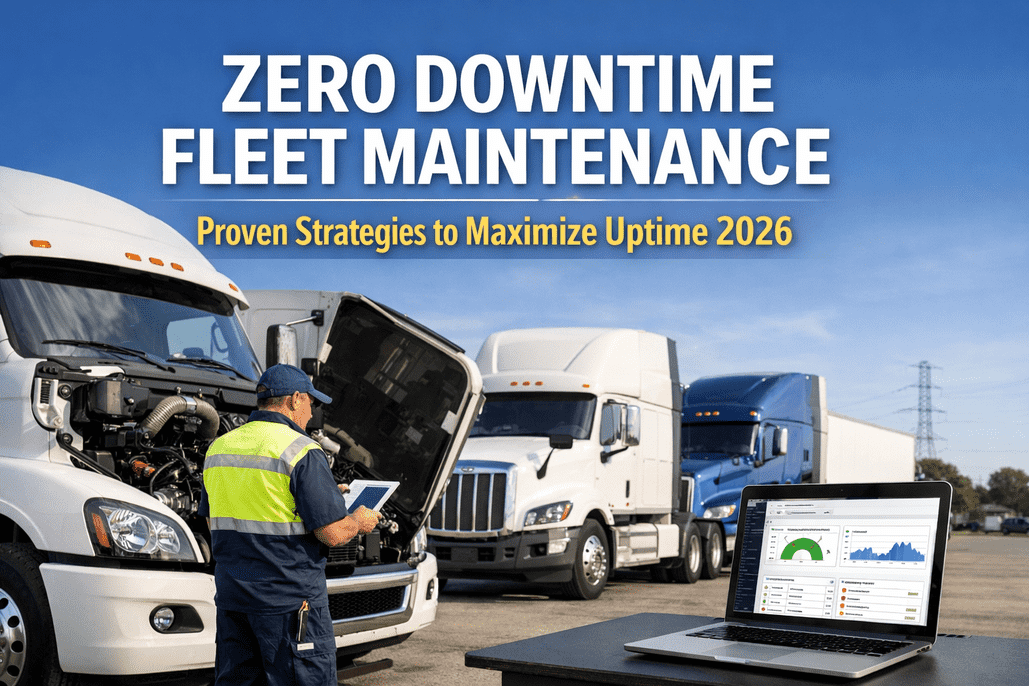
Every minute a truck sits idle costs your fleet $448-$760 per day in lost revenue—before towing, emergency repairs, and missed delivery penalties. The best-performing fleets in 2026 aren't just reducing downtime; they're engineering it out of existence. By combining predictive maintenance, real-time monitoring, and strategic scheduling, top operators achieve 95-99% uptime while cutting maintenance costs by 25-30%. Here's your complete playbook for building a zero unplanned downtime strategy. Start maximizing fleet uptime with FleetRabbit.
The True Cost of Downtime
Unplanned downtime costs the world's 500 biggest companies $1.4 trillion annually—11% of total revenues. For trucking fleets, a single breakdown triggers a cascade of expenses far beyond the repair bill.
The 5-Pillar Zero Downtime Framework
Achieving near-zero unplanned downtime requires a systematic approach addressing prevention, detection, and rapid response. Top fleets build their strategy on five interconnected pillars.
Predictive Maintenance
AI analyzes sensor data to predict failures 30-90 days ahead, enabling proactive repairs before breakdowns occur.
Preventive Scheduling
Time and mileage-based service intervals catch wear before it becomes failure. Every $1 spent saves $4 in repairs.
Real-Time Monitoring
Continuous telematics data streams identify anomalies the moment they develop—before drivers notice symptoms.
Rapid Response
Pre-planned emergency protocols minimize time from breakdown to back on road with vendor networks ready.
Continuous Optimization
Data-driven analysis refines processes monthly, compounding improvements that reduce future downtime events.
Predictive Maintenance: Forecasting Failures
Major fleets like Penske process 300+ million vehicle messages daily, using AI to spot patterns that signal developing problems weeks before failure. The result: repairs scheduled during planned downtime, not emergency roadside calls.
Engine Issues
Temperature, oil pressure, and vibration patterns reveal problems 30-90 days before failure
Brake Systems
Pad wear, fluid levels, and pressure patterns predict when service is needed
Transmission
Shift patterns, fluid temperature, and RPM correlations identify degradation
Battery Health
Voltage patterns and charge cycles predict failures before no-start events
Cooling System
Coolant trends and fan cycling patterns catch radiator and pump issues early
Tire Failures
TPMS data combined with tread wear patterns prevent dangerous blowouts
Building Your Predictive Foundation
Preventive Maintenance Excellence
While predictive catches developing issues, preventive ensures regular service happens before problems start. Fleets with strong PM compliance experience 20% fewer downtime days than those without structured programs.
Optimal PM Schedule
(Driver) Pre-trip DVIR, fluid levels, tire pressure visual, lights test, brake check
(5K miles) Oil/filter change, comprehensive fluids, suspension, exhaust, steering
(15K miles) Brake service, transmission fluid, cooling system, electrical, alignment
Achieving 95%+ PM Compliance
Real-Time Monitoring & Alerts
Continuous monitoring bridges the gap between scheduled maintenance and unexpected issues. Modern telematics capture thousands of data points per second, providing instant visibility into vehicle health.
Automated Alert-to-Action Workflow
Emergency Response Protocols
Even the best prevention can't eliminate every breakdown. Pre-planned response protocols minimize time from incident to resolution. Top fleets reduce emergency repair time by 20% with structured procedures.
- Driver safely positions vehicle
- Diagnostic codes captured
- Dispatch notified via app
- Location confirmed
- Remote diagnostic review
- Roadside fix or tow decision
- Nearest service identified
- Load protection activated
- Mobile tech dispatched
- Tow service ordered
- Parts availability confirmed
- Customer ETA updated
- Backup truck identified
- Load transfer coordinated
- Delivery rescheduled
- Driver reassignment
Building Your Response Network
KPIs & Continuous Optimization
Zero downtime isn't achieved once—it's maintained through continuous improvement. Fleets that embrace data-driven optimization report 18% improvement in downtime metrics over three years.
Fleet Uptime %
(Total Time – Downtime) ÷ Total Time × 100
Target: 95%+ | World-class: 99%+
PM Compliance Rate
Services On Time ÷ Services Due × 100
Target: 95%+ | Industry avg: 84%
Mean Time to Repair
Total Repair Time ÷ Number of Repairs
Target: Under 24 hrs | Avg: 1.68 days
Unplanned Ratio
Unplanned Repairs ÷ Total Repairs
Target: Under 20% | World-class: Under 10%
Monthly Optimization Review
Technology Investment
Building a zero downtime operation requires integrated technology connecting vehicles, maintenance systems, and decision-makers in real-time.
CMMS Platform
Centralizes scheduling, work orders, history, compliance
$20-$50/vehicle/moTelematics Hardware
Captures real-time engine data, fault codes, location
$100-$300/vehiclePredictive Analytics
AI-powered failure forecasting and optimization
$15-$50/vehicle/moMobile Apps
Driver DVIR, issue reporting, communication
Included in CMMS12-Month Implementation Roadmap
Audit processes • Deploy CMMS • Digitize records • Establish PM schedules • Pilot telematics
Milestone: 85% PM complianceConnect telematics to CMMS • Configure alerts • Train technicians • Build KPI dashboards • Vendor network
Milestone: Automated work ordersDeploy predictive analytics • Refine thresholds • Optimize inventory • Fleet-wide telematics • Mobile service
Milestone: 50% fewer unplanned eventsFine-tune models • 95%+ PM compliance • 95%+ uptime target • Continuous improvement • ROI validation
Milestone: Zero unplanned cultureCase Study: 50-Truck Fleet Results
Regional Trucking Company
Frequently Asked Questions
Zero unplanned downtime is the goal. Top fleets achieve 99%+ availability by converting breakdowns into planned service events. Scheduled maintenance still requires some downtime, but it's controlled.
Fleets with 10-15+ vehicles benefit if equipment is high-value ($150K+) or heavily utilized. Smaller fleets can start with strong PM programs and add predictive capabilities as they scale.
Most fleets see measurable improvement within 3-6 months. Full ROI typically occurs within 12-18 months. The first prevented breakdown often pays for several months of investment.
Yes. Aftermarket OBD-II devices retrofit older vehicles with basic telematics. They won't capture as much data as factory systems but provide valuable diagnostics and GPS.
Poor PM compliance is the leading cause of preventable downtime. Fleets below 75% compliance experience significantly more breakdowns. Focus on 95%+ compliance first.
Predictive maintenance provides weeks of advance notice, enabling just-in-time ordering. Integrate CMMS with suppliers for automated procurement when predictions trigger.
Key Takeaways
Ready for Zero Unplanned Downtime?
FleetRabbit provides the CMMS foundation—centralizing maintenance, automating scheduling, and tracking every metric that matters.