Materials compliance looks like a collection problem and is actually a currency problem. You can run a flawless campaign, achieve a high response rate and file on time, and still be holding declarations that fail — because the template version moved, the smelter reference list underneath it was updated, and a supplier submitted something complete by their standards and incomplete by your customer's. That pattern repeats annually at organisations that treat version tracking as a technical detail rather than an operating discipline. Worth stating one thing plainly before anything else: a completed reporting template is not a certificate. It supports data collection and due diligence; it does not independently prove compliance. A full filing cabinet of them tells you that you asked, not that your supply chain is clean. Talk to a solutions engineer about how much of your current declaration set is still valid.
Materials Compliance · Minerals Declarations
Supply Chain Data for Materials Compliance
Running declaration campaigns that produce usable data rather than returned files, keeping a set current against templates that move every year, chasing the gaps that actually matter, and arriving at an audit with escalation you can evidence.
Current versions — all reissued 17 April 2026
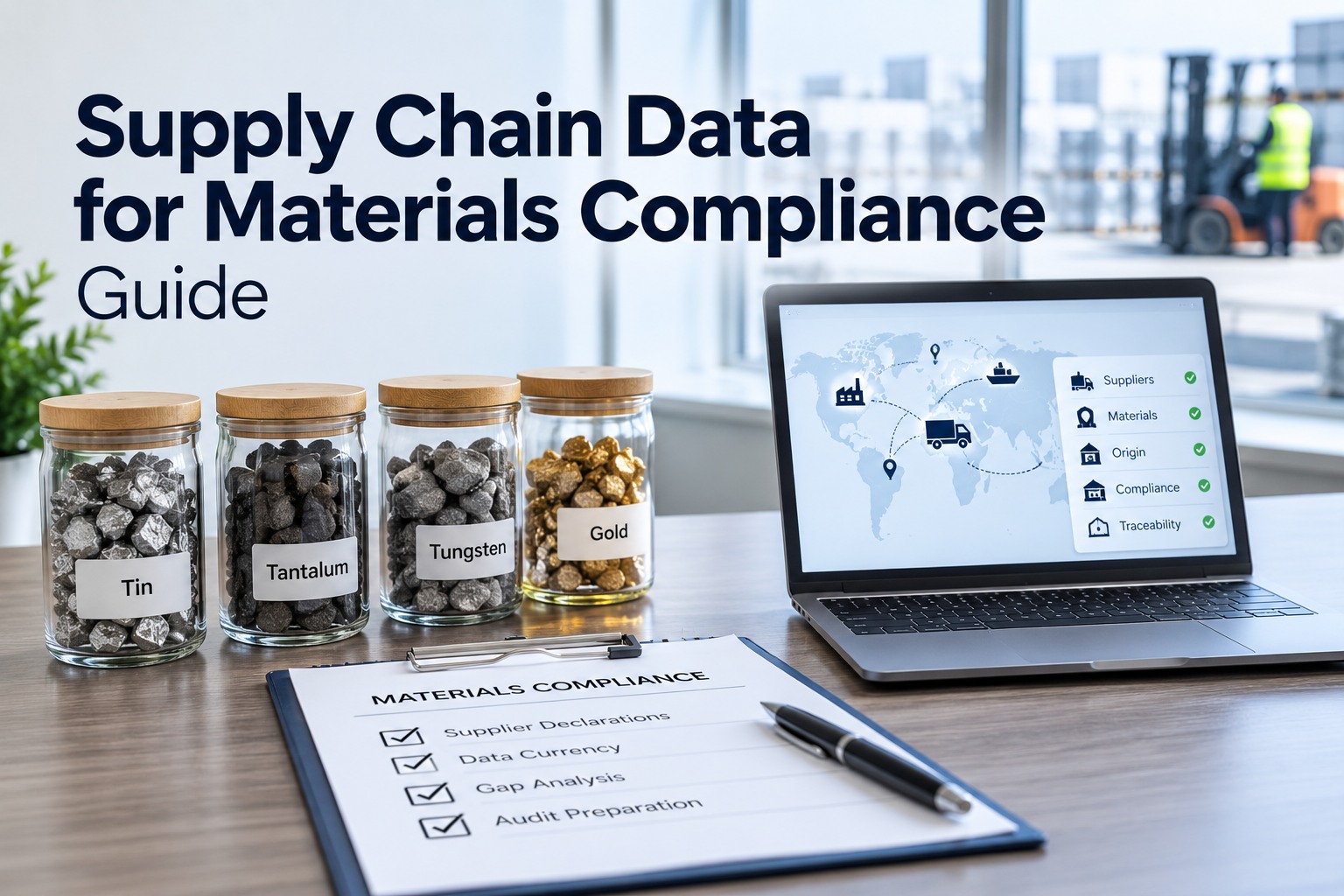
CMRT 6.6Tin, tantalum, tungsten, gold
EMRT 2.11Cobalt, mica, copper, graphite, lithium, nickel
AMRT 1.31Additional minerals in scope
Which Template, and Why It Matters
Three templates, three different drivers. Confusing them wastes supplier goodwill on the wrong request.
Swipe to see all columns
The expansion of the extended template to six minerals is described as a direct response to battery regulation, which tells you where this is heading. Materials reporting scope has grown with each electrification requirement, and there is no indication of that stopping — so build a process that absorbs a new mineral rather than one scoped to the current list.
The Currency Problem
The failure that repeats annually, and the one most programmes never diagnose because the symptom looks like supplier non-compliance.
What happens
A declaration complete by one standard and incomplete by anotherSuppliers submit files that are complete according to their own standards but incomplete according to the customer's current requirements — because they used a version they had saved, and the reference data underneath it has since moved.
Why it hides
A stale declaration looks completeNothing about an outdated submission announces itself. It arrives filled in, on time and apparently thorough — and only fails when a customer's system processes it or an auditor checks which version it was built on.
The fix
Source the template, do not let suppliers find oneObtain templates from the official source rather than from old email attachments, supplier portals or locally saved copies — and validate version on receipt rather than on submission. Version awareness is a business discipline, not a technical footnote.
The detail underneath this is the smelter reference data. Updates to the smelter reference and standard smelter lists ship with each release, which means a declaration built on last year's template carries last year's smelter universe — and a smelter that has since lost or gained conformance status will be recorded incorrectly through no fault of anyone involved.
Smelter Disclosure Is Where It Gets Hard
Described as the most operationally demanding part of completion, and the most common failure point.
Swipe to see all columns
That last row is the one auditors increasingly focus on. Customers and regulators are described as expecting traceable smelter logic and documented escalation where high-risk or unknown smelters are reported. Reporting an unverified smelter is not itself a failure. Reporting one with no evidence of follow-up is — because it shows the gap was recorded rather than worked.
2,000+
supplier surveys annually
For 3TG alone, at a typical large manufacturer — before cobalt and mica are added
At that volume, spreadsheets stop being a choice
Manual collection across several hundred to several thousand suppliers is described as no longer scaling — and each survey needs the correct version distributed, incomplete responses chased, smelter identities validated and the whole set reconciled against the current conformance list. Bring your current supplier list and last cycle's response data to a 30-minute session and we'll show you where the effort is actually going.
Run the Campaigns Together, Not Separately
A structural decision that removes a large amount of avoidable work and supplier irritation.
Separate campaigns duplicate outreach
Where conflict minerals and extended minerals campaigns run independently through spreadsheets and email, companies duplicate supplier outreach, lose track of product scope and create conflicting records. The same supplier gets asked twice for overlapping information by two people.
Coordinated campaigns reuse the data
A single coordinated process allows supplier and product data to be reused across both reporting streams. That halves the supplier burden on overlapping fields, which directly improves the thing everybody struggles with — response rate.
And it fixes the scope confusion
Conflicting records between two streams is a reconciliation problem nobody budgets for. One scope definition, referenced by both campaigns, removes an entire class of contradiction before it can be created.
Chasing the Gaps That Matter
Not every non-response is equal, and treating them equally is why chase effort produces so little.
01No response at allThe visible gap, and usually the one that absorbs all the chase effort. Worth ranking by whether the supplier's materials are actually in scope before escalating — a non-response from a supplier of a material with no relevant content is a low-value pursuit.
02Complete-looking but staleThe invisible gap, and the more dangerous one. A declaration on an obsolete version with outdated smelter reference data passes a completeness check and fails a validity one. Nobody chases these because nobody has flagged them as missing.
03Smelter entries that will not validateNames that do not reconcile against the reference list, or statuses that contradict current conformance. These need correction rather than chasing, and going back to the supplier for a free-text name they have already given you rarely produces a different answer.
04Declared gaps with no escalationAn unverified smelter honestly reported and then left alone. The declaration is fine; your due diligence is not. This is the gap most likely to be raised at audit and the least likely to be on a chase list.
One capability worth having before the next campaign, because it changes what chasing means: validation that flags incomplete, outdated or inconsistent disclosures before submission rather than after. Recent template versions carry expanded validation that rejects inconsistent submissions at the template level — but that only helps if somebody is checking rather than filing.
The Cascade Nobody Controls
Three realities about how this actually propagates, and why your response rate is partly somebody else's problem.
Your suppliers depend on theirs
A tier one supplier must collect updated responses from tier two and tier three before they can answer you accurately. A slow response is frequently a supplier waiting on their own supply base rather than ignoring you — which changes how escalation should be framed.
Smaller suppliers need help, not pressure
Suppliers with limited compliance resources are described as requiring training or portal-based guidance to complete new fields. When a template adds fields, the smallest suppliers are the ones who stall — and providing the guidance costs less than the chase cycle that follows its absence.
Conformance status is not yours to fix
Smelters must maintain their own conformance to appear as compliant in a submitted template. Where one lapses, your declaration changes through no action of your own — which is exactly why an annual refresh is a floor rather than a target.
A complete file is not the same as a clean supply chain
The reporting template is a data collection instrument, not a certification or legal certificate — completing it supports due diligence without independently proving compliance. That distinction matters at audit, where the question is not whether you collected declarations but whether you acted on what they said. A file full of returned templates showing unverified smelters, with no documented escalation against any of them, demonstrates a process that ran rather than a programme that worked.
Arriving at an Audit Prepared
Six things to be able to produce. The first three are collection artefacts and the last three are the ones that get asked about.
The declarations themselvesOn current versions, with the version recorded against each so you can demonstrate currency rather than assert it.
Campaign coverageWho was surveyed, against which scope, and why anyone in the supply base was excluded. Exclusion reasoning is part of the record.
Response and chase historyWhat was requested, when, how often, and what was received. This demonstrates effort where responses never arrived.
Escalation on declared gapsWhat you did about unverified or unknown smelters, documented. The expectation is traceable logic and evidenced escalation, not a note that the gap exists.
Smelter validation recordReconciliation against the conformance list at a stated date, since a status valid last quarter may not be valid now.
Product-level linkageWhich declarations cover which products, since customer requests increasingly expect mineral-level documentation at product or bill-of-materials level rather than at company level.
Getting the Cycle Right
Five practices. The first is the one that makes the annual refresh survivable.
1Check versions before the campaign, not duringVerify current template versions and mineral scopes from the official source before each cycle opens. Discovering mid-campaign that you distributed a superseded version means restarting with suppliers who have already responded once.
2Distribute the template rather than requesting oneIf suppliers find their own, some will use a saved copy from a previous year. Sending the current file removes an entire category of stale submission, and it costs nothing.
3Validate on receiptVersion, completeness, smelter reconciliation and internal consistency checked as files arrive rather than at filing. A rejection identified in week two is recoverable; one found in week eleven is not.
4Refresh at least annually, and on triggerAnnual refresh is the stated minimum. Add triggers — a new template version, a supplier change, a new product introduction, a conformance status change at a smelter you rely on.
5Work the escalations as a queue, not a noteEvery declared gap becomes an item with an owner and a next action. This is the difference between a programme that can evidence due diligence and one that can only evidence collection.
Frequently Asked Questions
Which template versions are current?The conflict minerals template at version 6.6, the extended minerals template at 2.11 and the additional minerals template at 1.31, all released on 17 April 2026. Earlier releases including CMRT 6.1, 6.22 and 6.5 and EMRT 2.0 are historical and should not be presented as current. Obtain templates from the official source before each cycle rather than from saved copies or old email attachments, since supporting lists and instructions change with each release.
What is the difference between the templates?The conflict minerals template covers tin, tantalum, tungsten and gold, and supports mandatory legal compliance obligations. The extended template covers cobalt, mica, copper, natural graphite, lithium and nickel, and is typically driven by customer and ESG requirements rather than statute. The additional template covers further minerals within the defined scope. Select by the materials involved and by what your customers are asking for, rather than by which one you ran last year.
Why do our declarations keep failing when suppliers say they are complete?Almost always a version problem. Suppliers submit files complete according to their own standards but incomplete according to the current requirements, because they used a saved template and the smelter reference data underneath has since been updated. A stale declaration looks complete — it arrives filled in and on time — and only fails when a system processes it or an auditor checks which version it was built on. Distribute the current template rather than requesting one.
What is the hardest part of completion?Smelter and refiner disclosure, described as the most operationally demanding part and the most common failure point. It requires smelter name, country and materials processed, certification status under the assurance process, whether minerals originate from conflict-affected or high-risk areas, and follow-up documentation where smelters are unaudited or unverified. That last item is increasingly where attention focuses — reporting an unverified smelter is not a failure, but reporting one with no evidence of follow-up is.
How often should declarations be refreshed?At minimum annually, which is the stated guidance. Add event triggers on top: a new template version, a change in your supply base, a new product introduction, or a change in conformance status at a smelter you depend on. That last one matters because smelters must maintain their own conformance to appear compliant — so a declaration can become inaccurate through actions entirely outside your control or your supplier's.
Does a completed template prove compliance?No. It is a reporting template rather than a certification or legal certificate — completing it supports data collection and due diligence but does not independently prove compliance. At audit the question is not whether you collected declarations but whether you acted on what they contained. A file of returned templates showing unverified smelters with no documented escalation demonstrates a process that ran rather than a programme that worked.
At what point does manual collection stop working?Earlier than most organisations admit. A large manufacturer typically manages two thousand or more supplier surveys annually for conflict minerals alone, with volume rising further once cobalt and mica are added — and manual collection across several hundred to several thousand suppliers is described as no longer scaling. Each survey requires correct version distribution, chase on incomplete responses, smelter validation and reconciliation against the current conformance list. Start free with three assets and build the record properly before the next cycle.
Collect Once, Keep It Current, Evidence the Escalation
Verify versions before opening a campaign and distribute the template rather than asking suppliers to find one, validate on receipt so failures are recoverable, run conflict and extended minerals campaigns together so supplier data is reused rather than requested twice, refresh annually and on trigger — and treat every declared gap as a queue item with an owner, because collection is what you can already prove and due diligence is what you will be asked about.
3TG
Cobalt & mica
Copper, graphite, lithium, nickel
Scope keeps growing
Template versions, mineral scopes and release dates reflect published information at the time of writing and are updated periodically — verify current versions and scopes from the official source before beginning each reporting campaign. This is general guidance rather than legal advice on your specific reporting obligations.