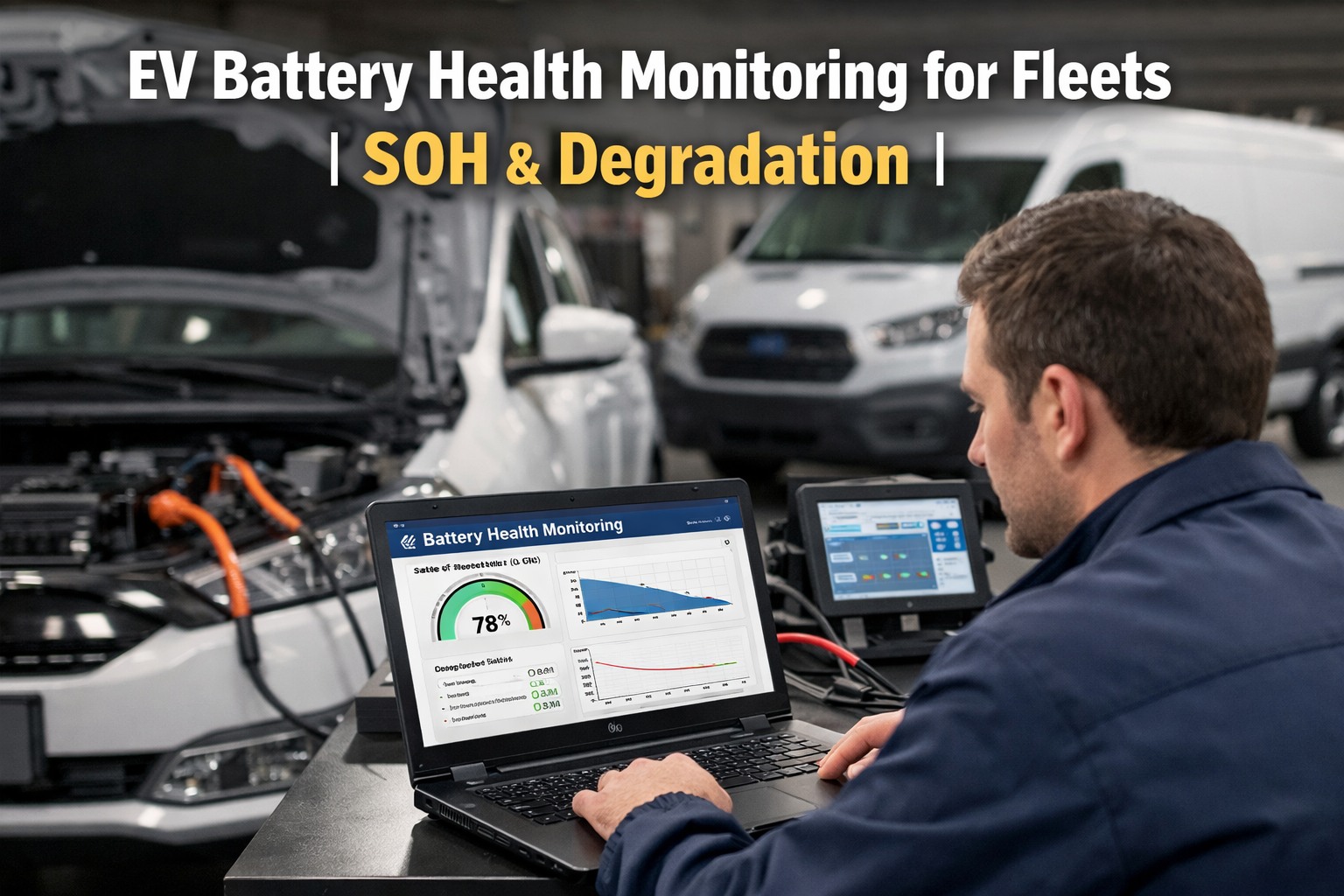
Battery is the largest EV TCO variableand state of health monitoring is critical for fleet success. The battery pack represents 30-40% of an electric vehicle's value, making it the single most expensive component to replace. Unlike combustion engines with predictable maintenance schedules, EV batteries degrade based on complex factors: charging patterns, temperature exposure, driving behavior, and time. Fleets that monitor battery health proactively extend battery life 20-30%, avoid unexpected replacement costs, and optimize their total cost of ownership. Those that don't face surprise degradation, warranty disputes, and premature battery failures that destroy EV economics. This guide covers everything fleet managers need to know about EV battery health monitoring, from understanding state of health metrics to implementing fleet battery management systems that protect your largest EV investment. Start monitoring your EV fleet battery health today, or schedule a battery monitoring demo.
EV Battery Health Monitoring for Fleets
Track state of health, forecast degradation, manage warranties, and optimize battery replacement timing across your commercial EV fleet.
What is EV Battery Health Monitoring for Fleets?
EV battery health monitoring tracks the condition, capacity, and performance of electric vehicle batteries across your fleet. At its core, this involves measuring State of Health (SOH)—the percentage of original battery capacity remaining compared to when the battery was new. A battery at 100% SOH delivers its full rated range; at 80% SOH, it delivers only 80% of original range.
Fleet battery management goes beyond simple SOH tracking. Comprehensive EV battery monitoring software analyzes charging patterns, temperature exposure, driving behavior, and historical trends to forecast future degradation. This predictive capability transforms battery management from reactive (discovering problems after they occur) to proactive (preventing problems before they impact operations). Start tracking your fleet battery health now.
Why Fleets Must Track Battery Degradation
Protect Your Largest Asset
Battery packs cost $10,000-$30,000+ to replace. Monitoring protects this investment and maximizes useful life.
Maintain Range Reliability
Degraded batteries reduce range, affecting route planning and service reliability. Know your actual capacity.
Preserve Warranty Rights
Document battery performance to support warranty claims. Most warranties guarantee 70-80% SOH for 8 years.
Plan Replacements Proactively
Forecast when batteries will need replacement to budget and schedule without disrupting operations.
Why Battery Health Monitoring is Critical for Commercial EV Fleets
The battery represents the single largest variable in EV total cost of ownership. While fuel and maintenance savings make EVs attractive, unexpected battery degradation or early replacement can eliminate these advantages entirely. Schedule a demo to see battery health tracking in action.
EV Total Cost of Ownership Breakdown
Impact of Battery Degradation on TCO
- 10% faster degradation = $2,000-5,000 additional cost per vehicle
- Early replacement (year 6 vs 10) = $15,000+ unplanned expense
- Warranty claim failure = Full replacement cost on fleet
- Reduced resale value = Lower SOH = lower vehicle value
Protect Your EV Fleet Investment
FleetRabbit's battery health dashboard tracks SOH, forecasts degradation, and alerts you to warranty thresholds across your entire EV fleet.
Key Features of Fleet EV Battery Monitoring Software
Comprehensive fleet battery management systems provide visibility and analytics that transform how you manage EV assets. Here are the essential capabilities every commercial EV fleet needs. Try FleetRabbit's battery monitoring features free:
State of Health (SOH) Tracking
Real-time battery state of health tracking for every EV in your fleet. View current capacity percentage, compare against original specifications, and track changes over time. Dashboard shows fleet-wide SOH distribution and flags vehicles below thresholds.
Battery Degradation Forecasting
AI-powered fleet battery degradation forecast predicts future SOH based on current trends, charging patterns, and usage profiles. Project battery health 6 months, 1 year, and 3 years ahead to plan proactively.
Temperature Monitoring
Track battery temperature during charging, driving, and parking. Identify vehicles exposed to extreme heat or cold that accelerates degradation. Alert when temperatures exceed optimal ranges.
Charging Behavior Analytics
Analyze charging patterns that impact battery life: DC fast charging frequency, charging to 100% regularly, charging while hot. Identify drivers or vehicles with harmful charging habits.
Battery Lifecycle Management
Complete EV battery lifecycle fleet tracking from deployment to retirement. Record charging cycles, deep discharge events, and maintenance interventions. Build comprehensive battery history for warranty and resale.
Fleet Battery Analytics Dashboard
Centralized battery health dashboard showing fleet-wide metrics: average SOH, degradation trends, warranty status, and replacement forecasts. Compare battery performance across vehicle models and usage patterns.
EV Battery Degradation: Causes and Prevention
Understanding what causes battery degradation helps fleets implement policies and practices that extend battery life. Most degradation factors are controllable through proper fleet management. Book a consultation to optimize your EV charging strategy.
Fast Charging Impact
DC fast charging generates heat and stresses battery cells. While convenient, frequent fast charging accelerates degradation by 20-30% compared to Level 2 charging.
Extreme Temperature Exposure
Batteries degrade faster in extreme heat (>95°F) or cold (<32°F). Hot climates accelerate chemical degradation; cold climates stress cells during charging.
Charging Cycles
Every charge-discharge cycle causes small capacity loss. High-mileage fleet vehicles accumulate cycles faster than personal vehicles.
Charging to 100% / Deep Discharge
Regularly charging to 100% or depleting below 20% stresses battery cells at voltage extremes, accelerating degradation.
Fleet Battery Warranty Management
Most EV manufacturers provide battery warranties guaranteeing minimum capacity (typically 70-80% SOH) for 8 years or 100,000-150,000 miles. Proper fleet battery warranty tracking ensures you capture warranty value when degradation exceeds thresholds. Start tracking warranty status across your EV fleet.
Warranty Threshold Monitoring
Warranty Management Best Practices
- Document everything: Maintain charging records, temperature logs, and maintenance history
- Set alerts: Notify fleet managers when vehicles approach warranty thresholds
- Track by vehicle: Different vehicles may have different warranty terms based on purchase date
- Act promptly: File warranty claims as soon as SOH drops below guaranteed levels
- Preserve evidence: Export battery health reports before and after warranty service
Predictive Battery Replacement Planning
Data-driven battery replacement planning transforms expensive surprises into budgeted, scheduled maintenance. Fleet battery analytics enable proactive replacement timing that minimizes both cost and downtime. Get a personalized battery replacement forecast for your fleet.
Monitor & Baseline
Establish degradation rates for each vehicle. Identify fast-degrading units early.
Forecast & Budget
Project replacement timing based on trends. Include battery costs in fleet budget.
Plan & Execute
Schedule replacements during low-demand periods. Consider second-life battery options.
Benefits of EV Battery Monitoring for Fleet Managers
Lower Operating Costs
Extend battery life through optimized charging practices. Avoid premature replacements. Capture warranty value. Reduce total cost of ownership.
Extended Battery Life
Identify and correct harmful charging behaviors. Prevent temperature damage. Optimize charging patterns based on actual usage needs.
Better EV Asset Planning
Make informed decisions about vehicle rotation, replacement timing, and fleet expansion based on actual battery performance data.
Improved Fleet Uptime
Prevent unexpected battery failures through predictive monitoring. Schedule maintenance during planned downtime. Maintain service reliability.
Start Monitoring Your EV Battery Health
Protect your EV fleet investment with comprehensive battery health monitoring, degradation forecasting, and warranty management.
Frequently Asked Questions
What is EV battery State of Health (SOH)?
State of Health (SOH) measures the current capacity of an EV battery compared to its original capacity when new. A battery at 100% SOH delivers its full rated range; at 80% SOH, it delivers only 80% of original range. SOH naturally decreases over time and with use—a process called degradation. Fleet managers track SOH to understand actual vehicle range capability, plan for replacements, and monitor warranty status.
How do fleets monitor EV battery health?
Fleets monitor battery health through EV battery monitoring software that connects to vehicle telematics systems. Modern EVs report battery data including current capacity, temperature, charging patterns, and cycle counts. Fleet battery management platforms aggregate this data across all vehicles, providing dashboards that show fleet-wide SOH, identify degradation trends, and alert managers to vehicles requiring attention.
How long do EV fleet batteries last?
Commercial EV batteries typically last 8-15 years or 150,000-300,000 miles before reaching end-of-life (usually defined as 70-80% SOH). Actual lifespan depends on charging practices, temperature exposure, and usage patterns. Fleet vehicles often accumulate miles faster than personal vehicles, but proper management—limiting fast charging, avoiding extreme temperatures, and optimizing charge levels—can extend battery life significantly.
Can battery degradation be reduced?
Yes, battery degradation can be significantly reduced through proper charging and operating practices. Key strategies include: limiting DC fast charging to 20% of total charges, avoiding regular charging to 100%, not depleting below 20% regularly, parking in temperature-controlled environments when possible, and pre-conditioning batteries before charging in extreme temperatures. Fleets implementing these practices see 20-30% slower degradation rates.
How does battery monitoring reduce fleet costs?
Battery monitoring reduces costs in multiple ways: extending battery life through optimized charging saves $10,000-30,000 per avoided replacement; documenting degradation supports warranty claims that might otherwise be denied; forecasting replacement needs enables budget planning and bulk pricing negotiations; and preventing unexpected failures avoids costly emergency replacements and lost revenue from vehicle downtime.
What battery health percentage triggers warranty claims?
Most EV manufacturers guarantee battery capacity of 70-80% SOH for 8 years or 100,000-150,000 miles (varies by manufacturer). If your battery falls below the guaranteed threshold within the warranty period, you're entitled to repair or replacement. Fleet battery monitoring software tracks these thresholds automatically and alerts you when vehicles approach or cross warranty claim territory, ensuring you capture all available warranty value.