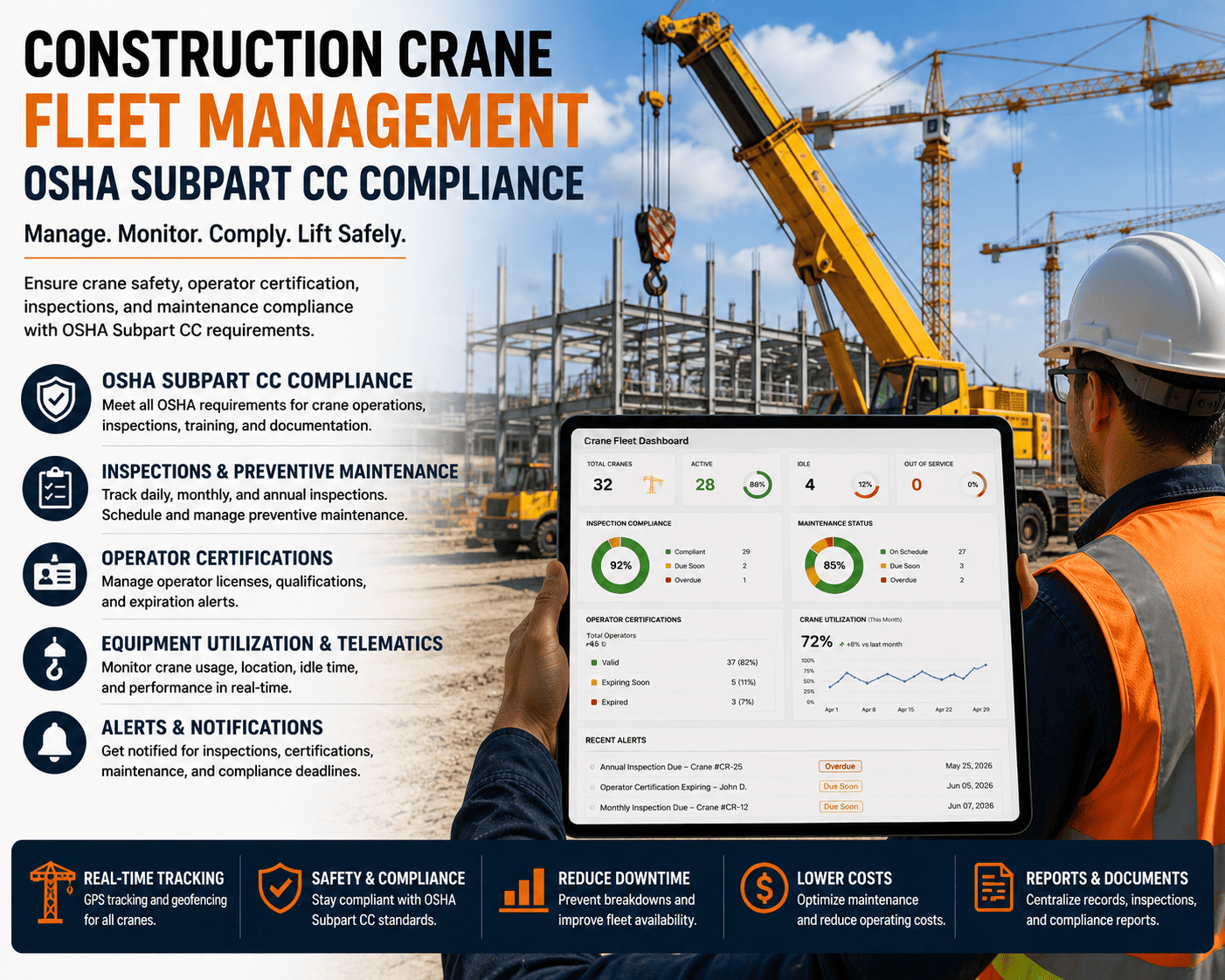
No other piece of equipment on a construction site carries the same weight of consequence as a crane, in every sense of the word. A dropped load isn't a maintenance line item, it's a fatality risk, which is exactly why OSHA built 29 CFR 1926 Subpart CC around one of the most prescriptive inspection frameworks in all of construction regulation. For a fleet manager running more than a handful of cranes, staying ahead of shift, monthly, and annual inspection tiers, wire rope criteria, and operator certification isn't optional paperwork. It's the difference between a crane that's legally allowed to lift today and one that isn't.
OSHA Subpart CC requires three inspection tiers for every crane: a competent-person shift inspection before each use, a documented monthly inspection retained for 3 months, and an annual comprehensive inspection by a qualified person retained for 12 months. Inspection-related violations are OSHA's most cited crane issue, with penalties reaching $16,550 per serious violation and $165,514 for willful violations. Sign up for FleetRabbit to track every tier, every crane, and every operator certification in one place.
The Three Inspection Tiers That Keep a Lift Legal
Subpart CC doesn't leave inspection frequency to interpretation. Section 1926.1412 lays out three distinct tiers, each with its own inspector qualification, documentation rule, and retention period, and mixing them up is itself a citable offense.
Shift Inspection
A visual walk-around before every shift, covering controls, safety devices, wire rope, hooks, and ground conditions. Takes 15 to 20 minutes. OSHA doesn't mandate written records for this tier, but most employers document it anyway to build a defensible history.
Monthly Inspection
A documented inspection of operating mechanisms, hooks, hoist chains, and hydraulic systems performed by a competent person. The written record must stay on site and be retained for at least 3 months.
Annual Inspection
A comprehensive inspection by a qualified person, sometimes requiring disassembly or non-destructive testing. The report must be kept for at least 12 months, and this tier can never be performed by a competent person alone.
Competent Person vs. Qualified Person: Know the Difference
OSHA draws a hard line between who can sign off on which tier, and using the wrong inspector level for an annual inspection is a citable violation on its own.
Competent Person
Has the authority and knowledge to identify hazards and take corrective action. Can perform shift and monthly inspections.
Qualified Person
Holds a recognized degree, certificate, or professional standing demonstrating expertise. Required for annual inspections, post-repair checks, and modified equipment.
Automate Your Shift, Monthly, and Annual Crane Inspections
FleetRabbit tracks every inspection tier per crane, flags what's due, and stores every record with the correct retention period built in.
Operator Certification Is Not Optional
Section 1926.1427 requires every crane operator to be certified or licensed, and separately evaluated by the employer on the specific machine they'll run. Certification itself has two parts: a written exam covering load charts and safe operating procedures, and a practical exam proving the operator can recognize the same items checked during a shift inspection. Certification bodies must be accredited by a nationally recognized agency, which today means ANSI or the NCCA.
What Supervisors Are On the Hook For
Employers must keep documentation of every operator's qualifications on the jobsite and stop work immediately if a certification lapses. A crane running under an expired or unverified operator certification is a compliance failure that exists the moment the engine starts, regardless of how well the machine itself was inspected.
The 20-Foot Rule
No part of the crane, rigging, or load may come within 20 feet of a live power line unless one of the specific mitigations in §1926.1408 is documented and in place. This single rule accounts for a significant share of crane-related citations and fatalities when overlooked.
The Violations That Cost the Most
Inspection failures consistently rank as OSHA's most-cited crane issue, largely because they're the easiest for an inspector to verify: either the documentation exists or it doesn't. The list below covers the violations that show up most often in citation data.
Inadequate or Missing Inspections
§1926.1412 — the single most cited crane standard.
Wire Rope Deficiencies
§1926.1413 — missed removal criteria on the crane's lifeline.
Power Line Safety Violations
§1926.1408 — working inside the 20-foot zone without mitigation.
Lack of Operator Certification
§1926.1427 — running a crane without a certified, evaluated operator.
Signal Person Qualification Failures
§1926.1428 — signalers without documented proof of qualification.
Why Digital Tracking Changes the Compliance Equation
OSHA's own enforcement priorities now actively favor digital documentation over paper logs, and for good reason. A digital system can timestamp a shift inspection, photo-verify a monthly checklist, flag an annual inspection due date weeks in advance, and surface an operator certification that's about to lapse, all before a human has to remember to check. Paper logs scattered across job trailers can't do any of that, and during an audit the gap between "we have it somewhere" and "here it is, timestamped" is the gap between a clean inspection and a citation.
FleetRabbit was built around exactly this three-tier structure. Every crane gets its own shift, monthly, and annual inspection schedule with the correct retention period attached automatically, and every operator's certification status is tracked against the specific machine they're evaluated on. Start a free trial to connect your first crane in minutes, or book a demo to walk through how the three tiers map onto your current fleet.
Frequently Asked Questions
Keep Every Crane Inspection-Ready, Every Single Shift
See how FleetRabbit maps shift, monthly, and annual inspections plus operator certifications onto your exact crane fleet.