Every fuel transaction on your company card looks legitimate on paper. Right station, reasonable amount, during working hours. The catch is that some of those transactions happened forty miles from where the equipment actually was that day, or filled a container that never touched a machine. That gap between what the receipt says and what actually happened is fuel slippage, and it is quietly draining a meaningful share of your fuel budget without ever looking suspicious on a monthly statement.
Industry estimates put fuel card misuse at 5 to 15 percent of total fuel spend for fleets that are not cross-referencing transactions against equipment location. For a construction operation spending half a million dollars a year on diesel, that range translates to tens of thousands of dollars disappearing before a single gallon does productive work. This guide breaks down where that loss actually comes from and how FleetRabbit closes the gap by matching every transaction to the equipment, operator, and site it claims to belong to.
Why Fuel Slippage Hides in Plain Sight
Fuel fraud rarely shows up as an obvious red flag. A charge at an approved station, for a normal dollar amount, during business hours passes every basic control a fleet typically has in place. The problem only becomes visible when that transaction gets checked against something the receipt cannot fake, like the equipment's actual GPS location at that exact timestamp.
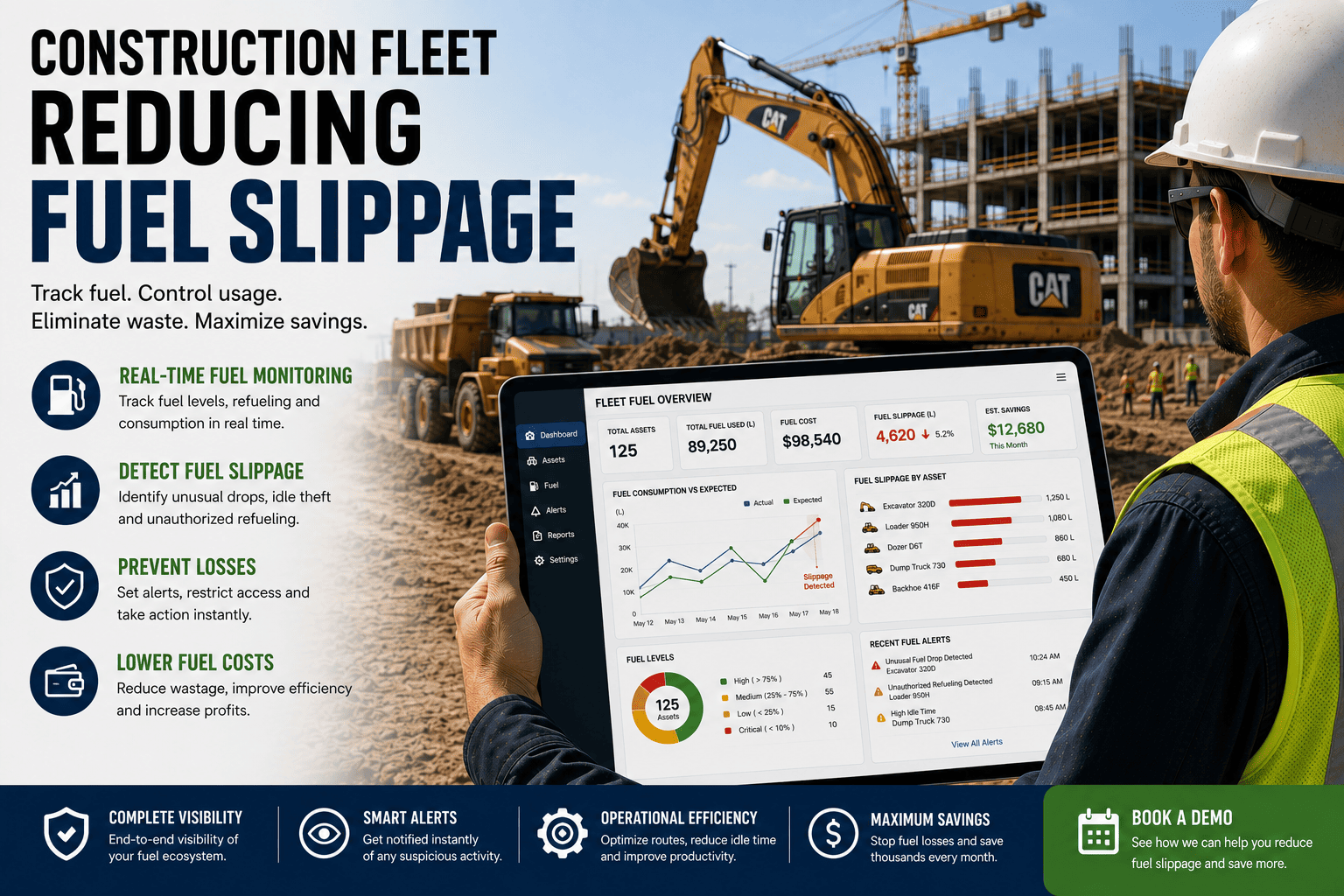
That kind of closed-loop verification, cross-referencing every fuel purchase against location and usage data in real time, is the difference between catching slippage on day one and discovering it during a year-end reconciliation. Fleets that switch from monthly reconciliation to real-time tracking commonly uncover eight thousand to twenty-two thousand dollars in previously undetected losses within the first week alone, not because the losses were new, but because nobody had been looking at the right data at the right time.
Why This Is Easy to Miss for Months
Most fleet managers are reviewing fuel spend at the end of the month, long after the transaction happened and the fuel is gone. By that point, a pattern of small, individually unremarkable purchases has already added up to a real number, and there is no way to recover it after the fact.
FleetRabbit cross-references every fuel purchase against equipment location and usage data in real time, flagging mismatches before they compound into real losses. Sign up free and see what your fleet's fuel data actually shows.
The Four Patterns Behind Most Fuel Slippage
Side Fueling
A company card fills a personal vehicle or a fuel container instead of the equipment it was issued for, one of the most common forms of internal misuse across construction fleets.
Off-Site Purchases
A transaction posted at a station nowhere near where the equipment was actually working that day is one of the clearest signals that something does not add up.
Split Transactions
A legitimate fill gets padded with an extra amount pumped into a separate container at the same stop, a pattern that rarely shows up unless volume is checked against tank capacity.
Usage-Mismatch Fills
Fuel volume that does not line up with the equipment's actual engine hours or duty cycle for that day is one of the strongest indicators that the fuel went somewhere else.
What a Single Fleet Actually Lost
One construction fleet operating across hundreds of miles, with crews often working off-site for weeks at a time, discovered a pattern of internal fuel theft costing five hundred to seven hundred dollars a month. That number alone does not sound dramatic, but scaled across a year and across every truck showing a similar pattern, it becomes a real hit to the bottom line that had gone unnoticed simply because nobody was cross-checking transactions against location.
Monthly Reconciliation Versus Real-Time Verification
| Detection Method | Monthly Reconciliation | Real-Time Verification |
|---|---|---|
| When Slippage Is Caught | Weeks after the transaction, if at all | At the moment the transaction posts |
| Verification Method | Manual review of station and dollar amount only | Cross-checked against GPS location and engine hours |
| Off-Site Purchases | Easy to miss without location context | Flagged immediately if equipment was elsewhere |
| Recoverability of Loss | Minimal, the fuel is already gone | Card use can be restricted before further loss occurs |
| Accountability | Difficult to trace to a specific operator | Every transaction tied to a specific machine and operator |
FleetRabbit alerts your team the moment a fuel transaction doesn't match equipment location or usage, instead of waiting for month-end to notice a pattern. Book a demo to see this working against your current fuel data.
Putting Better Fuel Controls in Place
Tie Every Transaction to a Specific Asset
Fuel cards assigned to a machine rather than a person make it far easier to catch a purchase that does not belong to that equipment's usage pattern that week.
Cross-Check Location Automatically
Comparing station location against equipment GPS data at the time of purchase is the single control that catches the majority of slippage before it becomes a recurring pattern.
Review Anomalies Weekly, Not Monthly
Waiting for a monthly statement means the fuel, and often the evidence, is long gone. Weekly anomaly reviews catch a developing pattern while there is still time to act on it.
Every unmatched fuel purchase is money leaving your fleet without a single productive mile behind it. FleetRabbit ties every transaction to the equipment and operator it belongs to, so slippage gets caught the day it happens, not the month after.