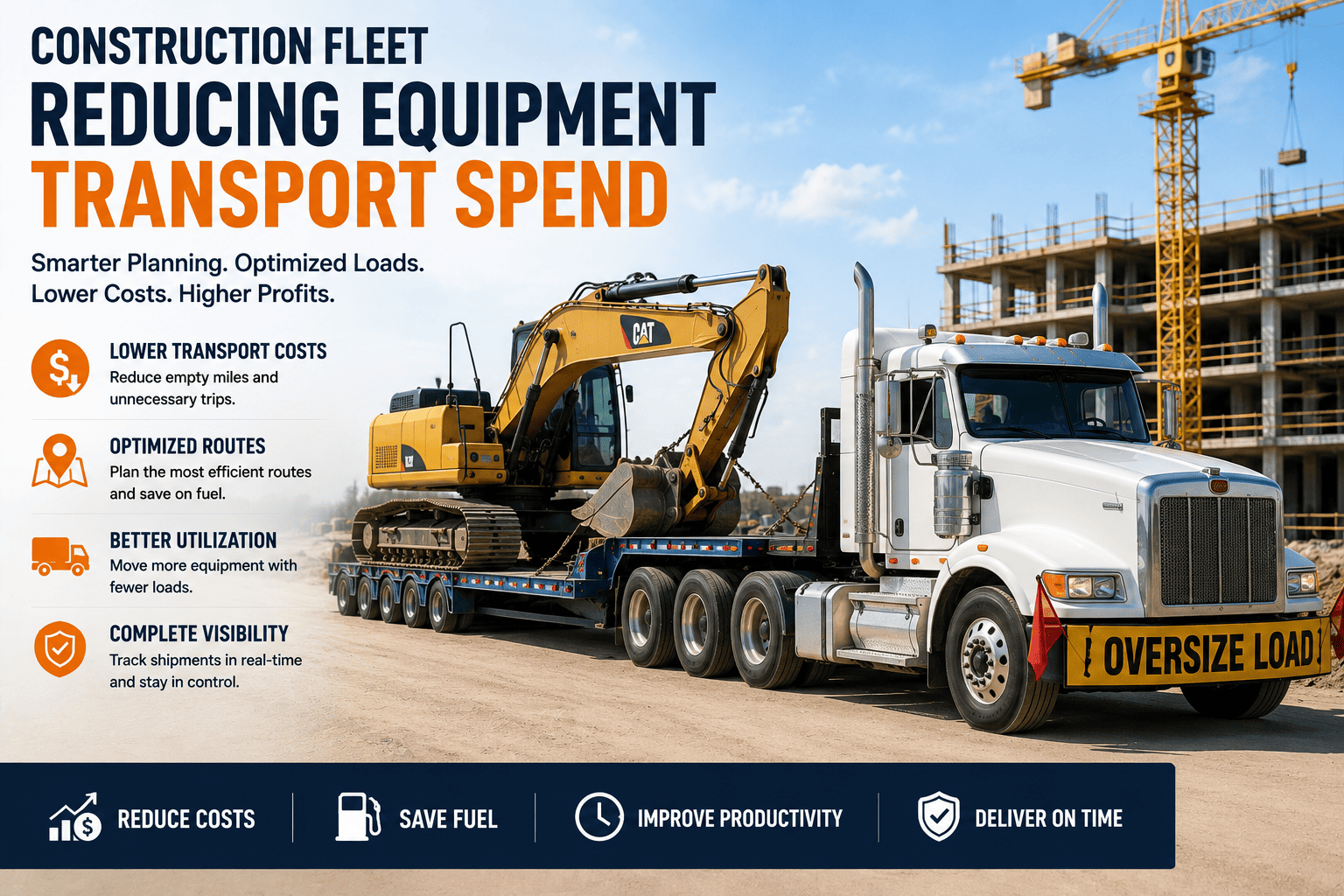
Every time a dozer, excavator, or crane rolls onto a lowboy, the meter starts running before the truck even leaves the yard. Construction fleets rarely lose money on the moves they plan carefully. They lose it on the moves that shouldn't have happened at all: equipment sent to a site too early, machines relocated twice because a schedule shifted, or a rental brought in when an idle owned unit was sitting three miles away the whole time. Transport spend is one of the few line items on a construction fleet's budget that can be cut by a third without touching a single project timeline, simply by deciding better.
Heavy equipment hauling typically runs 3 to 9 dollars per mile depending on load size, permits, and route, pushing a single cross-country move to 2000 to 10000 dollars. Industry data shows 15 to 25 percent of all equipment moves on a typical construction fleet are avoidable, driven by scheduling misalignment and poor visibility into idle machines. Smarter transport planning recovers 20 to 35 percent of annual hauling spend.
What's Actually Driving Your Equipment Transport Bill
Most fleet managers can quote a rough per-mile rate, but the invoice is rarely just linehaul. A lowboy carrying a standard excavator or dozer moves at 3 to 5 dollars per mile on average, and that number climbs toward 8 or 9 dollars per mile once a load needs permits, pilot cars, or specialized rigging. A short haul under 300 miles often costs more per mile than a long one, because fixed costs like loading, positioning, and driver time get spread across fewer miles. None of that is a surprise to an experienced logistics team. What catches fleets off guard is how often those charges get paid for a move that never needed to happen.
The Line-Haul Charge Isn't the Whole Story
Fuel surcharges move weekly with diesel prices. Oversize permits vary by state, and multi-state routes need a separate permit and approval window for each one crossed. Escort vehicles get added automatically once a load crosses width or weight thresholds. Seasonal demand compounds all of it. Construction season and harvest season both tighten heavy-haul capacity, and rates for the exact same lane can run 15 to 20 percent higher in peak months than in the off season.
| Cost Layer | Typical Range | What Triggers It |
|---|---|---|
| Base Line-Haul | $3.00 - $5.00 / mile | Standard lowboy load, legal weight and dimensions |
| Oversize / Overweight | $5.00 - $9.00 / mile | Load exceeds state width, height, or axle weight limits |
| Permits & Escorts | $300 - $2,500 per move | Multi-state routing, pilot car requirements, city ordinances |
| Seasonal Surcharge | +15% to +20% | Peak construction months, tightened lowboy capacity |
| Short-Haul Premium | +$1.00 - $2.00 / mile | Trips under 300 miles, fixed loading costs spread thin |
FleetRabbit tracks equipment location, utilization, and project schedules side by side, so every haul request gets checked against what's already available before a truck is booked. Start your free trial and see your avoidable transport spend in the first week.
The Hidden Cost of Unnecessary Equipment Moves
Not every transport charge buys something the project needed. Three patterns account for most of the waste construction fleets carry without noticing.
Redundant Mobilizations
A dozer is hauled to a site, then hauled back two weeks later when the phase gets delayed, then hauled out again once work resumes. Each leg costs full linehaul, and a single reschedule can turn one necessary move into three billed ones.
Schedule Misalignment
Transport gets booked off the original project calendar, not the updated one. When a site milestone slips by a week, the truck still shows up on the old date, and the machine sits idle on-site racking up rental days or gets moved again to make room.
Blind Rental Decisions
A regional manager rents a compactor for a nearby job because no one can see that an identical unit sits idle at a site 40 minutes away. The rental cost is visible. The transport cost that would have moved the idle unit instead never even gets compared.
A Smarter Way to Decide When (and Whether) to Move Equipment
Cutting transport spend isn't about negotiating a better per-mile rate, though that helps too. It's about making sure every haul request survives a quick check before a truck is dispatched. A four-step decision sequence catches most avoidable moves before they turn into invoices.
Benchmarking Your Transport Spend
Fleets that put this kind of check in place before every haul consistently land in a different cost bracket than fleets that book reactively. The gap shows up clearly once you track it by move.
| Metric | Reactive Fleet | Planned Fleet |
|---|---|---|
| Avoidable Moves per Quarter | 6 to 10 | 1 to 3 |
| Average Cost per Move | $3,200 - $6,500 | $2,200 - $4,000 |
| Annual Transport Spend (30-unit fleet) | $180,000 - $260,000 | $120,000 - $175,000 |
| Rental Overlap Incidents | Frequent, undetected | Flagged before booking |
FleetRabbit connects equipment location, utilization history, and project timelines so dispatch decisions are made with full visibility, not guesswork. Talk to our team and book a demo to walk through your own transport data.
How FleetRabbit Cuts Transport Spend
FleetRabbit gives construction fleets one place to check before a haul gets booked, replacing scattered spreadsheets and phone calls with a live view of every asset.
Live Equipment Location
GPS-based tracking shows exactly where every owned machine sits right now, so a dispatcher can spot an idle unit near a new job before approving a rental or a long-distance haul.
Utilization Scoring
Each asset carries a running utilization score based on hours, idle time, and site history, making it obvious which machines are genuinely busy and which are sitting unused.
Project Schedule Sync
Transport requests are checked against the current project calendar automatically, flagging any haul that's about to move equipment into a delayed or rescheduled phase.
Route and Permit Coordination
Nearby moves are grouped where routing allows, and permit lead times are tracked so bookings happen early enough to avoid rushed, premium-priced dispatch.
Unnecessary equipment moves quietly drain construction fleet budgets year after year. FleetRabbit gives dispatch teams the location, utilization, and schedule data needed to catch avoidable hauls before they're booked. Start your free trial today with no credit card required.