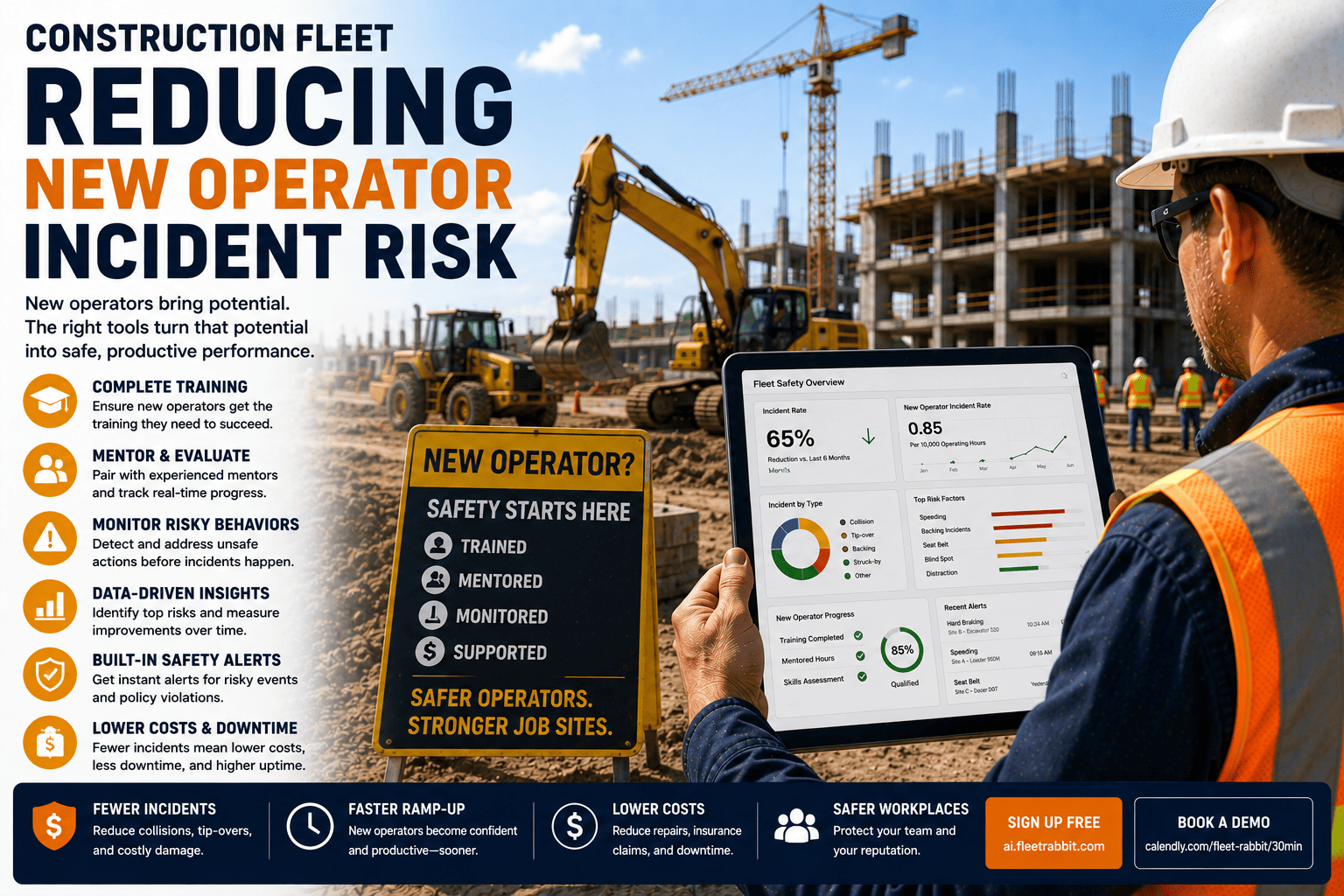
Every construction crew has felt it: the newest operator on site is the one everyone quietly keeps an eye on. That instinct is backed by decades of workplace safety research. Workers in their first month on a job face more than three times the risk of a lost-time injury compared to someone with over a year of experience on the same equipment, and nearly half of all construction injuries happen to workers with a year or less of tenure. New-operator incident risk isn't a training gap you can fully close with a single orientation session. It's a curve that has to be actively managed, and that's exactly where visibility into real operating behavior makes the difference between catching a risky pattern and reading about it in an incident report.
Workers in their first month on the job face over three times the risk of a lost-time injury compared to workers with more than a year of tenure. Across multiple state studies, 44 to 48 percent of all construction injuries occur to workers with one year or less on the job. Sites using behavior-based monitoring and structured new-operator coaching report 25 to 40 percent fewer incidents among first-year equipment operators.
Why New Operators Carry So Much Of The Risk
The research on this pattern is remarkably consistent across states and industries. Studies analyzing workers' compensation data in Tennessee, Washington, and Ohio all found that workers with six months of tenure or less accounted for roughly 30 to 34 percent of injuries, and workers with a year or less accounted for 45 to 48 percent, even though they represent a much smaller share of total hours worked on site. The pattern holds regardless of age or prior experience in the trade. What matters most is time on this specific equipment, in this specific environment, under this specific crew's routines. Unfamiliarity, not inexperience in general, is the driving factor.
That means every new hire, every reassigned operator moving to unfamiliar equipment, and every returning seasonal worker resets part of that risk clock. A veteran excavator operator moved onto a new skid steer for the first time carries some of the same elevated risk as a true newcomer, because the controls, the blind spots, and the site hazards are all new to them again. Supervisors who want to see how quickly a new operator's behavior stabilizes on a specific machine can book a demo and look at real onboarding data instead of relying on gut feel.
The First 90 Days: What The Risk Curve Actually Looks Like
New-operator risk doesn't decline evenly. It drops sharply in a predictable pattern once an operator gets consistent seat time on a specific machine and site, which is exactly why the first few weeks deserve closer attention than a standard onboarding checklist typically provides.
Weeks 1 To 2: Peak Risk Window
This is where lost-time injury risk is highest. Operators are still learning machine-specific controls, blind spots, and site layout simultaneously, and hesitation under time pressure is common. Close supervision and frequent check-ins matter most here.
Weeks 3 To 6: Rapid Improvement Period
Claim rates for workers in their second month on the job typically drop to roughly half the rate seen in the first month, as basic machine familiarity replaces conscious effort with muscle memory. This is the window where coaching on specific risky behaviors has the highest return.
Months 2 To 3: Stabilization
Risk continues declining but plateaus above the experienced-operator baseline. This is often when supervisors stop paying close attention, which is also when overconfidence-driven incidents start to appear alongside the earlier unfamiliarity-driven ones.
FleetRabbit flags harsh braking, rapid acceleration, excessive idling, and other risk indicators by operator, so supervisors can coach new hires on specific behaviors during the exact window when it matters most. Start free with 3 vehicles today.
What Behavior-Based Monitoring Actually Catches
Supervisors can't watch every operator every hour of every shift, which is exactly the gap that behavior monitoring closes. Instead of waiting for a near-miss report or an incident, specific operating patterns can flag a developing risk days or weeks before it turns into something serious.
Building A New-Operator Coaching Program That Works
Behavior data only helps if it turns into a conversation, not just a report nobody reads. The most effective programs pair specific, named behavior patterns with a short, direct check-in, rather than a general reminder about safety culture. The table below breaks down how a typical new-operator coaching cadence maps to the risk curve described earlier.
| Onboarding Stage | Typical Risk Level | Recommended Check-In Frequency | What To Focus On |
|---|---|---|---|
| Week 1 To 2 | Highest, over 3 times baseline | Daily behavior review | Machine-specific controls, blind spots, and inspection completeness |
| Week 3 To 6 | Declining rapidly, still elevated | Two to three times weekly | Recurring harsh event patterns and site-specific hazard awareness |
| Month 2 To 3 | Approaching baseline, plateauing | Weekly summary review | Overconfidence indicators and consistency across shift types |
| New Equipment Assignment | Resets to elevated regardless of tenure | Same cadence as Week 1 to 2 | Treat as a fresh onboarding period, not a continuation of prior experience |
The Cost Case For Managing This Risk Proactively
Beyond the human cost, new-operator incidents carry a heavy financial burden. A single recordable injury commonly triggers direct medical and workers' compensation costs, OSHA fines that can exceed 150000 dollars per violation, and indirect costs from schedule delays, equipment damage, and increased insurance premiums that often exceed the direct cost by two to four times. Firms that have implemented structured digital onboarding and behavior monitoring report a 25 percent reduction in safety incidents across worksites, alongside faster time-to-productivity for new hires.
Where The Return Comes From
Most of the return comes from catching a small number of high-risk operators early, rather than spreading attention evenly across every new hire. A handful of repeat behavior flags in the first two weeks typically predicts which operators need the most coaching, letting supervisors focus limited time where it has the greatest impact. Companies wanting to see this kind of early-warning signal on their own crew can book a demo and walk through a sample onboarding period.
Frequently Asked Questions
The Bottom Line For Construction Safety Leaders
New-operator risk is one of the most predictable patterns in construction safety, and predictable patterns are exactly what good visibility is built to catch. Waiting for an incident report to reveal that a new hire has been running harsh braking events all week, or skipping inspection steps on a piece of equipment they barely know, means the warning came too late to prevent the outcome. Structured onboarding paired with real operating behavior data turns a reactive safety program into one that catches risk while it's still coachable.
If your crew's new-operator safety program still relies on a supervisor's memory and a single orientation checklist, it's worth seeing what real-time behavior visibility looks like for your own site. You can start a free trial with a few vehicles, or book a demo to walk through your current onboarding process with the FleetRabbit team.
FleetRabbit surfaces harsh events, inspection patterns, and idle behavior by operator, so supervisors can coach the right person on the right issue at the exact moment it matters most. See fewer incidents within your first onboarding cycle. No credit card required to start.