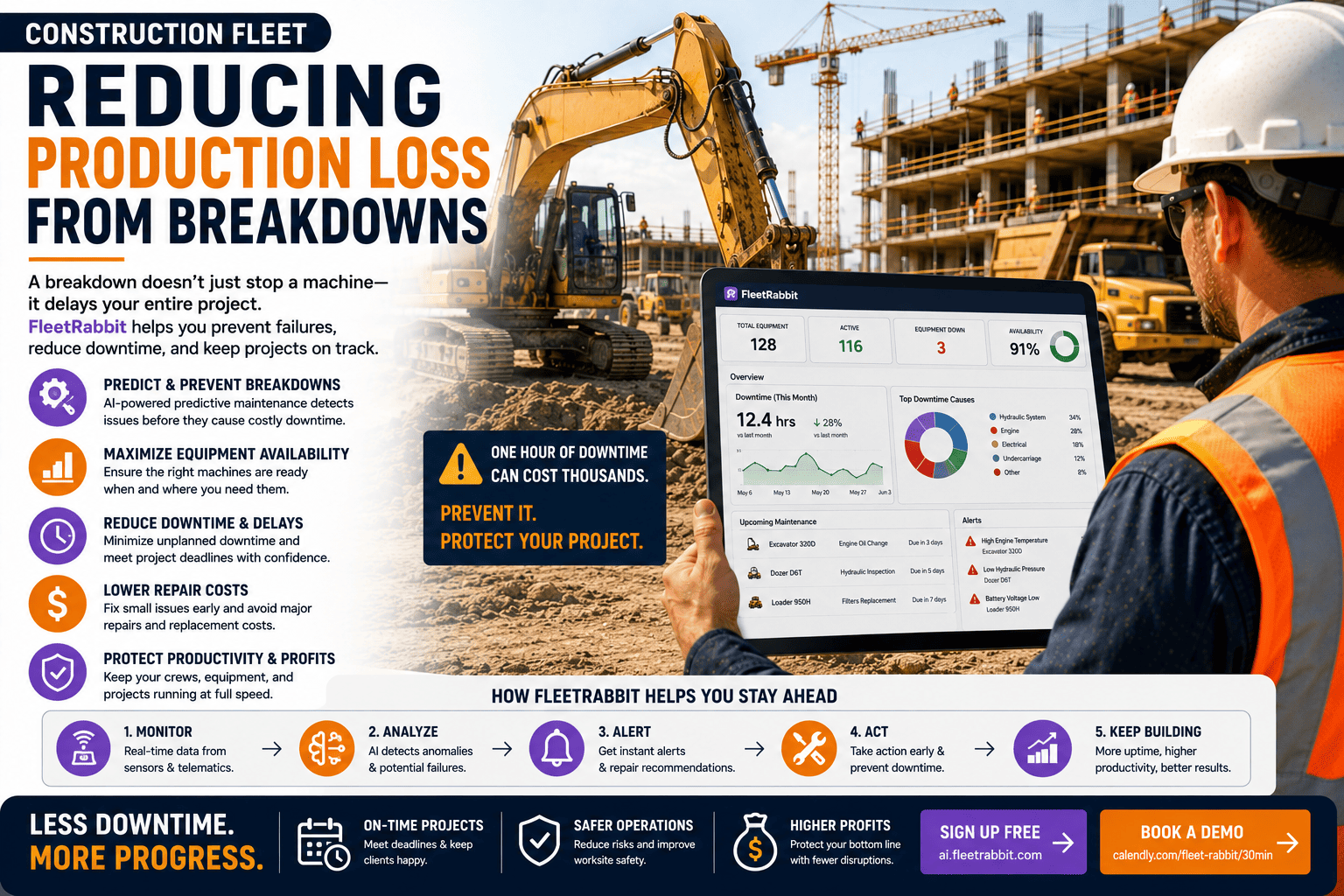
One excavator going down at 7 a.m. rarely stays a one-machine problem. By 9 a.m. the grading crew behind it is standing around, by noon a dozer has been pulled off a second site to cover the gap, and by the end of the week the project is paying for a rental machine just to hold the schedule together. A crew costing 142 dollars an hour collectively burns 1,136 dollars in an eight-hour downtime day producing zero output, and that number only covers the crew standing still, not everything the breakdown sets in motion around it.
A single unplanned equipment breakdown on a construction site typically costs 2,000 to 10,000 dollars a day once idle crew wages, rental replacements, and schedule penalties are included. One breakdown can create ripple effects across two to four connected job sites, multiplying the total productivity impact by three to five times the original downtime duration. Sign up for FleetRabbit to catch failures before they cascade, or book a demo to see engine-hour monitoring in action.
How One Breakdown Turns Into a Sitewide Delay
Production loss rarely looks like a single line item. It moves through a project in stages, and each stage adds cost the original repair invoice never captures.
Machine Fails Mid-Task
Work on the primary task stops instantly, and the crew assigned to it has nothing productive to do.
Crew Sits Idle
Labor keeps getting paid while output drops to zero for that section of the site.
A Second Machine Gets Pulled
A dozer pulled from one site to cover another site's breakdown leaves that second crew idle too, pushing its own timeline by days.
Rental Equipment Fills the Gap
Renting a replacement machine for even part of the downtime can add tens of thousands of dollars to a single asset's annual cost.
The Schedule Absorbs the Hit
Project delays from unavailable equipment can cost 2,000 to 10,000 dollars a day in idle labor, missed milestones, and subcontractor penalties.
Catch the Failure Before the Cascade Starts
FleetRabbit flags engine, hydraulic, and transmission warning signs days before a breakdown, so the first domino never falls. Start your free trial to monitor your fleet in real time, or book a 30-minute demo to see how it applies to your jobsites.
What a Single Breakdown Actually Costs
Fleet managers often price a breakdown by the repair bill alone. The real number is much larger once idle labor, rentals, and schedule pressure are added in. A single catastrophic transmission failure can trigger 400 to 800 non-productive hours annually per machine, and every hour of heavy equipment downtime costs an average of 740 dollars in lost productivity, overtime labor, and delivery delays.
| Cost Layer | What Drives It | Typical Impact |
|---|---|---|
| Idle Crew Wages | Operators and laborers paid while waiting on the fix | 1,000 to 1,500 dollars per crew, per day |
| Rental Replacement | Bringing in a substitute machine to hold the schedule | 80 to 150 dollars per hour |
| Secondary Site Delay | Reassigning equipment from another active project | Multi-day slip at the donor site |
| Schedule Penalties | Contract clauses tied to missed milestones | 1,000 to 5,000 dollars per day |
| Resale Value Loss | Frequent breakdown history on the asset's maintenance record | 15 to 30 percent lower resale value |
Engine-Hour Monitoring Turns Guesswork Into Warning Signs
Condition-Based Alerts Replace Fixed Schedules
Time-based service intervals treat every machine the same regardless of how hard it's actually working. Integrating telematics and IoT sensors enables condition-based maintenance that responds to actual equipment health rather than arbitrary schedules, preventing failures before they impact operations. An excavator running double shifts on a compaction-heavy site needs attention sooner than one sitting idle half the week, and engine-hour tracking is what tells you which is which.
Automated Work Orders Close the Gap Between Alert and Action
A system that generates work orders automatically, with detailed procedures and completion tracking, ensures nothing gets missed between the moment a warning sign appears and the moment a technician actually addresses it.
The Payoff Shows Up Fast
Predictive maintenance platforms can reduce unplanned downtime by up to 40 percent within a year and cut mean time to repair by 20 percent within 24 months, which is exactly the kind of return that offsets the cost of the system itself many times over.
Building a Production-Loss Prevention Plan
Track Engine Hours by Machine, Not by Fleet Average
Set service triggers based on how each asset is actually used on site.
Watch for Early Warning Patterns
Rising engine temperature, transmission shift irregularities, or hydraulic pressure drift usually appear days before a failure.
Keep a Backup Plan for High-Value Assets
Know in advance what a rental replacement would cost so a breakdown doesn't force a rushed, overpriced decision.
Review Breakdown History Every Quarter
Repeat failures on the same machine usually point to a deeper issue than the last repair addressed.
Turn Reactive Repairs Into Predictable Maintenance
FleetRabbit tracks engine hours, flags early warning signs, and automates work orders so your crews stay productive instead of standing around waiting on a fix. Create your free account today, or schedule a demo to see the alerts on your own equipment data.
Frequently Asked Questions
Every hour a machine sits broken is an hour your schedule, your crew, and your budget are all working against you at once. The projects that stay on track aren't the ones that never have equipment problems. They're the ones that catch the warning signs early enough to fix them on their own terms. Sign up for FleetRabbit to start catching those signs today, or book a demo to see it working on equipment like yours.
Stop Letting One Breakdown Stall the Whole Site
FleetRabbit's predictive maintenance and engine-hour monitoring catch failures before they cascade into idle crews, rentals, and missed milestones.