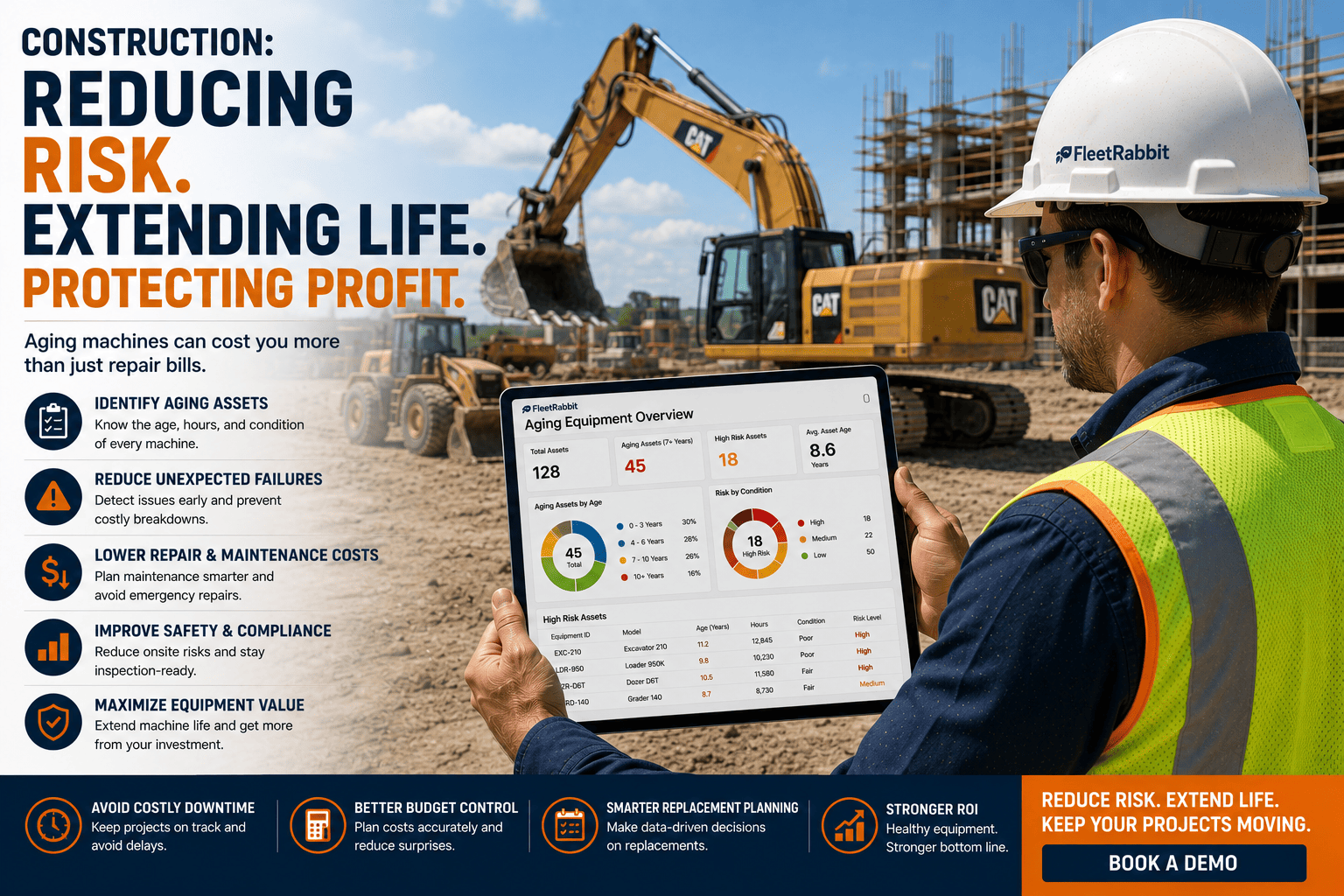
Every construction fleet has that one machine. The excavator that starts a little rougher every morning. The loader that visits the shop more than the jobsite. Owners keep it running because replacing it feels expensive, but what most fleet managers never calculate is that keeping it running is usually the more expensive choice. Aging equipment doesn't fail all at once. It fails gradually, in ways that quietly drain a budget long before a major breakdown forces the decision.
Construction equipment typically becomes financially risky once maintenance and repair costs climb past 50 to 70 percent of its remaining value, a point most machines reach between 10,000 and 15,000 operating hours. Past this point, repair frequency rises 30 to 45 percent, unplanned downtime doubles, and resale value keeps dropping every month the machine stays on payroll. Tracking usage data and running a lifecycle analysis lets fleet teams catch this shift before it becomes a costly surprise. You can sign up for FleetRabbit to start monitoring these signals automatically.
The Warning Signs Every Aging Machine Gives You
Heavy equipment rarely breaks down without warning. It tells you first, through small, easy-to-ignore signals that pile up over months. Recognizing these signs early is the difference between a planned rebuild and an expensive breakdown on a live jobsite.
Repairs Come Back to Back
A machine needing three or more unrelated repairs within a single quarter is signaling systemic wear, not isolated bad luck. This pattern usually means core components are failing together.
Fuel Burn Keeps Climbing
Aging engines and worn hydraulic systems lose efficiency gradually. A 10 to 15 percent rise in fuel consumption over a year, with no change in workload, points to declining internal condition.
Idle Time Keeps Growing
Operators quietly avoid unreliable machines, giving them lighter tasks or leaving them parked. Rising idle hours relative to the rest of the fleet often reflect a trust problem, not a scheduling one.
Resale Value Drops Faster
Once a machine passes its typical B50 threshold, buyers pay less because the failure risk climbs. Waiting past this point often means losing more resale value than the cost of an early replacement.
Where the Real Money Disappears
The purchase price of a machine is only a small part of what it actually costs to own. Across a working life, the equipment's operating and maintenance costs typically make up 50 to 70 percent of total ownership cost, while the purchase price represents only a fraction of the total spend. As machines age past their mid-life point, that ratio tips further, and every additional year of ownership adds more to the maintenance side of the scale than the depreciation side.
New & Depreciating
Fast value loss in early years, but low repair costs and full warranty coverage.
Prime Production
Depreciation levels off. This is the highest-value window for job output per dollar spent.
Rising Repair Curve
Component wear accelerates. Maintenance spend starts climbing noticeably year over year.
Break-Even Point
Repair and maintenance costs meet the machine's remaining value. This is the decision zone.
Retire or Rebuild
Past break-even, ownership cost outweighs output. Continued use erodes fleet profitability.
Know Exactly Where Each Machine Stands
FleetRabbit tracks operating hours, repair history, and cost trends for every asset, flagging machines approaching their break-even point before the numbers turn against you. Sign up free and see your fleet's lifecycle data in minutes, or book a demo to walk through your specific fleet with our team.
Rebuild, Replace, or Retire: Making the Right Call
Not every aging machine needs to be sold. Some are strong candidates for a component rebuild, while others have crossed a point where continued investment no longer makes sense. The right call depends on hours logged, repair trends, and how the machine is actually being used on site.
| Decision Path | Best Fit When | Typical Cost Range | Expected Outcome |
|---|---|---|---|
| Component Rebuild | Frame and undercarriage remain sound; failures are isolated to engine or hydraulics | 30 to 50 percent of new machine cost | Extends service life 3 to 5 more years at lower risk |
| Planned Replacement | Machine has crossed its break-even point; repairs are frequent and unpredictable | Full purchase price, offset by trade-in value | Restores reliability and predictable operating cost |
| Retire & Sell | Utilization is low and resale value is still meaningful | Recovers 15 to 25 percent of original value | Frees capital before value erodes further |
| Continue As-Is | Machine is within prime production years with stable costs | Standard scheduled maintenance only | Maximum value per dollar of ownership |
Building an Age-Aware Maintenance Strategy
Fleets that manage aging risk well don't treat every machine the same way. A five-year-old skid steer and a fifteen-year-old excavator need different inspection frequencies, different parts stocking strategies, and different financial tracking. Adjusting your approach as equipment ages catches problems while they are still cheap to fix.
Shorten Inspection Intervals as Hours Climb
Machines past 8,000 hours benefit from inspections every 100 to 150 hours instead of the standard 250-hour interval. Catching a worn seal or a developing hydraulic leak early avoids the cascading damage that turns a small repair into a major overhaul.
Track Cost Per Hour, Not Just Repair Totals
A single repair invoice tells you little on its own. Cost per operating hour, tracked over time, reveals the trend line that matters. A machine whose cost per hour has climbed 25 percent over two years is telling you something a repair log alone cannot.
Common Mistake: Waiting for a Total Breakdown
Many fleets treat replacement as a reaction to catastrophic failure rather than a planned decision. By the time a machine fails completely, its resale value has often dropped far below what it would have been six months earlier, turning a manageable transition into a costly scramble.
Common Mistake: Ignoring Utilization Data
A machine sitting idle 40 percent of the time is not saving money by staying in the fleet. It is tying up capital, insurance, and storage costs while contributing little to output. Utilization data should factor directly into every rebuild-or-retire decision.
What Fleets Save When They Manage Aging Equipment Proactively
Fleets that formalize lifecycle tracking consistently outperform those making replacement decisions on instinct alone. The pattern shows up clearly once operating hours, repair costs, and utilization are tracked together in one place.
Getting this right depends on having accurate, current data for every machine in the fleet, not estimates pulled together once a year. Teams that create a free FleetRabbit account can start logging hours, repairs, and costs against each asset immediately, building the history needed to spot the break-even point before it arrives unannounced.
Turn Aging Equipment From a Risk Into a Plan
Stop guessing which machine will fail next. FleetRabbit's asset lifecycle tools flag rising repair costs, falling utilization, and approaching break-even points across your entire fleet, so every rebuild or replacement decision is backed by real numbers. Talk to our team about your fleet by booking a demo, or get started right away with a free trial.
Frequently Asked Questions
Don't Let Aging Equipment Catch You Off Guard
Every machine has a break-even point. FleetRabbit helps you find it before it finds you, tracking hours, repair costs, and utilization so every rebuild, replace, or retire decision is backed by data instead of guesswork. Get started with a free trial or book a demo to see it applied to your own fleet.