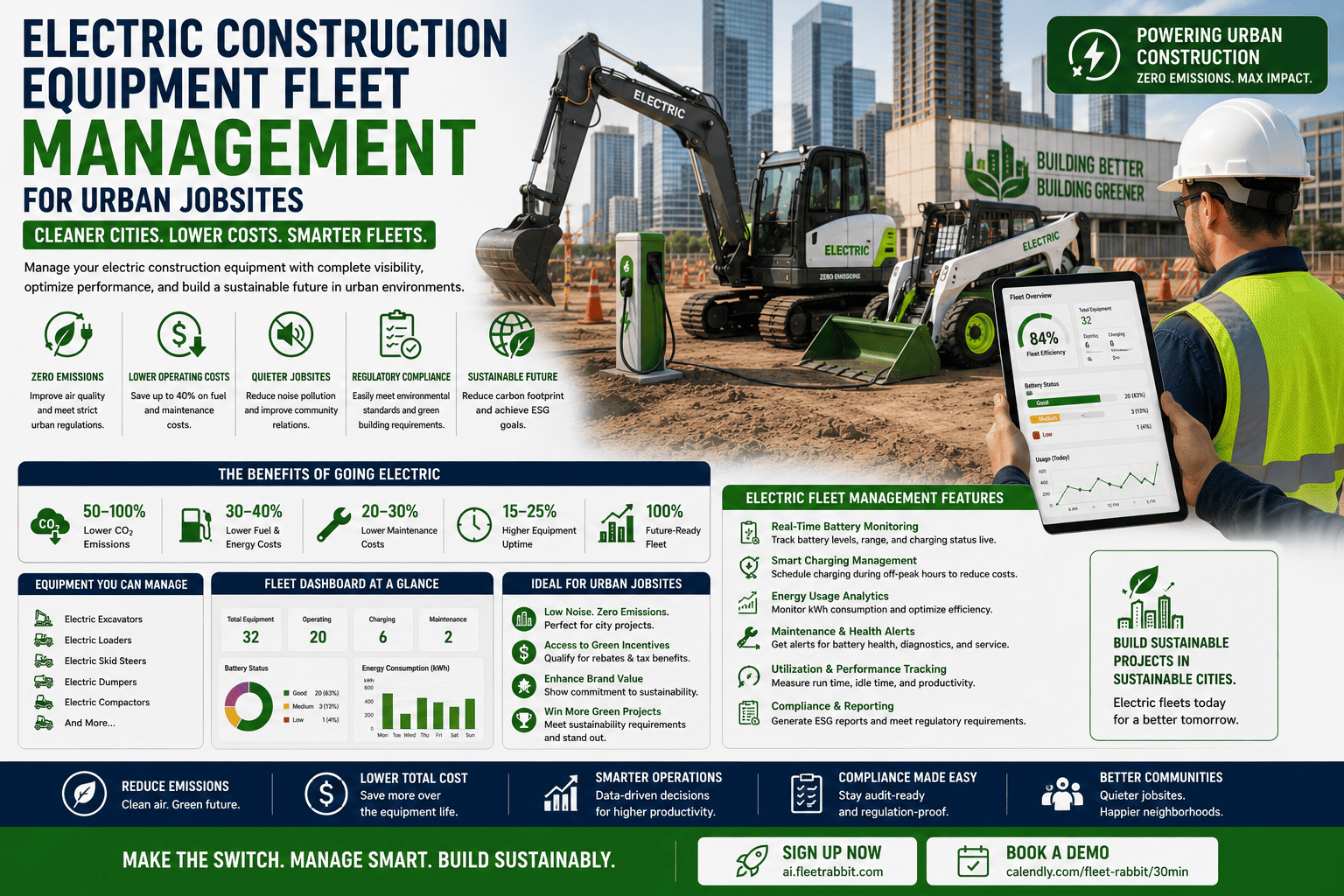
Job sites in dense cities now run on a different clock than rural projects. Noise ordinances shut diesel equipment down at 6 PM. Low-emission zones charge daily fees for high-emitting machines. Clients with sustainability mandates now write zero-emission clauses directly into contracts. For contractors working in cities, battery-powered construction equipment has quietly gone from experimental to essential, and the fleets that manage it well are winning the bids that fleets running loud diesel machines can no longer touch.
The catch is that electric equipment doesn't fail the way diesel equipment fails. There's no oil change light, no exhaust smell warning you something's wrong, no dipstick to check before the shift starts. A battery pack degrades silently over thousands of charge cycles, and by the time a machine can't finish a shift, the damage is already done. Managing an electric fleet well means watching different numbers, on a different schedule, with different tools than the ones diesel fleets have relied on for decades.
Electric construction equipment works best on urban, low-noise, short-duty-cycle job sites where quiet operation and zero tailpipe emissions matter most. Battery packs typically hold 3,000 to 5,000 charge cycles before dropping to 70 to 80 percent capacity, and purchase prices run 50 to 100 percent higher than diesel equivalents. Fleets that track battery health, charging cycles, and utilization closely recover that premium through 60 to 70 percent lower operating costs and access to job sites diesel machines can no longer enter.
Why Electric Equipment Is Winning Urban Job Sites
Three pressures are converging on city contractors at once, and none of them are slowing down. Municipal noise ordinances increasingly restrict diesel machinery after evening hours in residential zones. Low-emission zones in major cities now charge daily fees for high-emitting vehicles, with some markets extending those rules to construction equipment. And large clients, particularly on public infrastructure work, are writing zero-emission requirements directly into procurement contracts. A machine that can run quietly after 6 PM, skip the emission surcharge, and satisfy a sustainability clause isn't a nice-to-have anymore. It's the machine that gets the contract.
Quiet Operation After Hours
Electric excavators and loaders run at a fraction of diesel noise levels, letting contractors work residential zones after 6 PM without violating local ordinances that have shut diesel crews out entirely.
No Daily Surcharge Fees
Low-emission zones increasingly charge per-day fees for high-emitting diesel equipment. Battery-electric machines enter these zones free, removing a cost line that grows every time regulations tighten.
Sustainability Requirements Met
Public infrastructure clients increasingly require zero-emission equipment on site. Fleets with a documented electric roster qualify for contracts that diesel-only competitors are automatically excluded from.
None of this happens automatically, though. A contractor who electrifies a portion of the fleet without changing how that fleet is managed usually finds the transition harder than expected. Booking a demo with a team that has managed mixed diesel-electric fleets before is often the fastest way to see which parts of the transition actually need new tools.
What Actually Changes When Equipment Goes Electric
Hydraulics, undercarriages, tracks, buckets, and structural components don't care what powers the machine. Those still need the same inspections diesel equipment has always required. What changes is everything upstream of the drivetrain. There's no oil, no filters, no DEF fluid, no exhaust system to monitor. In their place: a battery pack that represents 30 to 40 percent of the machine's total value, high-voltage cables running at lethal current, a thermal management system that has to stay within a narrow temperature band, and a charging routine that directly determines how long that expensive battery lasts.
Battery State of Health Is the New Oil Life Indicator
State of Health, or SoH, measures a battery's current capacity against its original design capacity. A pack degrades gradually over 3,000 to 5,000 charge cycles, typically dropping from 100 percent to the 70 to 80 percent range most fleet managers treat as end of practical service life. Healthy fleets lose roughly 2 to 3 percent of capacity per year. Fleets that skip monitoring and let charging habits go unmanaged can see degradation rates two to three times higher, pulling a battery's useful life in by years and pulling forward a replacement bill that can run into tens of thousands of dollars per machine.
The Habits That Accelerate Degradation
Three behaviors do most of the damage: charging to 100 percent and leaving the machine sitting at full charge overnight, relying on fast-charging for every routine cycle instead of overnight charging, and letting equipment run hot for extended periods without cooling system checks. Every 10°C above the optimal operating range roughly doubles the chemical aging rate inside the cells. None of these habits are visible during a walkaround. They only show up months later as a machine that can no longer finish a full shift on one charge.
| Battery Metric | What It Tells You | Healthy Range | Action Trigger |
|---|---|---|---|
| State of Health (SoH) | Current usable capacity versus original capacity | Above 80 percent | Below 80 percent, begin replacement planning |
| Annual Degradation Rate | Speed of capacity loss year over year | 2 to 3 percent | Above 4 percent, review charging protocol immediately |
| Charge Cycle Count | Total full charge cycles completed to date | Under 3,000 cycles | Approaching 3,000 to 5,000, forecast replacement cost |
| DC Fast-Charge Ratio | Share of weekly charges using fast charging | Under 30 percent | Above 30 percent, shift routine charging to overnight depot |
| Sustained Operating Temp | Battery temperature under continuous load | 15°C to 35°C | Sustained above 40°C, inspect thermal management system |
FleetRabbit tracks battery state of health, charging cycles, and utilization for every electric machine alongside your diesel fleet, so nothing runs on a hidden schedule. Catch degradation trends before they become a stranded machine on a live job site.
Electric Versus Diesel: What Urban Contractors Are Actually Trading
The decision to electrify isn't all upside, and pretending otherwise sets fleet managers up for a rough first year. Purchase prices for electric excavators, loaders, and compact equipment still run 50 to 100 percent higher than diesel equivalents. Charging infrastructure requires upfront investment, and installation costs drop by roughly 40 percent when planned ahead rather than added as an emergency retrofit later. What contractors get in return is a 60 to 70 percent reduction in operating costs, driven by cheaper electricity than diesel fuel, far fewer moving parts to maintain, and access to job sites and contracts that diesel machines are increasingly locked out of.
Where Electric Equipment Makes Immediate Sense
Compact and mid-sized machines on short duty cycles in urban environments are the clearest win today. Mini excavators, compact loaders, and skid steers working controlled city sites with predictable overnight charging access see the fastest payback. Larger machines with 8-plus hour continuous duty cycles, or projects in areas without reliable charging infrastructure, still favor diesel or hybrid options for now, though that gap is narrowing as battery capacity and fast-charging networks expand.
A Practical Starting Point
Contractors who electrify successfully rarely convert an entire fleet at once. Starting with one or two electric units on urban or controlled-site work lets a team build charging habits and monitoring routines before scaling further. Signing up for a platform that already supports both powertrains means that first electric machine doesn't require a second, parallel system just to track its battery health.
Common Mistakes Fleets Make During the Transition
The single biggest mistake is treating electric equipment as a diesel machine with a different fuel source. Pre-shift inspections need entirely new checklist items: high-voltage interlock integrity, orange cable condition, insulation resistance, and coolant levels in the battery thermal system. Skipping these isn't just a maintenance gap, it's a safety-critical failure, since electric heavy equipment operates at voltages capable of causing serious arc flash injury. The second most common mistake is letting battery data sit inside a manufacturer's separate telematics portal instead of routing it into the same maintenance workflow as the rest of the fleet, where degradation alerts can actually trigger a work order instead of being noticed too late.
Battery degradation doesn't announce itself with a warning light. FleetRabbit tracks state of health, charge cycles, and utilization for every electric machine in your fleet, alongside your diesel equipment, in one dashboard. Catch the habits that shorten battery life before they cost you a machine mid-project.