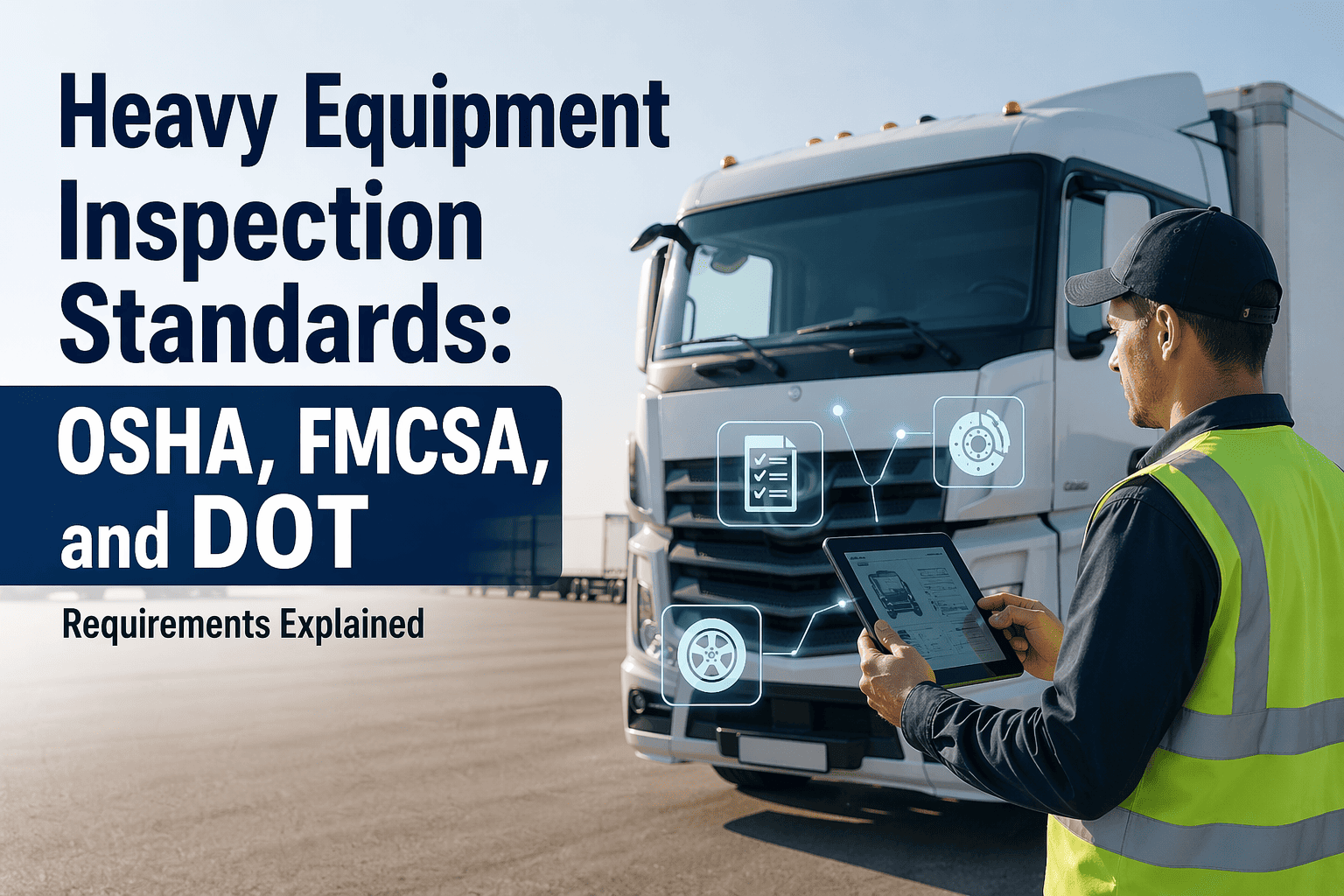
Construction fleet managers and project executives operating heavy equipment across active sites face a three-agency regulatory landscape that most compliance programmes address incompletely: OSHA 29 CFR 1926 governs equipment safety on construction sites and prescribes pre-use inspection requirements by equipment class; FMCSA 49 CFR Part 396 governs commercial motor vehicles used in construction operations and mandates systematic inspection, maintenance, and repair programmes with specific record retention requirements; and DOT standards impose additional inspection, vehicle condition, and documentation requirements on equipment that operates on or crosses public roads. Each framework has distinct scope, violation consequences, and documentation requirements — and the majority of construction citation events arise not from companies that ignored inspection requirements entirely, but from companies that addressed one framework while leaving gaps in another. This article provides a complete explanation of all three inspection frameworks, how they overlap on a construction fleet, and how FleetRabbit's compliance platform addresses every requirement simultaneously across all three regulatory authorities. Book a free compliance assessment session to map your fleet against OSHA, FMCSA, and DOT requirements.
OSHA 1926
Construction Site Equipment
Up to $156,259 per violation
FMCSA Part 396
Commercial Motor Vehicles
Up to $16,000 per violation
DOT Standards
On-Road Heavy Equipment
Vehicle OOS + civil penalties
OSHA 29 CFR 1926 — Construction Equipment Inspection Requirements
OSHA's construction standard (Subchapter C of 29 CFR 1926) is the primary regulatory framework governing equipment safety on construction sites. Its inspection requirements span multiple subparts depending on the equipment category — and each subpart specifies the inspection frequency, required inspector competency, documentation requirements, and defect disposition standards that apply.
OSHA
1926.602
Material Handling Equipment (Earthmovers)
Covers scrapers, loaders, crawlers, dozers, graders, agricultural tractors, and similar earthmoving equipment. Requires pre-start inspection by the operator before each use and after refuelling. All equipment must have audible warning devices, no defective brakes, and serviceable overhead guards. Seat belts required on equipment with ROPS.
Frequency: Pre-shift every use | Inspector: Operator
OSHA
1926.604
Site Clearing Equipment Operations
Specific requirements for equipment used in site clearing — including ROPS-equipped dozers, scrapers, and compactors. Requires operator to inspect equipment for proper function of all operating controls, brakes, lights, and safety devices before first use each shift. Equipment with defective safety devices must be removed from service.
Frequency: Pre-shift | Inspector: Operator / Competent Person
OSHA
1926.550 / CC
Cranes & Derricks — 3-Tier Inspection
The most comprehensive equipment-specific inspection standard in 29 CFR 1926. Mandates three distinct inspection tiers: shift pre-use (1926.1412(d)) by qualified operator, monthly inspections (1926.1412(e)) by qualified person, and annual comprehensive inspections (1926.1412(f)) by an accredited inspection organisation. Signed records required for all three tiers.
Frequency: Shift / Monthly / Annual | Inspector: Operator / QP / Engineer
OSHA
1926.454
Scaffolding & Aerial Lifts
Aerial work platforms (scissor lifts, boom lifts, telehandlers) require pre-use inspection including controls, personal fall protection attachment points, operating surfaces, and extension/retraction mechanisms. Inspections must be performed by a qualified person — typically the operator — before each work shift and following any incident or event that could affect the equipment's integrity.
Frequency: Pre-shift + post-incident | Inspector: Qualified Person
OSHA
1926.431–433
Mechanical & Electrical Systems
Maintenance of equipment motors, equipment drives, and all mechanical and electrical components — established maintenance schedules and inspection of all safeguards must be confirmed visually before each use. Defective equipment must be tagged out and reported immediately. Operator responsibilities extend to identifying and reporting electrical faults and mechanical failures at the pre-use inspection stage.
Frequency: Pre-use | Inspector: Operator
OSHA
1926.502
Fall Protection — Equipment Working at Height
Equipment operating adjacent to excavations, elevated work zones, or where operators could fall more than 6 feet requires fall protection system inspection before use. Includes assessment of fall arrest anchor points on aerial equipment, inspection of harnesses used with equipment, and verification of guardrails or fall protection barriers in the operating zone.
Frequency: Pre-use each shift | Inspector: Competent Person
OSHA Documentation Requirement
OSHA requires that inspection records for crane and derrick operations (Subpart CC) be maintained for a period sufficient to demonstrate compliance — typically interpreted as a minimum of 3 months for shift inspections and 12 months for monthly inspections. Annual inspection records must be retained until the next inspection is completed. FleetRabbit maintains all inspection records permanently in tamper-proof cloud storage, accessible at any time for OSHA audit purposes.
FMCSA 49 CFR Part 396 — Systematic Inspection, Maintenance & Repair
The Federal Motor Carrier Safety Administration's Part 396 applies to every commercial motor vehicle (CMV) operated in interstate commerce — including heavy construction equipment that travels on public roads between sites, haul trucks delivering materials, and support vehicles. Fleet managers commonly underestimate FMCSA scope, assuming it applies only to over-the-road trucking operations. Any construction vehicle operating interstate that falls within CMV definition is subject to Part 396.
§396.3
Systematic Inspection, Maintenance & Repair Programme
All motor carriers must systematically inspect, repair, and maintain all vehicles subject to their control. The regulation does not prescribe a specific inspection interval but requires that each vehicle be inspected at intervals sufficient to ensure the vehicle is in safe operating condition at all times. Most compliance programmes use 90-day periodic inspection cycles — FleetRabbit automates this scheduling based on actual mileage and engine hours.
Record retention: 1 year (while vehicle in fleet) + 6 months after removal
§396.11
Driver Vehicle Inspection Report (DVIR) — Daily
Drivers must complete a written DVIR at the end of each driving day — reporting the condition of specified vehicle components including service brakes, parking brake, steering, lights, tires, horn, windshield wipers, and emergency equipment. The carrier must certify that defects reported have been corrected or that correction is unnecessary before the vehicle is put back into service.
Record retention: 3 months
§396.13
Driver Inspection of Vehicle
Before operating a CMV, the driver must be satisfied that the motor vehicle is in safe operating condition. The driver must review the DVIR from the previous driver (if any) and sign the report to acknowledge it has been reviewed. Any defects reported that have not been repaired must be brought to the carrier's attention before the vehicle departs. FleetRabbit automates the DVIR review and sign-off workflow digitally.
Record retention: 3 months
§396.17
Periodic (Annual) Inspection — FMCSA Standard
All CMVs must undergo a periodic inspection at least once every 12 months. The inspection must cover all items listed in Appendix G to Subchapter B — including brake systems, coupling devices, exhaust systems, fuel systems, lighting, steering mechanisms, suspension, frame, tires, wheels, and windshield. Inspections must be performed by a qualified inspector meeting the competency standards of §396.19.
Record retention: 14 months
§396.19
Inspector Qualifications
Periodic inspections under §396.17 must be performed only by inspectors who have the knowledge and skills necessary to perform commercial vehicle inspections — including understanding of all brake system components, coupling systems, and the specific vehicle systems in Appendix G. Fleet managers must document that inspection personnel meet these qualifications. Evidence of qualification must be retained at the carrier's principal place of business.
Record retention: While employed + 1 year
§396.21
Periodic Inspection Record Maintenance
Records of §396.17 periodic inspections must be maintained — including the date of inspection, the signature of the inspector, the identification of the vehicle inspected, and a description of item defects found and corrective action taken. These records must be kept at the motor carrier's principal place of business or an inspection facility. FleetRabbit's digital records satisfy §396.21 requirements with digital signatures and permanent cloud retention.
Record retention: 14 months
FleetRabbit Regulatory Compliance Platform
OSHA, FMCSA, and DOT Compliance — Managed in One System
FleetRabbit handles the documentation, scheduling, record retention, and audit export requirements for all three regulatory frameworks simultaneously — giving fleet managers a single system that satisfies OSHA pre-use inspection requirements, FMCSA DVIR and periodic inspection records, and DOT vehicle condition standards for every asset in the fleet.
OSHA 1926 Compliant Records
FMCSA §396 DVIR + Periodic
DOT Vehicle Condition Standards
Tamper-Proof Audit Export
DOT Vehicle Inspection Standards — On-Road Heavy Equipment
The Department of Transportation's vehicle inspection standards apply to construction equipment operating on public roads — including haul trucks, concrete mixers, flatbed transport vehicles carrying equipment, and any heavy plant that self-propels on public highways between sites. DOT roadside inspections (supervised by CVSA-certified inspectors) follow a tiered inspection protocol with immediate Out-of-Service (OOS) authority for critical defect categories.
Level I
North American Standard Inspection
The most comprehensive roadside inspection — covers both driver credentials and vehicle condition. Vehicle elements inspected include brake systems (service, parking, and air pressure), coupling devices, exhaust systems, fuel systems, lighting, steering, suspension, tires, wheels/rims, emergency equipment, and windshields. Completion typically takes 45–60 minutes per vehicle. Critical deficiencies result in immediate OOS order — vehicle cannot move until defect is corrected.
OOS authority: Yes — immediate
Level II
Walk-Around Driver/Vehicle Inspection
A walk-around inspection that does not require the inspector to go under the vehicle. Covers the same vehicle components as Level I but from external access only — including lights, tires, coupling devices, cargo securement, exhaust, and visible brake components. Driver documents are also reviewed. This is the most common inspection type encountered in routine roadside scenarios.
OOS authority: Yes — for critical defects found
Level III
Driver/Credential Inspection
A driver-only inspection covering licence, medical certificate, and RODS (record of duty status) — but no vehicle inspection. Construction fleet managers should ensure all drivers of CMVs maintain current CDL, valid medical certificates, and compliant hours-of-service records. FleetRabbit stores CDL expiry dates and generates automated alerts 60 days before expiry for every operator in the system.
OOS authority: Driver credentials only
Level VI
Enhanced NAS Inspection (Cargo)
Applied specifically to vehicles transporting radioactive materials — uncommon in standard construction operations but applicable to specialist demolition and remediation fleets. Includes all Level I elements plus radioactive material securement and cargo condition assessment. Note: cargo securement standards (49 CFR Part 393) apply to all vehicles transporting equipment — strapping, chains, tensioners, and blocking must meet published standards for equipment weight and configuration.
OOS authority: Full vehicle and cargo
Where OSHA, FMCSA, and DOT Overlap — and Where They Diverge
The majority of construction fleet compliance failures occur not because a fleet manager is unaware of the regulations, but because the three frameworks create overlapping requirements that generate gap zones when addressed independently. The comparison below maps the key overlap areas and divergence points.
Scroll to view full table
| Compliance Area |
OSHA 1926 |
FMCSA Part 396 |
DOT Standards |
| Pre-use / pre-shift inspection |
Required — every shift, operator |
DVIR — every driving day |
Driver satisfaction — before trip |
| Periodic / annual inspection |
Required for cranes — annually by accredited inspector |
Required — annually, all CMVs |
Covered by FMCSA annual |
| Inspector qualifications |
Qualified person / competent person by equipment class |
§396.19 qualified inspector — documented |
CVSA-certified for roadside |
| Record retention |
3 months (shift) / 12 months (monthly) / until next annual |
3 months (DVIR) / 14 months (periodic) |
Aligned with FMCSA requirements |
| Defect disposition |
Grounded until repair — supervisor sign-off required |
Carrier certifies repair before re-use |
OOS — vehicle cannot move on road |
| On-site equipment only |
Yes — all construction site equipment |
Not applicable (site-only) |
Not applicable (site-only) |
| On-road construction vehicles |
Not applicable (public road) |
Yes — all interstate CMVs |
Yes — roadside inspection applicable |
| FleetRabbit covers this? |
Full coverage |
Full coverage |
Full coverage |
The Most Common Inspection Compliance Failures in Construction Fleets
OSHA 1926
Crane Monthly Inspection Not Completed
Shift inspections are completed but the monthly qualified person inspection is missed or completed by someone who does not meet the OSHA definition of "qualified person." Monthly inspection records not maintained at the site for the required period. Average citation value: $15,200.
OSHA 1926
Missing Defect Disposition Records
Defects noted on pre-use inspection forms are not followed up with documented repair records and return-to-service authorisation. OSHA requires evidence that defects were corrected or assessed — not just that they were recorded. Average citation value: $8,400.
FMCSA §396
DVIR Not Completed for Site-to-Site Moves
Haul trucks and transport vehicles moving equipment between construction sites on public roads are driven without completing the required DVIR at the end of each driving day. Carriers often assume the DVIR requirement only applies to long-haul operations — it applies to any driving day. Average civil penalty: $11,000 per instance.
FMCSA §396
Periodic Inspection Overdue or Records Missing
The annual §396.17 periodic inspection has not been completed within the preceding 12 months, or the inspection record cannot be produced at the time of a roadside enforcement event. Records must be on-vehicle or accessible immediately. Average civil penalty per vehicle: $14,700 + vehicle OOS.
DOT Roadside
Brake System Defects — Immediate OOS
Brake adjustment or brake component condition outside CVSA OOS criteria results in immediate vehicle Out-of-Service order — vehicle cannot move until defect is corrected at roadside or vehicle is towed. Construction programme delay consequences are severe when a site-critical haul truck is OOS. OOS rates for construction fleet vehicles average 26% in annual CVSA roadside blitzes.
DOT Roadside
Driver Medical Certificate Expired
CDL drivers of CMVs within the construction fleet are operating with an expired DOT medical certificate — invalidating their commercial licence for the period of expiry. Fleets managing multiple CMV drivers without automated expiry tracking regularly encounter this failure. Consequence: driver OOS + company safety rating impact.
How FleetRabbit Addresses All Three Regulatory Frameworks
01
OSHA Pre-Use Inspection Enforcement
Digital pre-use inspection checklists aligned to each OSHA equipment subpart — operators cannot bypass the inspection to log into an asset assignment. Critical defect submissions automatically ground the machine and create a maintenance work order. All inspection records stored with timestamp, GPS, operator identity, and photo documentation.
02
FMCSA DVIR Digital Workflow
FleetRabbit's mobile app supports FMCSA-compliant DVIR completion for all CMV operators — covering every §396.11 required component, with digital signature, timestamp, and automatic transmission to the fleet manager. Previous DVIR review and acknowledgment is enforced before each trip. Records retained permanently and accessible for enforcement events.
03
Periodic Inspection Scheduling (§396.17)
FleetRabbit schedules FMCSA periodic inspections based on mileage and date — ensuring no CMV exceeds its 12-month inspection interval. Fleet managers receive 60-day and 30-day advance alerts before any vehicle's periodic inspection is due. Inspection records uploaded digitally and retained for the required 14-month period.
04
Operator Certification & Medical Certificate Tracking
All operator CDL classes, equipment certifications, DOT medical certificates, and training records stored in FleetRabbit with automated expiry alerts — 60 days, 30 days, and 7 days before any credential lapses. Operators with expired DOT medical certificates are automatically blocked from CMV login assignments in the system.
05
Multi-Framework Audit Export
When an OSHA inspector, FMCSA enforcement officer, or DOT roadside inspector requests records, FleetRabbit exports the relevant package — pre-use inspections, DVIRs, periodic inspection records, defect histories, and repair records — in under 5 minutes. Separate audit packages for each framework, each containing all required documentation. No paper filing required.
From the Field
"
We had an FMCSA enforcement event on one of our haul trucks during a site-to-site equipment move. The inspector asked for the DVIR records and the §396.17 periodic inspection certificate on the spot. Before FleetRabbit, that would have meant a phone call to the office, someone searching through paper files, and us probably handing over an incomplete record. With FleetRabbit, our fleet manager pulled up both documents on her laptop in under 4 minutes and emailed them directly to the inspector. No citation. No delay. The inspector actually commented that our documentation was better-organised than most large carriers he inspects. The same system handles our OSHA crane inspection records and our operator certification tracking. Three compliance programmes in one platform — that's the ROI you don't see in the cost-per-asset calculation but you absolutely feel when an enforcement event hits.
Director of Fleet & Equipment Operations
Regional Civil & Earthworks Contractor — 84 Assets — 3 CMV Classes — 7 Active Sites
Frequently Asked Questions
QWhich construction equipment is subject to FMCSA Part 396 — on-site equipment or road vehicles only?
FMCSA Part 396 applies to commercial motor vehicles (CMVs) used in interstate commerce — defined as vehicles with a GVWR of 10,001+ lbs that cross state lines or are used in the transportation of goods in interstate commerce. For construction fleets, this typically covers haul trucks, concrete trucks, flatbed transport vehicles, and support vehicles that travel on public roads — not the heavy plant (excavators, dozers, cranes) that remain on-site and are transported on low-loaders. However, if on-site equipment drives on public roads between sites under its own power, DOT and potentially FMCSA requirements apply.
Discuss your specific fleet composition in a compliance assessment session.
QCan a digital inspection record (such as FleetRabbit's) satisfy OSHA and FMCSA documentation requirements?
Yes. Both OSHA and FMCSA accept electronic records that meet their documentation integrity requirements — including digital signatures, timestamps, and immutable record storage. FMCSA specifically addressed electronic DVIR and record systems in regulatory guidance — electronic records are acceptable provided they are tamper-resistant, accessible for the required retention period, and can be produced upon request during an enforcement event. FleetRabbit's records include digital operator signatures, GPS-stamped timestamps, and permanent cloud retention — satisfying both agencies' electronic record requirements.
QWhat is the difference between a "qualified person" (OSHA) and a "qualified inspector" (FMCSA §396.19)?
These are distinct standards with different competency requirements. OSHA defines a "qualified person" as someone who, by possession of a recognised degree, certificate, or professional standing, or who by extensive knowledge, training, and experience, has successfully demonstrated the ability to solve or resolve problems relating to the subject matter, work, or project. FMCSA §396.19 specifies that qualified inspectors must have specific knowledge of the brake system, lighting, steering, suspension, and other systems covered by Appendix G, demonstrated through training or documented work experience. A person can satisfy both definitions, but fleet managers must document the qualifications of inspection personnel separately for each framework. FleetRabbit stores inspector qualification records against each inspection record.
QHow does FleetRabbit handle multi-framework compliance for a fleet operating both on-site equipment and on-road vehicles?
FleetRabbit's asset management system allows each asset to be configured with its applicable regulatory frameworks — on-site OSHA inspection requirements for plant assets, FMCSA DVIR and periodic inspection requirements for CMVs, and DOT vehicle condition monitoring for road-going assets. The fleet manager sees a single consolidated compliance dashboard showing all assets and their compliance status across all applicable frameworks simultaneously. Alerts, inspection workflows, and record retention are all configured per-asset based on its regulatory classification. Mixed fleets (plant + CMVs) are fully supported without requiring separate systems for each asset type.
Book a demo to see how FleetRabbit manages mixed-fleet compliance.
OSHA · FMCSA · DOT Compliance Platform
Stop Managing Three Regulatory Frameworks with Three Different Systems
FleetRabbit handles OSHA pre-use inspection enforcement, FMCSA DVIR workflows and periodic inspection scheduling, and DOT operator credential tracking in a single platform — giving construction fleet managers the documentation, scheduling, and audit-export capability to satisfy all three frameworks simultaneously without paper records, manual tracking, or last-minute compliance scrambling.
OSHA 1926 Compliant
FMCSA §396 DVIR + Periodic
DOT Credential Tracking
Audit Export in 5 Minutes
Tamper-Proof Digital Records
April 22, 2026
By Michael
All Posts