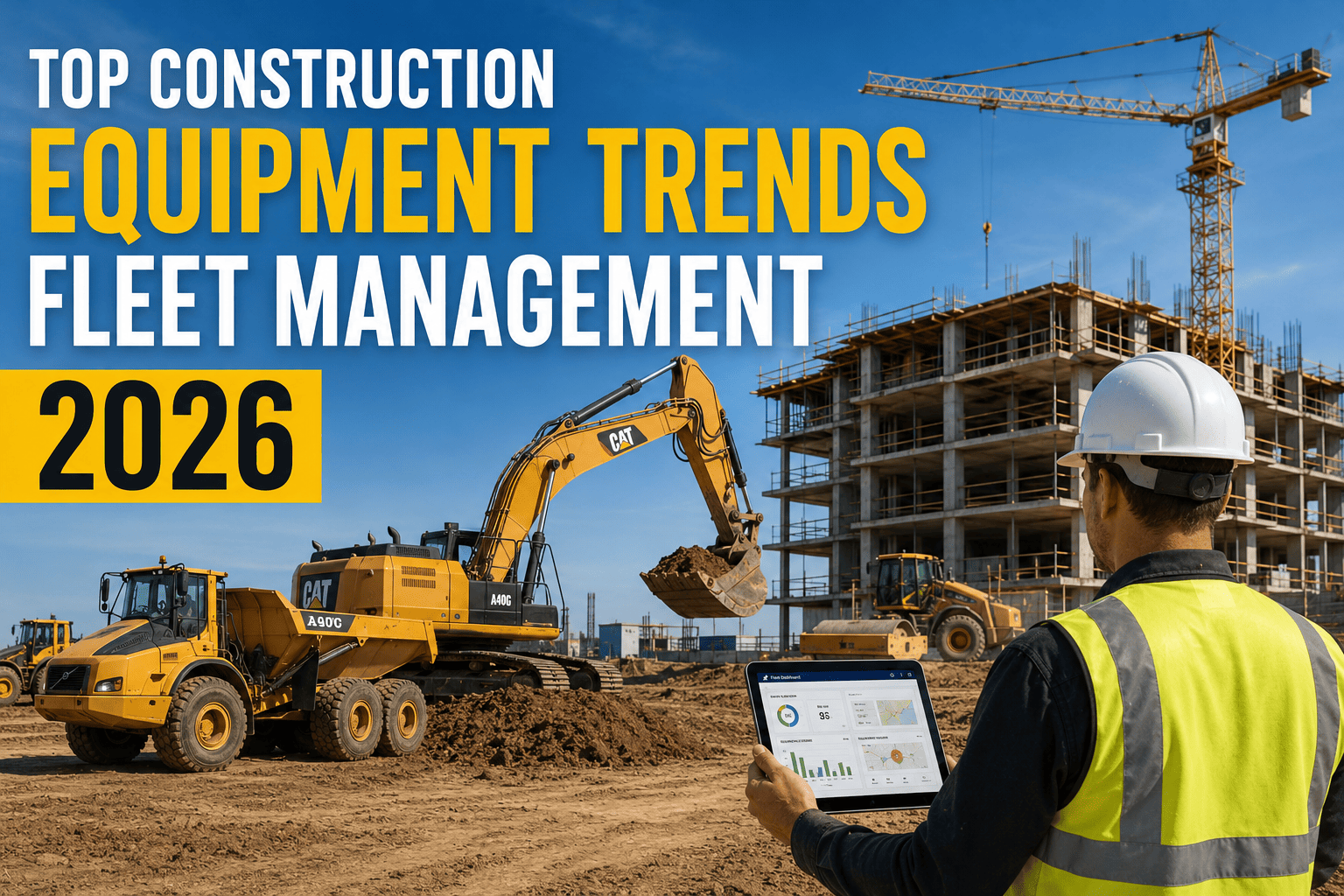
Walk any major jobsite in 2026 and the machines look mostly familiar, but what's happening underneath the hood, in the cab, and behind the scenes has changed more in the last two years than in the previous decade. Contractors aren't just buying bigger iron anymore. They're buying software wrapped around iron, and 68 percent of them are planning major technology investments this year to fight rising equipment costs and a labor shortage that has left roughly 440,000 operator positions unfilled. This piece walks through the five trends actually reshaping construction fleets right now, what the numbers behind each one really mean, and where to start if you're only ready to tackle one thing at a time. If a trend below sounds like something your fleet needs today, you can start a free trial or book a live demo to see it in action.
AI-powered predictive maintenance, advanced telematics, electrification, autonomous equipment, and operator-assist tools are the five trends defining construction fleets in 2026. Together, contractors adopting these technologies are reporting 25 to 40 percent lower operating costs, while predictive maintenance alone is cutting unplanned downtime by 30 to 65 percent depending on implementation.
Trend 01: AI-Powered Predictive Maintenance
Predictive maintenance has moved from a nice-to-have pilot project to the default expectation for serious fleets. Machine learning models trained on millions of equipment operating hours can now flag developing failures 200 to 400 hours before a breakdown, turning what used to be an unpredictable catastrophic event into a scheduled service call at a time the fleet manager chooses. Leading platforms are hitting roughly 92 percent accuracy in predicting failures three to six weeks out, which is enough lead time to order parts, schedule a technician, and plan the repair around a slow day instead of a busy one.
The Numbers Behind the Shift
Independent research from McKinsey shows organizations implementing predictive maintenance reduce unplanned downtime by 30 to 50 percent and cut overall maintenance costs by 10 to 40 percent. Construction-specific data pushes even higher, with some fleets eliminating up to 87 percent of unexpected equipment failures and cutting operational downtime by 65 percent once the system is fully adopted across the fleet.
Why This Trend Doesn't Require New Hardware
Most modern equipment built after 2001 already has the J1939 CAN bus infrastructure needed to feed these models, meaning contractors aren't buying new machines to get predictive maintenance. They're connecting the sensors already sitting inside the equipment they own to a platform smart enough to interpret what those sensors are saying.
FleetRabbit's AI maintenance platform monitors 40+ real-time parameters per machine and flags developing issues before they become downtime. Start your free trial and see your fleet's health in real time.
Trend 02: Telematics Becomes the Fleet's Central Nervous System
Telematics stopped being a simple GPS dot on a map years ago, but 2026 is the year it fully matured into the data backbone every other trend depends on. The global construction telematics market is projected to hit 1.5 billion dollars this year, growing at roughly 17 percent annually, and more than half of organizations, 53 percent, now name predictive maintenance alerts as the single most important feature when choosing a vendor.
Trend 03: Electrification Finds Its Realistic Lane
Diesel is still king on most heavy jobsites, but its reign is being challenged in the places where it makes physical sense. Electrification is moving faster than skeptics expected in compact equipment, where duty cycles allow overnight charging and battery weight isn't a dealbreaker. Urban sites in particular are pushing this shift, since electric equipment solves noise, emissions, and space constraints that matter more downtown than on a rural jobsite.
Where Batteries Still Fall Short
A 50-ton excavator running a full shift needs an amount of energy density that current battery technology simply can't deliver affordably. A battery pack large enough to run a large dozer for ten hours would weigh as much as a small car and cost more than the machine itself, which is why heavy earthmoving equipment is likely to stay diesel or hybrid for the foreseeable future even as compact machines go electric.
A Practical Path for Mixed Fleets
Many contractors are running electric equipment on urban sites while keeping diesel available for remote or physically demanding locations, with some targeting 30 to 40 percent electric penetration in their compact fleet by 2027 through this kind of strategic, site-by-site deployment rather than an all-or-nothing switch.
Trend 04: Autonomous and Semi-Autonomous Equipment
Autonomous construction equipment has moved from experimental pilot programs to trusted jobsite tools. Major manufacturers including Caterpillar, Komatsu, and Volvo are deploying self-driving dozers, excavators, and haul trucks that operate with minimal human oversight, and the motivation isn't replacing operators. It's addressing a shortage severe enough that many contractors simply can't hire enough qualified people regardless of budget.
Solving a Shortage, Not Creating One
Semi-autonomous systems function more like power steering than an autopilot. They let less-experienced operators be productive sooner while veteran operators handle the most complex work, which is why contractors using this equipment report higher operator satisfaction and retention rather than job losses.
Telematics and AI maintenance deliver the quickest return of any 2026 trend, often paying for themselves in 60 to 90 days. Book your demo to map out a phased plan for your fleet.
Trend 05: Operator-Assist Technology and Workforce Tools
The equipment showroom floor in 2026 looks less like a hardware showcase and more like a software demo. Manufacturers including Bobcat, Hitachi, and John Deere are building in-cab systems designed to support operators directly, from voice-activated jobsite assistants to real-time hazard detection. These tools reflect a broader shift where OEMs increasingly position themselves as technology providers rather than pure equipment manufacturers.
Flattening the Learning Curve
Grade-assist, safety alerts, and 3D machine control help newer operators reach experienced-level productivity faster, which matters enormously when the industry can't fill open seats fast enough. Rework avoidance matters just as much: with diesel and labor costs where they are, digging a hole twice is no longer an affordable mistake.
What This Means for Fleet Budgets
None of these trends require adopting everything at once. Most contractors are phasing implementation, starting with the technologies that pay for themselves fastest and building toward the more capital-intensive shifts like electrification and autonomy.
| Trend | Typical Starting Point | Reported Impact |
|---|---|---|
| Telematics | Foundational, implemented first across most fleets | 60 to 90 day payback window |
| AI Predictive Maintenance | Layered on top of existing telematics data | 30 to 65 percent less unplanned downtime |
| Electrification | Compact machines on urban sites first | 30 to 40 percent electric penetration by 2027 |
| Autonomous Equipment | Trial deployments on select machines | Higher operator retention and satisfaction |
| Operator-Assist Tools | In-cab systems on new equipment purchases | Faster ramp-up for newer operators |
Where Most Fleets Are Headed Next
With 68 percent of contractors planning major technology investment this year and fleets already reporting 25 to 40 percent lower operating costs from these trends combined, the fleets sitting out 2026 aren't avoiding risk. They're accumulating a competitive gap that gets harder to close every quarter they wait.
Frequently Asked Questions
The machines aren't the differentiator anymore. The technology running underneath them is. FleetRabbit gives you the telematics, AI-powered maintenance alerts, and real-time fleet visibility to put every trend in this guide to work on your jobsites.