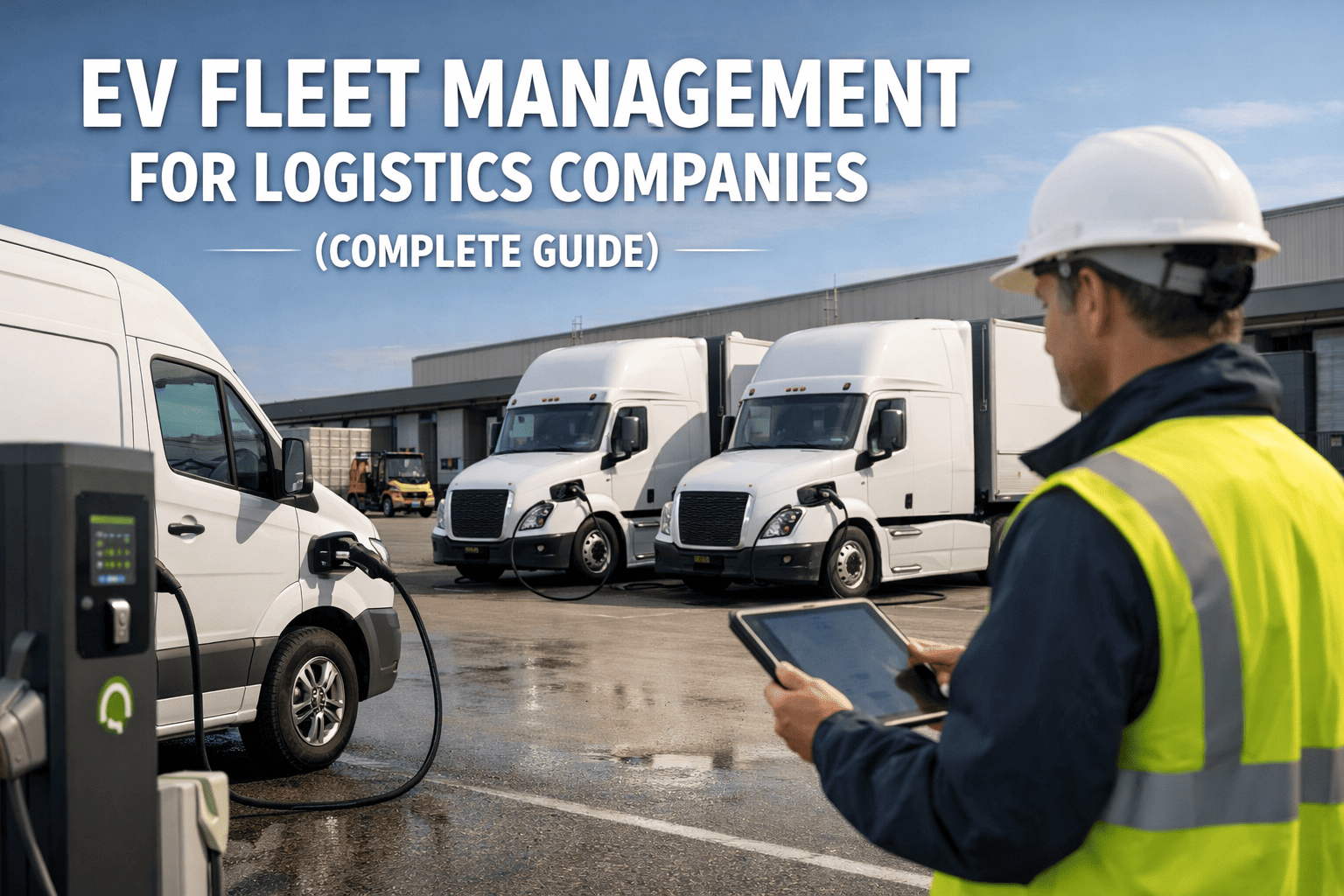
The logistics industry is going electric fast. The EV fleet management market is projected to grow from $9.1 billion in 2025 to $32.25 billion by 2030, with transportation and logistics commanding an 18% market share. But here's the challenge: managing electric delivery fleets requires fundamentally different tools than diesel. Route planning must account for charging stops. Battery health impacts uptime. And charging coordination can make or break your delivery schedules. This guide shows logistics companies exactly how to master EV fleet management — from charging infrastructure to route optimization to TCO calculation. Book a demo to see how FleetRabbit handles EV-specific logistics challenges.
EV Fleet Management for Logistics
Route Optimization, Charging & Operations for Electric Delivery Fleets
Why Logistics Needs EV-Specific Fleet Management
Managing electric delivery vehicles isn't the same as managing diesel fleets with different fuel. EVs introduce unique operational variables that standard fleet software can't handle. Range depends on load weight, weather, and terrain. Charging times vary by charger type and battery state. And route efficiency directly impacts whether drivers complete their stops — or get stranded. Here's what makes EV logistics management fundamentally different:
- Refuel anywhere in 5 minutes
- Range: fixed by tank size
- Routes: optimize for distance/time
- Maintenance: oil, filters, exhaust
- Charging: 30 min - 8 hours
- Range: varies by load, weather, terrain
- Routes: must include charging stops
- Maintenance: brakes, battery health
This is why 70% of fleets adopting EVs report needing specialized management software. Generic fleet tools create blind spots that lead to missed deliveries, stranded vehicles, and charging chaos. Calculate your EV fleet TCO to see the real cost picture.
The 5 Pillars of EV Logistics Management
Successful EV fleet operations for logistics companies rest on five interconnected systems. Miss any one, and efficiency suffers. Master all five, and you unlock the full 20-30% TCO advantage that makes electric logistics profitable:
Range-Aware Route Planning
AI calculates routes factoring battery state, load weight, elevation changes, and weather. Unlike diesel routing, EV routes must guarantee sufficient charge to complete all stops — plus reserve margin for delays.
Smart Charging Orchestration
Coordinate depot charging across your fleet to avoid peak demand charges, ensure vehicles are ready for morning dispatch, and prevent transformer overloads. Off-peak charging alone saves $18,000/truck annually.
Battery Health Monitoring
Track state-of-health across your fleet to predict range degradation, schedule replacements proactively, and maintain resale value. Modern batteries retain 70% capacity at 1M+ miles when properly managed.
Real-Time Fleet Visibility
Monitor charge levels, estimated range, and vehicle locations live. Dispatchers can reassign stops, trigger mid-route charging, or deploy backup vehicles before problems become missed deliveries.
TCO & Carbon Analytics
Compare EV vs diesel costs in real-time, track Scope 1 emissions reductions, and generate compliance reports. Prove ROI to stakeholders with actual operational data — not projections.
See EV Fleet Management in Action
Book a 30-minute demo to see how FleetRabbit handles charging coordination, range-aware routing, and battery monitoring for logistics fleets. Free for up to 3 vehicles.
Last-Mile Delivery: Where EVs Dominate
Last-mile delivery is the perfect EV use case. Short routes, frequent stops, return-to-depot patterns — all ideal for electric vehicles. E-commerce hit $310.3 billion in Q3 2025, with parcel volumes reaching 22.4 billion deliveries annually. Logistics leaders like Amazon, DHL, and UPS are deploying thousands of electric vans specifically because last-mile economics favor EVs:
Depot Charging
Overnight charging at depot means 100% charge every morning. No mid-route charging needed for typical 80-150 mile daily routes.
Stop-and-Go Efficiency
Regenerative braking recovers energy with every stop. More stops = more energy recovered. EVs actually gain efficiency in stop-and-go traffic.
Quiet Delivery
Silent operation enables early morning and late evening deliveries in residential areas — expanding delivery windows and improving OTIF rates.
Zone Access
Low Emission Zones in 30+ major cities restrict diesel delivery. EVs operate unrestricted, avoiding $950+ daily fines in CARB-designated areas.
EV vs Diesel: Logistics TCO Comparison
The upfront cost of electric delivery vehicles is 60-72% higher than diesel equivalents. But operating costs tell a different story. Electric delivery fleets achieve 20-30% lower TCO over 5 years, primarily through fuel and maintenance savings. For logistics companies running high-mileage routes, payback typically occurs within 2-3 years:
Based on 100,000 miles over 5 years, $0.17/mile diesel, $0.04/mile electricity, federal tax credits. Actual savings vary by utilization, electricity rates, and regional incentives. Use our TCO calculator for your specific fleet.
Charging Infrastructure for Logistics Depots
Charging infrastructure is the foundation of EV logistics operations. Get it wrong, and vehicles sit idle waiting for power. Get it right, and your fleet charges overnight, ready for morning dispatch without a second thought. Here's what logistics operators need to know:
Level 1 (120V)
Standard outlet. Too slow for logistics — avoid for commercial operations.
Level 2 (240V)
Ideal for overnight depot charging. Fully charges most delivery vans in 6-10 hours.
DC Fast (480V)
Rapid mid-route charging for long-haul. Adds 180 miles in ~1 hour.
Depot Charging Best Practices
- Install 1.2x chargers vs vehicles for redundancy and growth
- Use smart charging software to avoid peak demand charges
- Shift 80% of charging to off-peak hours (10 PM - 5 AM)
- Consider battery storage to buffer grid demand spikes
- Plan for 350 kW chargers to reduce vehicle idle time by 34%
Real Logistics Companies Using EV Fleets
Major logistics operators are already proving EV fleet viability at scale. These aren't pilot programs — they're production deployments handling millions of deliveries:
Custom-built electric delivery vans operating in 100+ US cities since 2021. Expanded to Germany with 1,000+ additional EVs.
Global zero-emissions goal driving rapid EV adoption. BYD contract deploying hundreds of electric trucks across Europe.
Leading electric vehicle adoption in logistics. Committed to achieving carbon neutrality by 2050.
EV Fleet Management Software Features
Standard fleet management software wasn't built for EVs. Logistics companies need AI-powered fleet management that understands battery dynamics, charging constraints, and range-dependent routing. Here's what EV-specific logistics software must include:
Implementation Timeline
Transitioning logistics operations to EV fleet management doesn't happen overnight — but it doesn't take years either. Most logistics companies achieve full operational capability within 90 days using a phased approach:
Assessment & Planning
Analyze current routes for EV viability. Identify depot charging requirements. Calculate TCO projections for your specific operations.
Infrastructure Setup
Install depot chargers. Configure telematics integration. Set up EV-aware routing in fleet management software.
Pilot Operations
Deploy EVs on select routes. Train drivers on charging protocols. Monitor performance and optimize charging schedules.
Scale & Optimize
Expand EV deployment based on pilot learnings. Implement predictive maintenance for battery health. Achieve full operational efficiency.
Frequently Asked Questions
Modern electric delivery vans offer 150-330 miles per charge depending on model. The Chevrolet BrightDrop offers 272 miles, Ford E-Transit provides 126 miles, and the Mercedes eSprinter reaches 248 miles. For last-mile delivery averaging 80-150 miles daily, most EVs complete routes on a single charge with margin to spare. Range varies with payload weight, weather conditions, and driving style — factors that EV fleet management software tracks and predicts.
Charging time depends on charger type and battery size. Level 2 chargers (standard for depot charging) fully charge most delivery vans in 6-10 hours — perfect for overnight depot charging. DC fast chargers can add 180 miles of range in about an hour, useful for mid-route top-ups on longer regional routes. Smart charging software schedules overnight charging during off-peak hours, reducing energy costs by up to 50%.
Yes, with proper planning. 85% of logistics routes under 300 miles are EV-viable with current technology. For regional operations, strategic DC fast charging stations at distribution hubs enable mid-route charging. The economics favor EVs for routes with predictable patterns, multiple daily trips, and depot charging capability. Long-haul over 300 miles remains challenging, though new vehicles like the Tesla Semi (500-mile range) are expanding possibilities.
Federal tax credits under the Inflation Reduction Act offer up to $7,500 for light-duty EVs and $40,000 for heavy-duty electric trucks. State programs add additional incentives — California's HVIP has allocated $1.7 billion for commercial EV adoption. Charging infrastructure qualifies for separate credits (30% under the Alternative Fuel Vehicle Refueling Property Credit). Many utilities also offer make-ready credits and commercial EV charging rates.
FleetRabbit provides EV-specific capabilities including real-time battery monitoring, range-aware route optimization, charging station integration, and TCO comparison dashboards. The platform tracks energy consumption per driver and route, monitors battery health degradation, and orchestrates depot charging to avoid peak demand charges. Best of all, it's free for up to 3 vehicles and just $3/vehicle/month after that — no contracts, no proprietary hardware required.
Ready to Electrify Your Logistics Fleet?
Book a 30-minute demo to see EV fleet management in action. We'll show you route optimization with charging stops, battery health monitoring, and TCO analytics for your specific operation. Free for 3 vehicles. $3/vehicle/month after that. No contracts.