Fleet electrification is no longer a distant vision — it is accelerating faster than most fleet managers realize.+ In 2025 alone, electric vehicle (EV) registrations for commercial fleets grew by 47% year-over-year, driven by plunging battery costs, expanded charging infrastructure, and aggressive state-level incentives. California, New York, Texas, and Florida have each committed over $500 million to accelerate medium- and heavy-duty EV adoption. The total cost of ownership for electric delivery vans and last-mile trucks is already competitive with diesel in 34 states. sign up for FleetRabbit to track electrification readiness or book a demo to see how our platform models EV transition scenarios for your specific routes.
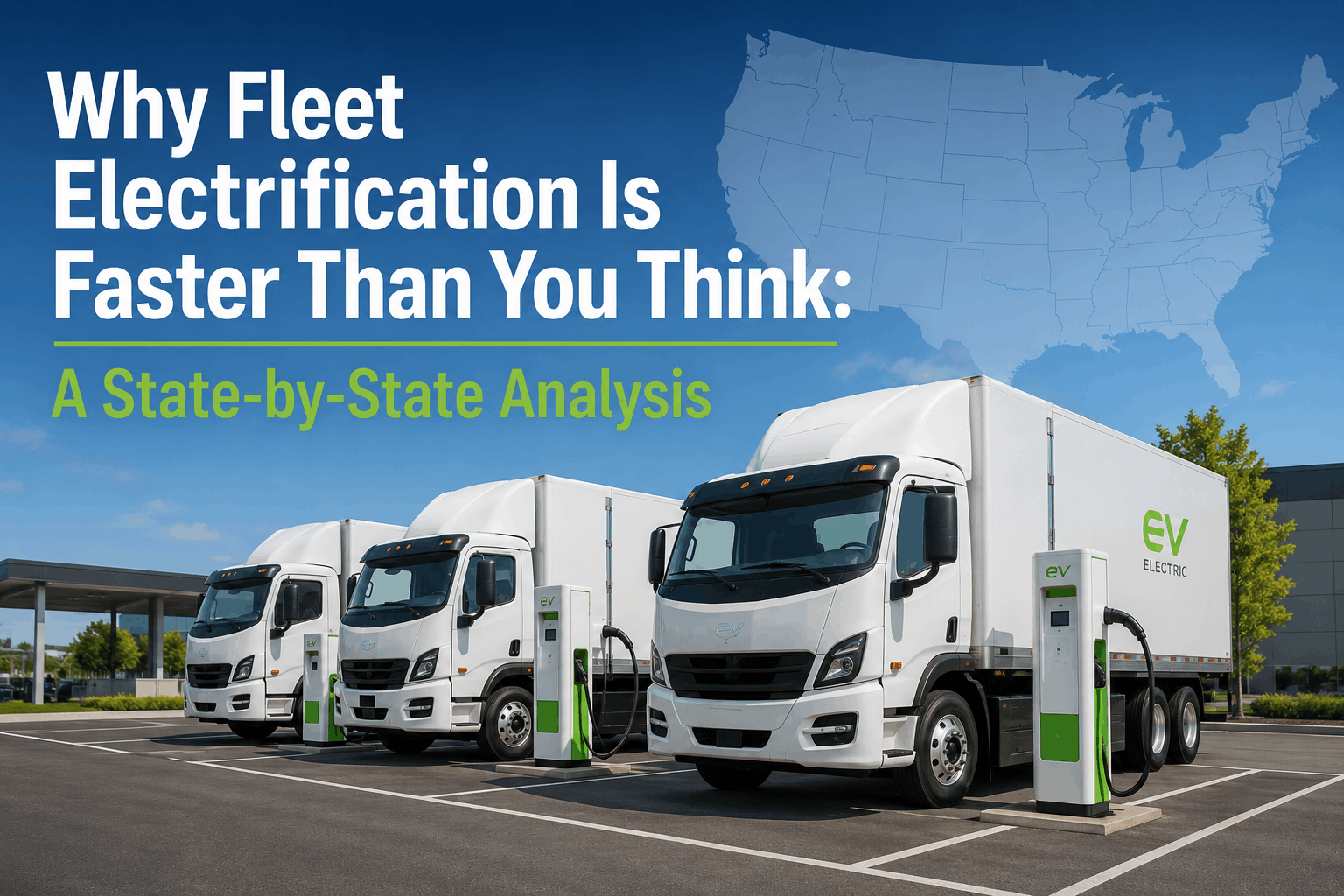
Why Fleet Electrification Is Faster Than You Think: A State-by-State Analysis
The conventional wisdom that EV adoption is "five years away" is obsolete. Battery pack costs have dropped below $100/kWh for the first time in 2026, making electric trucks price-competitive with diesel at acquisition for certain classes. Meanwhile, 42 states now offer some form of EV incentive for commercial fleets, ranging from tax credits to direct rebates for depot chargers. The following state-by-state breakdown reveals the leaders and laggards — and why 2026-2027 will be the inflection point for fleet electrification.
Leading States: Where Electrification Is Already Mainstream
Advanced Clean Fleets rule requires drayage trucks to be zero-emission by 2035. Over 15,000 electric trucks already funded.
Charge Ready NY 2.0 covers 80% of depot charging installation costs. Target: 100% zero-emission school buses by 2035.
Combined with federal IRA 45W credit, effective cost reduction reaches 60% for Class 5-7 trucks.
Key market shift: The Inflation Reduction Act's Commercial Clean Vehicle Credit (45W) provides up to $40,000 per heavy-duty EV. When combined with top state programs like California's HVIP, fleets can reduce upfront costs by 70% or more. sign up to access our incentive calculator and see real savings for your zip code.
Rapidly Accelerating States: 2026-2027 Tipping Points
States like Colorado, Oregon, Washington, and Massachusetts have adopted the Advanced Clean Trucks (ACT) rule, mandating that 40-75% of new truck sales be zero-emission by 2035. Colorado's Commercial EV Rebate offers $12,000 per vehicle, stackable with federal credits. Washington's CVRP provides up to $25,000 for fleet EVs plus $5,000 per depot charger. These states are seeing EV adoption rates double year over year. book a demo to model charging infrastructure costs and savings projections for your operating region.
Charging Infrastructure: The Real Accelerator
The National Electric Vehicle Infrastructure (NEVI) program is deploying $5 billion over five years to build DC fast chargers along highway corridors. As of June 2026, 38 states have broken ground on NEVI-funded sites, with over 2,800 new commercial charging points operational. Additionally, utility-led make-ready programs in Maryland, Illinois, and Michigan cover 100% of interconnection costs for depot charging. The average depot charging installation cost has dropped 31% since 2024 due to standardized hardware and streamlined permitting. sign up to receive alerts about utility grant deadlines in your state.
Total Cost of Ownership (TCO) Deep Dive
For last-mile delivery vans (Class 2b-3), electric TCO is already 8-12% lower than diesel over 5 years in high-mileage applications, even without incentives. For heavy-duty Class 8 tractors, the breakeven point occurs at 120,000 miles per year due to high battery capacity costs — but with state and federal incentives, the payback period drops to 2.5 years. Maintenance savings are substantial: EVs have 70% fewer moving parts, reducing scheduled maintenance costs by an average of $0.12 per mile. Fleets using telematics data from FleetRabbit report another 15% savings through optimized charging schedules. book a demo to run a customized TCO simulation with your actual duty cycles.
Don't wait for the perfect moment — electrification economics already work
FleetRabbit helps you map incentives, plan charging, and track real-world EV performance. Join forward-looking fleet managers already making the transition.
Challenges and How States Are Addressing Them
Grid capacity remains a concern in certain utility territories. However, managed charging and vehicle-to-grid (V2G) pilot programs are expanding. California's Demand Response program pays fleets up to $2,000 per vehicle annually for reducing charging during peak hours. Texas has launched a $300 million Grid Resilience Fund specifically for fleet depot upgrades. Moreover, battery swapping stations are being piloted in California and New York for high-utilization fleets, reducing effective downtime to under five minutes. Fleets that start planning now will have first-mover advantage before incentive funds are exhausted. sign up for our weekly electrification newsletter to stay ahead of policy changes.
Critical stat: According to the 2026 Fleet Electrification Readiness Survey, 54% of fleet managers cite "lack of internal expertise" as the top barrier. However, those using dedicated electrification software (like FleetRabbit) report 2.5x faster planning cycles and 30% lower infrastructure costs. book a demo to see how we simplify the complexity.
State-by-State Incentive Snapshot (Top 5)
Up to $240k per drayage truck. Also includes free technical assistance.
Vouchers plus 80% charger coverage. School bus focus.
$15k-$90k per vehicle. Additional $4k per charger.
$12k per truck + $5k per charger, no cap on vehicles.
Up to $25k for EV replacement of older diesel vehicles.
The 2030 Outlook: What's Coming Next
By 2030, analysts project that 45% of new medium- and heavy-duty truck sales will be battery electric. Seven states have already adopted the Advanced Clean Trucks rule covering over 35% of the US commercial vehicle market. Solid-state batteries entering production in 2027-2028 will further reduce weight and cost. Meanwhile, federal tailpipe emission standards finalized in 2025 will effectively require 50% of new vocational trucks to be zero-emission by 2032. Fleets that begin electrification pilots in 2026-2027 will be well-positioned to meet these regulations without scramble-buying expensive compliance credits. sign up to access our regulatory roadmap tool that maps your fleet against upcoming mandates.
Frequently Asked Questions
Electrify with confidence — not guesswork
FleetRabbit gives you the data, insights, and tools to plan your EV transition state by state. From incentive tracking to depot charging design, we simplify the journey.