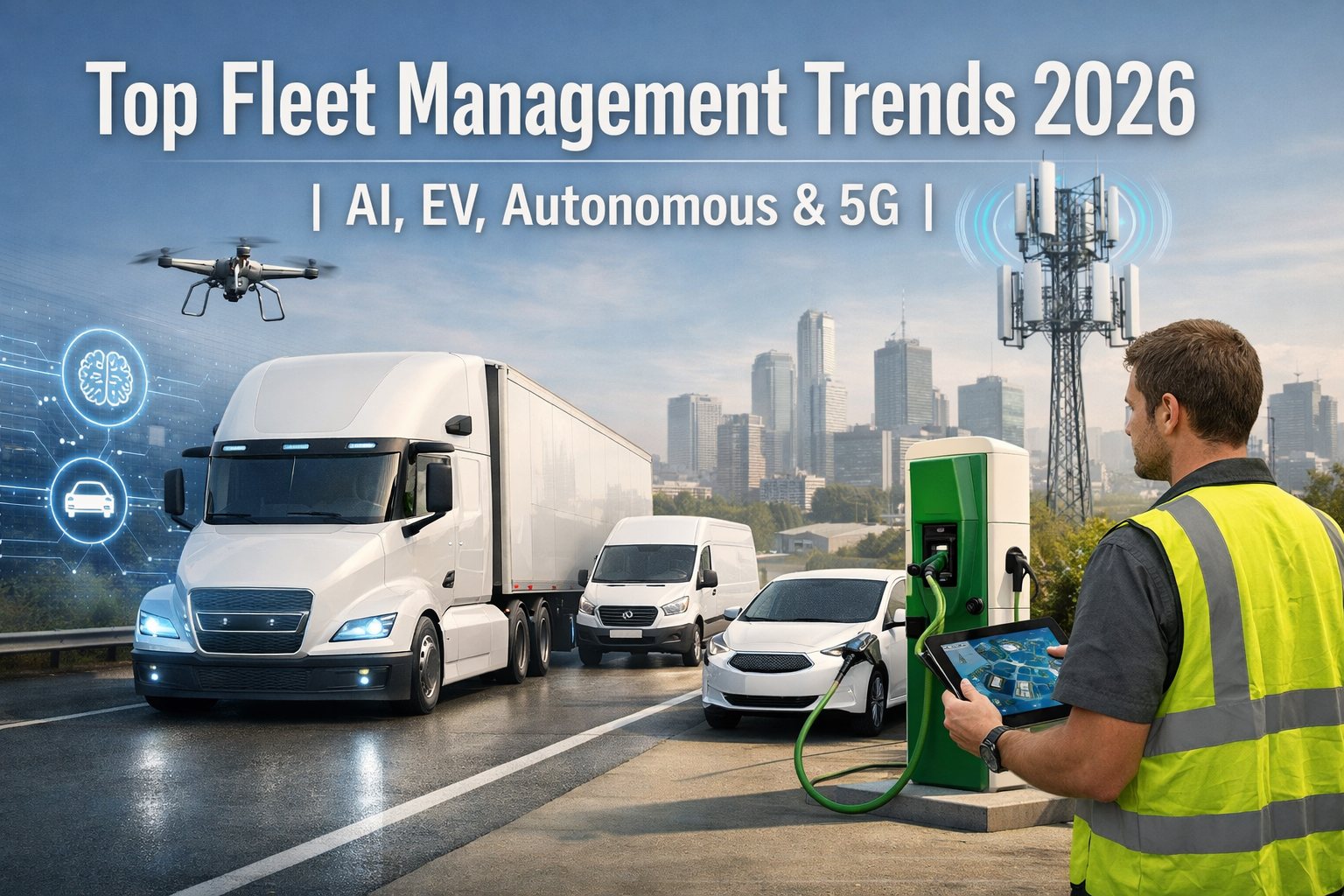
Fleet management in 2026 isn't about keeping up anymoreit's about pulling ahead. The fleets achieving 25-40% efficiency gains aren't lucky; they're leveraging AI-powered optimization, electric vehicle economics, and connected technologies that transform raw data into competitive advantage. Meanwhile, operators still running on spreadsheets and gut instinct watch margins shrink as fuel costs rise, drivers quit, and customers demand real-time visibility they can't deliver. The technology gap between industry leaders and laggards is widening every quarter. This guide breaks down the 10 fleet management trends reshaping 2026—with real numbers, practical implementation paths, and the business case for acting now rather than later. Book a demo to see how FleetRabbit helps you implement these trends.
The 2026 Fleet Technology Landscape: What's Changed
Three years ago, AI route optimization was a pilot program. Electric trucks were science projects. Telematics meant basic GPS dots on a map. Today, 78% of fleet operators are actively investing in AI capabilities. EV deployments have grown 340% since 2023. And real-time video telematics streams HD footage from every vehicle in the fleet. The transformation isn't coming—it's here, and the operators who recognized it early are now operating at cost structures their competitors can't match.
2026 Fleet Technology Adoption: Leaders vs. Laggards
| Capability | Industry Leaders (Top 20%) | Industry Average | Laggards (Bottom 30%) |
|---|---|---|---|
| AI Route Optimization | Full deployment | Pilot programs | Not started |
| Predictive Maintenance | 85% breakdown prevention | 50% prevention | Reactive only |
| EV Fleet Percentage | 15-25% electrified | 5-10% electrified | 0% / "evaluating" |
| System Integration | Fully connected stack | Partial integration | Siloed systems |
| Cost Per Mile | $1.45-1.65 | $1.85-2.10 | $2.25-2.60 |
The cost-per-mile gap tells the story: leaders operate at $1.45-1.65 while laggards struggle at $2.25-2.60. On a 50-truck fleet running 100,000 miles annually, that's a $3-4 million difference in operating costs. Technology adoption isn't optional anymore—it's survival. Schedule a demo to see where your fleet stands.
Trend #1: AI-Powered Fleet Operations Go Mainstream
Artificial intelligence has moved from "interesting experiment" to "competitive necessity" in fleet management. The numbers are unambiguous: fleets using AI-powered route optimization report 15-20% fuel savings. Predictive maintenance AI reduces unplanned breakdowns by 70%. AI driver coaching cuts safety incidents by 45%. These aren't projections—they're documented results from thousands of fleets operating in 2026.
What AI Actually Does for Fleet Operations:
- Route Optimization: Analyzes traffic patterns, weather, delivery windows, and vehicle capabilities across hundreds of variables simultaneously. A human dispatcher managing 50 trucks faces 10^67 possible route combinations daily—AI solves this in seconds and improves with every delivery
- Predictive Maintenance: Monitors engine sensors, component wear patterns, and operating conditions to predict failures 2-4 weeks before they happen. No more roadside breakdowns. No more emergency repairs at 3x the cost
- Driver Coaching: Identifies specific behaviors—hard braking, rapid acceleration, excessive idle—and delivers personalized coaching that actually changes habits. Fleet-wide fuel efficiency improves 8-12% from behavior changes alone
- Demand Forecasting: Predicts capacity needs weeks ahead by analyzing seasonal patterns, customer behavior, and market signals. Right-size your fleet before peak season, not during it
The adoption curve has reached the tipping point. 78% of fleet operators now invest in AI capabilities, up from 45% just two years ago. But here's the critical insight: only 23% have achieved full integration. The opportunity window for competitive advantage through AI is closing—but it hasn't closed yet. Book a demo to see AI-powered fleet management in action.
The AI Implementation Reality Check
AI isn't magic. It requires clean data, proper integration, and realistic expectations. Fleets that succeed with AI start with one high-impact use case (usually route optimization), prove ROI, then expand. Fleets that fail try to implement everything at once with messy data and disconnected systems. The technology works—but implementation matters. Talk to our team about the right AI starting point for your fleet.
Trend #2: Electric Vehicle Economics Reach the Tipping Point
The EV debate is over for a significant portion of fleet operations. Battery costs have dropped 40% since 2022. Charging infrastructure has expanded to cover major corridors. And the total cost of ownership math now favors electric for urban delivery, last-mile, and regional distribution routes. The question isn't whether EVs make sense—it's which routes to electrify first and how fast to scale.
Electric vs. Diesel: 2026 Total Cost of Ownership (Annual, Per Vehicle)
| Cost Category | Diesel | Electric | Advantage |
|---|---|---|---|
| Fuel / Energy | $24,000 | $8,500 | EV saves $15,500 (65%) |
| Maintenance | $8,200 | $3,100 | EV saves $5,100 (62%) |
| Depreciation | $12,000 | $15,500 | Diesel saves $3,500 |
| Total Annual TCO | $44,200 | $27,100 | EV saves $17,100 (39%) |
Based on 60,000 annual miles, regional delivery duty cycle, 2026 fuel/energy prices. Your results vary by route, climate, and charging setup.
Where EVs Win in 2026 (And Where They Don't—Yet)
- Urban Delivery / Last Mile: STRONG FIT. Routes under 150 miles, depot charging, frequent stops that maximize regenerative braking. EVs dominate this segment economically
- Regional Distribution: STRONG FIT. Fixed routes under 250 miles between facilities with charging infrastructure. Overnight charging fits operational schedules perfectly
- Mixed Operations: MODERATE FIT. EVs handle predictable short routes while diesel covers variable long-haul assignments. Ideal for phased transition
- Long-Haul (300+ miles daily): WAIT UNTIL 2027-2028. Charging infrastructure and time constraints still favor diesel. Megawatt charging networks expanding rapidly—reassess annually
Most fleets discover 20-40% of their current operations can electrify profitably today. The leaders aren't waiting for 100% readiness—they're capturing savings on eligible routes now while building operational expertise for broader deployment. Book a demo to analyze your fleet's EV readiness.
Trend #3: Autonomous Technology Delivers Value Today
Forget the hype about fully driverless trucks taking over highways tomorrow. That's a 2030+ story. The 2026 story is about the autonomous technologies delivering measurable value right now: advanced driver assistance systems reducing accidents by 40%, truck platooning saving 10-15% on fuel, and limited hub-to-hub autonomous operations launching on specific corridors.
Autonomous Technology: What's Actually Available in 2026
| Technology Level | What It Does | 2026 Status | ROI Impact |
|---|---|---|---|
| Level 2 ADAS | Adaptive cruise, lane keeping, automatic emergency braking | Commercially available on new trucks | 40% accident reduction, lower insurance |
| Level 2+ Platooning | V2V-connected convoys, 50ft following distance | Active pilots in 25+ states | 10-15% fuel savings on eligible routes |
| Level 4 Hub-to-Hub | Driverless highway segments between transfer points | Limited commercial routes launching | Labor cost reduction on specific lanes |
| Level 5 Full Autonomy | No human required, any condition | 2030+ timeline | Future planning only |
The smart play for 2026: spec Level 2 ADAS on every new truck purchase (the safety and insurance ROI is immediate), evaluate platooning for high-volume interstate lanes, and monitor Level 4 developments for 2028+ planning. Don't wait for perfect autonomy—capture the value available today.
Want to understand how autonomous technology fits your fleet's future? Book a strategy session with our team to map the technology roadmap for your specific operations.
Trend #4: 5G Transforms What's Possible with Telematics
5G isn't just faster 4G. It's a fundamentally different capability that enables fleet applications that were technically impossible before. Real-time HD video from every vehicle. Instant diagnostics without batched uploads. AI processing on the vehicle itself rather than round-tripping to the cloud. The fleets deploying 5G-enabled telematics in 2026 are operating with visibility their competitors can't match.
What 5G Enables for Fleet Operations:
- Live Video Telematics: Continuous HD streaming from dash cams and around-vehicle cameras. Real-time coaching, instant incident documentation, active security monitoring. 4G bandwidth made this impractical at scale—5G makes it standard
- Instant Vehicle Diagnostics: Complete engine data transmitted in real-time, not batched hourly. Fault codes trigger immediate alerts. Over-the-air updates push software fixes without shop visits
- Edge AI Processing: Artificial intelligence runs directly on the vehicle, enabling instant safety interventions without network latency. Critical for advanced driver assistance and future autonomous features
- V2X Connectivity: Vehicles communicate with traffic signals, loading docks, fuel stations, and each other. Coordinated arrivals, optimized traffic flow, automated check-ins
Trend #5: Cybersecurity Becomes Operational Priority
Connected fleet technology creates connected fleet vulnerabilities. The same systems that enable real-time visibility and AI optimization also create attack surfaces that criminals exploit. Ransomware attacks on logistics companies increased 300% since 2023. The average cost of a successful fleet system breach: $250,000+ including ransom, recovery, downtime, and lost business. Cybersecurity isn't an IT issue anymore—it's an operational survival issue.
Fleet Cybersecurity Threats You're Facing in 2026:
- Ransomware: Attackers encrypt your dispatch, ELD, and routing systems. Operations stop completely until you pay or rebuild from scratch. Average downtime: 3-5 days. Average total cost: $250,000+
- Telematics Hijacking: Compromised devices provide access to vehicle systems, location data, and connected enterprise networks. One vulnerable device can expose your entire operation
- Supply Chain Exposure: Your integrations with customers, fuel cards, and third-party platforms create data pathways attackers exploit. Their breach becomes your breach
Fleet Cybersecurity Non-Negotiables for 2026:
- Multi-factor authentication on every system, every user, no exceptions
- Regular security audits of telematics devices, APIs, and integration points
- Employee training focused on phishing—still the #1 attack vector
- Vendor verification confirming security practices of every integration partner
- Tested backup/recovery procedures you've actually practiced, not just documented
- Incident response plan specific to fleet systems with defined roles and procedures
The investment in cybersecurity feels like insurance—until you need it. Then it's the difference between a contained incident and a business-ending catastrophe. Book a demo to see FleetRabbit's enterprise security capabilities.
Trend #6: ESG Reporting Shifts from Optional to Required
Three years ago, sustainability reporting was a nice-to-have for fleets courting environmentally conscious shippers. Today, it's a contract requirement. Major retailers and manufacturers now mandate emissions data from carriers—they need your Scope 3 numbers for their own regulatory compliance. California's Advanced Clean Fleets rule requires zero-emission vehicle purchases. SEC climate disclosure rules ripple through supply chains. Fleets without sustainability tracking lose bids to competitors who can provide the required documentation.
What You Must Track and Report in 2026:
- Carbon Emissions (Scope 1 & 3): Your direct fleet emissions plus your contribution to customer supply chains. Per-shipment emissions data increasingly required in RFPs
- Fuel Efficiency Metrics: MPG by vehicle, route, and driver. Idle time tracking. Year-over-year improvement targets specified in contracts
- Electrification Progress: EV percentage, deployment roadmap, charging infrastructure investments. Shippers want to see the plan, not just current state
- Safety & Social Metrics: Accident rates, driver turnover, training programs, diversity statistics. The "S" in ESG carries equal weight now
The fleets treating ESG as a checkbox exercise miss the point. Sustainability tracking done right identifies efficiency opportunities—the same data that satisfies reporting requirements also reveals fuel waste, maintenance gaps, and operational inefficiencies. Start your free trial to access automated ESG reporting.
Trend #7: Driver Experience Technology Finally Gets Serious
The driver shortage isn't a trend—it's a chronic condition the industry has failed to solve for a decade. Turnover rates still exceed 90% at large carriers. But 2026 marks a shift in how progressive fleets approach the problem: instead of just monitoring drivers more intensively, they're investing in technology that makes the job better. The fleets winning the driver retention battle focus on experience, not surveillance.
Technology That Actually Improves Driver Experience:
- Streamlined Digital Workflows: Apps that eliminate paperwork frustration. Digital DVIRs completed in 2 minutes. Electronic BOLs. Instant load details. Administrative burden reduced 60%
- Transparent Pay Systems: Real-time earnings visibility. Accurate settlement calculations drivers can verify. Instant pay options. No more "wait and see what the check says"
- Smart Home Time Routing: AI dispatch that genuinely prioritizes driver preferences and home location—not just lip service. Predictable schedules that let drivers plan their lives
- Quality In-Cab Technology: Reliable connectivity for streaming and family calls. Improved climate control. Ergonomic seating. Modern trucks designed around driver comfort, not just cargo capacity
The data is clear: fleets investing in driver experience technology see 25-35% lower turnover than those focused purely on monitoring and compliance. At $8,000-15,000 per driver replacement, the ROI case writes itself. Book a demo to see driver-focused fleet management.
Trend #8: API Integration Becomes Table Stakes
The era of siloed fleet software is over. In 2026, "does it integrate?" is the first question in every platform evaluation. Fleet operators demand seamless data flow between their fleet management system, ELD devices, fuel cards, accounting software, TMS platforms, maintenance systems, and customer portals. Platforms without robust API capabilities are losing deals—period.
The Connected Fleet Tech Stack:
- ELD & Telematics → Fleet Platform: Real-time GPS, HOS data, vehicle diagnostics flowing automatically
- Fuel Cards → Fleet Platform → Accounting: Transactions imported, matched to vehicles, coded to GL accounts without manual entry
- TMS ↔ Fleet Platform: Load assignments, ETAs, and POD documentation synchronized bidirectionally
- Maintenance Systems → Fleet Platform: Fault codes trigger work orders. Parts availability checked. Warranty tracked automatically
- Fleet Platform → Customer Portals: Real-time tracking, accurate ETAs, delivery confirmation shared automatically
Fleets with fully integrated tech stacks report 65% reduction in administrative time and 40% faster decision-making. The manual data entry that consumed hours becomes automatic. The reports that took days compile instantly. Integration isn't a feature—it's the foundation everything else builds on. Book a demo to see FleetRabbit's integration capabilities.
Trend #9: Fleet Simulation Changes How Decisions Get Made
Should you add 10 trucks or lease 15 smaller ones? Reroute through Phoenix or Albuquerque? Defer maintenance on 5 units to cover a demand spike? Replace 20% of diesel with electric next year? These decisions used to rely on spreadsheets and gut instinct. In 2026, leading fleets simulate them—testing scenarios virtually before committing real trucks and real dollars.
What Fleet Simulation Enables:
- Route Scenario Testing: Model alternate routes against real traffic, fuel costs, and delivery windows. Know the impact before you commit trucks
- Expansion Modeling: Test buy vs. lease, vehicle types, and capacity scenarios against actual demand patterns. See utilization rates before signing contracts
- EV Transition Planning: Simulate electric vehicle performance on your specific routes with your payloads, your terrain, your climate—not manufacturer specs
- Disruption Planning: Model fuel price spikes, driver shortages, weather events, demand swings. Build contingency plans based on data, not guesses
The fleets using simulation report dramatically better outcomes on major decisions: 15-25% improvement in asset utilization, 30% reduction in planning errors, and significantly faster response to changing conditions.
Trend #10: Compliance Automation Eliminates Administrative Burden
IFTA reporting. HOS monitoring. Driver qualification files. Medical certificate tracking. Drug testing schedules. Emissions reporting. The compliance burden grows every year, consuming administrative hours that could go toward actually running the fleet. In 2026, RegTech—regulatory technology—automates what used to require armies of compliance clerks.
Compliance Automation in 2026:
- Automated IFTA: GPS data calculates fuel tax by jurisdiction automatically. Filing-ready reports generated monthly. Audit issues flagged before they become problems
- Proactive HOS Monitoring: AI predicts violations before they occur. Optimal break timing suggested. Exceptions documented automatically. Violation rates drop 80%
- DQ File Management: CDL expirations, medical certs, drug tests, training requirements—all tracked with 60-day advance alerts. No more compliance gaps discovered during audits
- Emissions Reporting: As CARB rules expand nationally, automated tracking ensures compliance without manual data compilation
Still managing compliance manually? Book a demo to see how FleetRabbit automates IFTA, HOS monitoring, and DQ file management. Or start your free trial and experience automated compliance today.
Frequently Asked Questions
AI-powered operations. With 78% of fleets now investing in AI and documented results showing 15-20% fuel savings, 70% fewer breakdowns, and 45% reduction in safety incidents, AI has moved from experimental to essential. The competitive gap between AI adopters and laggards is widening every quarter. Fleets that delay implementation face compounding disadvantages as early movers refine their capabilities.
If you have urban delivery, last-mile, or regional distribution routes under 200 miles daily—start now. The TCO math already favors EVs for these applications, and early movers are building operational expertise while capturing fuel and maintenance savings. Long-haul operations should wait for 2027-2028 when charging infrastructure reaches critical density, but continue monitoring developments closely. Most fleets find 20-40% of current operations can electrify profitably today.
Full autonomy (Level 5) is a 2030+ story—don't plan around it yet. But Level 2 ADAS is available today and reduces accidents by 40%. Truck platooning pilots in 25+ states demonstrate 10-15% fuel savings. Limited Level 4 hub-to-hub operations are launching on specific corridors. The smart play: implement available ADAS now for immediate safety ROI, evaluate platooning for high-volume lanes, and monitor Level 4 for future planning.
Start with multi-factor authentication everywhere—it prevents most unauthorized access. Then prioritize employee phishing training (still the #1 attack vector), regular security audits of connected systems, vendor security verification for all integrations, and tested backup/recovery procedures. Average ransomware cost exceeds $250,000. Prevention investment delivers immediate ROI compared to recovery costs.
ESG has moved from voluntary to mandatory. Major shippers require emissions data for their Scope 3 reporting—no data, no contract. California's Advanced Clean Fleets rule mandates ZEV purchases. SEC disclosure rules affect supply chains. Fleets without sustainability tracking are losing bids to competitors who can provide required documentation. The good news: proper ESG tracking also reveals efficiency opportunities that improve operations independent of reporting requirements.
The Technology Gap Is Widening. Which Side Are You On?
Industry leaders operate at $1.45-1.65 per mile. Laggards struggle at $2.25-2.60. The difference is technology adoption—AI optimization, EV economics, integrated systems, automated compliance. FleetRabbit delivers the capabilities that separate winners from the rest. See it in action.