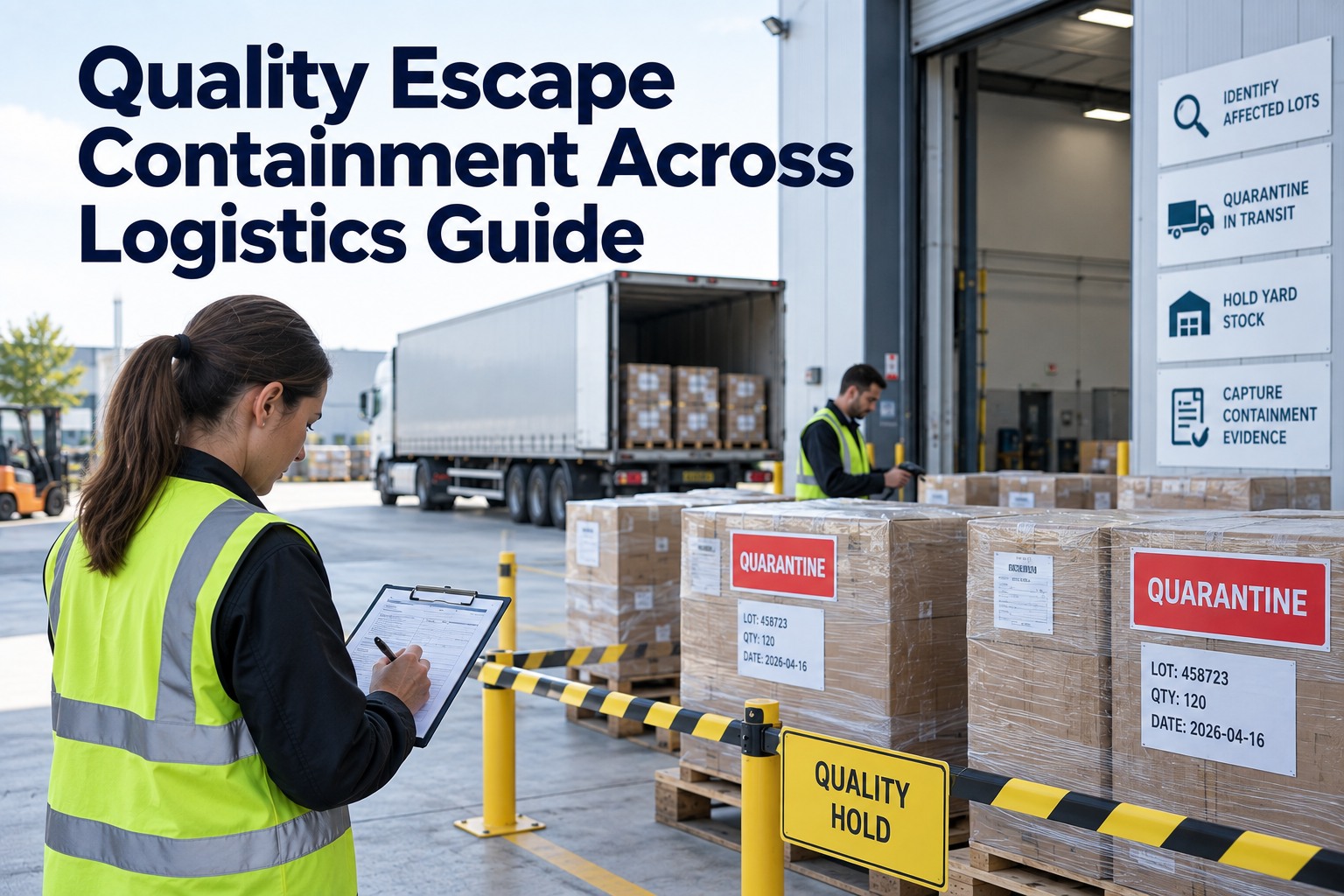
Containment is a quality decision executed almost entirely by logistics. When a defect escapes, the requirement is not to stop production — it is to immediately contain all suspect material at the supplier, at the customer, in transit, and at the customer's customer. Two of those four locations are moving or already inside somebody else's site, and neither is visible from a quality system. That is the real problem with escape containment: identifying the affected lot takes hours, and physically arresting it across four locations takes days you do not have. Meanwhile the clock that matters has already started, because release from controlled shipping is decided by documentation rather than by how clean the parts have become. Book an architecture review to see how fast your records could scope an affected lot today.
Quality Escape Containment Across Logistics
Scoping the affected lot in both directions, arresting stock in four places at once including the two you cannot see, and assembling the evidence that actually ends controlled shipping.
Four Places, Two of Them Invisible
The containment requirement is explicit about scope. Where operations struggle is that each location has a different owner, a different mechanism and a different clock.
| Location | Who has to act | What actually stops the stock | Why it fails |
|---|---|---|---|
| At the supplier | Your own plant and warehouse | Hold status applied at lot level, quarantine bins, picking excluded | Rarely — this is the location everyone contains first and best |
| In transit | Logistics and the carrier | Intercepting or diverting shipments already released, and flagging containers en route | Nobody knows which despatches contained the affected lot without querying the shipment records |
| At the customer | The customer's receiving and line-side stores | Notification precise enough that they can find it — container references, not just a date range | A vague scope forces them to quarantine far more than was affected, at your cost and their disruption |
| At the customer's customer | Beyond your direct relationship entirely | Escalation through your customer, with identifiers they can act on | You have no visibility and no authority — only the quality of your identifiers travels that far |
Scoping Runs in Two Directions
Both are needed, and most operations can do one of them quickly.
What Quarantine Has to Do Mechanically
Applying a hold status is the easy part. These six behaviours are what make the hold real rather than advisory.
CS1 and CS2, and What Separates Them
Understanding the escalation matters because the cost profile changes completely at the second level.
| Controlled Shipping Level 1 | Controlled Shipping Level 2 | |
|---|---|---|
| Who inspects | Your own employees, or a third party you choose — the decision usually driven by cost and staff availability | An accredited third-party provider from the customer's approved vendor list, mandated rather than chosen |
| What it requires | Containment plus redundant 100% inspection, root cause identified, irreversible corrective actions, then verification that they worked | The same, executed and independently verified by the external agency inspecting every outgoing part |
| Who pays | You | You — with third-party inspection costs reported to run into hundreds of thousands per month on larger programmes |
| Typical trigger | A confirmed defect reaching the line, a line-down or stop-ship traced to your part, repeat defects, or a PPM spike | CS1 failing to demonstrably contain the problem, or an issue judged high-risk from the outset |
| Exit criteria | Commonly 20 to 30 working days of data verifying that normal production controls are effective | Comparable clean-day evidence, independently verified, with an audit typically scheduled |
Documentation Decides the Release
The most expensive misunderstanding in containment, stated as directly as the industry states it.
The Signal That Means the Fix Did Not Hold
One pattern is described as the clearest available indicator, and it is worth watching for on your own suppliers as much as guarding against on your own site.
Preparing Before You Need It
Containment speed is decided by work done months earlier. Five things to establish while nothing is wrong.
Frequently Asked Questions
In four places simultaneously: at the supplier, at the customer, in transit, and at the customer's customer. The first is straightforward because you control it. The remaining three depend entirely on how precisely you can identify which containers and shipments carried the affected lot — because remote containment is only as good as the identifiers you can give someone else to act on.
In both directions. Forward traceability starts from a suspect input and establishes everywhere it went — which parts, which shipments, which destinations — and defines the containment perimeter. Backward traceability starts from the failed part and reconstructs its inputs, machine, station and process parameters, which finds root cause and reveals whether the initial perimeter was too narrow. Without reliable records, either becomes a manual investigation across logs and spreadsheets while the material keeps moving.
At level one you contain and run redundant 100% inspection using your own people or a third party you select, identify root cause, implement irreversible corrective actions and verify they worked. At level two an accredited third-party provider from the customer's approved list executes and verifies that containment, inspecting every outgoing part — mandated rather than chosen, and still at your expense, with costs reported to reach hundreds of thousands per month on larger programmes.
Documentation, not clean parts alone. Weak paperwork can keep a supplier in controlled shipping even after production has gone clean, because release is granted on proof that the defect can no longer escape. Expect to need charted inspection data, a completed 8D with verified root cause and irreversible actions, and typically 20 to 30 working days of evidence that normal production controls are effective. Error-proofing carries more weight than added inspection, since inspection is what failed.
Because something produced the defect and something separately allowed it to escape — past inspection, through packing, onto a truck. Guidance is explicit that both need distinguishing and both need irreversible actions. Fixing only the production cause leaves the escape route open, which is why the next defect reaches the customer the same way. Escape root cause spans inspection, packing and despatch, and is frequently the analysis nobody owns.
Six mechanical behaviours: lots default to hold on receipt, directed putaway is blocked from released locations, picking excludes held stock automatically, label printing is refused for held items, containers inherit hold status from their contents and synchronise on release, and blocked pick or ship attempts are logged. Test it — place a lot on hold and try to pick, label and ship it. If any succeeds, the hold is a flag rather than a control.
That the corrective action was not irreversible. The same defect reappearing in serial production within roughly thirty to sixty days of a verified 8D closure is described as the clearest available signal that containment discipline cannot hold a fix, whatever the analysis says on paper. Failure to exit second-level containment within about eight weeks is treated similarly — as loss of control of the quality system rather than a difficult defect. Start free with three assets and build the record before you need it.