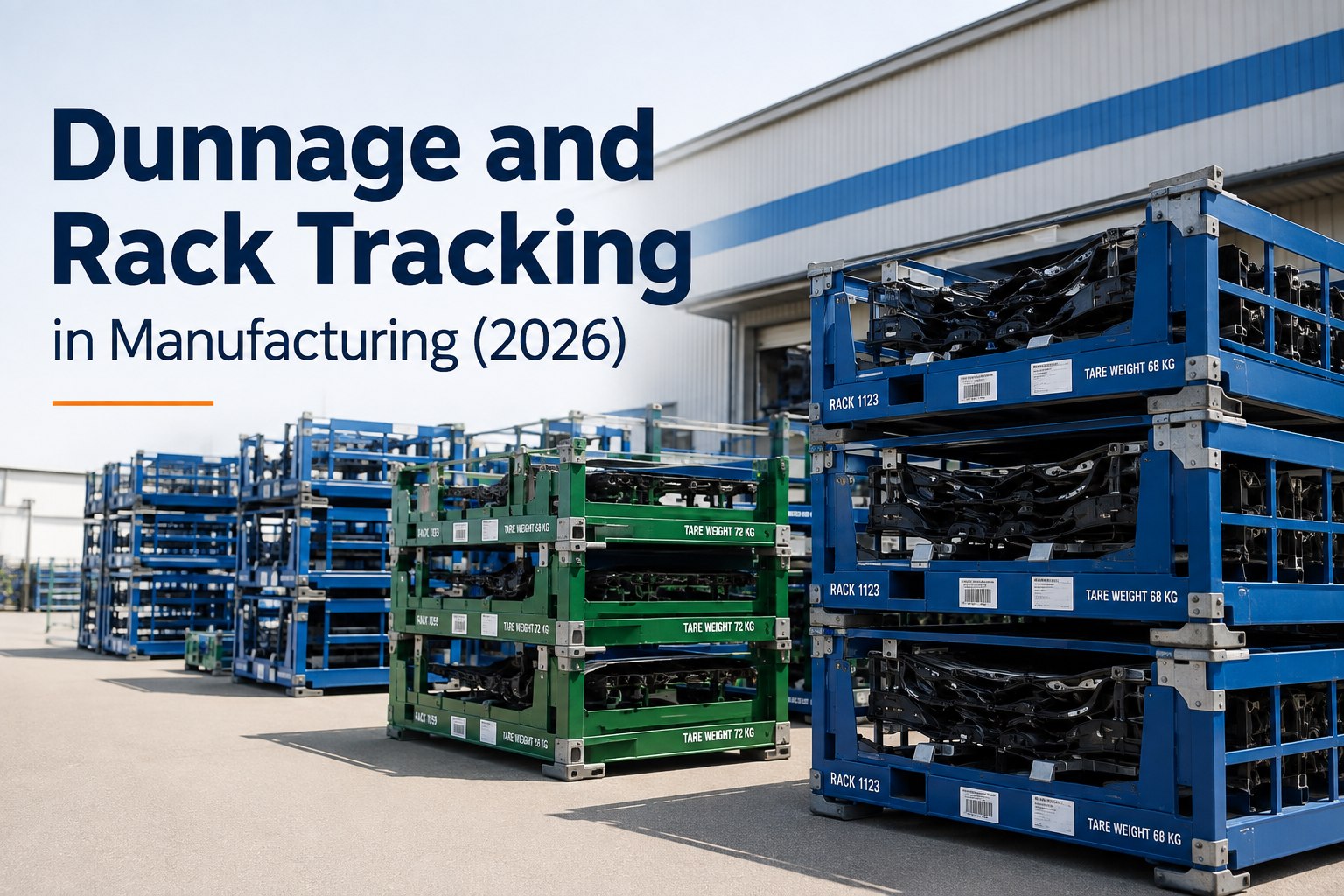
Dunnage is the returnable asset class that behaves least like the rest of the pool, and it gets managed as though it behaves the same. A stackable tote is fungible — any tote will do, and losing one costs the price of one tote. A custom steel rack is not: it was fabricated around a specific part's geometry, it fits one program, and a single missing rack of body panels can trigger a line-down event costing five to seven figures per hour. The loss rate on returnable assets generally sits somewhere between 5% and 15% a year, but that figure is a distribution rather than a number — shaped by where assets travel, who handles them and how visible they are between handoffs. On high-value custom dunnage, the tail of that distribution is where the real money goes. Request the integration datasheet to see how rack-level tracking maps onto your own programs.
2026 GUIDE · RETURNABLE ASSETS
Dunnage and Rack Tracking in Manufacturing
High-value rack visibility, the loss hotspots that rarely appear in an audit, deposit schemes that actually change behaviour, and forecasting that replaces reactive dunnage buying.
Under 2%
5% to 15% — typical annual loss
Below 2% is what leading-edge AI-enabled tracking has achieved on reusable plastic RTP. The wide band on the right is where most fleets still sit — and where the distribution matters more than the average.
Dunnage Is Not a Tote
Four properties separate custom racks and dunnage from the rest of the returnable pool, and each one changes how they should be managed.
Part-specific by design
Custom steel racks and dunnage trays are fabricated around one part's dimensions to protect it in transit. Another program's rack is not a substitute, however many are sitting in the yard.
High unit value
Automotive is the heaviest user of high-value custom returnable containers. Replacement is a fabrication lead time, not a purchase order against stock.
Directly line-critical
Sequenced JIT parts move in these racks between Tier 1 suppliers and OEM assembly plants. A shortfall does not degrade service — it stops a line.
Repairable in parts
Damaged components can often be replaced rather than scrapping the whole rack — which makes condition tracking worth as much as location tracking.
The asymmetry that justifies the spend
A lost tote costs the tote. A lost rack can cost an hour of production. That difference is why high-value steel racks and specialty dunnage typically justify continuous location tracking, while lower-cost totes and reusable bins are tracked adequately through scan events at key handoff points. Same programme, two different levels of investment, decided by consequence rather than by unit price.
Where Racks Actually Go
Five hotspots account for most of the loss, and only one of them is theft. The rest are process failures that leave no obvious trail.
1Absorbed into another programmeRacks designed for one part number get pulled into a different programme's rotation at a shared dock, quietly reducing the pool available for their intended line. Nothing is lost — it is just no longer where it belongs.
2Stranded at a supplierHeld as a private buffer against collection unreliability, or simply never collected. Invisible to you unless the supplier reports it, which they have limited incentive to do.
3Sitting in a return trailer yardEmpty dwell is the quiet killer. One Tier 1 supplier cut average empty-container dwell in the return trailer yard from 9.8 days to 3.4 after deploying continuous tracking — the racks were never missing, just parked.
4Damaged and set asidePulled from rotation for repair and then forgotten in a corner. Still owned, still counted on paper, contributing nothing to the pool.
5Phantom containers in the recordsDiscrepancies between what the system says and what exists, accumulated over years of manual reconciliation. Programmes that moved to scan-on-dispatch and scan-on-receipt report eliminating these outright.
Match the Method to the Asset
Tracking technology is a cost per asset, so the sensible approach tiers it by value and consequence rather than applying one method everywhere.
← Swipe to see all columns →
Two practical cautions. First, metal reflects radio signals and liquid absorbs them, which breaks RFID and some BLE reads — steel racks need tags built for harsh conditions, placed on non-metallic or external surfaces, with industrial-grade antennas behind them. Second, checkpoint-based systems tell you an asset passed a reader, not where it is now; that distinction decides whether you are managing location or auditing history.
Tier the tracking, not the whole fleet at once.
The integration datasheet covers rack-level identity, scan and reader event capture, how tracking data joins your ERP and WMS records, and the pool position each tier produces.
Deposit and Accountability Schemes
Technology finds racks. Commercial terms create the reason to send them back. The strongest programmes run both, and the second is usually cheaper than the first.
Deposit against the asset
A refundable value held per rack, released on return in serviceable condition. Simple, and effective precisely because it puts the cost of non-return on the party holding the asset.
Works whenThe replacement value is stated and the return deadline is a number, not "promptly"
Contract assignment
Tagged assets assigned to a specific customer or supplier contract, so every rack in circulation has a named holder at all times rather than belonging to the pool in general.
Works whenAssignment updates automatically at each handoff rather than being maintained by hand
Scan on dispatch and receipt
Both parties scan at both ends. The model European OEMs have used to enable predictive forecasting and eliminate phantom-container discrepancies from the records.
Works whenSuppliers have the means to scan — supply the tags and the process, do not just mandate them
Return compliance scoring
Share of assets returned within the agreed window, reported per partner and fed into the commercial review alongside quality and delivery.
Works whenIt carries weight on the scorecard rather than sitting in a separate report
The results are documented
A third-party RTI pool operator serving multiple OEMs assigned tagged assets to customer contracts through an API-linked transport system and audited inventories with ruggedised handheld readers during loading and unloading — improving asset utilisation by 28% and cutting replacement costs by €1.4 million a year. The mechanism was not the hardware; it was that every asset had an accountable holder.
Forecasting Instead of Reacting
Most dunnage spend is reactive — a shortage appears, a rush order goes out, and the fabrication lead time becomes a production risk. Forecasting turns that into a planned purchase.
1Establish real cycle time per programmeFull loop, supplier fill to supplier fill, measured rather than assumed. This is the input every forecast depends on and the one most often taken from a design assumption.
2Track in-transit inventory continuouslyHow many racks are moving, where, and how many are due back this week. A pool position that only updates at audit cannot support a forecast.
3Model shortfall against the build planRequired racks per shift at planned volume against available pool, so a predicted shortfall is flagged with enough notice to order rather than expedite.
4Feed measured loss rate into replacementYour own rate per programme, not a benchmark. Loss varies by lane and by handler, so a single fleet figure will over-order on some programmes and under-order on others.
5Separate repairable from lostRacks awaiting repair are recoverable capacity. Counting them as losses buys assets you already own; ignoring them overstates the pool.
Plants that eliminate reactive dunnage buying by forecasting returnable pool availability report meaningful spend reductions — and the mechanism is simple. Reactive buying pays a premium for speed on an asset with a fabrication lead time. Forecast buying pays list price with notice.
What to Record Per Rack
Six fields. Together they support location, condition, accountability and forecasting from one record.
Persistent asset identityA durable identifier fixed to the rack for its service life, independent of what it carries or where it is going. Everything else hangs off this.
Programme and part assignmentWhich part number this rack was built for, so cross-programme absorption becomes visible rather than being discovered as a shortage.
Current holder and locationNamed party plus last known position, updated at each handoff. "In the pool" is not a location.
Dwell in current stateHow long it has sat where it is. Rising empty dwell is the earliest signal available and it precedes every shortage.
Condition and repair statusServiceable, damaged, in repair or withdrawn — because components can be replaced individually and a repairable rack is not a lost one.
Cycle count and loss historyTrips completed and losses recorded per programme, which is what turns replacement forecasting from an estimate into a calculation.
Rack-Level Visibility, Programme by Programme
Fleet Rabbit records identity, programme assignment, holder, dwell and condition per rack, surfaces cross-programme absorption and rising empty dwell before they become shortages, and turns measured cycle time and loss rate into a replacement forecast you can order against.
Frequently Asked Questions
How much dunnage should we expect to lose?
Returnable asset loss generally runs 5% to 15% a year, but treating that as a single figure is the mistake — it is a distribution shaped by where assets travel, who handles them and how visible they are between handoffs. Measure it per programme and per lane rather than fleet-wide. Manufacturers integrating IoT and RFID into returnable containers have reported cutting asset loss by around 28%, and leading-edge AI-enabled tracking has pushed shrinkage on reusable plastic RTP below 2%.
Should every rack get an RFID tag?
Tier it. High-value steel racks and specialty dunnage typically justify RFID or GPS for continuous location data, while lower-cost totes and reusable bins are tracked adequately through scan events at key handoff points such as dock receipt and wash-in. Tag selection matters as much as the decision — metal reflects radio signals and liquid absorbs them, so steel racks need durable tags on non-metallic or external surfaces with industrial-grade antennas to hold reliable read rates.
Where do racks most often go missing?
Rarely to theft. The commonest cause is absorption — a rack designed for one part number gets pulled into another programme's rotation at a shared dock, quietly reducing the pool for its intended line. After that: stranded at suppliers, parked in a return trailer yard, set aside damaged and forgotten, or existing only as a phantom entry in the records. One Tier 1 cut average empty dwell in the return yard from 9.8 days to 3.4 with continuous tracking; those racks were never lost, just stationary.
Do deposit schemes actually work?
Yes, provided the terms are specific. A deposit only changes behaviour when the replacement value is stated and the return window is a number rather than an expectation. The stronger version is contract assignment — every tagged asset allocated to a named customer or supplier contract so nothing is ever simply "in the pool". One third-party operator combining that with handheld audits during loading and unloading improved asset utilisation by 28% and cut replacement costs by €1.4 million a year.
How far ahead can a shortage be predicted?
It depends entirely on the quality of two inputs: measured cycle time per programme and continuous in-transit inventory. With both, a shortfall can be flagged with enough notice to place a normal order against a fabrication lead time instead of an expedite. Without them, the first signal is a line-side shortage. That is the difference between forecast buying at list price and reactive buying at a premium — and it is why plants eliminating reactive dunnage purchasing report material spend reductions.
When is tracking hardware not the answer?
Three situations, all worth checking before spending. Where a reliable barcode, QR or RFID process already answers the question you are asking. Where no owner or team is able to act on the exceptions the system would generate — alerts nobody responds to cost money and change nothing. And where the economics depend on unrealistic recovery assumptions. Record current loss, dwell, search effort and replacement behaviour first, then pilot in the real operating environment rather than around an office.
What is the fastest first step?
Give your highest-value racks a persistent identity and record two things against it — programme assignment and dwell in current state. Programme assignment exposes cross-programme absorption, which is the largest single loss route and costs nothing to detect once the field exists. Dwell exposes the racks that are stationary rather than missing. Both can be captured with durable labels and existing handhelds before any tag investment.
Start a free trial to set it up against your own programmes.
Track the Rack, Not the Pool
Identity per asset, programme assignment so absorption is visible, dwell so stationary racks stop reading as losses, tiered tracking by consequence rather than unit price, and a forecast built on your own measured cycle time.
Works with GTL and Odette labelling · Runs on existing handsets · Site-level configuration