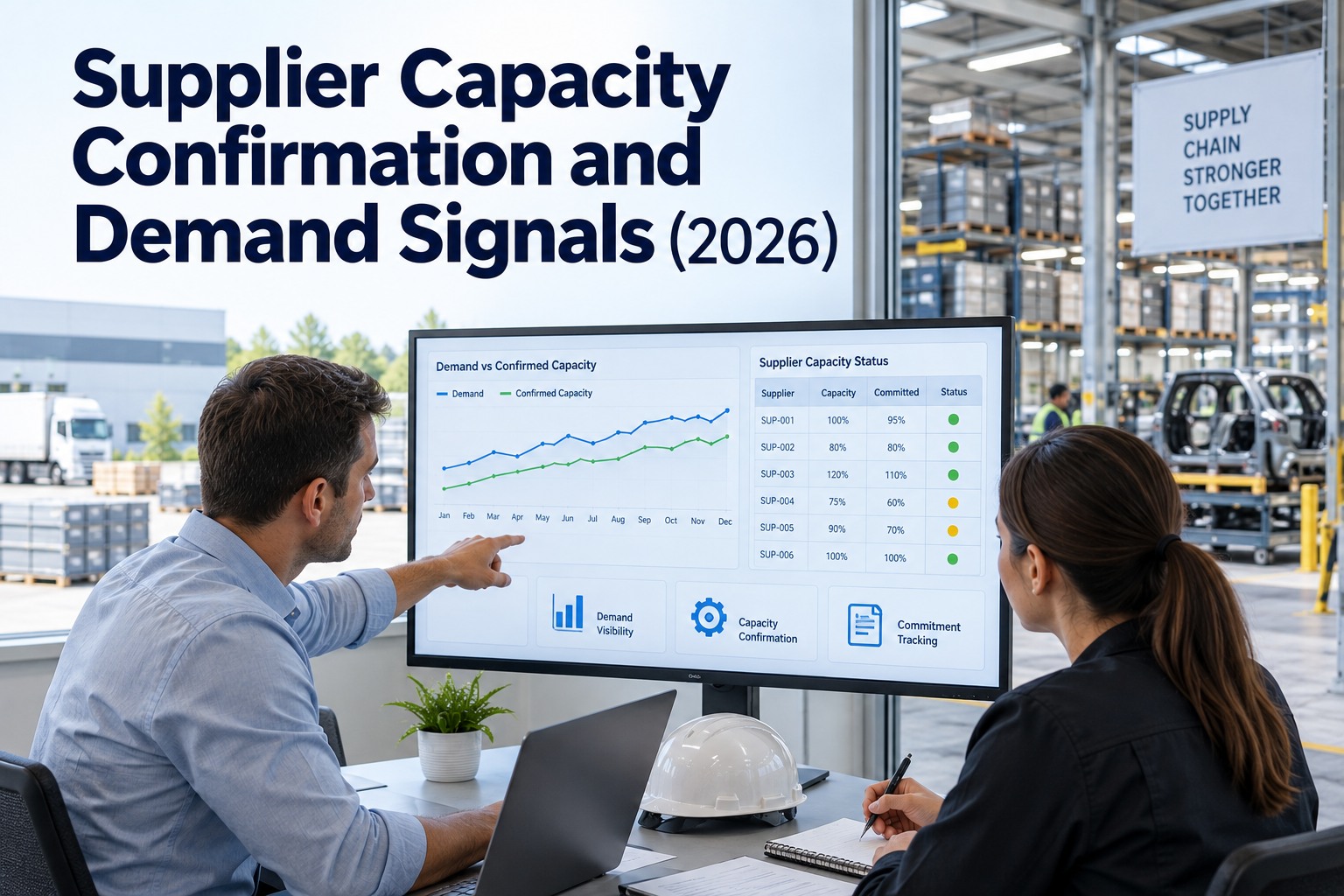
Capacity confirmation rarely fails because a supplier misled anyone. It fails because "confirmed" is an ambiguous word. Confirmed against which weeks — the total for the quarter, or the peak in week nine? Confirmed against which production capacity, and shared with how many other customers drawing on the same line? Both parties leave the call believing they agreed, and the gap surfaces months later as a bottleneck that was foreseeable the whole time. The industry response is a standard that removes the ambiguity rather than a better meeting: a defined data model, a defined exchange protocol, and — most importantly — a uniform business logic so both sides interpret the same figures the same way. There is also a finding in it worth knowing before you read anything else. Total demand can fall while bottlenecks are created, because mix shifts between markets activate different parts. Ask for the deployment brief to see what your current confirmations actually commit to.
Supplier Capacity Confirmation and Demand Signals
What a confirmation has to specify before it means anything, the weekly data model behind the standard, how silent under-commitment hides inside an aggregate yes, and why falling demand still produces bottlenecks.
Falling Demand Still Creates Bottlenecks
The counter-intuitive finding, and the reason a quiet forecast is not a reason to stop matching.
What "Confirmed" Has to Specify
Five dimensions. A confirmation missing any of them is an expression of confidence rather than a commitment.
The Data Model, in Plain Terms
Three mechanics worth understanding before any deployment conversation, because they determine what the exchange can and cannot tell you.
| Element | What it does | Why it matters operationally |
|---|---|---|
| Week-based material demand | Expresses requirement per material per week across the horizon, carried as demand series | Peaks and troughs stay visible instead of averaging out inside a monthly or quarterly figure |
| Capacity groups | Jointly defined mapping of which demand volumes match which production capacities | Turns "we have capacity" into a specific claim about a specific resource, which can then be matched rather than believed |
| The inactive flag | Marks a demand as inactive, after which it must be ignored in matching across the whole horizon — treated as if it does not exist | A demand you deactivate may be archived or deleted in the partner's local application. Reversible, but not free — the other side may have already planned around its absence |
| Uniform business logic | Consumers, providers and application providers must adopt the same logic, data models and protocols | The actual point of the standard. Two systems exchanging data while interpreting it differently produce agreement on numbers and disagreement on meaning |
Silent Under-Commitment
Four shapes it takes. None involves anybody saying no, which is exactly why it survives a review meeting.
Why a Supplier Would Genuinely Want This
Worth understanding, because a capacity programme that only serves the customer will be complied with rather than used.
Where It Is Actually Running
Three data points, offered so the standard reads as an operating reality rather than a roadmap item.
| Evidence | What it shows | Relevance to your programme |
|---|---|---|
| A live OEM–supplier exchange | BMW Group and BASF exchanging standardised demand and capacity data, using a certified suite alongside an internal manufacturer system | Interoperability between a certified product and an in-house system is proven rather than theoretical — you are not obliged to adopt one vendor on both sides |
| Multiple certified solutions | Several providers certified against the demand and capacity standard, with an open session held to present them | Freedom of choice with interoperability preserved, which changes the procurement question from which platform to which capability |
| Formal qualification path | Training and expert qualification available for the use case specifically | You can build internal capability rather than depending entirely on a vendor to interpret the standard for you |
Getting Started Without Boiling the Ocean
The standard itself points at the sensible scope, and it is narrower than most programmes assume.
Frequently Asked Questions
CX-0128, the Demand and Capacity Management Data Exchange standard, currently published at version 2.3. It defines standardised data models, secure exchange protocols and a shared logic for interpreting demand and capacity data, and requires that data consumers, providers and application providers all adopt the same business logic. It is designed for every participant in the automotive supply chain regardless of size or position, and it prioritises parts and materials critical to manufacturing.
Strategic planning horizons of up to twenty-four months, with demand and capacity datasets continuously updated and exchanged rather than confirmed once. Deployments report that changes in material requirements and emerging bottlenecks become visible and addressable well in advance within a horizon of several months — which is the difference between a planning decision and a recovery exercise.
Because mix moves independently of volume. Shifts between markets change which vehicle profiles are being sold, and different profiles consume different parts — so a supplier can be over-demanded on one component while aggregate volume declines. The recognised consequence is late detection of bottleneck situations that were foreseeable throughout, which is why matching has to run at part level rather than against a volume total.
Five specifics: which weeks it covers rather than which period total, which defined capacity group it refers to, whether that group is shared with other customers, what horizon it spans, and how often it will be refreshed. A confirmation missing any of these is a statement of confidence rather than a commitment — and the failure that follows is usually a granularity problem rather than a dishonesty one.
Not by asking again, since a second confirmation at the same granularity returns the same answer. It surfaces through matching at part and week level against a named capacity group, which turns the gap into an arithmetic result rather than a judgement about reliability. The four common shapes are an aggregate yes hiding a weekly peak, capacity double-committed across customers, confirmation against capacity that has been planned but not built, and silence being read as agreement.
Reduced overproduction risk, primarily. Greater visibility of customer demand improves their planning accuracy and produces more balanced production — and inventory built against an unclear forecast is their working capital, not the customer's. Deployments also report materially less manual coordination effort, with changes communicated faster and impacts analysed more efficiently, which compounds for a supplier serving many customers.
With production-critical parts only, since the standard prioritises those explicitly and whole-catalogue attempts stall. Define capacity groups jointly before exchanging any data, because agreeing which demand matches which capacity is the substantive work. Then agree what a detected bottleneck triggers, and who authorises each mitigation, before you find one. Start free with three assets and begin with the parts that stop the line.