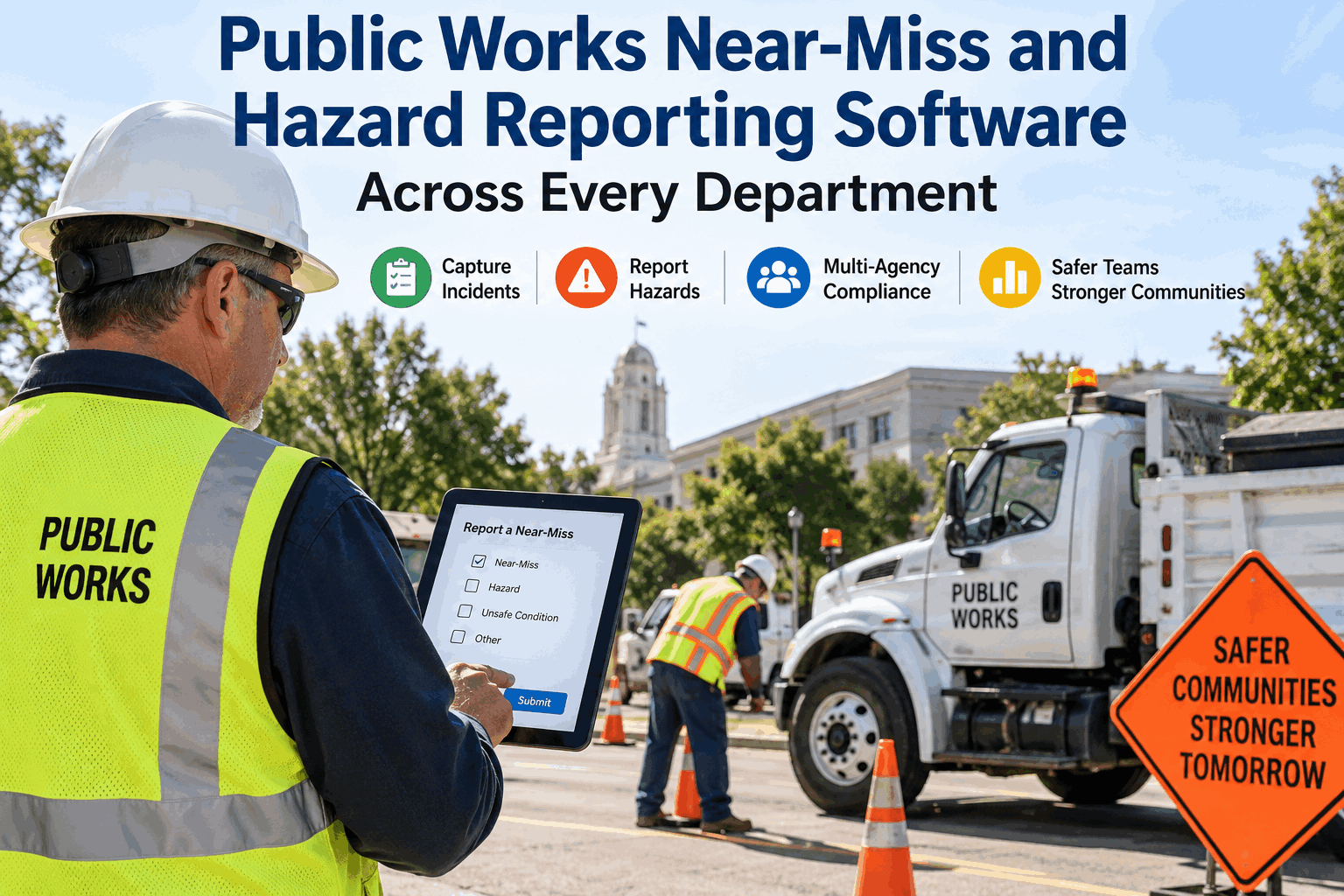
Municipal public works departments, county highway divisions, and regional infrastructure agencies operate in dangerous work environments where blind spots, live traffic corridors, overhead utility lines, and heavy equipment operation create constant safety risks. Street sweepers, backhoes, asphalt rollers, sewer jetters, and snowplow trucks maneuver alongside unpredictable public commuter traffic and active pedestrian zones. In government fleet operations, an unreported near-miss—such as an excavator bucket grazing a de-energized utility line, a plow truck slipping on an unbanked curve, or a rear worker stepping into an unspotted lane—is a direct precursor to a fatal OSHA-recordable incident. When municipalities rely on paper incident slips, delayed safety committee meetings, or verbal reports, critical field hazards remain unaddressed across city departments. Implementing multi-agency public works near-miss reporting software unifies mobile offline hazard logging, GPS telematics hazard mapping, automated risk escalation, and corrective action tracking into a single municipal dashboard. By empowering front-line maintenance personnel and heavy equipment operators to document close calls in seconds, public agencies prevent catastrophic worker compensation claims, reduce municipal vehicle collision damage, and maintain an auditable safety record. To explore how our hazard mitigation engine protects field crews and eliminates safety blind spots, book a live technical demonstration with our government safety software team or launch your municipal safety workspace immediately through our free platform sign up.
Public Works Near-Miss and Hazard Reporting Software Across Every Department
A comprehensive public sector risk prevention and safety operations blueprint. Empower public works, water distribution, street maintenance, and sanitation crews to capture mobile near-miss events, automate hazard escalation, and track corrective engineering actions.
Civilian commuter vehicle breached taper cones at 45 MPH on 4th Ave, narrowly missing rear asphalt raker by < 3 feet. Buffer TMA truck was not properly staged down-lane.
Boom arm came within 18 inches of unmapped overhead telecommunications drop line during trench shoring lift. Operator immediately stopped hydraulic boom movement.
Intercept Public Works Hazards Before They Turn into Tragedies
Eliminate paper safety forms, empower field crews with mobile offline near-miss reporting, automate supervisor hazard escalations, and protect municipal balance sheets starting from $3/vehicle/month with no hardware lock-in.
The Heinrich Safety Pyramid: Why Near-Miss Reporting Protects Public Fleets
Occupational safety science demonstrates that for every fatal or catastrophic industrial accident, there are 29 minor recordable injuries and approximately 300 unrecorded near-miss incidents. In municipal public works and heavy fleet operations, these near-miss events occur daily: a sweeper truck operator experiencing sudden brake fade on a steep descent, a pothole patcher driver narrowly missing an inattentive pedestrian, or a snowplow blade catching a concealed raised storm manhole casting. When municipal departments ignore these warning signs because "nobody got hurt," the identical set of physical circumstances eventually repeats—resulting in catastrophic vehicle rollover, permanent worker disability, or pedestrian fatalities. Traditional public fleet management treats accidents after the fact through police investigations and insurance payouts. Implementing dedicated public works near-miss software flips this dynamic into proactive hazard defense. Field personnel submit close-call reports in seconds directly from their smartphones or vehicle telematics consoles, flagging road layout dangers, malfunctioning vehicle components, and blind spots across town. Safety committees can examine live spatial hazard heatmaps by scheduling a tailored public sector safety software demo or configure test near-miss forms via our quick platform sign up.
Geofenced Spatial Hazard Mapping
Every logged near-miss captures sub-meter GPS coordinates automatically. FleetRabbit aggregates incident clusters across municipal GIS layers, identifying dangerous intersections, low-clearance railway bridges, and unbanked roads that require immediate public works engineering intervention.
Connected Dash Cam & Telematics Triggering
When telematics sensors detect severe G-force spikes (harsh swerving, sudden hard braking, or stability control engagement), the system automatically flags a potential near-miss. In-cab dash cam video clips are linked to the dispatch queue, giving safety officers objective visual context.
Automated Corrective Action Tracking (CAPA)
Logging a hazard is meaningless without accountability. FleetRabbit routes flagged incidents directly to the responsible division supervisor, generating digital Corrective and Preventative Action (CAPA) tasks: updating traffic control tapers, replacing worn equipment, or conducting tailgate safety briefings.
Multi-Agency Cross-Departmental Sharing
A hazard identified by a street maintenance worker often threatens water utility and sanitation crews operating in the exact same neighborhood. FleetRabbit unifies risk data across departments, allowing municipal leaders to coordinate unified work zone traffic management citywide.
Direct Technical Matrix: Paper Hazard Slips vs. FleetRabbit Near-Miss Software
Operating a municipal public works fleet with paper safety clipboards, suggestion boxes, and manual incident spreadsheets creates severe blind spots that delay corrective actions and expose cities to staggering civil liability. Review how traditional paper reporting compares directly against FleetRabbit's automated, mobile-first near-miss platform across essential public fleet safety benchmarks. Public works directors and risk managers can evaluate custom multi-agency hazard escalation by scheduling an executive public safety software demonstration or explore mobile field hazard reporting via our self-service platform sign up.
| Safety Management Dimension | Paper Safety Forms & Suggestion Boxes | FleetRabbit Near-Miss Management Platform | Municipal Taxpayer & Crew Advantage |
|---|---|---|---|
| Field Hazard Reporting Latency | Days to weeks; paper sits in crew trucks | Sub-minute mobile submission with live photo capture | Enables same-day hazard remediation |
| Worker Psychological Safety | Workers fear blame; close calls concealed | Optional anonymous reporting & positive safety culture | Increases field hazard reporting volume by 400% |
| Spatial GPS Cluster Analysis | None; manual street names scribbled on paper | Automated GIS heatmapping across municipal corridors | Identifies dangerous road layouts before crashes occur |
| Corrective Action Tracking (CAPA) | Lost in meeting minutes; zero follow-through proof | Digital ticket assigned to supervisors with photo sign-off | Guarantees 100% auditable hazard remediation proof |
| OSHA 300 & Public Risk Audit Readiness | Weeks spent manually assembling paper binders | 1-click export of cryptographically certified safety files | Shields municipal balance sheets from civil liabilities |
4-Stage Closed-Loop Hazard Mitigation Sequence
FleetRabbit operationalizes public works safety into an automated, four-stage workflow that connects field hazard capture directly to supervisory triage, corrective engineering remediation, and citywide safety committee reviews. To see how these stages work together, book a live walkthrough demo of our public works safety console.
Mobile Field Hazard Capture
Field workers or equipment operators launch the mobile app, snap photos of the close-call scenario (e.g., sagging tree limb over traffic), record voice notes, and submit reports in under 45 seconds.
Automated Severity Triage & Alerting
The system evaluates incident severity based on equipment type, location, and hazard category, immediately sending push notifications and SMS alerts to the responsible division superintendent.
Corrective Action & Work Order Sync
The supervisor assigns a prioritized corrective work order (e.g., pruning crew dispatch, traffic taper adjustment, or equipment repair), tracking resolution with required follow-up verification photos.
Safety Committee Review & Audit Archive
Completed corrective actions update citywide safety dashboards, automatically populating monthly safety committee review agendas and archiving tamper-proof compliance records for OSHA audits.
Financial Capital Stewardship: Eliminating the Hidden Costs of Unaddressed Hazards
Operating a municipal public works fleet without proactive near-miss reporting software creates compounding financial losses across workers' compensation claims, vehicle repair bills, and civil liability settlements. When an unaddressed roadway hazard leads to a collision between a city dump truck and a civilian commuter, the municipality faces hundreds of thousands of dollars in vehicle replacement costs, legal defense fees, and state OSHA fines. Identifying these systemic cost drivers helps public works directors and municipal risk managers build an airtight business case for automated near-miss software before city councils and county commissions. Calculate your agency's exact risk recovery by booking an operational safety assessment demo or get started directly via our rapid platform sign up.
Top Causes of Municipal Budget Waste from Unmonitored Safety Hazards
Municipal Safety Platform Capabilities
Enables field workers to log hazards and capture photos in rural areas or storm situations with zero cellular connectivity, syncing automatically upon reconnection.
Maintains distinct administrative workspaces for Streets, Water, Parks, and Sanitation while enabling cross-agency hazard visibility on shared corridors.
Runs seamlessly on standard municipal smartphones, rugged field tablets, or desktop browser terminals without requiring specialized hardware.
ROI & Public Safety Stewardship Framework for Municipal Leadership
When city managers and municipal risk directors evaluate near-miss reporting software, public officials must measure financial return across workers' compensation claims reduction, vehicle longevity, insurance loss ratios, and public safety credibility. FleetRabbit delivers quantifiable financial return across all primary public sector risk management categories. To review your customized municipal hazard mitigation forecast, schedule an executive public safety briefing demo with our team or start configuring your department's safety reporting workflows today with a free account.
Workers' Compensation Savings
Eliminating physical hazards before injuries occur cuts municipal workers' comp claims by an average of 42%, lowering annual municipal self-insured retention deductibles significantly.
Heavy Equipment Protection
Intercepting near-misses such as boom-to-utility clearance errors or blind-spot reversing hazards prevents catastrophic machinery collisions, slashing municipal fleet body shop repairs.
Audit & OSHA Defensibility
Maintaining a closed-loop digital record of every reported hazard and its corresponding supervisory remediation proves due diligence, defending city leadership during state and federal regulatory reviews.
Frequently Asked Questions: Public Works Near-Miss Reporting Software
What is a public works near-miss, and why is reporting it critical for municipalities?
A near-miss is an unplanned event that did not result in injury, illness, or equipment damage, but had the potential to do so under slightly different circumstances (e.g., an excavator bucket coming within inches of an overhead line or a commuter vehicle clipping traffic cones in a work zone). Reporting near-misses allows public works departments to identify and resolve root-cause hazards before they result in catastrophic worker injury or municipal liability.
How does the software encourage front-line crew members to report close calls without fear of discipline?
FleetRabbit fosters a proactive, non-punitive safety culture by allowing workers to submit near-miss reports anonymously if preferred. The mobile reporting flow is intentionally designed to be fast (under 45 seconds) and constructive, emphasizing hazard identification and environmental factors rather than assigning individual fault, which increases field reporting participation by over 400%.
Can field crews log hazard reports if they are working in areas with no cellular reception?
Yes. The FleetRabbit mobile application features a robust offline-first architecture. Field workers can capture photos, record voice descriptions, and submit near-miss reports even in remote drainage ditches, rural highway corridors, or underground utility vaults. The application encrypts and stores the report locally, automatically uploading the data to the central safety console the moment cellular connectivity is restored.
How does the software integrate with existing municipal work order systems?
FleetRabbit features pre-configured REST APIs and webhooks that connect directly to municipal work order and asset management platforms (such as Cityworks, Cartegraph, Tyler Technologies, and Lucity). When a field near-miss indicates an infrastructure hazard—such as a missing stop sign or a collapsed storm drain—the software can automatically generate an engineering work order in your existing municipal system.
Upgrade Your Municipal Safety Operations Today
Eliminate paper safety forms, empower front-line public works crews with mobile hazard reporting, and build a proactive, zero-incident safety culture across every department. Deploy FleetRabbit today with zero proprietary hardware lock-in.
Share This Story, Choose Your Platform!
From our blog

Electric Delivery Van Proof-of-Delivery Software Guide

What Is Apparatus Readiness? NFPA Fire Fleet Compliance Guide

What Is Fleet Chargeback? Municipal Fleet Cost Guide 2026

What Is a Government Motor Pool? Fleet Management Guide

What Is NFPA 1911? Fire Apparatus Readiness & Compliance

FTA-Compliant CMMS for Transit: Funding, ROI & Costs

Sanitation Fleet Management Software | Government Guide