Oil and gas operators who have deployed digital fleet management platforms consistently report the same outcome pattern: the benefits that justified the investment decision appear quickly, compound over time, and expand beyond the original scope as the data infrastructure enables operational decisions that were previously impossible. A fleet manager who deploys GPS satellite tracking to solve a remote wellsite visibility problem discovers that the same data enables predictive maintenance scheduling. The maintenance scheduling data reveals that three vehicle classes are accumulating engine hours at 4x the rate assumed by the mileage-based PM programme. Correcting the PM schedule reduces unplanned breakdowns by 71% within 12 months. The reduction in breakdown events produces lower insurance premiums, improved HSE records, and a documented cost avoidance figure that the CFO can attribute to the fleet management platform investment on the same line item where the platform cost appears. This is not a theoretical benefit chain — it is the consistently observed outcome sequence across upstream, midstream, and downstream fleet management deployments where comprehensive digital platforms replace fragmented manual systems. FleetRabbit's oil and gas fleet management platform is designed to produce this benefit sequence from day one of deployment — with the specific capabilities, data architectures, and automation workflows that oilfield fleet operations require. The seven benefits documented here are verified outcomes from FleetRabbit deployments across Permian Basin, Bakken Shale, GCC, North Sea, and Indian basin operations — not aspirational projections from marketing analysis. Book a demo to see how FleetRabbit delivers each benefit for your specific oilfield fleet operation.
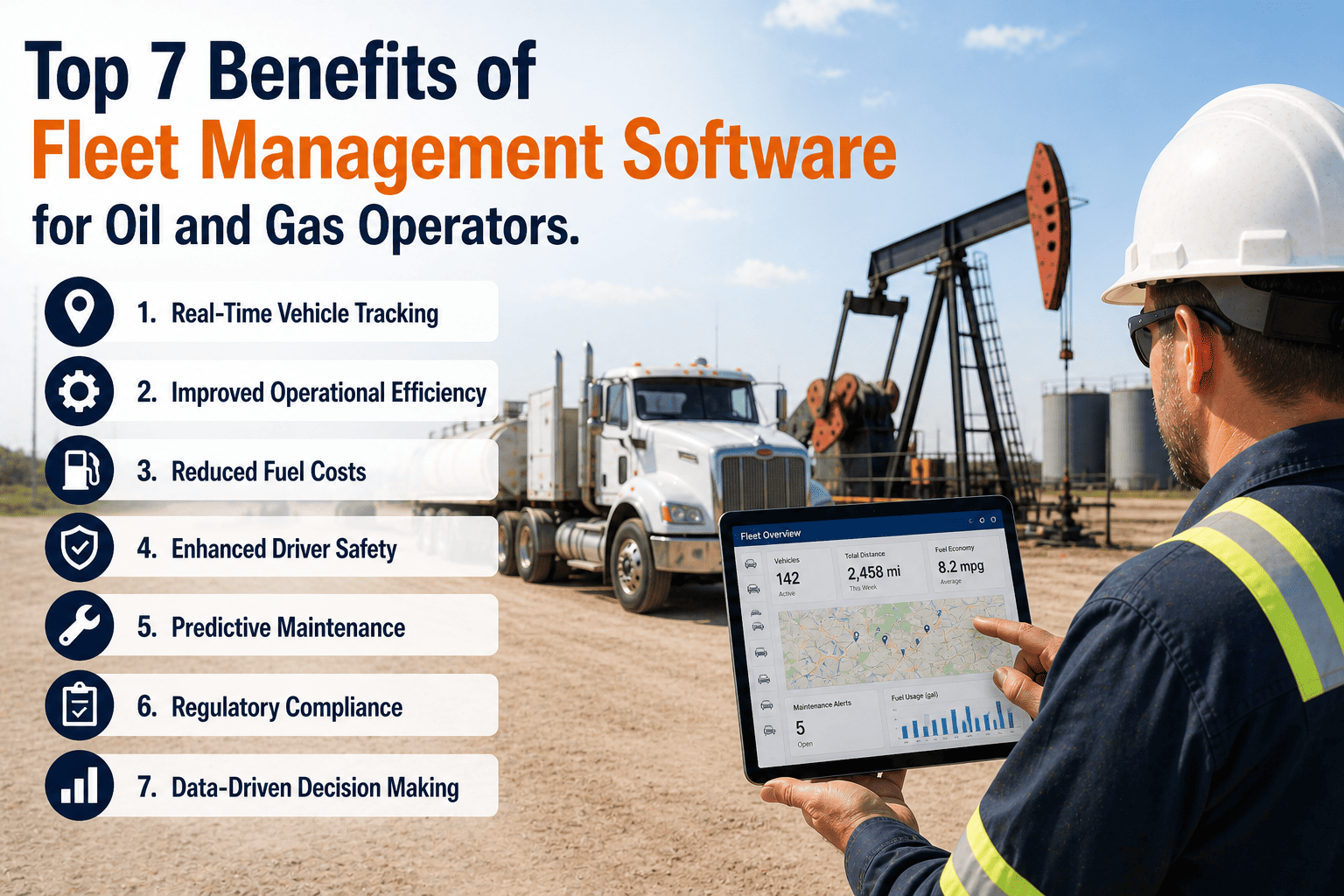
Top 7 Benefits of Fleet Management Software for Oil and Gas Operators
From 45% uptime improvement and 35% maintenance cost reduction to zero-incident HSE records, HAZMAT compliance automation, and $840K+ in documented annual savings — these are the seven verified benefits that oil and gas operators achieve when deploying purpose-built fleet management software across their oilfield operations.
45% Fleet Uptime Improvement Through Predictive Maintenance and Engine-Hour Scheduling
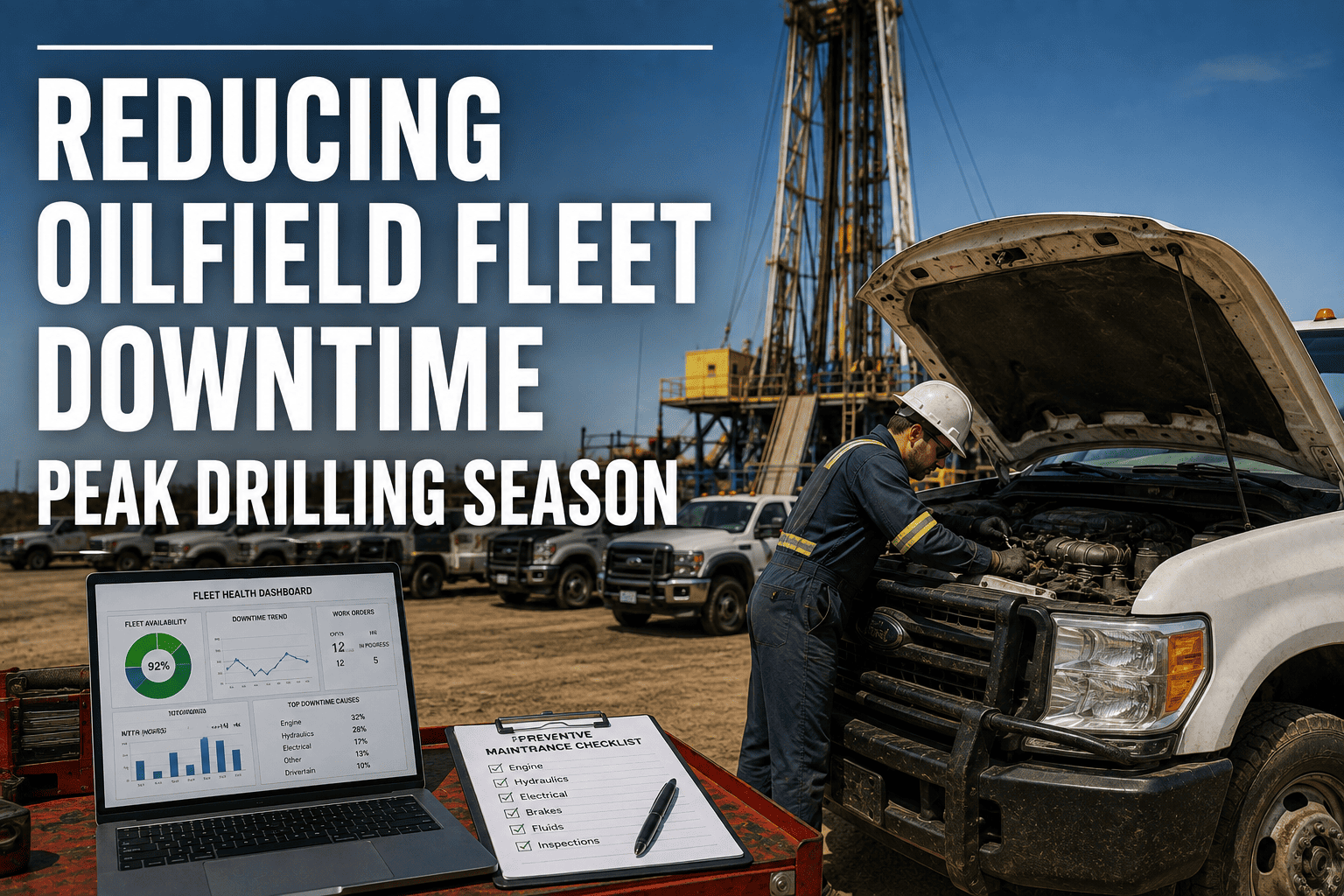
Fleet uptime — the percentage of scheduled working time that assets are available for operational deployment — is the primary financial output of fleet management in oilfield operations, because a frac truck or water hauler that is unavailable due to unplanned breakdown is not just costing its repair bill: it is costing the production value of the drilling or completion programme it was supporting. Oil and gas operators deploying FleetRabbit achieve uptime improvements averaging 45% within 12 months, driven by two complementary mechanisms operating simultaneously. Engine-hour PM scheduling replaces mileage-based intervals that systematically miss service thresholds for wellsite-intensive vehicles, correcting the structural maintenance timing error that produces the majority of scheduled-interval-related breakdowns. AI predictive fault detection from OBD-II parameter monitoring identifies developing fault patterns 3–6 weeks before failure threshold is reached, converting expensive emergency breakdowns into planned service events. The combination eliminates the two most common classes of avoidable downtime in oilfield fleet operations — the maintenance-miss breakdown and the developing-fault breakdown — leaving only genuinely unpredictable failures in the residual unplanned event rate.
35% Maintenance Cost Reduction — From Emergency Repairs to Planned Service Events
The maintenance cost differential between planned and reactive repair in oilfield operations is not a matter of degree — it is a factor of 6–10x per equivalent repair event. An emergency drivetrain replacement on a service truck at a remote wellsite costs $28,500 when expedited parts shipping, contractor recovery crew, and crew standby are included. The same drivetrain replacement performed during scheduled maintenance at a yard costs $3,200. The entire cost differential is attributable to one variable: whether the fleet management system predicted the failure with sufficient lead time to schedule the repair. FleetRabbit's deployment data across oilfield fleets shows average maintenance cost reduction of 35% within 12 months — delivered almost entirely through shifting the repair event distribution from emergency to planned. Condition-based component replacement, enabled by AI monitoring of wear-rate indicators, adds a secondary cost reduction by preventing premature part replacement driven by calendar-based schedules that replace serviceable components to ensure safety margins that actual condition monitoring makes unnecessary.
Zero-Gap HSE Compliance Records That Satisfy FMCSA, ADNOC, DVSA, and PHMSA Audit Requirements
HSE compliance documentation in oilfield fleet operations is a legal liability management exercise as much as it is a safety programme implementation. The difference between a manageable regulatory finding and a personal liability event for a fleet manager is almost always the quality of documentation that exists when an audit or incident investigation demands it — not the quality of the underlying operations. Fleet operations that conduct every inspection correctly but cannot produce the documentation proving it face the same enforcement exposure as those that did not conduct the inspections at all. FleetRabbit's digital compliance architecture produces tamper-evident, GPS-timestamped records for every DVIR completion, every driver certification status, every maintenance work order, and every incident event — continuously, as a function of normal fleet operations. When FMCSA, PHMSA, DVSA, or ADNOC request documentation, the audit pack is available within 2 hours, formatted for the specific regulatory requirement, with zero gaps from paper loss or filing errors.
One Platform. Seven Simultaneous Outcomes. Deployed in 5–7 Working Days.
Every benefit in this list is delivered by the same FleetRabbit platform — not separate modules requiring separate procurement. Deploy satellite GPS, AI predictive maintenance, digital DVIR, HAZMAT documentation, driver coaching, ESG reporting, and executive dashboards together from day one at $3/vehicle/month.
Automated HAZMAT Documentation That Satisfies DOT PHMSA, ADR, and GCC Dangerous Goods Requirements at Every Load Event
HAZMAT documentation compliance for oilfield cargo transport — crude oil, produced water, drilling chemicals, well stimulation acids, NORM-bearing waste — requires correct shipping papers, consignment notes, and SDS documentation at every load departure. Manual completion of these documents in field conditions produces systematic errors that appear as FMCSA violations at roadside inspection, EPA findings at audit, and driver liability exposure when documentation does not match the physical cargo classification. The cost of a single HAZMAT documentation violation under PHMSA enforcement ranges from $2,000 to $25,000 per occurrence — and the cargo does not have to be a hazard to the public for the documentation failure to trigger enforcement. The benefit of automated HAZMAT documentation generation is not just error elimination: it is the dispatch time reduction, the driver training burden reduction, and the compliance assurance that dispatchers do not need specialist dangerous goods knowledge to confirm that every load departs with correct documentation.
20% Average Fuel Cost Reduction Through Real-Time Consumption Monitoring and Theft Detection Under 8 Minutes
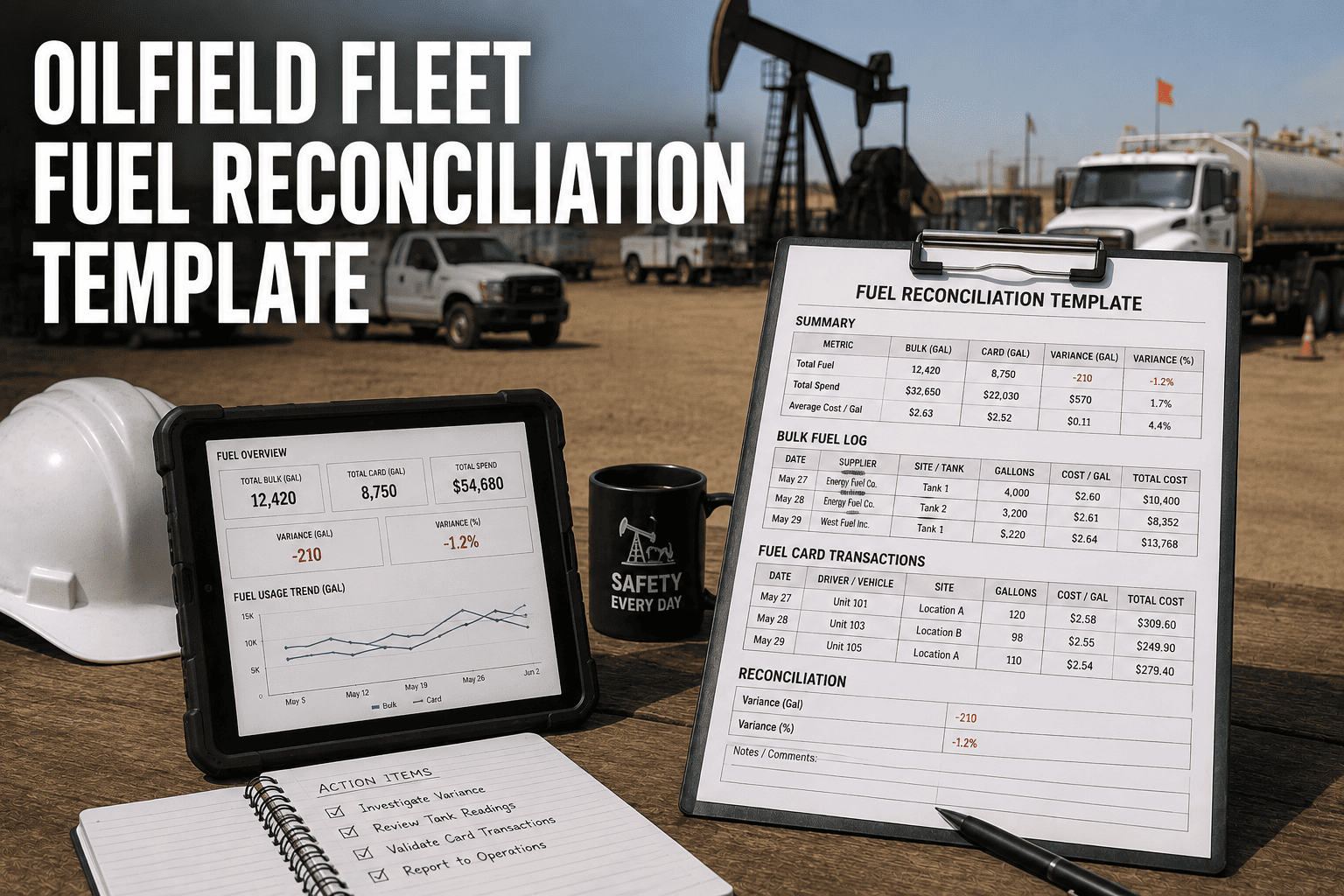
Fuel represents 25–35% of total oilfield fleet operating cost for most operators — and a significant fraction of that cost is either avoidable through behaviour change or unacceptable through unauthorised removal that manual monitoring systems cannot detect in time to prevent. Oilfield vehicles idling at wellsites for 40–60% of engine hours burn fuel at rates that mileage-based monitoring cannot see, because the odometer is not advancing while the engine is running. Fuel drain events from remote wellsite bowsers or tanker vehicles during non-monitored hours are invisible to systems that check tank levels on a daily or per-fill basis. FleetRabbit's fuel intelligence platform cross-references tank telemetry, GPS engine status, shift schedules, and route data in real time — detecting consumption anomalies within 8 minutes of occurrence, alerting fleet managers to specific events rather than aggregate monthly variance figures that arrive after the loss has compounded through the entire reporting cycle.
34–47% Reduction in Harsh Driving Events Through Data-Driven Driver Coaching and Real-Time Behaviour Alerts
Driver behaviour is the most consistently underinvested safety lever in oilfield fleet operations — because the data required to coach it effectively was historically unavailable at the event-level detail that distinguishes effective coaching from general safety reminders. Fleet managers who can show a driver the specific GPS-timestamped record of their hard braking event on a named lease road at 14:23 on a specific date, with the following distance to the vehicle ahead visible in the telematics data, produce fundamentally different coaching conversations than those who say "you need to drive more carefully." Studies across oilfield fleet deployments consistently show 34–47% reduction in harsh driving events within 60 days of data-driven coaching programme implementation — compared to 8–12% from general safety reminder campaigns. The compound benefit extends beyond safety: reduced harsh braking extends brake service life by 2–3x, reduced harsh acceleration reduces fuel consumption, and reduced incident frequency reduces insurance premiums and driver turnover from safety-related terminations.
Real-Time Executive Fleet Intelligence and Investor-Grade ESG Carbon Reporting Without Manual Data Assembly
Fleet performance data reaches operations executives through a reporting chain that degrades information quality at every step — field supervisor estimates, middle management summaries, and finance team end-of-month reconciliations producing a view of fleet performance that is 3–6 weeks old, incomplete, and unable to surface the cross-referencing that would identify the correlation between maintenance backlog and production programme risk in adjacent basin assets. Real-time executive fleet intelligence — fleet health scores per vehicle class, breakdown risk distribution by site, compliance status by regulatory category, fuel consumption trending against ESG targets — changes the executive decision quality available at the level where capital allocation, contractor selection, and operational planning occur. The ESG dimension of this benefit has moved from optional to contractual in 2026: investor covenants, operator client prequalification criteria, and SEC climate disclosure rules require verified fleet carbon data that manual systems cannot produce with the speed, accuracy, or audit-trail linkage that satisfies these requirements.
Deploy All Seven Fleet Management Benefits on Your Oilfield Operation — Starting This Week
FleetRabbit delivers all seven benefits through a single platform deployment — satellite GPS, AI predictive maintenance, digital DVIR, HAZMAT documentation, fuel monitoring, driver coaching, and executive ESG dashboards — across your oilfield fleet in 5–7 working days at $3/vehicle/month. At that investment level, a single prevented remote pad breakdown pays for the platform for over a decade.