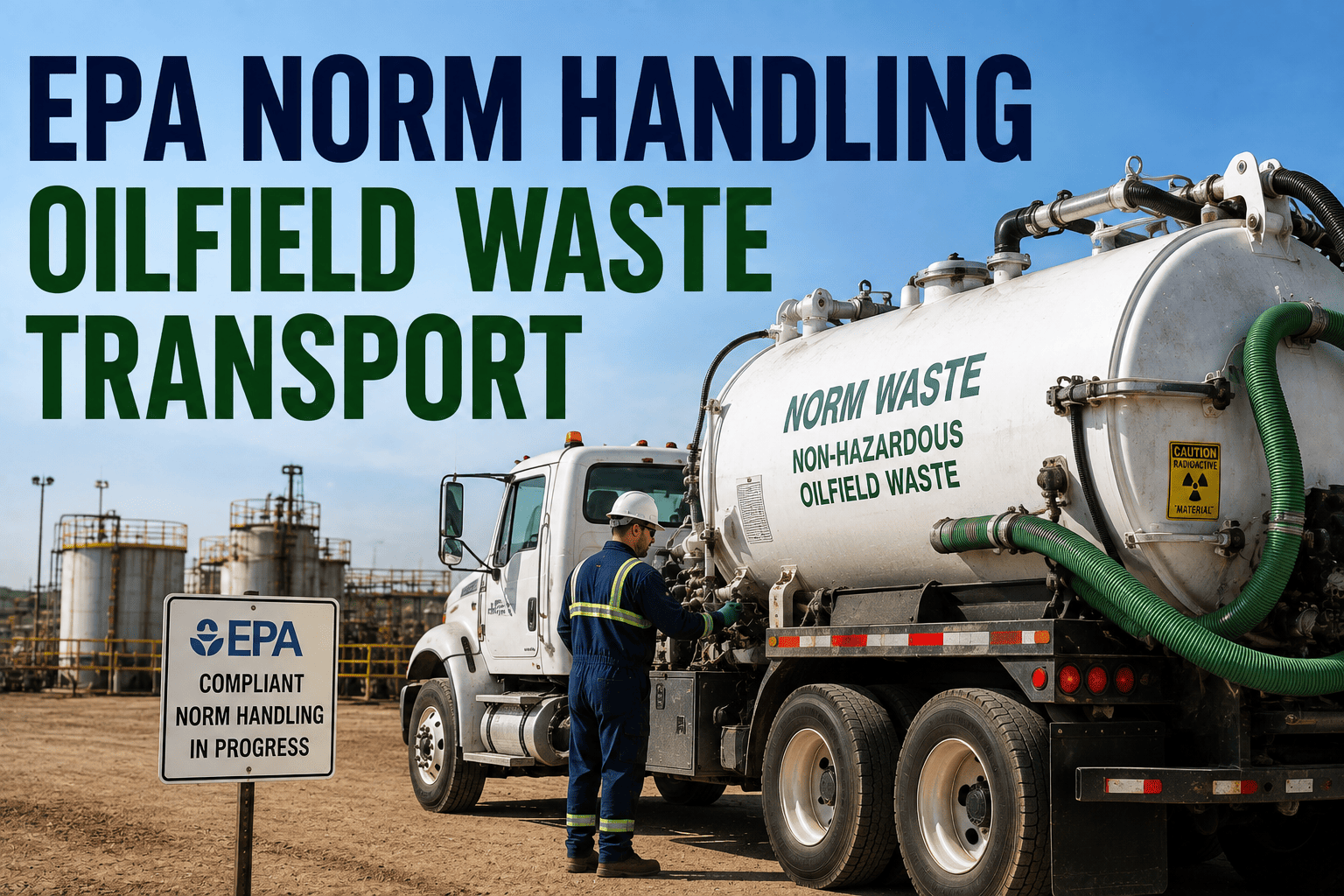
Scale buildup inside a joint of used tubing doesn't look any different from ordinary oilfield scrap. But if it's carrying elevated radium-226 or radium-228, moving it off location without the right survey, documentation, and disposal pathway can turn a routine haul into a regulatory violation with real radiation-safety consequences. Naturally occurring radioactive material, commonly called NORM, and its technologically enhanced form, TENORM, show up in produced water, tank bottoms, pipe scale, and filter media across oil and gas operations. This guide walks through what actually has to happen before that waste leaves the well site, who regulates it, and where fleets get the paperwork wrong.
NORM/TENORM oilfield waste isn't regulated by a single federal rule. EPA provides the underlying radiation guidance and technical basis, but day-to-day permitting, exemption levels, and disposal requirements are set primarily by state agencies, many of which follow the CRCPD's Part N model regulations. Once waste is above exemption levels, it typically needs a radiation survey, proper labeling, transport under DOT's Class 7 radioactive material rules where applicable, a completed manifest, and delivery to one of the small number of facilities licensed to accept it.
What Counts As NORM Versus TENORM
NORM refers to radioactive material that occurs naturally in rock and soil, including uranium, thorium, and their decay products like radium. It's present at low levels almost everywhere. TENORM is the same material after oilfield processes concentrate it to higher levels than background, which is what regulators actually care about. In practice, TENORM shows up in a handful of predictable waste streams: scale inside tubing and flowlines, sludge and tank bottoms from separators and storage tanks, filter cake from produced water treatment, and contaminated equipment surfaces. Radium concentrations in these streams are typically low, but elevated readings well above background soil levels are what trigger handling requirements.
Why This Falls To States, Not Just EPA
EPA's role here is largely technical: setting radiation protection guidance, publishing screening information, and outlining the science behind exemption thresholds. Actual permitting and enforcement for oilfield NORM waste sits with state regulators, since federal law doesn't give EPA direct authority over most NORM disposal from oil and gas production. Texas is a useful example: the Railroad Commission regulates disposal of oil and gas NORM waste, while the Department of State Health Services separately regulates radiation protection for possessing, transporting, and storing NORM. Many states model their rules on the Conference of Radiation Control Program Directors' Part N framework, but exemption levels and paperwork requirements still vary by state, which is exactly why multi-state fleets run into inconsistent handling procedures.
Survey results, manifests, and disposal confirmations scattered across paper and email are how NORM shipments become compliance headaches. FleetRabbit centralizes waste documentation per load, per driver, per destination, so your chain of custody is intact before an auditor ever asks. Sign up free to see it organized automatically.
Where Elevated Readings Actually Show Up
Not every load off a well site needs a radiation check, but certain waste streams warrant it every time. Understanding which materials are worth screening keeps surveying practical instead of treating every load as a potential radiation hazard.
| Waste Stream | Why It Concentrates NORM | Typical Handling Step |
|---|---|---|
| Pipe And Tubing Scale | Radium co-precipitates with barium sulfate scale as produced water moves through equipment | Survey before decontamination or disposal, decontaminate before reuse or recycling |
| Tank Bottoms And Sludge | Settled solids concentrate radionuclides that were dissolved in produced fluids | Survey and classify prior to hauling, manifest if above exemption levels |
| Produced Water Filter Cake | Filtration media traps concentrated solids from water treatment processes | Screen at generation point, route to authorized disposal if elevated |
| Contaminated Equipment | Internal surfaces accumulate scale and sludge residue over service life | Survey scrap loads for hidden sources before recycling at a smelter |
Transport Rules Once Waste Is Classified
Once a survey confirms a load is above the applicable exemption level, how it moves depends on the concentration found. Materials that qualify as Class 7 radioactive material under DOT's hazardous materials regulations fall under packaging, labeling, and placarding requirements in 49 CFR 173 Subpart I, which govern radioactive shipments across the transportation network generally, not just oilfield waste. Waste below the Class 7 threshold but still above a state's exemption level typically still requires manifesting and delivery to a facility specifically licensed to accept NORM, even though it doesn't trigger full DOT radioactive material placarding.
The Manifest Is Your Liability Record
A completed manifest does more than satisfy a checkbox. It creates a documented record showing the waste's origin, its survey results, the carrier who moved it, and the facility that accepted it. If contamination is ever traced back to a disposal site, that chain-of-custody trail is what separates a compliant generator from a liable one. Missing or incomplete manifests are one of the most common findings when state inspectors review oilfield waste programs.
Handling Contaminated Equipment Separately
Equipment that's been in produced-fluid service, tubing, separators, valves, and tank internals, needs its own path. It can often be decontaminated and returned to service or sent for scrap recycling, but only after it's surveyed and cleaned to acceptable levels. Scrap loads headed to a smelter are routinely screened for hidden radioactive sources precisely because contaminated oilfield equipment has entered the general scrap stream in the past. Equipment that can't be decontaminated to acceptable levels goes to a landfill specifically licensed to accept NORM material rather than a standard construction or municipal facility.
Building A Defensible Handling Process
Fleets that move oilfield waste without incident tend to share the same practices. They survey waste streams at the point of generation rather than guessing based on appearance. They keep manifests and survey results attached to the load rather than filed separately after the fact. They confirm a disposal facility's current license status before routing a shipment, since licensing and acceptance criteria can change. And they train drivers to recognize which waste categories require documentation review before loading, not after the truck is already at the gate.
If your fleet handles produced water, tank bottoms, or scrap equipment from well sites, it's worth confirming your current documentation practices actually hold up under a state inspection. You can sign up for FleetRabbit to see waste chain-of-custody tracking built into your existing workflow, or book a demo to walk through your specific waste streams and disposal routes with our team.
Frequently Asked Questions
Key Takeaways
NORM and TENORM handling in oilfield operations isn't a single federal checklist, it's a layered system where EPA guidance sets the technical foundation and state agencies handle permitting, exemption levels, and enforcement. The practical requirements come down to the same core sequence every time: survey the waste stream at the point of generation, manifest anything above exemption levels, and route it to a facility actually licensed to accept it. Fleets that build this sequence into their standard workflow avoid the two most common failures, moving elevated waste without documentation and discovering a disposal facility's license had lapsed after the load already arrived.
FleetRabbit tracks survey results, manifests, and disposal facility status per shipment, so your chain of custody is complete before a state inspector asks for it. Get set up in minutes with no credit card required.