ESG reporting obligations for oil and gas fleet operations have shifted from voluntary disclosure frameworks to investor covenant requirements, operator client prequalification criteria, and — in an increasing number of jurisdictions — regulatory mandates that carry legal liability for material misrepresentation. A midstream fleet operator managing 200 vehicles across compressor station support, pipeline patrol, and crude tanker routes now faces ESG disclosure requirements from institutional investors demanding Scope 1 emission data, operator clients requiring contractor fleet carbon footprint documentation in their own ESG supply chain reporting, SEC climate disclosure rules requiring material climate-related risk quantification, and internal sustainability targets that require verified baseline data to be credible. The problem is not that oilfield fleet managers are unwilling to measure and report carbon emissions. The problem is that the data required for credible ESG fleet reporting — real-time fuel consumption per vehicle, idle hour accumulation by asset class, emission factors applied per fuel type and duty cycle, and year-on-year reduction trajectory — is generated by telematics systems that were never configured to output data in ESG reporting formats, and is consolidated across multiple systems that cannot produce a unified fleet carbon footprint without manual aggregation that takes weeks to assemble and produces figures that no auditor would certify as reliable. FleetRabbit's ESG fleet reporting platform captures fuel consumption, idle reduction data, and emission factor calculations automatically across every oilfield vehicle — generating verified Scope 1 fleet emission baselines, tracking reduction trajectories against ESG targets, and producing board-level and investor-grade sustainability dashboards without manual data assembly. Fleet managers get the operational fuel efficiency data they already need. Operations executives get the ESG-formatted carbon reporting their investors and clients require. Both from a single platform that deploys in 5–7 working days. Book a demo to see FleetRabbit's ESG fleet reporting for oil and gas operations.
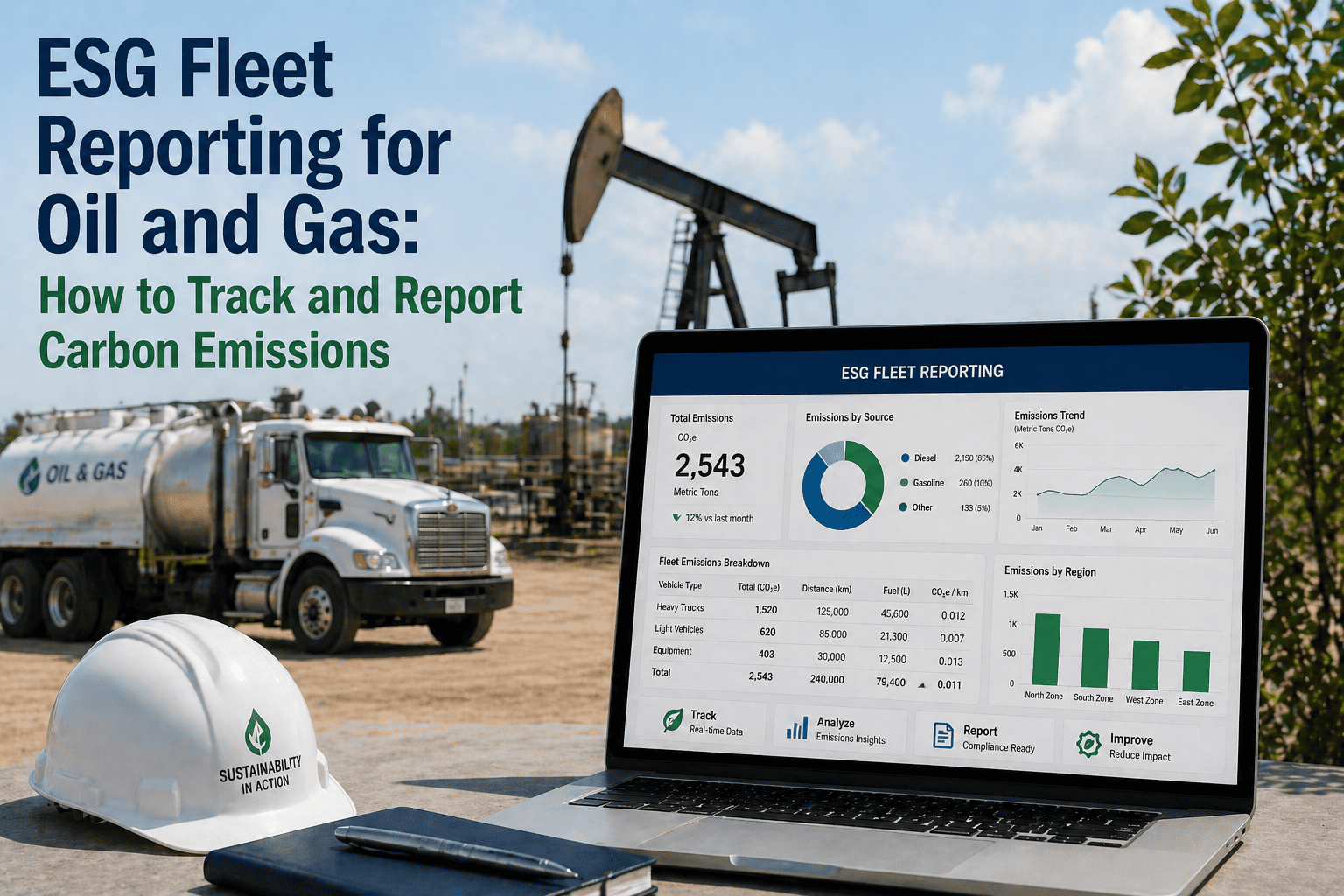
ESG Fleet Reporting for Oil and Gas: How to Track and Report Carbon Emissions
FleetRabbit provides idle reduction data, fuel consumption analytics, emission tracking, and automated sustainability dashboards — turning oilfield telematics data into investor-grade ESG fleet carbon reports without manual assembly. Deploy in 5–7 working days at $3/vehicle/month.
Why Oilfield Fleet ESG Reporting Fails on Manual Data Assembly
The gap between what institutional investors, operator clients, and regulators require from oilfield fleet ESG reporting and what manual data assembly from disconnected systems can produce is structural — not a matter of effort. The data exists. The problem is architecture.
Fleet carbon calculations require total fuel consumed per vehicle per period — but this data lives in telematics vendor exports that require manual consolidation into a spreadsheet before emission factors can even be applied. For a 200-vehicle fleet, this assembly process takes 3–5 days per reporting cycle and produces figures that auditors cannot independently verify against the source data.
ESG frameworks require idle reduction performance to be reported separately from operational fuel consumption — but most oilfield telematics systems aggregate engine hours without distinguishing idle from loaded operation. Oilfield vehicles idling at wellsites for 40–60% of engine hours generate disproportionate emission contributions that are invisible without dedicated idle monitoring against operational status.
An oilfield fleet operating diesel HGVs, CNG-powered service trucks, and LPG-fuelled wellsite vehicles requires different emission factors per fuel type, applied against vehicle-specific consumption data. Without a configured emission factor framework, fleet carbon calculations either use single-fuel assumptions that misrepresent the actual fleet or require an external consultant to apply the calculation framework manually each reporting cycle.
FleetRabbit captures fuel consumption per vehicle per shift — broken down by idle burn, loaded travel, and PTO operation — and applies configured emission factors automatically. Scope 1 fleet emission figures are calculated in real time with audit-trail linkage to the source telematics data. No manual consolidation. No post-cycle spreadsheet assembly. Verifiable by third-party assurance providers directly from the FleetRabbit data export.
FleetRabbit tracks idle hours separately from operational engine hours for every vehicle — enabling idle emission attribution, idle reduction campaign performance measurement, and year-on-year idle intensity improvement reporting. In-cab idle reduction alerts reduce idle hours by 25–35% within 60 days of deployment, generating measurable emission reduction that can be reported as a verified ESG outcome with FleetRabbit data as the evidence base.
FleetRabbit's ESG module applies the correct emission factor per fuel type per vehicle — IPCC, DEFRA, EPA, or custom factors for specific regulatory frameworks — generating Scope 1 fleet emission totals that are GHG Protocol compliant and suitable for CDP disclosure, SEC climate rule filings, and investor ESG covenant reporting without external consultant re-calculation.
From Raw Oilfield Telematics Data to Investor-Grade ESG Carbon Reports — Automatically
FleetRabbit captures fuel consumption, idle hours, and emission data across every vehicle in your oilfield fleet — applying your configured emission factor framework to produce verified Scope 1 carbon baselines, reduction trajectory tracking, and board-level ESG dashboards without manual data assembly across disconnected systems.
FleetRabbit ESG Fleet Reporting Capabilities for Oil and Gas Operations
Scope 1 Fleet Emission Baseline Generation
FleetRabbit applies configured GHG Protocol, DEFRA, or EPA emission factors to real-time fuel consumption data per vehicle — generating a verifiable Scope 1 fleet carbon baseline that updates daily. The baseline is broken down by vehicle class, operational site, asset type, and reporting period — enabling the per-category attribution that ESG disclosure frameworks require for credible reporting. Audit-trail linkage to source telematics data makes the figures third-party assurance ready without additional data preparation.
Idle Reduction Monitoring and Emission Attribution
FleetRabbit tracks idle hours separately from operational engine hours for every vehicle — attributing idle fuel consumption and associated Scope 1 emissions as a discrete, reducible emission source. In-cab idle alerts deploy automatically when a vehicle exceeds the configured idle threshold. The FleetRabbit ESG dashboard tracks idle reduction campaign performance — measuring the emission impact of behavioural interventions in real time and reporting verified reduction outcomes per vehicle, per site, and per fleet-wide programme period.
Fuel Efficiency Analytics by Vehicle Class and Route
FleetRabbit generates fuel efficiency metrics per vehicle, per vehicle class, per route corridor, and per operational site — enabling fleet managers to identify the highest-emission assets and the specific operational patterns generating disproportionate fuel consumption. For oilfield fleets where a small subset of heavy-duty frac trucks or vacuum units may account for 60% of total fleet emissions, this asset-level visibility is essential for targeted emission reduction strategy rather than fleet-wide average metrics that obscure the actual improvement opportunity.
Automated ESG Dashboard and Investor-Grade Report Generation
FleetRabbit generates ESG fleet carbon reports in investor-grade format — covering fleet-wide Scope 1 emissions for the reporting period, year-on-year reduction trajectory against baseline, idle intensity metrics, fuel efficiency improvement, and per-vehicle-class emission attribution. Reports are exportable in PDF and data formats suitable for CDP disclosure submissions, SEC climate rule filings, GRESB assessments, and investor ESG covenant reporting without requiring external consultant reformatting of the underlying data.
Driver Behaviour Emission Contribution Scoring
FleetRabbit scores individual driver emission contribution — combining idle time, harsh acceleration events, excessive speed, and fuel consumption variance from vehicle class baseline — into a driver-level emission intensity score that fleet managers can use to target coaching interventions at the specific drivers generating the highest emission footprints within their class. Studies across oilfield fleet deployments show that the highest-emission 20% of drivers consistently account for 35–45% of driver-controllable fuel consumption variance — making driver-level emission scoring one of the highest-leverage ESG intervention tools available.
Fleet Electrification and Alternative Fuel Transition Planning
FleetRabbit's fleet lifecycle analytics provide the asset utilisation, route distance, and duty cycle data that inform evidence-based fleet electrification and alternative fuel transition decisions — identifying which vehicle classes and routes are operationally compatible with available zero-emission alternatives and modelling the emission reduction impact of phased fleet transitions. ESG commitments to fleet decarbonisation require verified baseline data and transition impact modelling to be credible — FleetRabbit provides both from the same operational dataset.
What ESG Fleet Intelligence Delivers for Oilfield Operations Executives
For VP-level and C-suite operations leaders in oil and gas, ESG fleet reporting is no longer a sustainability team exercise — it is a material financial risk, an investor covenant obligation, and an operator client prequalification requirement. FleetRabbit delivers the data infrastructure to manage it credibly.
Investor ESG Covenant Compliance — Verified Fleet Carbon Data
Private equity and institutional debt providers financing oilfield operations increasingly include ESG covenant provisions requiring verified Scope 1 emission reporting as a loan covenant condition. Covenant breach from inability to produce verified fleet carbon data — not from failure to reduce emissions — is now a documented risk for oilfield operators relying on manual data assembly. FleetRabbit provides the verified fleet Scope 1 data that satisfies covenant reporting requirements with audit-trail linkage to source telematics data.
Operator Client ESG Supply Chain Requirements
Major operator clients — ADNOC, Saudi Aramco, BP, Shell, Equinor — are incorporating contractor fleet carbon footprint data into their Scope 3 emission reporting and supply chain ESG assessments. Contractors unable to provide verified fleet emission data risk disadvantaged positioning in contract renewals and prequalification assessments where ESG performance is scored alongside HSE compliance and financial standing. FleetRabbit generates the contractor fleet ESG data that major operator clients require — in their specific reporting format — without manual assembly.
SEC Climate Disclosure Rule — Material Fleet Emission Quantification
SEC climate disclosure rules require material climate-related risk quantification for public companies — including Scope 1 emission figures where the fleet is a material emission source. For oilfield operators where the vehicle fleet constitutes a significant fraction of total Scope 1 emissions, the fleet carbon data quality directly affects the credibility of SEC filing disclosures. FleetRabbit provides the verified, methodology-documented fleet emission figures that SEC disclosure requires without the engagement of external emissions consultants for each filing cycle.
Internal Sustainability Target Tracking — Board-Level Reporting
Oilfield operators with internal net-zero or emission reduction commitments need verified baseline data and continuous reduction trajectory monitoring to demonstrate credible progress to boards, employees, and external stakeholders. FleetRabbit provides the live fleet carbon dashboard and automated quarterly reporting that boards require — showing fleet-wide emission intensity, year-on-year reduction performance, and per-initiative impact measurement in a format that communicates progress without requiring technical interpretation.
Common Questions About ESG Fleet Carbon Reporting with FleetRabbit
Turn Your Oilfield Fleet Telematics Into Investor-Grade ESG Carbon Reporting
FleetRabbit captures fuel consumption, idle hours, and emission data across every oilfield vehicle — applying your configured emission factor framework to produce verified Scope 1 baselines, reduction trajectory tracking, and board-level ESG dashboards without manual data assembly. Deployed in 5–7 working days at $3/vehicle/month.