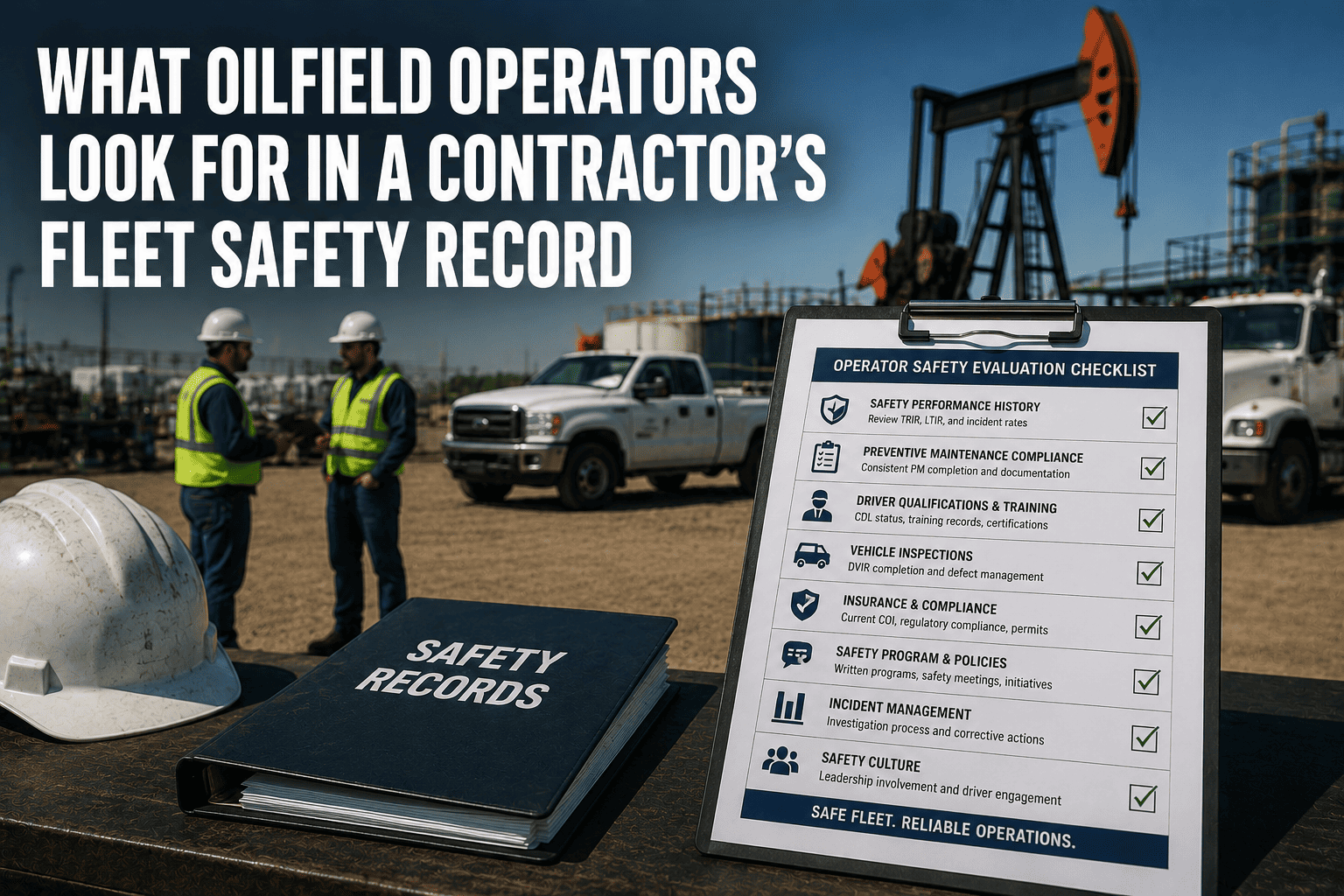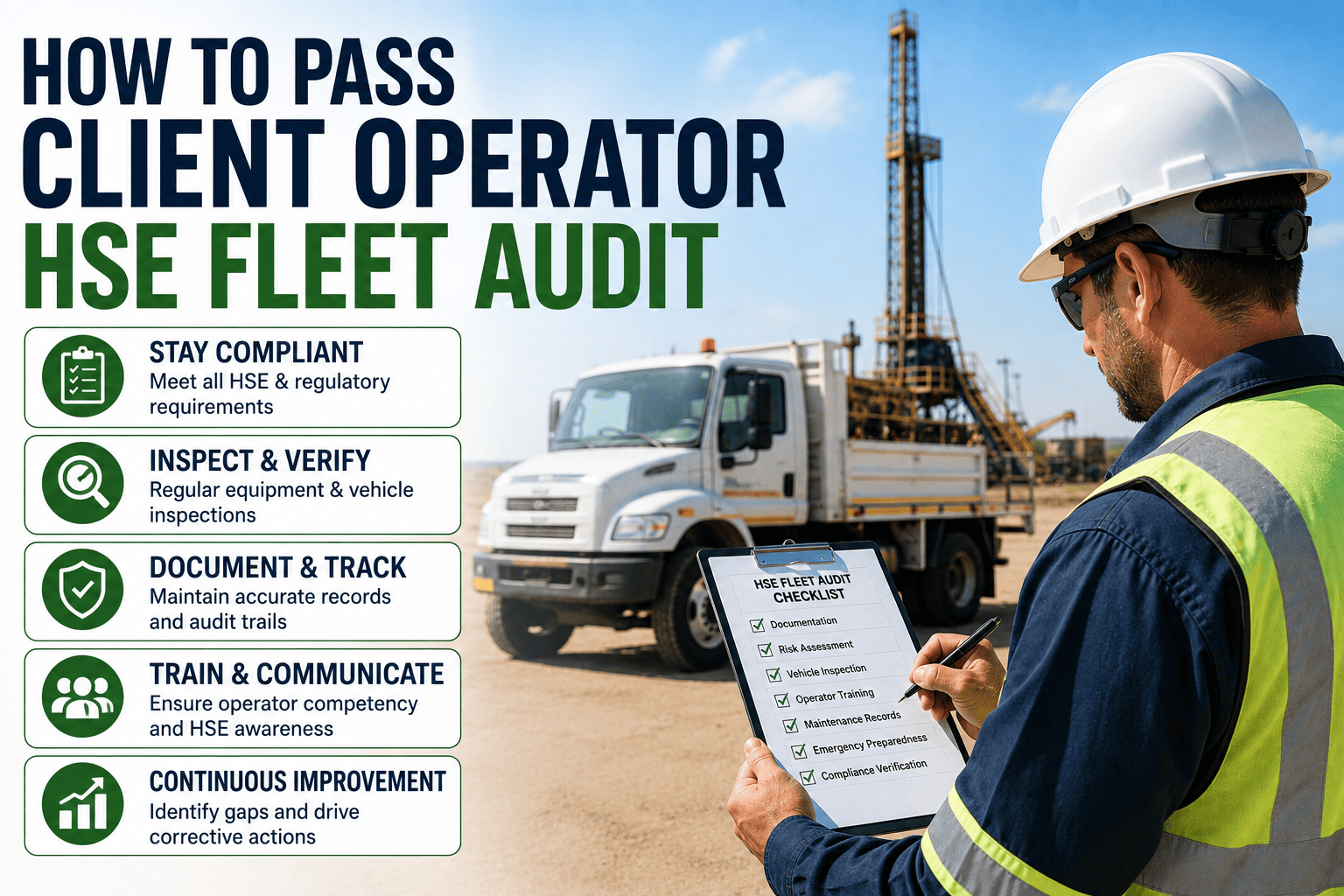
An operator HSE audit rarely fails a contractor because of one dramatic violation. It fails them one missing document at a time, an expired medical certificate, a defect that was inspected but never closed out, a site-specific standard the crew never knew had changed. Passing a client operator fleet audit on the first attempt isn't about scrambling the week before, it's about having the paperwork already sitting where an auditor can find it. This guide walks through the domains auditors actually check, why contractors get caught out, and the prep timeline that gets a fleet audit-ready without a last-minute fire drill. If you'd rather see how this looks on your own fleet, sign up for FleetRabbit or book a demo and we'll walk through your audit history together.
Site-specific HSE requirements, the client's own standard layered on top of the regulatory minimum, generate the highest volume of audit findings across contractor fleets. A fleet that meets DOT and OSHA minimums can still fail an operator audit because it applied the wrong standard for that specific client site. Manually assembling audit documentation typically takes 40 to 60 hours per review, and roughly 68 percent of oilfield fleets are still doing it from paper records, which is where most of the gaps get discovered too late.
Why Client Operator Audits Are Different From a DOT Review
A DOT or OSHA review checks a contractor against a fixed regulatory floor. A client operator audit checks against that same floor plus whatever the operator added on top, vehicle acceptance standards, site access protocols, H2S and ATEX certification requirements, and reporting timelines that can be stricter than the statutory minimum. Those client-specific standards also change between contract cycles, and they aren't always formally communicated as amendments, so a contractor can be fully DOT-compliant and still walk into a finding because the site standard moved and nobody updated the checklist.
That's why the fleets that pass on the first try treat every client site as its own compliance profile instead of running one generic checklist everywhere. The standard gets confirmed at contract award, documented, and re-verified before each audit cycle rather than assumed from the last contract.
FleetRabbit keeps inspection records, driver files, and site-specific standards in one place, so a full audit package builds in minutes instead of a 40 to 60 hour manual pull.
The Six Domains Auditors Actually Check
Most operator audits move through the same set of domains in roughly the same order. Knowing where findings usually cluster tells you where to spend your prep time.
| Domain | What Gets Checked | Most Common Finding |
|---|---|---|
| Driver Qualification | License status, medical certificates, MVR history, training records | Medical certificate expired or missing from the file |
| Vehicle Inspection Program | DVIRs, preventive maintenance schedule adherence, defect closeout | Defect logged on inspection but no closeout record attached |
| Site-Specific Standards | Vehicle acceptance checklist, site access passes, client technical spec | Regulatory minimum applied instead of the client's stricter standard |
| Incident and Near-Miss Reporting | Reporting timelines, root cause analysis, corrective action tracking | Incident logged but no documented corrective action follow-through |
| Hours of Service | HOS logs cross-checked against dispatch and telematics data | Logs kept but never reconciled against actual dispatch records |
| Emergency Response Readiness | Site orientation proof, H2S and ATEX certification, evacuation familiarity | No documented proof crew completed site-specific orientation |
A Two-Week, Pass-Ready Prep Timeline
Fleets that consistently pass on the first attempt run the same short runway before every audit cycle.
Days 14 to 8: Pull and Compare
Every driver file and vehicle record gets pulled and checked against that specific client's standard, not the generic regulatory minimum, so gaps surface with time left to fix them.
Days 7 to 3: Close the Loop
Open defects get closed out with records attached, missing certifications get chased down, and the team runs a mock document pull to see how fast any single record can be produced.
Day of Audit: One Point of Contact
A single person owns document requests during the audit, able to produce any record within minutes rather than promising to "send it over later," which is itself a common finding.
Whether you run one client site or a dozen, the standard that matters is the one written into that specific contract. Let's look at how your current documentation stacks up.
Frequently Asked Questions
The fleets that pass on the first try aren't lucky, they've simply stopped treating audit prep as a scramble. Sign up to centralize your records, or book a demo and we'll map your next audit against your current documentation.