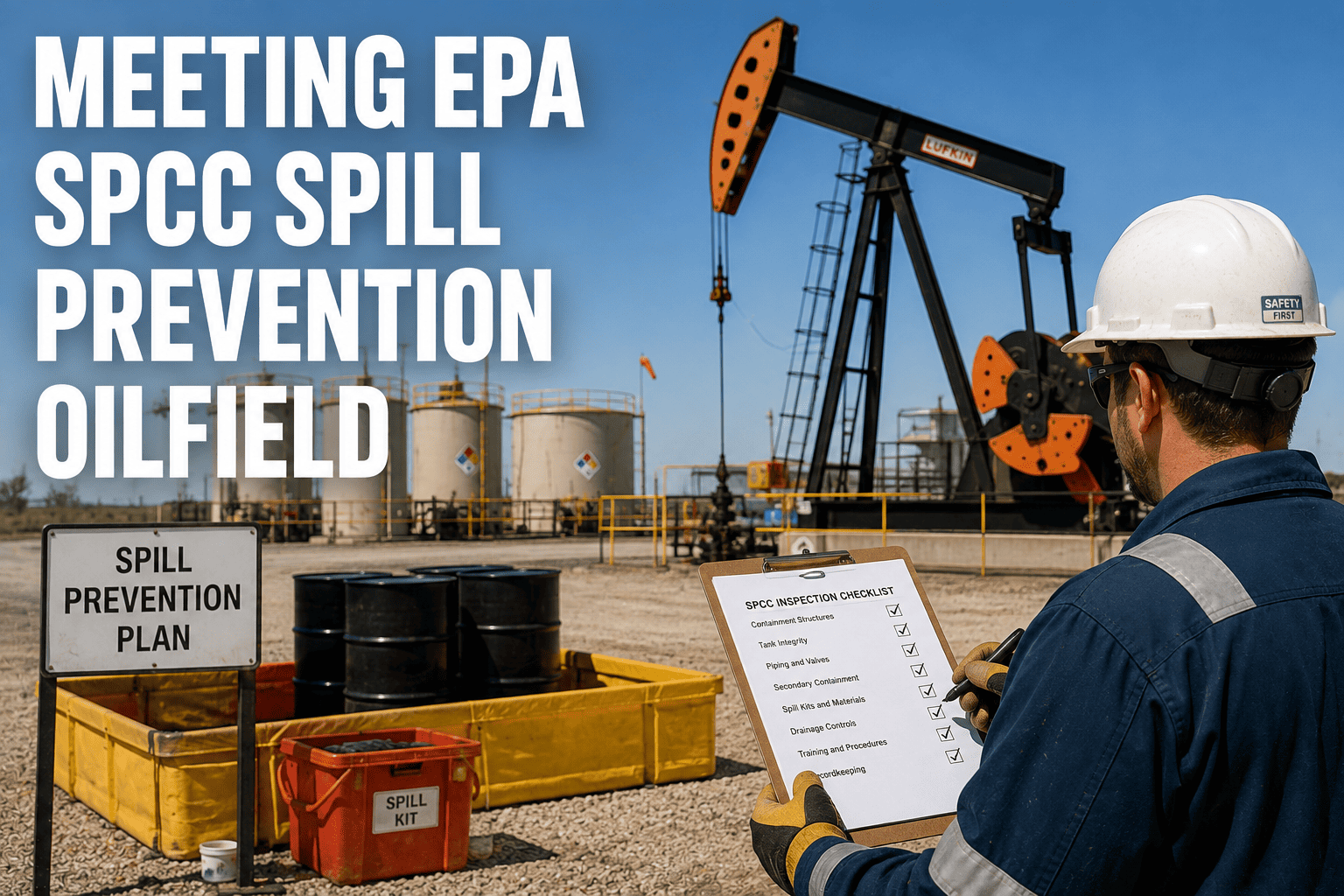
An oilfield fleet doesn't just move equipment and crews between well sites. It moves diesel, hydraulic fluid, lube oil, and produced water in tanks, totes, and mobile refuelers all day long, and every one of those transfers is a potential spill waiting to happen. The EPA's Spill Prevention, Control, and Countermeasure rule exists precisely because of that risk, and for fleets operating on or near oil and gas locations, SPCC compliance is rarely optional. Understanding where your fleet fits under the rule, and what it actually requires day to day, is the difference between a routine inspection and a costly enforcement action.
Any oilfield facility or fleet yard storing more than 1,320 gallons of oil in aboveground containers of 55 gallons or larger must maintain a written SPCC Plan under 40 CFR Part 112. That plan must cover secondary containment, routine inspections, employee training, and spill response readiness, and it must be reviewed at least once every five years or amended within six months of any material operational change.
Why Oilfield Fleets Sit Squarely Inside SPCC Jurisdiction
Upstream oil and gas operations are named directly in 40 CFR Part 112 as a covered sector, and fleet yards that fuel, store, and transfer oil products for drilling, production, or gathering activities are treated the same as the well sites they serve. A location qualifies once it stores, transfers, or consumes oil-based products and holds more than 1,320 gallons in aggregate aboveground capacity, or more than 42,000 gallons in completely buried tanks, and could reasonably discharge into a navigable water or adjoining shoreline. Diesel fuel islands, hydraulic oil drums for workover rigs, lube totes for compressor stations, and mobile refuelers servicing remote pads all count toward that total.
The complication for fleet managers is that oil inventory rarely sits still. Trucks are loaded and unloaded, mobile refuelers move between locations, and temporary tanks appear and disappear with drilling schedules. An SPCC Plan has to reflect that reality, with a current facility diagram, an accurate oil inventory, and defined transfer procedures for every point where product changes hands. Fleets that treat the plan as a one-time document rather than a living record are the ones that get flagged when conditions on the ground no longer match what is on paper. A short review of your current locations against the threshold, done today, tells you exactly where you stand before an inspector does it for you.
Qualified Facility vs. Full SPCC Plan
Not every oilfield fleet needs an engineer-certified plan. Facilities with 10,000 gallons or less in aggregate storage, and a clean discharge history for the prior three years, may self-certify as a Qualified Facility using a simplified Tier I or Tier II template. Larger or higher-risk fleet yards typically need a full plan prepared under sound engineering practice and reviewed by a licensed Professional Engineer. Knowing which tier applies to each of your locations avoids both under-compliance and unnecessary engineering spend.
FleetRabbit keeps tank inventories, containment inspections, and training logs in one place across every yard and rig site, so your SPCC documentation is always audit-ready. Sign up free and see your compliance status in one dashboard.
The Core Pieces Every Oilfield SPCC Plan Must Cover
An SPCC Plan is only as strong as the operational habits behind it. EPA guidance breaks the rule down into a handful of concrete obligations, and oilfield fleets typically encounter every one of them somewhere in daily operations, from the fuel island at the yard to the refueler parked beside a rig.
| Plan Element | What It Covers | Where Fleets Get Tripped Up |
|---|---|---|
| Facility Diagram & Inventory | Site map showing tanks, totes, drums, transfer points, and drainage routes with listed capacities | Diagrams left unchanged after new tanks or mobile refuelers are added to a yard |
| Secondary Containment | Berms, dikes, or double walls sized for the largest container plus precipitation | Temporary or mobile storage parked outside designated containment areas |
| Transfer Procedures | Written steps for loading, unloading, and mobile refueler operations | Field crews improvising transfers differently from what the plan describes |
| Inspections & Records | Scheduled visual checks of tanks, valves, and containment with signed logs | Inspections performed but never logged, leaving no evidence during audits |
| Personnel Training | Annual briefings on spill prevention, discharge procedures, and applicable regulations | New hires and seasonal drivers skipped from the training cycle |
| Plan Review & Amendment | Five-year review cycle plus updates within six months of major operational change | Plans reviewed on paper but never reconciled with what actually changed on site |
Where Oilfield Fleets Commonly Fall Out Of Compliance
SPCC violations rank among the most frequently cited environmental infractions in the oil and gas sector, and the pattern behind most of them is remarkably consistent. Mobile equipment, seasonal staffing, and remote locations make it easy for a plan to drift away from reality.
Mobile Refuelers And Temporary Storage
Mobile refuelers get streamlined containment requirements while actively transferring fuel, but that exemption disappears the moment a refueler is parked and used as a fixed storage container instead of a mobile one. Fleets that leave a refueler sitting at a location for weeks between transfers can unintentionally trigger full secondary containment obligations they were not planning for.
Practical Fix
Track how long each refueler or portable tank sits idle at a site, and flag anything approaching a fixed-use pattern so containment can be added before it becomes a violation rather than after.
Inconsistent Inspection Logging
Verbal confirmation that a tank was checked carries no weight with an inspector. EPA guidance for regional inspectors treats missing documentation the same as a missed inspection, which means a fleet that actually maintains its equipment well can still be cited for poor recordkeeping alone.
Practical Fix
Digital inspection checklists tied to a specific tank, tote, or vehicle create a timestamped record automatically, removing the gap between what crews do and what the paperwork can prove.
Building A Fleet-Wide Spill Prevention Routine
The fleets that stay compliant without last-minute scrambling treat SPCC obligations as part of normal maintenance workflow rather than a separate compliance project. Tank and container inventories get updated the same day equipment moves. Containment structures get inspected on the same schedule as the vehicles that use them. Training gets refreshed annually and logged with the rest of driver certifications. None of this requires extra headcount, it requires the right system to catch what would otherwise slip through.
Telematics and digital work order platforms that already track vehicle maintenance can extend naturally into spill prevention recordkeeping, since much of the same data, location, usage, and inspection history, feeds both purposes. A platform that flags a refueler sitting idle too long, or a containment inspection coming due, closes the exact gaps that turn routine oilfield operations into SPCC findings. If your team is still tracking tanks and inspections on spreadsheets across multiple yards, it's worth booking a short call to see how much of that can run on autopilot instead.
FleetRabbit tracks tank inventories, containment inspections, refueler dwell time, and driver training in a single system, so your next SPCC review starts with answers instead of a scramble. Book a demo to walk through your current setup with our team.
Key Takeaways For Fleet Managers
SPCC compliance for oilfield fleets comes down to three habits done consistently: know your actual oil storage volume at every yard, keep containment matched to what is really parked there, and document inspections the moment they happen rather than after the fact. The rule itself has not changed dramatically in decades, but enforcement attention on oil and gas operations has, and fleets that treat their plan as a living document rather than a filing cabinet item are the ones that pass reviews without incident.
If your fleet is managing tanks, refuelers, and inspection schedules across multiple well sites by memory or spreadsheet, that is usually where the gaps start. A short conversation with our team can show you exactly where your current setup stands against SPCC expectations.
FleetRabbit brings tank inventories, containment inspections, and training records together in one place across every yard and rig location, so compliance stops being a scramble before every audit. Start free or talk to our team about your specific sites.