Natural gas fleet transition in oil and gas is one of those operational shifts that promises environmental compliance and long-term cost savings but introduces immediate logistical complexity. The challenge is not that fleet managers do not understand the value of CNG and LNG vehicles — it is that most fleet management systems are structurally designed for a single-fuel reality. They track diesel fill-ups, diesel maintenance intervals, and diesel range expectations. When a mixed fleet enters the yard, the data infrastructure fractures. A CNG unit running low on range in the Permian Basin does not trigger the same alerts as a diesel truck. An LNG vehicle requiring cryogenic maintenance checks is often missed because the system only tracks standard engine hours. Safety and efficiency in a mixed-fuel environment require a platform that understands the distinct operational profiles of natural gas vehicles alongside traditional diesel assets. FleetRabbit’s multi-fuel fleet management platform provides the unified data infrastructure for this transition — tracking CNG/LNG fill events, monitoring range limitations specific to natural gas, managing divergent maintenance schedules, and ensuring that safety protocols are applied correctly regardless of the fuel source. This article details the specific steps to managing a natural gas fleet transition in oil and gas — and the FleetRabbit capabilities that support each stage of the process. Book a demo to see FleetRabbit's multi-fuel fleet management platform for oil and gas operations.
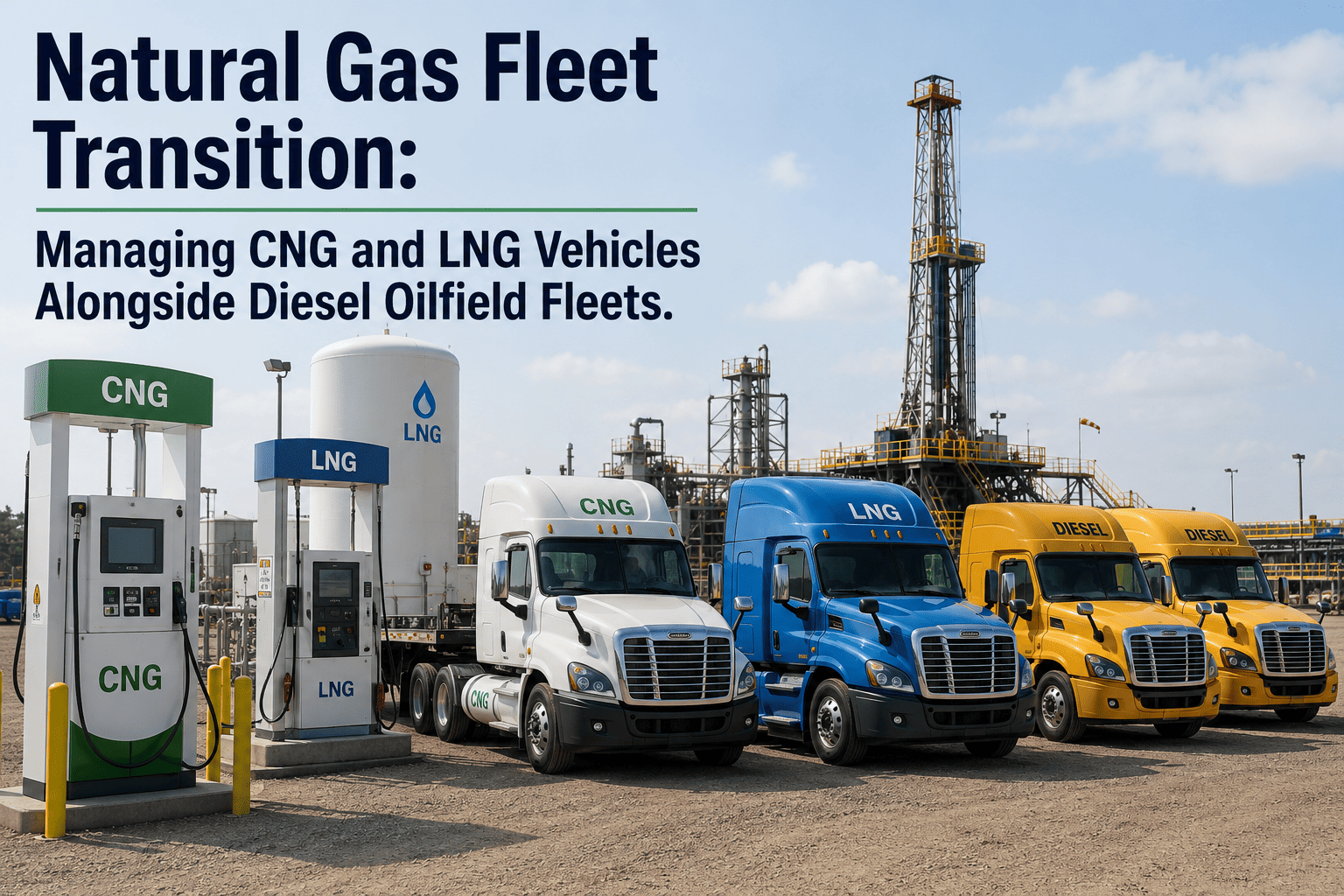
Managing CNG and LNG Vehicles Alongside Diesel Oilfield Fleets: A Unified Data Approach
Mixed-fuel oilfield fleets are the new reality. FleetRabbit's multi-fuel fleet management tracks CNG/LNG fill events, range limitations, and maintenance differences alongside your existing diesel fleet, ensuring no vehicle is left unmanaged due to fuel type.
Why Traditional Fleet Management Systems Fail Mixed-Fuel Oilfield Operations
The gap between diesel-centric fleet management tools and the reality of mixed-fuel oilfield operations creates blind spots that impact safety, compliance, and cost efficiency. Most systems treat all vehicles identically, ignoring the unique operational constraints of CNG and LNG assets.
Range Anxiety and Refueling Logistics Are Not Tracked
CNG and LNG vehicles have different range profiles and refueling infrastructure requirements than diesel. A diesel-centric system does not alert managers when a CNG unit is dispatched on a route exceeding its safe range, or when nearby refueling stations are offline. This leads to stranded assets and operational delays.
Maintenance Schedules Diverge Significantly
Natural gas engines have different maintenance intervals and requirements compared to diesel engines. Oil changes, spark plug replacements, and cryogenic system checks for LNG vehicles are often missed when managed on a generic diesel schedule, leading to premature wear and costly repairs.
Fuel Cost Analysis Is Inaccurate Without Segmentation
Comparing the cost-per-mile of CNG/LNG vehicles against diesel requires precise tracking of fuel type-specific consumption. Generic fleet tools aggregate fuel costs, masking the true ROI of natural gas vehicles and making it difficult to justify further transition investments to executives.
Safety Protocols Differ by Fuel Type
Handling incidents involving CNG or LNG vehicles requires specific safety protocols distinct from diesel spills or fires. If dispatchers and safety officers cannot instantly identify the fuel type of a vehicle involved in an incident, response times slow down and safety risks increase.
Unified Tracking for Diesel, CNG, and LNG Assets. Real-Time Visibility. Accurate ROI.
FleetRabbit provides the complete data infrastructure for mixed-fuel oilfield fleets — from real-time range monitoring for CNG units to specialized maintenance tracking for LNG vehicles, ensuring every asset is managed according to its specific operational needs.
How FleetRabbit Solves the Mixed-Fuel Management Problem
FleetRabbit’s platform is built to handle the complexity of modern oilfield fleets. It does not force natural gas vehicles into a diesel mold. Instead, it adapts its tracking, alerting, and reporting capabilities to the specific needs of each fuel type.
Fuel-Type Specific Range Monitoring and Alerts
Range anxiety is a major barrier to natural gas adoption. FleetRabbit eliminates this by tracking fuel levels and range estimates specific to CNG and LNG vehicles. The system alerts dispatchers when a vehicle’s remaining range is insufficient for its assigned route, suggesting refueling stops based on real-time station availability.
Divergent Maintenance Schedule Management
Natural gas engines require different maintenance than diesel engines. FleetRabbit allows fleet managers to set custom maintenance schedules based on fuel type, engine model, and manufacturer recommendations. This ensures that LNG cryogenic systems and CNG spark plugs are serviced on time, preventing costly downtime.
Accurate Fuel Cost and ROI Analysis
To justify the transition to natural gas, executives need clear data on cost savings. FleetRabbit segments fuel consumption by type, providing accurate cost-per-mile analysis for diesel, CNG, and LNG vehicles. This data enables precise ROI calculations and supports strategic decision-making.
Safety Protocol Integration and Incident Response
In the event of an incident, knowing the fuel type is critical for safety response. FleetRabbit tags every vehicle with its fuel type, ensuring that dispatchers and emergency responders have immediate access to this information. This reduces response time and enhances safety outcomes.
Measured Outcomes for Oilfield Fleets Transitioning to Natural Gas with FleetRabbit
Manage Your Mixed-Fuel Oilfield Fleet with Confidence — Starting in 5–7 Days
FleetRabbit provides fuel-specific range monitoring, divergent maintenance scheduling, accurate ROI analysis, and safety protocol integration — everything required to manage a successful natural gas fleet transition at $3/vehicle/month.