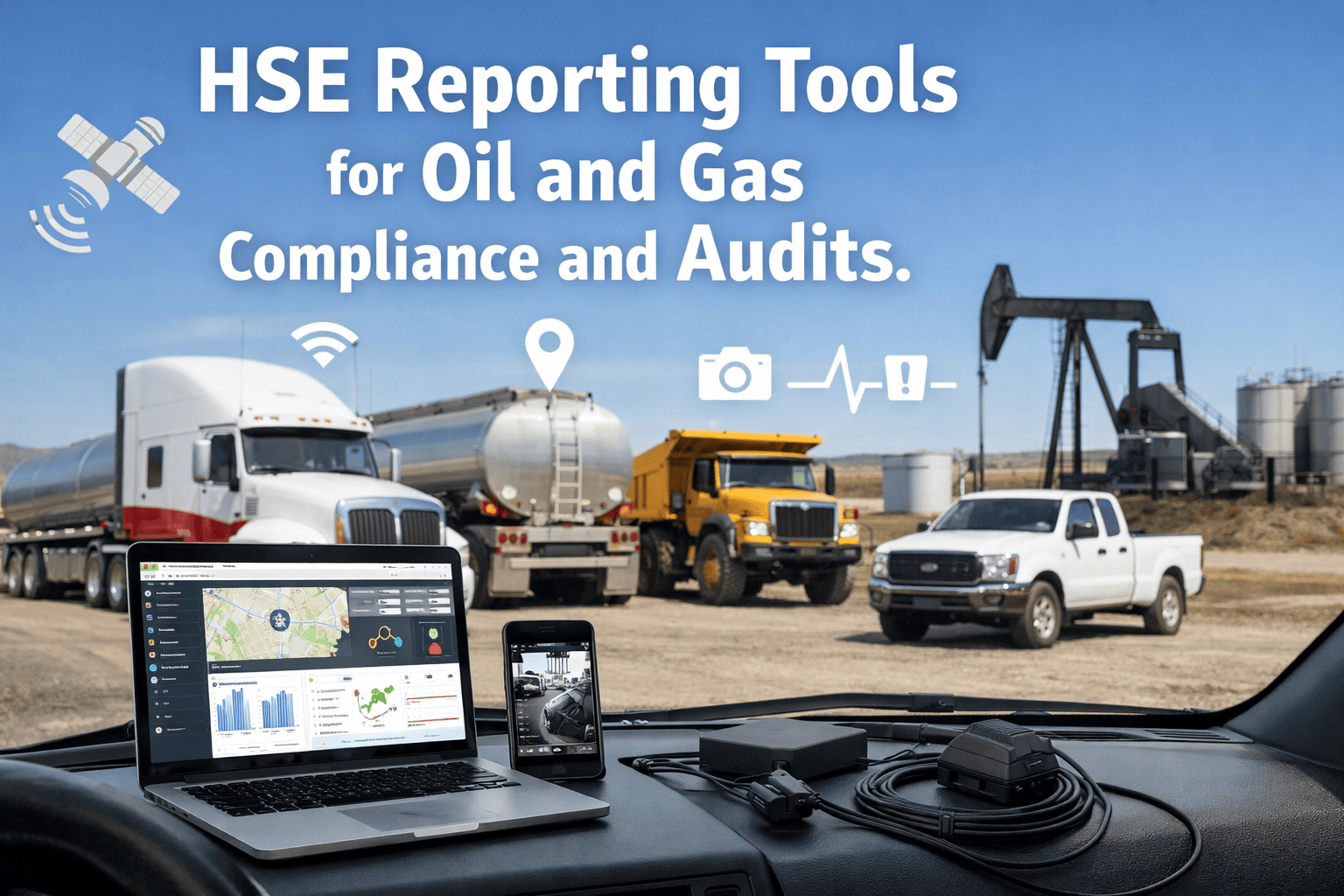
Oilfield operators managing complex drilling rigs and service equipment face increasing scrutiny from regulatory bodies like OSHA and the EPA, where manual HSE reporting processes often lead to compliance gaps, audit failures, and significant financial penalties. When a major operator faced repeated citations for late incident reporting and inconsistent safety metrics, post-audit analysis revealed that critical HSE data was siloed across spreadsheets, paper logs, and disparate systems — preventing timely aggregation and accurate submission. Book a demo to see how FleetRabbit's automated HSE reporting tools streamline compliance and eliminate audit risks.
Guide Summary
This guide details how oilfield operators can leverage automated HSE reporting tools to simplify OSHA, API, and EPA compliance. It covers incident-to-report automation workflows, automated report generation, real-time safety performance dashboards, regulatory framework requirements under OSHA 29 CFR 1904 and EPA reporting standards, the creation of immutable audit trails, and the FleetRabbit platform integration points that connect HSE data with fleet asset and field operations management to produce a fully unified compliance posture.
60%
Reduction in time spent compiling monthly HSE reports with automated aggregation
100%
Audit readiness with real-time data validation and immutable trail documentation
$50K+
Average cost avoided per prevented compliance violation before it becomes a citation
24h
Maximum turnaround for automated incident report generation and routing to approval
The Compliance Challenge in Oilfield HSE Operations
HSE compliance in the oil and gas sector is not solely about avoiding fines. It is about maintaining the license to operate in environments where regulatory bodies, insurers, investors, and operator customers review safety performance records as a condition of contract award and business partnership. Regulatory frameworks such as OSHA's Recordkeeping Standard under 29 CFR 1904 and the EPA's environmental reporting requirements demand precise, timely, and verifiable data structured to specific format requirements that do not accommodate the inherent variability of manual, paper-based record systems.
However, many oilfield operators and service companies continue to manage HSE compliance through combinations of paper-based incident logs, Excel spreadsheets used for monthly aggregations, email chains for approvals and corrections, and verbal communication between field personnel and HSE managers who may be located at offices hundreds of miles from the active drill site. This fragmentation creates data entry errors through manual transcription, delayed reporting that violates the specific regulatory windows mandated by OSHA and EPA frameworks, and an inability to produce immediate evidence of compliance history during unannounced regulatory inspections.
The consequences of fragmented HSE documentation accumulate over time. A single missed OSHA 300 log entry creates compliance exposure. A pattern of late incident reporting across multiple sites creates the record of systemic non-compliance that regulators use to justify elevated penalty assessments and increased inspection frequency. And the inability to produce a verifiable, timestamped corrective action record when a citation is contested eliminates the documentation basis for successful penalty negotiation or appeal. FleetRabbit's automated HSE reporting infrastructure closes each of these vulnerability categories through system-level controls rather than relying on the consistency of individual operators across distributed field locations.
Regulatory Framework Requirements: OSHA 29 CFR 1904 and EPA Reporting Standards
Before examining how FleetRabbit automates compliance with oilfield HSE reporting requirements, it is essential to understand the specific regulatory obligations that define what compliant documentation must include, how quickly it must be produced, and how long it must be retained in verifiable form. The regulatory landscape for upstream oil and gas operations includes both federal OSHA requirements that apply to all covered employers and EPA reporting requirements specific to environmental incident and chemical release events.
OSHA's injury and illness recordkeeping standard under 29 CFR 1904 requires covered employers to maintain a log of work-related injuries and illnesses on OSHA Form 300, prepare a separate incident summary supplementary record on OSHA Form 301 for each recordable case within seven calendar days of learning of the incident, and post an annual summary of the Form 300 log on OSHA Form 300A between February 1 and April 30 of each year. For severe injuries, including hospitalizations of any employee and any amputation or loss of an eye, OSHA requires notification within 24 hours. For work-related fatalities, the notification window is eight hours. These regulatory timelines do not accommodate the information fragmentation created by paper-based field incident reporting that requires physical document transmission before records can be reviewed and classified.
OSHA 29 CFR 1904
Injury and Illness Recordkeeping
Form 300 Log Entry
Within 7 days of incident knowledge
Auto-populated from incident capture and classification
Form 301 Supplementary Record
Within 7 days of incident knowledge
Generated automatically from incident submission data with required field mapping
Form 300A Annual Summary
Post Feb 1 through Apr 30 annually
Scheduled automated generation from full-year 300 log data
Severe Injury Notification (Hospitalization)
Within 24 hours
Immediate escalation alert to HSE manager and designated reporting contact
Fatality Notification
Within 8 hours
Critical severity alert with regulatory notification timer and documented submission record
EPA Environmental Reporting
Spill, Release, and Emergency Reporting
CERCLA Section 103 Release Notification
Immediate upon knowledge of reportable quantity release
Release classification triggers immediate NRC notification workflow with quantity and location pre-populated
EPCRA Section 304 Emergency Release Notification
Immediate — to SERC and LEPC
Parallel notification routing to state and local agencies from single FleetRabbit incident record
Tier II Chemical Inventory Report
March 1 annually
Scheduled annual report generation from chemical inventory and storage location data
Spill Prevention and Control Plan Review
Within 60 days of qualifying spill event
Post-incident corrective action deadline tracker with documentation milestone alerts
The EPA's emergency planning and community right-to-know reporting requirements add a parallel compliance obligation for oilfield operations that store or use threshold quantities of listed hazardous chemicals in their drilling fluid systems, process equipment, or fuel storage infrastructure. Section 304 of the Emergency Planning and Community Right-to-Know Act requires immediate notification to state emergency response commissions and local emergency planning committees when a release of a listed extremely hazardous substance exceeds its reportable quantity. The simultaneous, immediate nature of this notification requirement makes manual process compliance essentially impossible given the information availability constraints at a typical remote oilfield incident site. FleetRabbit's incident classification system identifies releases that trigger EPCRA Section 304 requirements and initiates the appropriate notification documentation workflow without requiring the incident reporter to know the regulatory classification of the release at the time of initial submission.
Incident-to-Report Automation Workflow
The core of modern HSE compliance is the ability to capture an incident at the source and immediately transform it into a compliant report without requiring HSE managers to rebuild the record from manually transmitted field notes. FleetRabbit's Incident-to-Report Automation Workflow eliminates the lag between event occurrence and regulatory documentation by digitizing the entire chain from field capture through classification, approval, and regulatory format output.
1
Immediate Digital Capture at the Event Site
Field personnel log incidents through FleetRabbit's mobile application, which is designed for offline operation in remote oilfield environments with intermittent or absent cellular connectivity. The submission captures structured data including incident type, injured party or environmental receptor, location via GPS coordinates, date and time with tamper-evident immutable timestamping, severity assessment using a standardized classification interface, witness identification, initial corrective action taken, and photographic or video documentation attached directly to the incident record. Because the timestamp is recorded at the moment of data entry by the mobile device rather than when the form is eventually transmitted to a server, offline submissions retain their original occurrence time regardless of when connectivity is restored.
2
Auto-Classification and Severity Routing
Upon submission, FleetRabbit's classification logic evaluates the incident data against OSHA 29 CFR 1904 recordability criteria and internal severity classification frameworks configured for the operator's specific policies. Incidents are classified as Recordable, Lost Time Incident, Restricted Work Case, Medical Treatment Only, First Aid, Near Miss, or Environmental Release, with the classification logic considering the type of injury or illness, the treatment provided, the number of days away from work or on restricted duty, and the nature of any environmental release. Classification results are presented to the assigned HSE manager with the supporting logic visible for review, allowing the manager to confirm or override the automated classification with their correction documented in the version history. The incident is then routed to the appropriate approval workflow based on its severity tier and the organizational approval matrix configured for the specific site or project.
3
Validation, Approval, and Digital Signature
The HSE manager receives an alert for each pending incident at their approval level with a direct link to the full incident record including all supporting documentation. Approval is completed through digital signature within FleetRabbit's workflow interface, with the identity, timestamp, and approval decision recorded in the incident's audit trail. If the reviewing manager requires additional information before approving, a return-for-correction workflow sends the incident back to the originating field contact with specific information requests documented. Every correction, return, resubmission, and re-approval step is recorded with a timestamp and user identification, creating a complete version history that demonstrates to regulators that the final approved record is the product of a structured review process rather than a retrospective document.
4
Regulatory Format Output and Submission Readiness
Once the incident record is approved through the digital workflow, FleetRabbit automatically populates the applicable regulatory report format from the structured incident data. Recordable injuries and illnesses are aggregated into the OSHA 300 log in the required column format. Individual incident narratives are formatted to the OSHA Form 301 supplementary record template. Environmental releases are formatted for the applicable EPA notification report. The system presents the completed regulatory document for final HSE manager review before submission, with all required fields pre-populated and any incomplete required fields flagged for attention. The submission-ready document is retained as a permanent artifact against the originating incident record, providing a single location where the incident capture, the approval trail, and the regulatory submission output are all accessible for audit review.
Automated HSE Report Generation for Recurring Regulatory Filings
Beyond individual incident documentation, oilfield HSE compliance requires the recurring production of consolidated reports that aggregate incident data, leading indicator metrics, safety observation counts, inspection findings, and environmental compliance records across an entire fleet or site portfolio. These recurring reports — monthly internal safety reviews, quarterly regulatory submissions, annual OSHA log postings, and operator-required performance reports — consume significant HSE manager time when generated manually and introduce aggregation errors that create discrepancies between what is submitted to regulators and what the underlying data actually shows.
FleetRabbit's Automated HSE Report Generation engine pulls data from all connected incident, inspection, and environmental record sources to create accurate, standardized reports without manual data compilation. The scheduling capability allows HSE managers to configure each report type once and receive it automatically at the configured frequency without further action, converting a recurring administrative task into a verified data product that arrives ready for review and distribution.
OSHA 300 Log and 300A Annual Summary
Automatically maintained throughout the year from each recorded incident classification. The 300 log is always current and available for regulatory inspection without requiring assembly from individual incident records. The 300A summary is generated automatically in January from the prior year's log data, pre-populated with establishment information and the required total incident rates calculated from recorded cases and employee hours worked.
TRIR and LTIR Calculation and Reporting
Total Recordable Incident Rate and Lost Time Incident Rate are calculated automatically from FleetRabbit's incident data using standard OSHA formula structures applied to the configured employee hours worked figure. Both rates are calculated at the site, project, business unit, and company level for any selected time period, enabling comparison against industry benchmark rates and contractually committed performance targets in operator safety scorecards.
Near Miss and Safety Observation Reports
Leading indicator reports tracking near miss submission volume, safety observation completion rates, and hazard identification activity by site and by time period. Near miss reporting rate is one of the leading indicators most strongly associated with lower lagging incident rates in oilfield environment research, and FleetRabbit's tracking of near miss activity over time enables HSE managers to demonstrate leading indicator program improvement in operator and board-level safety performance reviews.
EPA Tier II and Environmental Release Summary
Tier II chemical inventory data maintained throughout the year in FleetRabbit's facility and equipment chemical registry generates the annual Tier II submission report with quantity and location data pre-populated from the maintained records. Environmental release incidents classified during the year are summarized with release quantity, material, receptor, and corrective action documentation for annual environmental compliance summary reporting to regulatory agencies and operator environmental managers.
Operator and Client Safety Performance Reports
Customizable report templates formatted to match operator-specific HSE performance reporting requirements, including incident summaries by work category, corrective action completion tracking, safety meeting attendance records, and inspection finding resolution status. Scheduled distribution to operator HSE contacts eliminates the manual compilation burden that service company HSE teams typically carry at weekly or monthly reporting intervals.
Corrective Action Close-Out Status
Tracking of all open corrective actions assigned from incident investigations, inspection findings, and near miss analyses, with due date monitoring, responsible party identification, and completion verification documentation. Reports show the age profile of open corrective actions, overdue items requiring escalation, and the percentage of corrective actions completed within their target window — a metric that regulators and operators use to assess the seriousness of the organization's commitment to systemic hazard elimination.
Real-Time Safety Performance Dashboards for HSE Leadership
Reactive HSE management, where performance problems are identified from monthly reports compiled after the fact, is structurally unable to intervene in emerging safety trends before they produce recordable incidents. The interval between the leading indicator signals that precede a recordable event and the event itself is measured in days or weeks, not months. HSE managers who receive performance data monthly are always reviewing history rather than managing present risk. FleetRabbit's real-time safety performance dashboards give HSE managers and site supervisors the operational visibility needed to identify trend deterioration the moment it appears in the data, enabling intervention before the trajectory produces its outcome.
The real-time dashboard capability also fundamentally changes the relationship between corporate HSE leadership and field operations. In organizations where HSE data exists only in field office files and monthly email attachments, corporate HSE directors cannot see field performance with any fidelity between reporting periods. When a high-risk site is trending toward a recordable event based on increased near miss frequency, rising hazard observation rates, or declining inspection compliance scores, the corporate HSE leader who could intervene with additional resources has no visibility into the trend until the monthly report arrives — often after the event has already occurred.
01
Live Incident and Near Miss Activity Feed
Real-time display of all incident and near miss submissions across the fleet or project portfolio, with incident type, location, severity classification, and approval status visible as events occur. HSE managers can see the full current-day activity across all sites without requesting status updates from field contacts or waiting for batch reporting periods. New submissions appear immediately in the dashboard feed regardless of whether the submitting device has just restored connectivity from an offline field period.
02
Rolling TRIR and LTIR Trend Display
Total Recordable Incident Rate and Lost Time Incident Rate displayed as rolling 12-month trend lines updated automatically with each new recordable incident classification. The trend display shows current rate against the prior period baseline, against industry benchmark rate data, and against any contractually committed performance target included in operator agreements. Deteriorating trends are flagged visually before rate thresholds are breached, enabling HSE leadership to investigate root causes of the trend before rates reach contractual notification or penalty trigger levels.
03
Leading Indicator Heatmap by Site
Color-coded heatmap showing the performance status of three to five configurable leading indicators across all active sites simultaneously. Indicators typically tracked include near miss submission rate per worker-hour, safety observation completion percentage against target, stop-work event frequency, inspection compliance rate, and corrective action on-time completion rate. Sites showing deterioration in multiple leading indicators simultaneously receive visual escalation to prompt field supervisor or HSE manager site contact before lagging indicators are affected.
04
Corrective Action Aging and Overdue Tracker
Visual display of all open corrective actions across the portfolio sorted by age relative to their committed completion deadline. Corrective actions approaching their deadline without documented progress appear on an amber aging list. Overdue items escalate to a red overdue category with visible responsible party assignment and days overdue count. Corporate HSE leadership can use the overdue tracker to prioritize their site engagement calendar toward the locations where corrective action discipline is weakest and systemic hazard elimination program integrity is most at risk.
05
Regulatory Deadline and Filing Status Monitor
Calendar-based display of all upcoming regulatory reporting deadlines across OSHA, EPA, and state environmental agency filing requirements, with completion status indicated for each filing event. Pending filings within 14 days are flagged for HSE manager attention. Completed filings display their submission timestamp and the responsible staff member's identity alongside the submission confirmation documentation. This single-view regulatory calendar replaces the manual compliance calendar tracking that HSE coordinators typically maintain in separate spreadsheets.
06
Workforce Safety Certification Compliance Status
Dashboard tracking of safety training and certification compliance for all personnel assigned to active projects and sites, showing each person's current certification status, expiration dates, and any certifications that have expired or will expire within the next 30 days. HSE managers can see at a glance whether a specific site has personnel with lapsed required certifications before those personnel are scheduled for safety-critical tasks, eliminating the risk of assignment of unqualified personnel that creates both safety exposure and regulatory violation exposure.
Audit-Ready Documentation and Immutable Audit Trail Management
During a regulatory inspection or internal audit, the ability to demonstrate the integrity of the HSE record — that data has not been retroactively altered, that the sequence of events documented in the record matches what actually occurred, and that the approval and review process was followed for each document — is as important as the content of the record itself. Regulators conducting OSHA recordkeeping inspections have specific methods for identifying backdated records, missing entries, and documentation gaps that create incomplete audit trails. Organizations with electronic HSE management systems that create timestamped, version-controlled records can demonstrate data integrity positively rather than having to prove a negative in response to regulatory challenge.
Immutable Timestamps
Every action in FleetRabbit's HSE workflow — initial incident submission, classification, return-for-correction, resubmission, manager review, digital signature, and report generation — is recorded with a system-generated timestamp that cannot be modified by any user regardless of their administrative permissions. The timestamp record is part of the system's audit log rather than the document data, making it inaccessible to any editing action that affects the document content. This approach produces an audit trail that demonstrates to regulators the precise sequence and timing of every step in the documentation process for every HSE record in the system.
Version Control and Change History
Any modification to an approved HSE record — whether initiated by an HSE manager discovering an error, a corrective action update, or an amended incident classification — creates a new version while preserving the prior version as a permanent read-only record. The version history view shows the complete progression of each record from initial submission through all subsequent versions with the content differences, responsible user identity, and reason for modification documented at each version boundary. Auditors can review the complete history of any record and confirm that modifications followed the appropriate workflow rather than representing unilateral data changes without documentation.
Centralized Document Repository
All HSE documentation including incident records, regulatory submissions, investigation reports, corrective action records, inspection findings, and supporting evidence such as photographs, witness statements, and laboratory analysis reports are stored in FleetRabbit's secure centralized repository with access controlled by role-based permissions. During a regulatory inspection, the HSE manager can retrieve any requested record immediately through the FleetRabbit search interface without dependency on finding the correct physical file location or email thread. The repository also provides the retention period management that ensures records are maintained for the OSHA-required five-year retention period and EPA-required retention periods applicable to each record category.
Chain of Custody Documentation for Evidence
For incidents that involve environmental sampling, third-party laboratory analysis, or physical evidence collection as part of the investigation process, FleetRabbit maintains chain of custody documentation that records who collected each evidence item, when it was collected, the location and conditions of collection, the laboratory or analysis facility to which it was submitted, and the analysis results linked directly to the incident record. This chain of custody documentation is critical when environmental incident records are reviewed by EPA enforcement staff or become part of legal proceedings, where evidence integrity challenges can be anticipated and must be preemptively addressed through documented custody continuity.
Integration With Fleet Asset Management and Field Operations
HSE incidents in oilfield environments rarely exist in isolation from the equipment condition, maintenance history, and operational status of the assets involved. A driver injury in a fleet vehicle is connected to the vehicle's maintenance record, its most recent DVIR submission, the driver's training and certification status, and the load assignment that placed the driver on the road at the time of the incident. A chemical release from a tank on a drilling location is connected to the tank's inspection history, the last measurement and monitoring record, and the corrective action status from any prior inspection finding that identified equipment condition concerns. Without integration between HSE incident data and fleet asset management data, investigating the root causes of oilfield incidents requires manual cross-referencing of records from separate systems that were not designed to communicate with each other.
FleetRabbit's native integration between the HSE reporting module and the fleet asset management module allows incident records to be linked directly to the involved vehicle's or equipment asset's complete operational history at the time of investigation. When a vehicle incident is classified in the HSE module, the investigating HSE manager can pull the involved vehicle's preventive maintenance compliance history, open corrective work orders, DVIR submission records from the day of the incident, and fuel and utilization records from the prior operating period — all from within the incident investigation interface rather than by navigating to separate system sections or requesting data from a fleet maintenance administrator.
Vehicle PM compliance history accessible from within incident investigation record for root cause documentation
Open defect work orders at time of incident visible to investigator without accessing separate maintenance module
Incidents automatically flagged on vehicle asset timeline for maintenance cost and reliability trend analysis
Post-incident vehicle inspection work orders created directly from incident record with HSE linkage preserved in work order documentation
Recurring incidents for the same vehicle class trigger pattern alert for systemic maintenance root cause investigation
Driver Vehicle Inspection Reports from the day of a vehicle incident accessible from the incident record for pre-incident condition documentation
Safety inspection findings that were open and unresolved at time of environmental incident are automatically included in the incident root cause documentation
Inspection compliance rate for the involved vehicle or equipment asset at time of incident captured as part of the regulatory record
Post-incident corrective inspections assigned through the inspection module with completion tracking linked to the originating HSE incident record
Inspection non-compliance patterns linked to incident frequency analysis for systemic equipment management risk identification
Involved worker's training and certification status at time of incident accessible from incident investigation record
Incidents involving workers with lapsed required certifications documented with certification status detail in regulatory submission
Post-incident retraining assignments linked to incident record with completion tracking and verification documentation
Worker incident history accessible to HSE managers for pattern identification without accessing separate HR system data
Contractor and visitor incident documentation linked to host company record with contractor HSE performance data aggregated for vendor management review
This integration depth is particularly valuable in investigations that must produce defensible corrective action plans for regulatory review. An OSHA compliance officer reviewing the investigation report for a recordable vehicle incident will evaluate whether the investigation considered the maintenance state of the vehicle, whether the driver's training was current, and whether there were prior near misses or inspection findings related to the same hazard category that were inadequately resolved. A FleetRabbit-supported investigation that presents this contextual documentation automatically as part of the structured investigation record demonstrates the thoroughness that distinguishes a compliant organization from one that treats incident investigation as a documentation ritual rather than a substantive root cause identification process.
Key Benefits for HSE Managers and Compliance Officers
Speed
Regulatory Reporting from Days to Hours
Manual OSHA log compilation from distributed paper-based field incident records typically requires two to three days of HSE coordinator time per month. FleetRabbit's automated aggregation and OSHA format population reduces this to a review-and-submit process measured in hours, with the time saving compounding across all recurring regulatory reporting obligations throughout the year.
Accuracy
Elimination of Transcription and Aggregation Errors
Manual transcription from paper incident reports into digital logs introduces errors at each step — field report to email, email to spreadsheet, spreadsheet to regulatory form. FleetRabbit's single-capture data model means incident data is entered once and flows through classification, approval, and reporting without re-entry at any step, eliminating the transcription errors that create discrepancies between submitted regulatory records and underlying incident data.
Compliance
Regulatory Deadline Adherence Across Multiple Frameworks
FleetRabbit's regulatory deadline calendar and automated alert system ensures that no OSHA notification window, EPA reporting deadline, or state environmental agency filing date passes without HSE manager notification. For organizations managing compliance obligations across multiple states and regulatory jurisdictions simultaneously, the centralized deadline calendar eliminates the manual tracking burden that creates missed deadline risk in organizations relying on individual coordinator awareness of overlapping regulatory calendars.
Visibility
Portfolio-Level Safety Performance in Real Time
Corporate HSE directors and VP-level operations leaders gain real-time visibility into safety performance across the entire fleet and site portfolio without requiring field coordinators to compile and submit status reports. The decision to mobilize additional HSE support to a deteriorating site, renegotiate contractor HSE performance, or report a trend to executive leadership can be made from current data rather than from a monthly report that describes the previous month's performance rather than the present moment's risk.
Frequently Asked Questions on Oilfield HSE Compliance Automation
QHow does FleetRabbit handle offline incident submissions from remote oilfield locations without cellular coverage?
FleetRabbit's mobile application is designed with offline-first architecture specifically for oilfield environments where cellular connectivity is intermittent or absent. Field personnel complete the incident submission form on their mobile device while offline, and the application stores the completed record locally with a system-generated timestamp recording the actual time of data entry. When connectivity is restored, the record uploads automatically in full with the original offline timestamp preserved as the incident occurrence time. The submission metadata distinguishes between offline capture time and server upload time, ensuring that the regulatory timeline for notification and recording is based on when the incident was actually documented rather than when network conditions allowed transmission.
Book a demo to see the offline incident capture and timestamp preservation in the FleetRabbit mobile application.
QCan FleetRabbit's HSE module be configured to meet the specific reporting format requirements of multiple major oil and gas operators simultaneously?
Yes. FleetRabbit's report template configuration supports multiple custom report formats that can be defined to match the specific HSE reporting requirements of each operator customer the service company works with. If one operator requires a weekly safety observation count summary in a specific format and a second operator requires a monthly incident summary with a different field structure, both report templates are maintained in FleetRabbit and scheduled for automatic generation and distribution to the respective operator contacts. Data fields mapped across different operator templates pull from the same underlying FleetRabbit incident and observation records, ensuring that the same underlying data base produces each operator-specific report format without manual reformatting work by the HSE coordinator.
QHow does FleetRabbit support investigation root cause documentation and corrective action tracking after a recordable incident?
FleetRabbit's incident record carries a root cause investigation section that supports structured root cause documentation using configurable cause categories appropriate to oilfield operations, including equipment failure, procedural non-compliance, inadequate training, environmental conditions, supervision deficiency, and design or engineering factors. For each identified root cause, corrective actions are assigned within the investigation record with a responsible party, target completion date, and verification method specified. The corrective action tracking module monitors due dates and sends reminders to responsible parties as deadlines approach, escalates overdue items to the assigned HSE manager, and requires documented verification of completion before the corrective action is marked closed. The full investigation and corrective action record remains linked to the originating incident permanently in the FleetRabbit audit trail.
QHow does FleetRabbit's HSE compliance module handle incidents involving subcontractors or third-party personnel working on oilfield sites?
FleetRabbit allows the configuration of contractor and subcontractor personnel records within the workforce management module, enabling incidents involving contractor personnel to be documented in the same system as incidents involving company employees with appropriate identification of the worker's employer of record. For OSHA recordkeeping purposes, the correct determination of whether a contractor's recordable incident belongs on the host employer's 300 log or the contractor's own log depends on OSHA's multi-employer worksite analysis, which considers who controls the means and methods of the contractor's work. FleetRabbit's incident record includes a worker classification field that supports the documentation needed to make and defend this determination, and the HSE manager's classification decision and reasoning are preserved in the audit trail.
Book a demo to discuss how FleetRabbit's workforce configuration handles contractor personnel documentation for your specific site structure.
QWhat record retention capabilities does FleetRabbit provide to meet OSHA's five-year HSE record retention requirement?
FleetRabbit's document repository is configured with retention period management that prevents deletion of HSE records before their applicable regulatory retention period has expired. OSHA's five-year retention requirement for injury and illness records is enforced through system-level retention holds applied to all OSHA-classified incident records, Form 300 logs, Form 301 records, and Form 300A summaries. Records subject to retention holds cannot be deleted by any user regardless of their administrative role. The retention period is calculated from the end of the calendar year to which the record applies, consistent with OSHA's retention counting methodology, and records become eligible for deletion only after the full retention period has elapsed and an authorized administrator confirms the deletion decision. EPA records subject to longer retention requirements receive correspondingly extended retention holds configured at the record type level.
Automate Your Oilfield HSE Compliance With FleetRabbit
From instant field incident capture through automated OSHA and EPA report generation, real-time safety performance dashboards, and immutable audit trail documentation integrated with your fleet maintenance and inspection data, FleetRabbit provides the complete HSE compliance infrastructure that oilfield operators and service companies need to pass audits with confidence and focus management attention on preventing incidents rather than documenting them retroactively.
OSHA 300 Log Automation
EPA Emergency Reporting
Immutable Audit Trails
Real-Time Safety Dashboards
Fleet Asset Integration
Corrective Action Tracking
April 17, 2026
By David
All Posts