Carbon emissions management in oilfield fleet operations has evolved from voluntary sustainability aspiration to operational business imperative — driven by client ESG reporting requirements, regulatory emissions disclosure mandates, investor sustainability screening criteria, and the operational efficiency gains that systematic emissions monitoring and reduction programs produce alongside environmental benefit. FleetRabbit's fleet intelligence platform provides oilfield operators with the real-time fuel consumption monitoring, idle time quantification, route efficiency analytics, and emissions calculation framework needed to measure, report, and systematically reduce carbon footprint across upstream and midstream transportation operations. Book a demonstration to see FleetRabbit's emissions monitoring and reporting capabilities for your oilfield fleet.
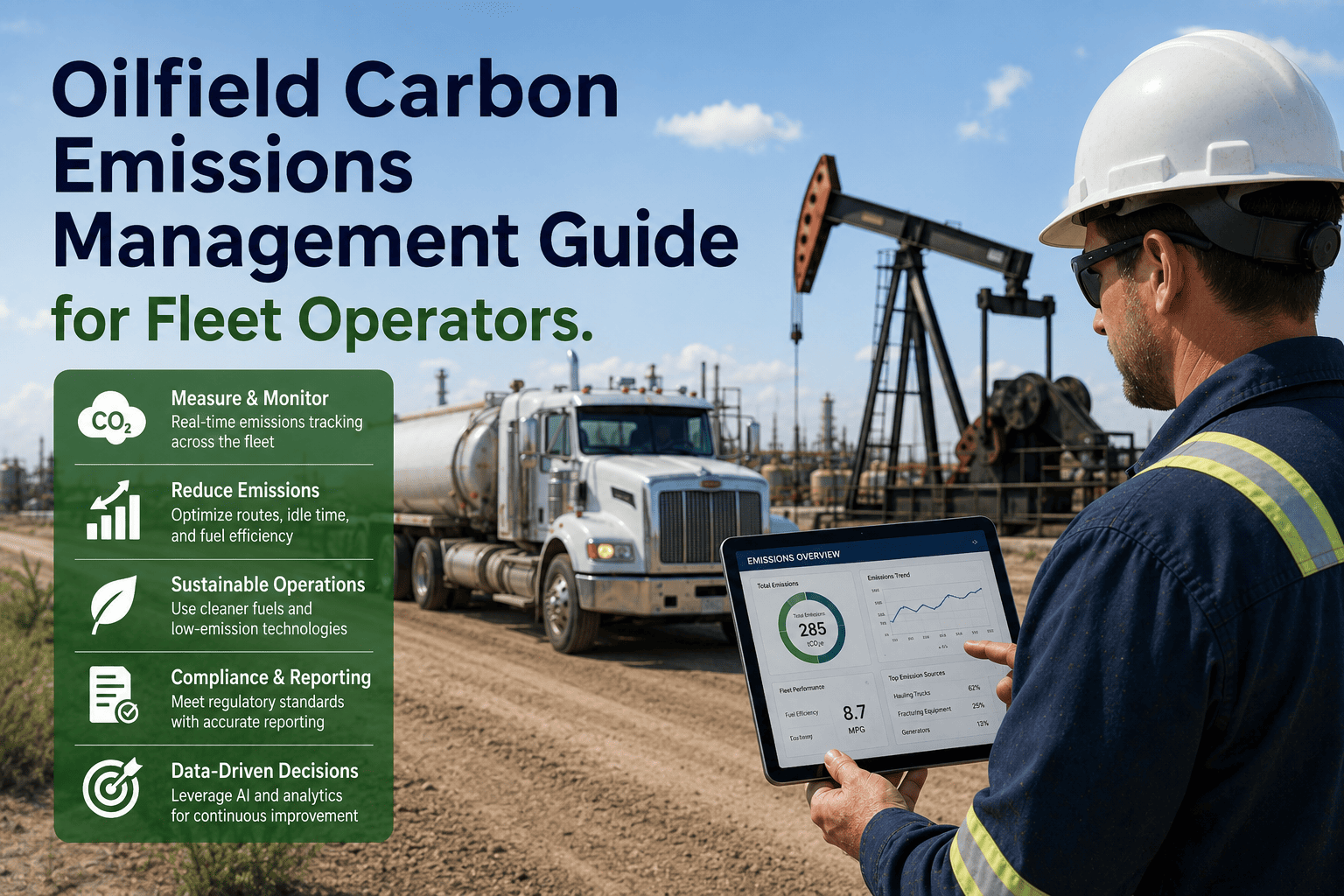
Oilfield Carbon Emissions Management Guide for Fleet Operators
A comprehensive framework covering fleet emissions measurement, reduction strategy implementation, regulatory disclosure preparation, and client ESG reporting — powered by FleetRabbit's real-time fuel intelligence and carbon tracking platform for upstream and midstream oilfield transportation operations.
Why Oilfield Fleet Carbon Management Has Become an Operational Priority
The business case for oilfield fleet emissions management extends well beyond environmental obligation. Major integrated oil and gas operators — BP, Shell, TotalEnergies, Chevron, and regional NOCs — have embedded contractor carbon disclosure requirements into their HSE prequalification processes, making measurable emissions performance a contract eligibility criterion for oilfield service companies competing for upstream work. Contractors unable to provide documented fleet emissions data and reduction program evidence face disqualification from preferred supplier status regardless of operational capability in other performance dimensions.
FleetRabbit's fleet intelligence platform provides oilfield operators with the real-time fuel consumption data, emissions calculation framework, and reporting tools needed to satisfy client HSE carbon disclosure requirements and demonstrate measurable reduction program performance. Start your free trial and begin tracking fleet emissions across your oilfield operation today.
Building a Credible Fleet Emissions Measurement Foundation
Accurate emissions reporting requires systematic measurement methodology — not estimated fleet averages or industry benchmarks applied to vehicle counts. The measurement credibility that client ESG programs and investor disclosure requirements demand is built on verified fuel consumption data correlated with GPS-confirmed operational activity across individual vehicle populations.
Scope Definition and Boundary Setting
Define the organizational boundary for fleet emissions measurement — which vehicles, equipment categories, and operational geographies fall within the reporting scope. Oilfield fleet operators typically classify company-owned and operated vehicles as scope 1 direct emissions, contracted vehicles as scope 3 category 4 upstream transportation, and facility fuel consumption separately from mobile asset consumption. Boundary definition documentation is required by GHG Protocol Corporate Standard and CDP disclosure frameworks.
Fuel Consumption Data Collection
Verified fuel consumption data — not estimated consumption based on manufacturer specifications — forms the emissions calculation foundation. FleetRabbit integrates with fuel card transaction systems and GPS telematics to capture actual dispensed volumes per vehicle per period, reconciled against odometer readings and operating hours to identify data quality issues and consumption anomalies that would distort emissions calculations. This verified consumption dataset satisfies third-party assurance requirements that estimated data cannot meet.
Emissions Factor Application
Fuel consumption volumes are converted to CO2 equivalent emissions using EPA-published emissions factors for diesel, gasoline, CNG, and LNG fuel types — applying current year factors that account for combustion efficiency and upstream fuel production emissions where full lifecycle reporting is required. FleetRabbit applies verified emissions factors automatically to transaction data producing CO2e calculations per vehicle, per operational unit, and across fleet totals for reporting period aggregation.
Verification and Assurance Preparation
Third-party emissions verification requires documented data lineage from raw fuel transaction records through calculation methodology to reported emissions totals. FleetRabbit maintains the complete audit trail — fuel card transaction records, GPS-verified mileage, applied emissions factors, and calculation outputs — in formats exportable for independent verifier review. This documentation infrastructure reduces third-party assurance engagement cost by eliminating the manual data reconstruction that unsystematic measurement approaches require.
Fleet Emissions Reduction Strategies for Oilfield Operations
Idle Time Elimination — Highest ROI Emissions Reduction
Extended engine idle time at remote well sites, during crew waiting periods, and at staging areas represents the single most addressable emissions source in oilfield fleet operations — consuming fuel with zero operational output while producing avoidable carbon emissions that accumulate into significant annual totals across large fleet populations. Industry data consistently identifies idle time as responsible for 15 to 30 percent of total fleet fuel consumption in oilfield operations characterized by operational waiting periods, remote site staging, and climate control demands at extreme ambient temperatures.
FleetRabbit's idle time monitoring captures per-vehicle idle duration, idle fuel consumption, and idle CO2e production — providing fleet managers with both the dollar cost and the carbon cost of idle behavior in terms that motivate both financial and sustainability performance improvements simultaneously. Driver-level idle scorecards enable targeted coaching that produces measurable consumption reduction within weeks of program activation.
Route Optimization and Dispatch Efficiency
Suboptimal route planning in oilfield operations — assigning distant vehicles to jobs when closer units are available, routing through longer alternative paths during permit or access restrictions, and dispatching multiple units where consolidated loads would suffice — produces unnecessary fuel consumption and avoidable emissions. FleetRabbit's GPS-based asset tracking provides dispatchers with real-time vehicle positions enabling nearest-available assignment decisions that reduce empty miles across the operational network.
Driver Behavior and Eco-Driving Programs
Hard acceleration, overspeed on highway and lease road segments, aggressive braking, and late gear shifts each produce measurable fuel consumption increases relative to smooth, anticipatory driving technique. FleetRabbit's driver behavior monitoring quantifies the fuel efficiency differential between high-performing and low-performing drivers operating identical vehicles on equivalent routes — identifying the coaching opportunity value and creating the accountability framework that self-improvement programs without data cannot achieve.
Preventive Maintenance and Equipment Efficiency
Under-inflated tires increase rolling resistance and fuel consumption by 1 to 3 percent per 10 PSI of underinflation. Clogged air filters reduce combustion efficiency. Misaligned wheels increase fuel consumption through additional drivetrain resistance. Systematic preventive maintenance execution through FleetRabbit's digital inspection and PM scheduling platform maintains equipment at peak fuel efficiency — producing emissions reductions as a direct outcome of proper mechanical condition maintenance.
Quantify and Eliminate the Idle Time Driving 15-30% of Oilfield Fleet Emissions
FleetRabbit's idle time monitoring quantifies per-vehicle and per-driver idle consumption in both fuel cost and CO2e terms — creating the accountability data that drives behavioral change and produces measurable emissions reduction within weeks of program deployment across oilfield fleet operations.
FleetRabbit Idle Time Monitoring — From Invisible Cost to Managed Reduction
Per-Vehicle Idle Time Reporting
Total idle hours, idle fuel consumed, idle CO2e produced, and idle time as a percentage of total engine-on time reported per vehicle for any selected period — identifying the highest idle contributors across the fleet population and quantifying the financial and carbon cost of each unit's idle behavior in concrete terms that motivate action from both fleet managers and operations directors reviewing cost performance.
Driver Idle Scorecards and Coaching
Idle time ranked per driver across the fleet enables targeted coaching conversations with the specific, objective performance data required to distinguish drivers whose idle behavior reflects operational necessity from those whose patterns reflect habit or convenience. Driver-level accountability creates self-improvement incentive that fleet-level aggregate reporting cannot produce — naming individuals with the highest idle consumption transforms abstract fleet sustainability goals into personal performance targets.
Site-Level Idle Pattern Analysis
Idle time aggregated by well pad location, staging area, and operational site identifies high-idle locations driven by operational conditions — extended waiting periods before well access, climate control demands during extreme temperature periods, or operational procedures requiring extended engine-on status. Site-level patterns distinguish behavioral idle reduction opportunities from operational necessity, enabling targeted policy changes at specific locations rather than blanket idle time policies that create operational friction.
Automated Idle Alerts and Policy Enforcement
Configurable idle duration thresholds trigger real-time alerts to fleet managers and supervisors when vehicles exceed defined idle limits — enabling active intervention before extended idle events produce significant fuel waste. Idle policy enforcement through alert systems creates consistent application of idle management standards across dispersed oilfield operations without requiring supervisory physical presence at remote locations to monitor compliance.
Idle Reduction Financial Quantification
Monthly idle reduction reporting quantifies the fuel cost and CO2e savings produced by program behavioral changes — providing the financial ROI documentation that validates continued emissions management investment and demonstrates the economic benefit of carbon reduction programs to operations and finance leadership who evaluate program value in revenue and cost terms rather than sustainability metrics alone.
Trend Tracking and Reduction Verification
Month-over-month and quarter-over-quarter idle time trend analysis documents the emissions reduction outcomes of management program implementation — creating the verifiable performance record required for client ESG program reporting that claims emissions reduction from specific operational interventions must substantiate with trend data rather than point-in-time snapshots.
Eliminating Empty Miles — The Invisible Emissions Source in Oilfield Fleet Dispatch
Empty mile travel — vehicles repositioning between jobs without productive cargo or service payloads — represents a significant emissions source in oilfield fleet operations where dispersed asset locations, variable job scheduling, and reactive dispatch practices produce suboptimal asset utilization. Every empty mile driven produces fuel consumption and CO2e emissions with zero operational value, making empty mile reduction one of the purest emissions interventions available to fleet managers without operational trade-off.
Real-time GPS positions of all available vehicles visible to dispatchers through web and mobile interfaces — enabling nearest-available assignment decisions based on actual positions rather than assumed locations from verbal driver reports. Position-based dispatch consistently reduces empty repositioning miles by 15 to 25 percent compared to proximity-blind dispatch practices in oilfield fleet operations with high vehicle-to-job site ratios.
Automated arrival and departure detection at job sites, staging areas, and maintenance facilities provides accurate mileage accounting for emissions calculation — eliminating the mileage estimation errors that produce inaccurate per-job fuel attribution and distort emissions intensity calculations used in client carbon reporting programs.
Actual routes driven compared against planned routes identify unauthorized detours, inefficient alternative routing, and personal-use travel that adds mileage, fuel consumption, and CO2e to the operational fleet total. Route compliance monitoring creates the behavioral accountability structure that reduces route deviation to approved operational requirements.
Empty mile reduction and idle time elimination in oilfield fleet operations create dual financial returns — direct fuel cost savings and client ESG program compliance benefits that FleetRabbit's platform delivers simultaneously through a single operational intelligence system. Book a demonstration showing emissions reduction potential for your specific fleet operation.
Carbon Reporting for Client ESG Programs and Regulatory Disclosure
Carbon reporting in oilfield fleet operations requires documentation systems that satisfy the specific methodology requirements of multiple simultaneous reporting obligations — operator ESG prequalification programs, CDP climate disclosure questionnaires, GHG Protocol inventory submissions, and regulatory emissions reporting mandates each apply distinct measurement methodology requirements, boundary definitions, and verification standards that generic fleet reporting cannot reliably satisfy.
Fleet emissions data formatted for ISNetworld, Avetta, and operator-specific prequalification program requirements — covering scope 1 fuel combustion emissions, intensity metrics, reduction targets, and program initiative documentation that HSE prequalification reviewers evaluate during contractor qualification assessment.
Monthly fleet carbon performance dashboards for operations leadership — emissions by vehicle class, driver, and site with trend analysis, reduction initiative progress tracking, and financial value of emissions reduction achievements expressed in fuel cost savings that connect environmental performance to financial outcome.
Comprehensive annual fleet emissions inventory prepared for GHG Protocol conformant reporting — including boundary definition, data sources, emissions factor documentation, uncertainty assessment, and year-over-year comparison with reduction attribution analysis for assurance provider review.
Per-client or per-project fleet emissions reports allocating carbon footprint to specific operator relationships for client carbon accounting programs — providing the contract-level emissions attribution data that integrated oil and gas operators require from contractors for their own scope 3 category 1 purchased goods and services emissions inventory.
Complete Oilfield Fleet Carbon Management From a Single Platform
FleetRabbit integrates every component of an effective oilfield fleet emissions management program — real-time consumption monitoring, idle tracking, route efficiency analytics, driver behavior scoring, and ESG-ready carbon reporting — into a single platform deployable across 50 to 200 vehicle oilfield fleets in 3 to 4 weeks.
Carbon Emissions Management Questions for Oilfield Fleet Operators
Measure, Reduce, and Report Oilfield Fleet Emissions From a Single Platform
FleetRabbit's fleet intelligence platform delivers the complete oilfield carbon management program that client ESG prequalification requirements, investor sustainability disclosure obligations, and operational fuel cost economics demand simultaneously — real-time fuel consumption monitoring with automatic CO2e calculation, idle time quantification driving 8 to 15 percent emissions reduction, position-based dispatch eliminating empty mile emissions, driver behavior coaching producing measurable consumption improvement, and GHG Protocol conformant carbon reports satisfying major oil and gas operator HSE prequalification formats. Deploy across 50 to 200 vehicle oilfield fleets in 3 to 4 weeks and begin generating verified emissions reduction performance records within the first operational quarter.